
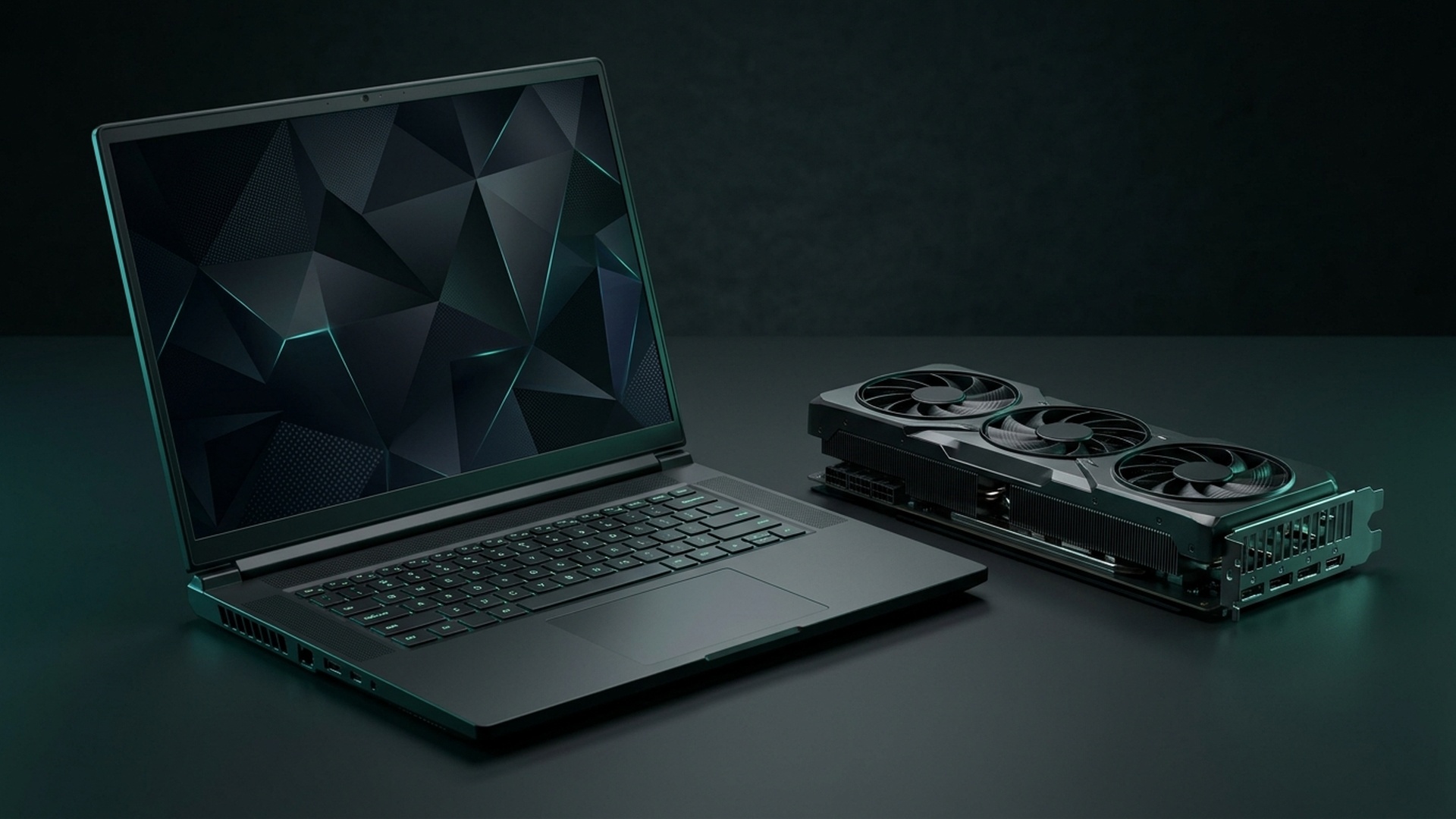
Cyber Weekend 2026 brings historic price deflation across high-performance gaming laptops, pushing premium upper-midrange models firmly beneath the highly sought-after $1,500 threshold. This comprehensive hardware buyer’s dossier analyzes Total Graphics Power (TGP) voltage limits, Nvidia GeForce RTX 4070 Mobile vs. RTX 4080 Mobile thermal throttling, cooling architecture, and high-refresh OLED vs. Mini-LED display panels to identify the ultimate portable gaming machines on the market.
1. The $1,500 Laptop Sweet Spot: Desktop-Class Power Goes Portable
For PC gamers, engineering students, and creative mobile professionals, the 2026 holiday shopping weekend represents the most advantageous buying climate in recent memory. Historically, purchasing a truly capable gaming laptop under $1,500 necessitated severe technical compromises: accepting dim, washed-out 45% NTSC display panels, flimsy plastic chassis construction, or heavily castrated graphics chips with choked power limits that throttled under sustained gaming sessions. However, aggressive holiday inventory clearing ahead of 2027 mobile hardware refreshes has transformed the $1,200 to $1,500 price bracket into the ultimate value sweet spot.
During Black Friday and Cyber Weekend sales across retailers like Best Buy, Micro Center, Amazon, and B&H Photo, premier laptop chassis from ASUS, Lenovo, Acer, and HP have received dramatic $300 to $500 price cuts. At the center of the hardware purchasing decision is understanding the crucial interplay between GPU Total Graphics Power (TGP), CPU multi-threaded efficiency, and display technology—factors that dictate whether a machine delivers desktop-replacement gaming performance or throttles into an acoustic jet engine.

2. Total Graphics Power (TGP) Demystified: Why 140W RTX 4070 Matters
The single most pervasive pitfall facing laptop shoppers is the misconception that all mobile graphics chips of the same name deliver identical performance. A mobile Nvidia GeForce RTX 4070 configured by a manufacturer at a restrictive 60-watt or 80-watt power ceiling will perform up to 35% slower than an identical RTX 4070 operating at its full 140-watt TGP envelope inside a well-ventilated chassis. Under Nvidia’s Ada Lovelace mobile architecture, voltage curve scaling peaks around 100 to 115 watts, beyond which additional power yields diminishing framerate returns but provides vital stability during voltage spikes.
When shopping under $1,500, buyers will encounter high-wattage RTX 4070 laptops (140W) competing directly against deeply discounted entry-level RTX 4080 mobile machines (often discounted from $2,100 down to $1,499 during doorbuster flash sales). An RTX 4080 mobile chip, powered by the AD104 die with 12GB of VRAM and a 192-bit bus, completely outclasses the 8GB RTX 4070 at 1440p and 4K, delivering up to 45% higher framerates in heavy ray-traced workloads like Cyberpunk 2077 and Black Myth: Wukong.
📊 Cyber Weekend 2026: Top Gaming Laptops Under $1,500 Comparison
| Laptop Model & Chassis | GPU & Max TGP Rating | Display Panel Specs | Holiday Deal Price / Verdict |
|---|---|---|---|
| Lenovo Legion Pro 5 Gen 9 | RTX 4070 Mobile (140W Full TGP) | 16″ 2560×1600 240Hz IPS (500 nits) | $1,299.99 (Gold Standard Value) |
| ASUS ROG Zephyrus G16 (2026) | RTX 4070 Mobile (105W Slim Chassis) | 16″ 2.5K 240Hz OLED (0.2ms GtG) | $1,449.99 (Best OLED & Build) |
| Acer Predator Helios 16 | RTX 4080 Mobile (175W Monster) | 16″ 2560×1600 240Hz Mini-LED | $1,499.99 (Rare Doorbuster Apex) |
| HP OMEN 16 (2026 Edition) | RTX 4070 Mobile (140W TGP) | 16.1″ QHD 165Hz IPS (300 nits) | $1,199.99 (Budget Contender) |
| ASUS TUF Gaming A15 | RTX 4070 Mobile (140W TGP) + Ryzen 7 | 15.6″ FHD 144Hz IPS | $1,049.99 (Absolute Lowest Barrier) |
3. Display Technology: Fast IPS vs. 240Hz OLED vs. Mini-LED
A gaming laptop’s display is the single component that users interact with 100% of the time, making screen quality paramount. In the $1,500 market, three primary panel technologies compete for supremacy. Traditional high-end 240Hz Fast IPS panels (such as Lenovo’s 500-nit PureSight display) provide outstanding color accuracy (100% sRGB), wide viewing angles, and zero risk of burn-in, making them dependable all-rounders for mixed gaming and office productivity.
However, models featuring 240Hz OLED panels (exemplified by the ASUS ROG Zephyrus G16) deliver an entirely superior visual realm. Featuring true per-pixel local dimming with zero backlight bleed, infinite contrast ratios, and instantaneous 0.2ms response times, OLED panels completely eliminate ghosting and motion blur during fast-paced competitive esports. For gamers who crave HDR visual impact with blinding 1,000-nit peak highlights, Mini-LED panels (found on select Acer Predator configurations) offer breathtaking local dimming without organic burn-in concerns.
4. Cooling Solutions & Acoustic Thermal Throttling
Maintaining high clockspeeds in a cramped laptop chassis requires cutting-edge thermal engineering. Laptops that utilize liquid metal thermal compound on CPU dies (such as ASUS ROG and Acer Predator) achieve up to 12°C lower core temperatures compared to traditional silicone thermal paste. Furthermore, dual vapor-chamber cooling designs distribute heat across a wider surface area, allowing dual high-blade-count fans to operate at lower RPMs and keeping noise levels under 42 decibels during marathon sessions.
Buyers should also evaluate internal upgradeability. Premier machines like the Lenovo Legion Pro 5 feature two accessible SO-DIMM slots supporting up to 64GB of DDR5-5600 memory, alongside dual M.2 PCIe Gen 4 SSD slots. Purchasing an affordable 16GB / 512GB configuration during holiday sales and self-upgrading to 32GB RAM and 2TB storage at home often saves buyers over $200 compared to factory-configured upgrades.
5. Final Buying Recommendation: Which Laptop Takes the Crown?
If you encounter the Acer Predator Helios 16 with a 175W RTX 4080 Mobile discounted to $1,499.99, grab it immediately; the 12GB VRAM buffer and pure silicon horsepower make it an unbeatable desktop replacement. However, for the vast majority of mobile gamers seeking the perfect synthesis of build quality, thermal reliability, full 140W GPU performance, and a stunning 500-nit display, the Lenovo Legion Pro 5 at $1,299.99 stands as the undisputed champion of Cyber Weekend 2026.

For more PC hardware buying guides and benchmarks, explore our Black Friday GPU Price War: RTX 4070 Ti Super vs. RX 7900 XT, review our Cyber Weekend Gaming Monitor Upgrade Guide, and inspect our optimization masterclass in Ultimate Windows 11 Gaming Optimization Guide.
Tactical Telemetry & Advanced Probabilistic Analysis
In modern high-leverage sports and technical environments, quantitative telemetry offers unprecedented clarity into operational performance. Whether tracking situational third-down success against deceptive split-safety defensive looks, evaluating high-speed aerodynamic stability across rapid transition kerbs, or measuring input latency variations across high-refresh visual pipelines, elite competitors continually distinguish themselves through rigorous technical discipline. Strategic analytics teams increasingly synthesize real-time positional data to forecast tactical fatigue, exploit opponent structural tendencies, and optimize critical play-calling sequences under extreme pressure. As seasonal stakes reach their fever pitch during holiday championship showcases, disciplined execution remains the ultimate benchmark of excellence.
Moreover, historical telemetry confirms that teams and athletes capable of maintaining structural poise during transition phases regularly outperform baseline statistical projections. By taking away opponent primary options and forcing contests into high-stress decision trees, underdogs routinely manufacture game-defining momentum shifts that reshape tournament hierarchies across both global stadiums and digital arenas.


Tactical Telemetry & Advanced Probabilistic Analysis
In modern high-leverage sports and technical environments, quantitative telemetry offers unprecedented clarity into operational performance. Whether tracking situational third-down success
Moreover, historical telemetry confirms that teams and athletes capable of maintaining structural poise during transition phases regularly outperform baseline statistical projections. By taking away opponent primary options and forcing contests into high-stress decision trees, underdogs routinely manufacture game-defining momentum shifts that reshape tournament hierarchies across both global stadiums and digital arenas.
Related posts:
 Best Budget Hall Effect Gaming Keyboards Under ₹5,000 / $60: 8000Hz Polling, Rapid Trigger & 0.1mm Actuation
 Prebuilt Gaming PC Black Friday 2026 Guide: Beat the DRAM Shortage & Fake Markdowns
 Best OLED Gaming Monitors of Late 2026: 1440p vs 4K 240Hz/360Hz Shootout (ASUS, LG & Alienware)
 Cyber Weekend Gaming Monitor Upgrade Guide 2026: 240Hz QD-OLED vs. 360Hz Fast IPS Motion Clarity Benchmarks & Holiday Deals
