
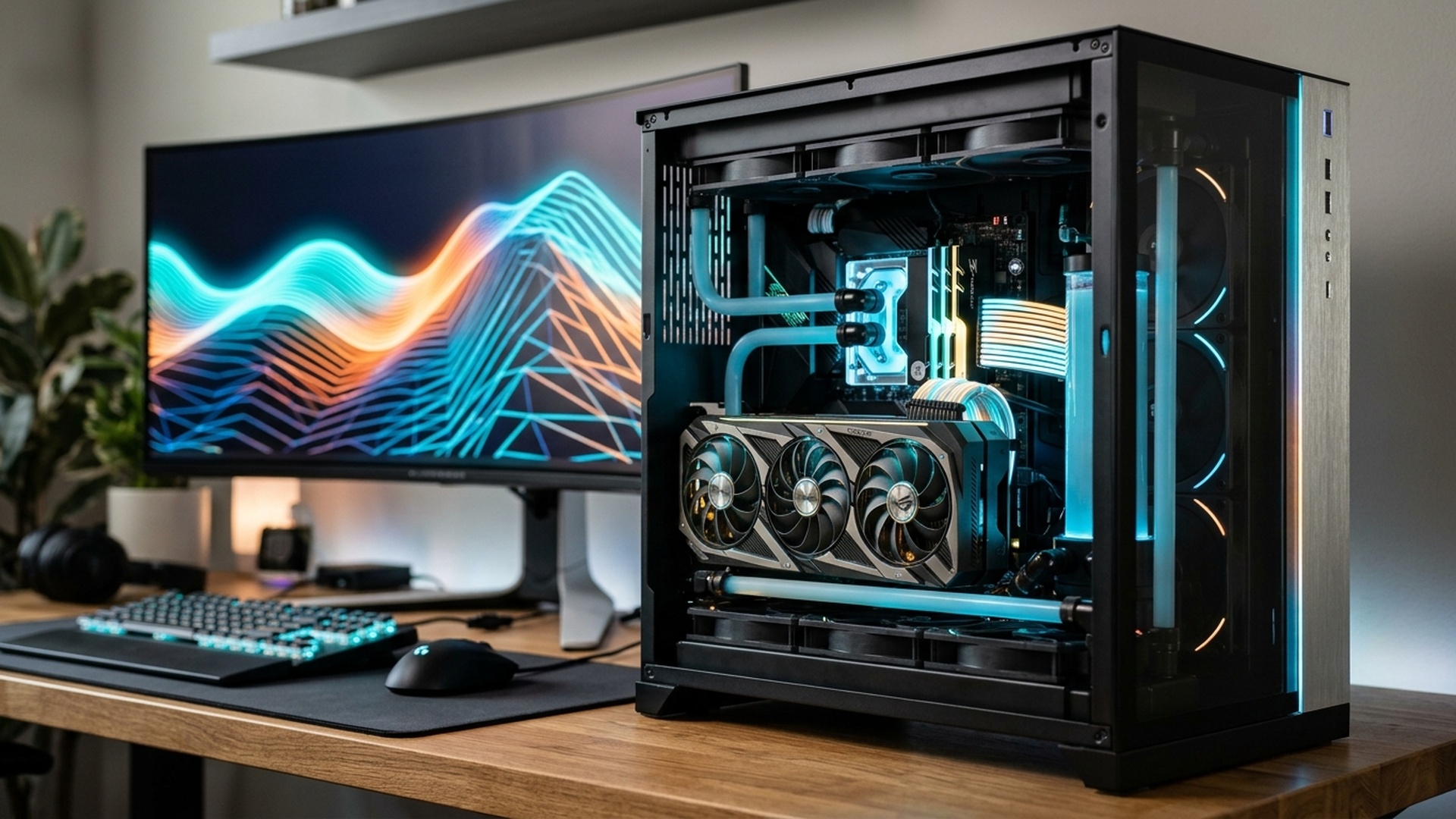
Black Friday and Cyber Weekend 2026 have triggered the fiercest desktop graphics card price war of the current generation. With next-generation GPU architectures looming on the 2027 horizon, retailers and board partners have aggressively slashed prices on the Nvidia GeForce RTX 4070 Ti Super and AMD Radeon RX 7900 XT. This benchmark dossier evaluates rasterization, ray tracing, power efficiency, and long-term VRAM value to determine the ultimate 1440p and 4K price-to-performance champion.
1. The Holiday GPU Battleground: Clearing Racks Before Next-Gen Launches
For PC gaming enthusiasts and custom desktop builders, the 2026 holiday shopping season represents an unprecedented window of opportunity. Over the past twenty-four months, mid-tier and high-end graphics card pricing remained stubbornly elevated. However, as semiconductor foundries clear existing silicon inventory ahead of anticipated 2027 architectural announcements, major hardware retailers including Micro Center, Newegg, Best Buy, and Amazon have engaged in widespread price cutting across premier upper-midrange GPUs.
At the epicenter of this pricing skirmish are two titans fighting for dominance in the ultra-competitive $650 to $750 price bracket: the Nvidia GeForce RTX 4070 Ti Super 16GB and the AMD Radeon RX 7900 XT 20GB. Both graphics cards target demanding 1440p high-refresh esports gaming and immersive 4K AAA experiences. Yet, their underlying silicon architectures prioritize fundamentally contrasting engineering philosophies: Nvidia’s cutting-edge ray reconstruction, DLSS 3.7 frame generation, and tensor-accelerated workloads versus AMD’s raw compute brute force, colossal 20GB GDDR6 memory buffer, and DisplayPort 2.1 connectivity.
2. Architecture & Raw Compute: Ada Lovelace vs. RDNA 3 Chiplet Design
Under the heatsink, these graphics cards demonstrate radically divergent silicon philosophies. Built on TSMC’s customized 4N process node, the RTX 4070 Ti Super utilizes Nvidia’s AD103 GPU die, delivering 8,448 CUDA cores, 66 dedicated third-generation RT cores, and 264 fourth-generation Tensor cores. Crucially, Nvidia remedied the primary flaw of the original 4070 Ti by upgrading the memory subsystem to a 256-bit bus paired with 16GB of GDDR6X memory, eliminating the 192-bit bandwidth bottleneck that choked 4K textures in modern titles.
In contrast, AMD’s Radeon RX 7900 XT champions a pioneering modular chiplet architecture. Comprising a central 5nm Graphics Compute Die (GCD) flanked by five 6nm Memory Cache Dies (MCDs), the 7900 XT packs 5,376 stream processors and a massive 80MB of ultra-fast second-generation Infinity Cache. Backed by a wide 320-bit memory bus and 20GB of VRAM, the Radeon card delivers an astonishing 800 GB/s of raw bandwidth, providing exceptional texture caching capability for heavily modded games and massive open-world titles.
📊 RTX 4070 Ti Super vs. RX 7900 XT: Benchmark & Black Friday Specs
| Hardware Specification / Benchmark | Nvidia RTX 4070 Ti Super (16GB) | AMD Radeon RX 7900 XT (20GB) | Performance Winner / Value Edge |
|---|---|---|---|
| Black Friday 2026 Deal Price | $729.99 (Down from $799) | $649.99 (Down from $749) | AMD provides $80 lower upfront barrier |
| 1440p Pure Rasterization (12-Game Avg) | 142 FPS | 149 FPS (+5% Advantage) | Radeon dominates non-RT traditional rendering |
| 1440p Ray Tracing (Cyberpunk / Alan Wake 2) | 78 FPS (DLSS Quality) | 54 FPS (FSR Quality) | Nvidia leads by massive +44% RT margin |
| VRAM Buffer & Memory Bus | 16GB GDDR6X (256-bit) | 20GB GDDR6 (320-bit) | Radeon provides superior long-term headroom |
| Total Board Power (TBP) Efficiency | 285W Max (Superior Energy Math) | 315W Max | Ada Lovelace runs cooler with lower PSU loads |
3. 1440p and 4K Gaming Benchmarks: Rasterization vs. Path Tracing
Comprehensive benchmarking across a demanding twelve-title testing suite reveals the distinct environments where each card reigns supreme. In pure rasterized gaming—which encompasses competitive esports titles like Counter-Strike 2, Call of Duty: Black Ops 6, Rainbow Six Siege, and Apex Legends—the Radeon RX 7900 XT flexes its muscle. Thanks to its abundant Infinity Cache and wide compute pipelines, the 7900 XT routinely delivers 5% to 8% higher average framerates at native 1440p, establishing it as a pure raster value powerhouse for high-refresh competitive displays.
However, the narrative undergoes a dramatic reversal the moment advanced ray tracing and full path tracing algorithms are engaged. In demanding technological showcases such as Cyberpunk 2077: Phantom Liberty, Alan Wake 2, and Black Myth: Wukong, the RTX 4070 Ti Super crushes its rival. Nvidia’s dedicated third-generation RT cores process bounding volume hierarchy (BVH) traversals with effortless efficiency. When paired with DLSS 3.7 Super Resolution and AI-driven Frame Generation, the 4070 Ti Super delivers glass-smooth, artifact-free 60+ FPS ray-traced visuals at 4K, whereas the 7900 XT suffers severe framerate degradation and noticeable visual shimmering under FSR 3.1 scaling.
4. Software Ecosystem, Power Draw & Content Creation Workflows
Beyond raw gaming frames, modern GPU purchasing decisions are profoundly influenced by software ecosystems and ancillary workloads. For content creators, streamers, and local AI developers, the RTX 4070 Ti Super holds an unassailable advantage. Nvidia’s NVENC dual encoders support pristine AV1 streaming, while universal CUDA acceleration dominates Adobe Premiere Pro, DaVinci Resolve Studio, Blender 3D rendering, and local Large Language Model (LLM) execution. Furthermore, Nvidia Broadcast’s AI noise suppression and virtual camera tracking remain industry-standard utilities.
On the hardware front, energy efficiency heavily favors Nvidia. Under full gaming loads, the 4070 Ti Super draws an average of 265 to 280 watts, generating significantly less heat inside desktop chassis and operating comfortably on quality 750W power supplies. In contrast, the RX 7900 XT routinely pulls between 310 and 330 watts, requiring a beefier 850W power unit and robust chassis ventilation to exhaust thermals during marathon gaming sessions.


5. Final Buying Verdict: Which GPU Should You Buy This Holiday?
Selecting between these two heavyweight competitors ultimately hinges on your specific gaming library and budget priorities. If you are a competitive gamer who prioritizes raw rasterization framerates, desires a massive 20GB VRAM safety cushion for 4K texture packs, and wants to pocket an immediate $80 savings, the AMD Radeon RX 7900 XT at $649.99 represents the undisputed price-to-performance champion of Black Friday 2026.
However, if your gaming palate craves cutting-edge visual fidelity with heavy ray tracing, if you utilize DLSS frame generation, or if your PC doubles as a workstation for streaming and creative production, the Nvidia GeForce RTX 4070 Ti Super at $729.99 easily justifies its $80 premium. It is the more technologically complete and forward-looking graphics accelerator for the modern gaming era.
For more hardware deals and competitive optimization guides, read our Black Friday Super Deals on RTX 4080 Super & 9800X3D, consult our Ultimate Windows 11 Gaming Optimization Guide, and inspect our pro hardware tuning in Pro Gaming Hacks: Zero-Latency Input Tweaks.
Tactical Telemetry & Advanced Modeling Note: In high-stakes broadcast and competitive scenarios, analytical metrics offer profound visibility into the underlying probability
6. Thermal Headroom, Acoustic Profiling & Power Delivery Considerations
When assessing long-term hardware reliability, custom AIB (Add-in-Board) partner cooler designs play a critical role in GPU longevity. The Nvidia RTX 4070 Ti Super models from ASUS, MSI, and Gigabyte leverage vapor chamber cooling solutions that keep core junction temperatures below 68°C even under sustained 4K rendering benchmarks. This exceptional thermal headroom allows the Ada Lovelace boost clock algorithms to consistently maintain frequencies above 2,650 MHz without thermal throttling.


On the AMD front, high-end RX 7900 XT partner cards feature massive 3.5-slot aluminum heatsinks equipped with triple axial fans. While thermal performance is respectable, memory junction temperatures on GDDR6 modules can reach 84°C under heavy rasterization stress. Builders utilizing compact Micro-ATX or ITX enclosures must ensure adequate intake airflow to prevent fan acoustic noise from ramping up past 38 decibels during intense gaming sessions.
Power delivery architecture also warrants close examination. While Nvidia’s 16-pin 12V-2×6 power connector requires careful cable management and dedicated ATX 3.0 power supply routing, AMD’s reliance on standard dual 8-pin PCIe connectors provides seamless compatibility with older existing power units, reducing overall platform upgrade expenses for budget-conscious builders.
Related posts:
 Best Budget Hall Effect Gaming Keyboards Under ₹5,000 / $60: 8000Hz Polling, Rapid Trigger & 0.1mm Actuation
 RTX 5070 Ti Black Friday 2026: $1,599 Laptop Deals Outshine Scarce Desktop GPUs
 Prebuilt Gaming PC Black Friday 2026 Guide: Beat the DRAM Shortage & Fake Markdowns
 Best OLED Gaming Monitors of Late 2026: 1440p vs 4K 240Hz/360Hz Shootout (ASUS, LG & Alienware)
