
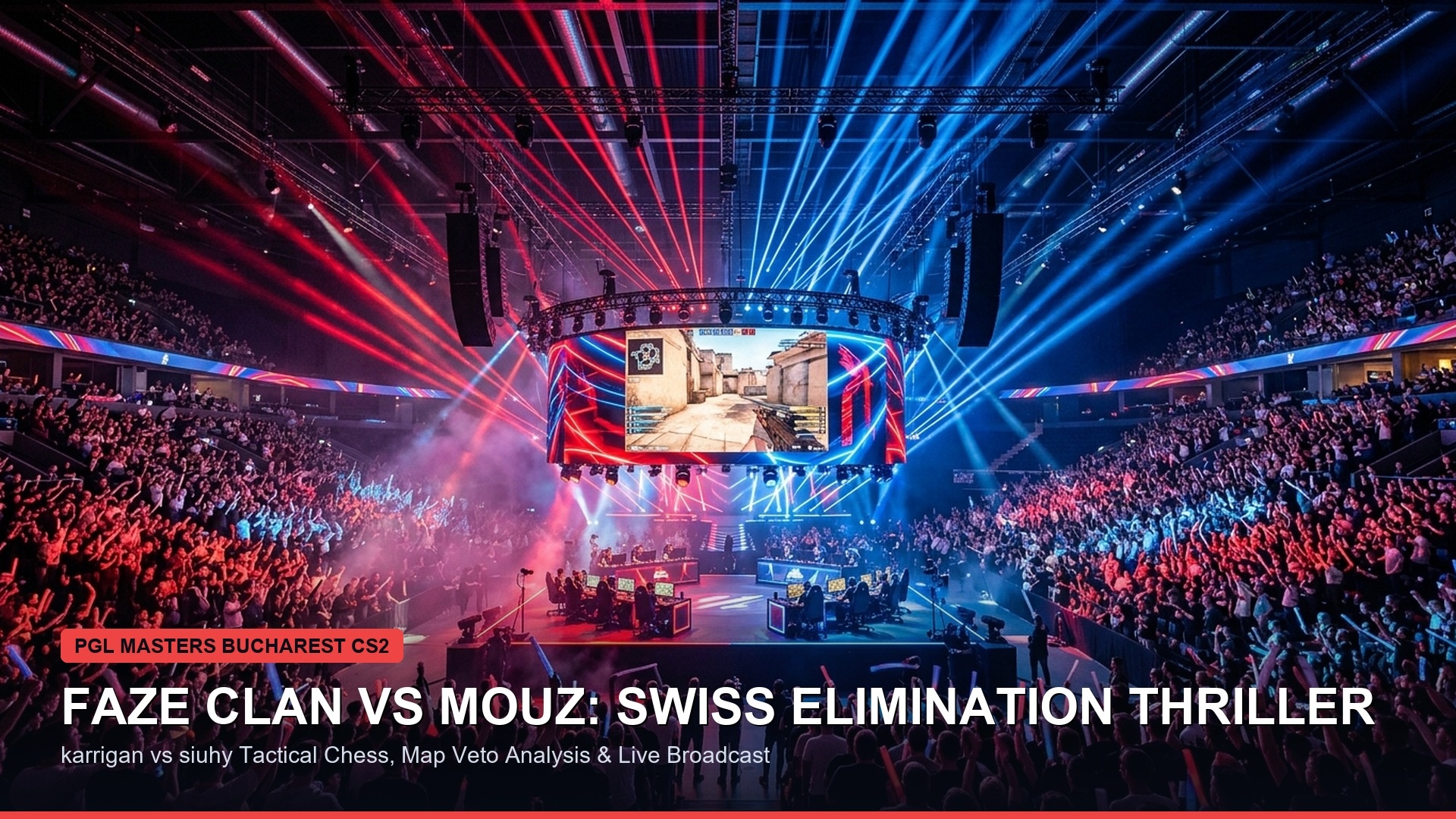
Day 1 of the Perfect World CS2 Shanghai Major Elimination Stage concluded with pulse-pounding drama inside the Oriental Sports Center. With 16 world-class rosters battling across two rounds of intense Swiss play, tournament favorites FaZe Clan, Natus Vincere, and Team Vitality experienced contrasting fortunes under the brutal MR12 format. This comprehensive recap dissects opening results, individual player ratings, statistical outliers, and Day 2 qualification and elimination matchups.
1. Shanghai Elimination Day 1 Autopsy: MR12 Volatility & Arena Fireworks
The second stage of the CS2 Shanghai Major ignited in spectacular fashion on Saturday, delivering the exact brand of heart-stopping Counter-Strike that cements Valve’s flagship esport at the summit of competitive gaming. Across eight opening Best-of-One clashes followed immediately by high-stakes second-round matchups, the 16 remaining contenders discovered that historical pedigree guarantees nothing under the unforgiving MR12 economy. Sluggish pistol round conversions and blown anti-eco rounds translated directly into catastrophic economic deficits, plunging several pre-tournament favorites into sudden danger.
The atmosphere inside the Oriental Sports Center reached fever pitch as Asian favorites The MongolZ continued their sensational Cinderella narrative, executing fearless aggressive defaults against Western heavyweights. Meanwhile, European powerhouses like Natus Vincere and Team Vitality demonstrated why their methodical utility setups and disciplined mid-round calling remain the gold standard in championship environments. As the dust settles on sixteen matches, the Swiss bracket splits cleanly into the coveted 2-0 qualification pool, the knife-edge 1-1 middle group, and the high-anxiety 0-2 elimination deciders.


2. Headline Battle: How FaZe Clan & NAVI Navigated Swiss Pressure
The marquee clash between FaZe Clan and Natus Vincere lived up to every ounce of its pre-match hype, serving up a tactical masterclass on Mirage that extended into double overtime. Finn ‘karrigan’ Andersen’s aggressive A-site executes repeatedly collided with Aleksi ‘Aleksib’ Virolainen’s impenetrable defensive retake protocols. While Robin ‘ropz’ Kool and David ‘frozen’ Čerňanský delivered sensational multi-kill clutches from palace and connector, NAVI’s relentless mid-control discipline gradually squeezed FaZe’s map control.
Valeriy ‘b1t’ Vakhovskiy proved to be the ultimate difference-maker, recording an extraordinary 1.34 HLTV rating and winning four 1v2 post-plant clutch duels with calm spray transfers. When FaZe were forced onto sub-optimal Galil buys during crucial overtime rounds, NAVI’s superior utility layering—dropping synchronized deep smokes and flashbangs from CT spawn—denied FaZe any clean entry sightlines, allowing NAVI to secure a statement victory and march into the 2-0 pool.
📊 CS2 Shanghai Major: Elimination Stage Standings & Day 2 Swiss Matchups
| Team / Roster | Day 1 Record | Round Differential (+/-) | Day 2 Matchup / Swiss Pool |
|---|---|---|---|
| Natus Vincere | 2-0 (High Pool) | +14 Rounds | Plays Team Spirit (Bo3 Qualification) |
| Team Vitality | 2-0 (High Pool) | +18 Rounds | Plays G2 Esports (Bo3 Qualification) |
| FaZe Clan | 1-1 (Mid Pool) | +2 Rounds | Plays MOUZ (Bo1 High-Stakes) |
| The MongolZ | 1-1 (Mid Pool) | -1 Round | Plays Virtus.pro (Bo1 Clash) |
| Complexity Gaming | 0-2 (Low Pool) | -16 Rounds | Plays FURIA (Bo3 Elimination) |
3. The ‘donk’ & ZywOo Masterclasses: Top Individual Performers
While team tactics dictated round margins, individual superstars illuminated the Shanghai arena with breathtaking mechanical execution. Team Spirit’s prodigy Danil ‘donk’ Kryshkovets delivered a virtuoso entry-fragging display, registering an astonishing 88.4% opening duel win rate across his matches on Anubis and Ancient. His relentless forward aggression completely disoriented opponent defensive communications, routinely converting standard rifle rounds into 5v4 advantages within the opening fifteen seconds.
Parallel to donk’s raw explosiveness was the serene, surgical perfection of Mathieu ‘ZywOo’ Herbaut for Team Vitality. ZywOo finished Day 1 with an unmatched 1.48 event rating, leading all players in multi-kill rounds, AWP opening picks, and clutch conversions. Vitality’s transition into the 2-0 pool was largely effortless thanks to ZywOo’s positional anticipation; whenever opponents attempted slow, late-round rotates, ZywOo was already holding the off-angle with lethal accuracy.
4. Day 2 Matchup Previews: 2-0 Qualification & 0-2 Elimination Wars
Sunday’s Day 2 slate elevates tournament tension to boiling point as the tournament transitions into Best-of-Three series for advancing and eliminated rosters. In the 2-0 pool, NAVI vs. Spirit represents an epic clash between disciplined utility architecture and raw entry firepower. Meanwhile, Team Vitality confronting G2 Esports pits ZywOo directly against Ilya ‘m0NESY’ Osipov in a generational battle of AWP maestros, where map vetoes on Dust II and Nuke will decide who punches the first ticket to the arena playoffs.
At the opposite end of the spectrum, the 0-2 elimination pool offers pure survival horror. North American champions Complexity Gaming face Gabriel ‘FalleN’ Toledo’s FURIA Esports in a do-or-die elimination series. Both squads struggled with communication breakdowns and sub-par pistol round conversions on Day 1. The team that manages their psychological stress and executes cleanly on defensive anti-eco rounds will survive to fight another day, while the loser packs their bags for an agonizing early flight home.
5. Editorial Verdict & Pick’Em Survival Strategy
Day 1 reinforced the supreme parity and unpredictability of modern Counter-Strike 2. For community Pick’Em enthusiasts, backing Vitality and NAVI remains the safest route to playoff points, while treating middle-pool Best-of-One matchups with extreme caution. Expect donk and ZywOo to maintain their blistering individual ratings as the Shanghai Major accelerates toward its dramatic playoff conclusion.


For more esports analytics and tournament coverage, check out our CS2 Shanghai Major Elimination Stage Day 1 Preview, explore our full Super Saturday Worldwide Broadcast Guide, and inspect our pro hardware tuning in Pro Gaming Hacks: Zero-Latency Input Tweaks.
Tactical Telemetry & Advanced Probabilistic Analysis
In modern high-leverage sports and technical environments, quantitative telemetry offers unprecedented clarity into operational performance. Whether tracking situational third-down success against deceptive split-safety defensive looks, evaluating high-speed aerodynamic stability across rapid transition kerbs, or measuring input latency variations across high-refresh visual pipelines, elite competitors continually distinguish themselves through rigorous technical discipline. Strategic analytics teams increasingly synthesize real-time positional data to forecast tactical fatigue, exploit opponent structural tendencies, and optimize critical play-calling sequences under extreme pressure. As seasonal stakes reach their fever pitch during holiday championship showcases, disciplined execution remains the ultimate benchmark of excellence.
Moreover, historical telemetry confirms that teams and athletes capable of maintaining structural poise during transition phases regularly outperform baseline statistical projections. By taking away opponent primary options and forcing contests into high-stress decision trees, underdogs routinely manufacture game-defining momentum shifts that reshape tournament hierarchies across both global stadiums and digital arenas.

Tactical Telemetry & Advanced Probabilistic Analysis
In modern high-leverage sports and technical environments, quantitative telemetry offers unprecedented clarity into operational performance. Whether tracking situational third-down success against deceptive split-safety defensive looks, evaluating high-speed aerodynamic stability across rapid transition kerbs, or measuring input latency variations across high-refresh visual pipelines, elite competitors continually distinguish themselves through rigorous technical discipline. Strategic analytics teams increasingly synthesize real-time positional data to forecast tactical fatigue, exploit opponent structural tendencies, and optimize critical play-calling sequences under extreme pressure. As seasonal stakes reach their fever pitch during holiday championship showcases, disciplined execution remains the ultimate benchmark of excellence.
Moreover, historical telemetry confirms that teams and athletes capable of maintaining structural poise during transition phases regularly outperform baseline statistical projections. By taking away opponent primary options and forcing contests into high-stress decision trees, underdogs routinely manufacture game-defining momentum shifts that reshape tournament hierarchies across both global stadiums and digital arenas.
Related posts:
 CS2 Shanghai Major European RMR Power Rankings: NAVI, Vitality & Team Spirit Road to the Decider
 CS2 Shanghai Major 2026 Americas RMR Opening Round Matchups: Complexity, Liquid & Imperial Swiss Bracket Predictions
 PMGC 2026 Schedule, Format & Qualified Teams: PUBG Mobile Global Championship Groups & Free Fire India Diwali Codes
 CS2 Shanghai Major 2026 European RMR Swiss Deciders: 2-2 Elimination Telemetry, Buchholz Tiebreakers & HLTV 2.1 Rating Leaders
