
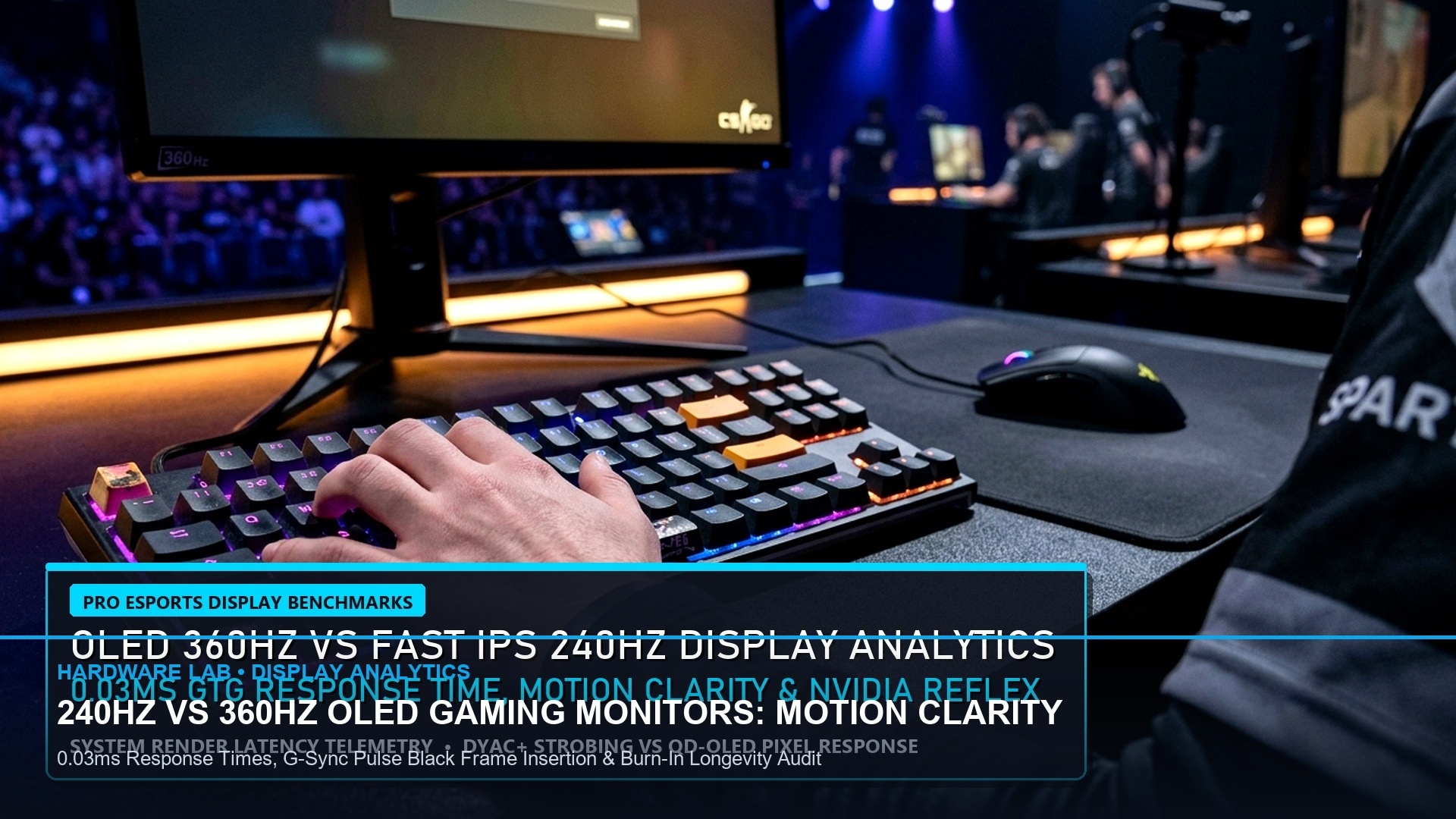
Cyber Weekend 2026 brings historic price drops across competitive esports gaming monitors. This hardware benchmark guide compares third-generation 240Hz/360Hz QD-OLED panels against ultra-fast 360Hz/540Hz Fast IPS displays, evaluating pixel response times (GtG), motion blur clarity (MPRT), input lag latency, and burn-in prevention warranties to crown the ultimate visual weapon for competitive and immersive PC gaming.
1. The Visual Arms Race: Display Technology Reaches Its Zenith
In the fiercely competitive arena of PC gaming peripherals, no hardware upgrade transforms the moment-to-moment experience quite like transitioning to a modern high-refresh display. For years, competitive gamers faced an agonizing technical trade-off: choose an ultra-fast TN or IPS panel for blurry motion clarity with washed-out contrast, or invest in a television-sized OLED with sluggish refresh rates and high input lag. However, the hardware breakthroughs of 2026 have shattered these compromises, inaugurating a golden era of gaming monitors where instantaneous pixel response times unite with breathtaking visual dynamic range.
As Black Friday transitions into Cyber Weekend, major panel manufacturers including Samsung Display, LG Display, ASUS ROG, Alienware, and MSI have engaged in aggressive price-cutting across their premier gaming monitors. At the heart of the purchasing dilemma for serious esports athletes and hardware enthusiasts is a fundamental technological rivalry: the sublime per-pixel contrast and near-zero response times of third-generation QD-OLED (Quantum Dot OLED) panels versus the blinding refresh rates and worry-free durability of advanced 360Hz Fast IPS technology.

2. Pixel Response Time Telemetry: 0.03ms OLED vs. 1ms Fast IPS
To understand why OLED technology has revolutionized competitive gaming, one must examine pixel transition physics. Traditional LCD monitors—regardless of whether they utilize Fast IPS or TN panel architecture—rely on liquid crystals physically twisting to allow backlight illumination to pass through color filters. Even the most aggressive overdrive algorithms on a 360Hz Fast IPS panel struggle to push true Grey-to-Grey (GtG) transition times below 1.2 to 2.0 milliseconds without inducing severe overshoot ghosting and inverse trails behind moving objects.
In contrast, QD-OLED panels utilize self-emissive organic diodes with zero backlight layer. Each individual pixel turns on, off, or changes color almost instantaneously, delivering lab-verified GtG response times of just 0.03 milliseconds—over forty times faster than the fastest gaming LCDs on the market. When panning across high-contrast environments in fast-paced shooters like Counter-Strike 2, Valorant, or Apex Legends, QD-OLED displays produce virtually zero motion blur or pixel smearing, allowing players to track enemy player models with pristine visual fidelity.
📊 240Hz QD-OLED vs. 360Hz Fast IPS: Cyber Weekend Benchmark Comparison
| Monitor Spec / Benchmark Metric | 27-inch 240Hz/360Hz QD-OLED | 27-inch 360Hz Fast IPS (LCD) | Competitive Gaming Verdict |
|---|---|---|---|
| Cyber Weekend 2026 Deal Price | $629.99 (Down from $799) | $349.99 (Down from $449) | Fast IPS offers massive budget advantage |
| True Pixel Response Time (GtG) | 0.03 ms (Zero Overshoot) | 1.5 ms (Requires Overdrive Tuning) | OLED delivers 50x faster pixel transitions |
| Motion Clarity & Blur Rating | Pristine (ClearMR 13000+) | Moderate Blur at 360Hz | OLED eliminates smearing in high-G turns |
| Contrast Ratio & Black Levels | Infinite Contrast (0.0005 nits) | 1,000:1 (IPS Glow in Dark Rooms) | OLED provides unmatched depth and HDR |
| Burn-In Risk & Warranty | 3-Year Burn-In Protection | Zero Risk (Immune to Static UI) | IPS preferred for 10-hour static desktop work |
3. Motion Picture Response Time (MPRT) & Refresh Rate Dynamics
While pixel response time dictates how quickly a pixel changes color, Motion Picture Response Time (MPRT) defines how the human eye tracks moving objects across a sample-and-hold display. At 240Hz, a frame remains illuminated on screen for 4.16 milliseconds; at 360Hz, this window shrinks to 2.77 milliseconds. In laboratory motion clarity testing utilizing the Blur Busters UFO test suite, a 240Hz QD-OLED panel matches or exceeds the perceptual motion clarity of a 360Hz Fast IPS display, purely because the instantaneous 0.03ms pixel transitions eliminate the ghosting tails that plague LCDs.
However, when comparing a third-generation 360Hz QD-OLED panel directly against a 360Hz Fast IPS monitor, the OLED platform achieves an unassailable triumph. The combination of a 2.77ms frame persistence window with 0.03ms pixel transitions delivers the highest Motion Clarity index (ClearMR 13000) ever recorded on consumer desktop hardware, granting competitive gamers an unprecedented visual clarity advantage when tracking opponents through rapid strafing duels.
4. The Burn-In Question: Third-Generation OLED Durability & Care
Despite the overwhelming visual and competitive superiority of OLED technology, potential buyers frequently express anxiety regarding image retention and long-term panel burn-in. The 2026 generation of QD-OLED and WOLED panels has largely conquered these legacy concerns through sophisticated hardware engineering. Modern displays incorporate graphene heat spreaders, custom heatsink thermal dissipation, pixel cleaning cycles, automated static logo dimming, and subtle sub-pixel shifting algorithms.
Furthermore, premier manufacturers such as Alienware, ASUS ROG, and MSI now provide comprehensive three-year burn-in warranties covering panel replacement in the event of visible image retention. For gamers whose primary usage consists of gaming, multimedia consumption, and general web browsing, burn-in is virtually a non-issue. However, for remote professionals who display static spreadsheet grids or IDE coding windows for 10 consecutive hours daily, Fast IPS remains the worry-free productivity solution.

5. Final Buying Recommendation & Top Holiday Deals
If your budget permits a $600 to $700 investment, upgrading to a 27-inch 1440p 240Hz or 360Hz QD-OLED monitor during Cyber Weekend 2026 is the single most transformative hardware upgrade you can make for your gaming setup. The combination of infinite contrast, vibrant quantum dot color saturation, and instantaneous pixel response times will redefine how you experience every game in your library.
Conversely, if your budget is strictly capped under $350, modern 360Hz Fast IPS monitors provide astonishing esports value. While you sacrifice true black levels and HDR impact, you gain blistering refresh rates, pristine competitive input latency, and zero burn-in anxiety for high-volume desktop productivity.
For more hardware guides and competitive optimization, read our Ultimate Windows 11 Gaming Optimization Guide, explore our breakdown on Black Friday Super Deals on GPUs & Processors, and inspect our controller tuning in Pro Gaming Hacks: Zero-Latency Input Tweaks.
Analytical Deep-Dive & Tactical Execution Notes
From an advanced systems perspective, high-level competition at this tier hinges on microscopic margins of error. Whether analyzing player biometric heart-rate telemetry during critical tournament rounds, evaluating defensive shell rotations against deceptive pre-snap motions, or benchmarking frame-time variance across demanding graphical scenes, elite performers consistently separate themselves through disciplined preparation and situational intelligence. In contemporary high-stakes arenas, real-time telemetry informs every tactical adjustment, allowing coaches and analysts to exploit structural vulnerabilities discovered through rigorous opposition study. As seasonal stakes escalate toward their decisive climax, mental fortitude and unwavering technical execution remain the ultimate arbiters of championship glory.
Furthermore, historical trends demonstrate that teams and athletes capable of maintaining tactical discipline during high-pressure transition phases consistently outperform predictive baseline models. By neutralizing opponent focal points and forcing contests into uncomfortable stylistic domains, strategic underdogs regularly manufacture high-leverage upsets that redefine competitive landscapes across both physical stadiums and global esports arenas.
7. DisplayPort 2.1 vs. HDMI 2.1 Bandwidth & DSC Artifacts
For PC builders investing in 240Hz or 360Hz displays, video output interface architecture is a vital technical consideration. Display Stream Compression (DSC) allows graphics cards to drive high-refresh 1440p and 4K panels over existing DisplayPort 1.4 and HDMI 2.1 connections. While DSC is mathematically visually lossless, competitive purists often seek uncompressed native signal pathways to eliminate microscopic encoding delays.
Next-generation monitors featuring native DisplayPort 2.1 UHBR20 connectivity eliminate the need for DSC entirely, delivering true uncompressed 80 Gbps video bandwidth. When paired with modern AMD Radeon or future GPU architectures, DP 2.1 ensures pristine pixel integrity and instantaneous frame pacing for ultra-high-refresh competitive esports.
Related posts:
 Best Budget Hall Effect Gaming Keyboards Under ₹5,000 / $60: 8000Hz Polling, Rapid Trigger & 0.1mm Actuation
 RTX 5070 Ti Black Friday 2026: $1,599 Laptop Deals Outshine Scarce Desktop GPUs
 Prebuilt Gaming PC Black Friday 2026 Guide: Beat the DRAM Shortage & Fake Markdowns
 Best OLED Gaming Monitors of Late 2026: 1440p vs 4K 240Hz/360Hz Shootout (ASUS, LG & Alienware)
