
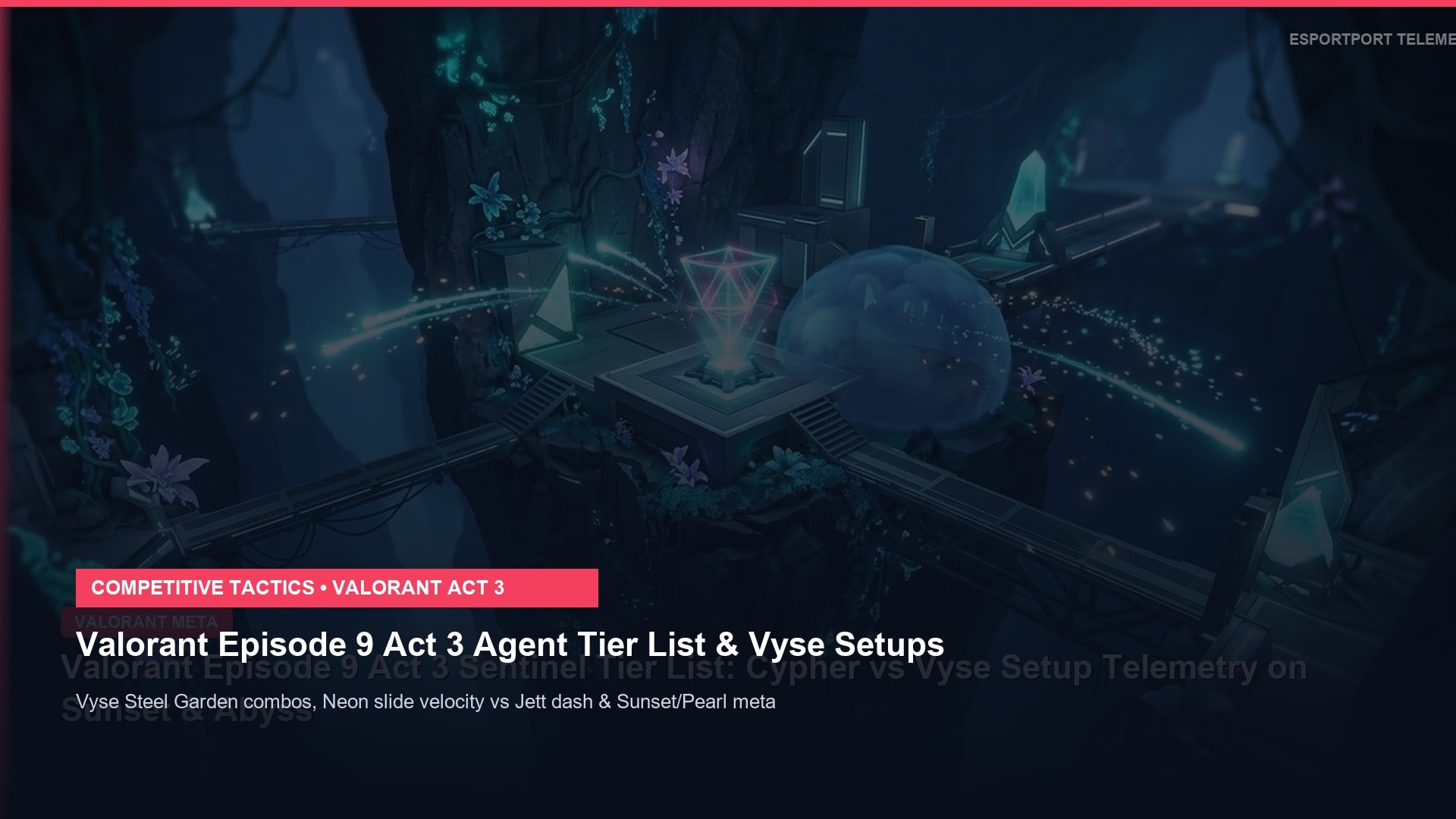
With the conclusion of international off-season showcases like Red Bull Home Ground Berlin and the Pacific Convergence, the competitive meta in Valorant Episode 9 Act 3 has solidified into one of the most dynamic tactical environments in the shooter’s history. Riot Games’ recent balance adjustments—reworking Sentinel agent Vyse’s ability windups, rebalancing Initiator info-gathering cooldowns, and standardizing spray reset times on the Phantom and Vandal—have disrupted long-standing agent hierarchies.
Across Immortal and Radiant ranked queues in North America, Europe, Brazil, and the Asia-Pacific region, mechanical duelist aggression must now navigate intricate metallic traps, global suppression fields, and surgical flash retakes. Below is the definitive, data-backed Episode 9 Act 3 Agent Tier List, accompanied by weapon duel telemetry and site-anchor tactical blueprints.
1. Official Agent Tier List Matrix (Radiant & Pro Play Consensus)
Agents are ranked based on win rate differentials, pick rates in VCT-sanctioned off-season tournaments, and individual impact across the current seven-map competitive pool (Ascent, Bind, Haven, Split, Sunset, Lotus, Abyss):
| Tier | Agents | Primary Role | Pro Pick Rate | Key Strengths & Synergy |
|---|---|---|---|---|
| S-Tier (Mandatory) | Vyse, Jett, Omen, Sova | Sentinel, Duelist, Controller, Initiator | 68.4% – 84.1% | Unmatched site lockdown (Vyse), reliable entry-fragging (Jett), infinite regenerating smokes (Omen), and irreplaceable dart recon (Sova). |
| A-Tier (Strong Meta) | Cypher, Killjoy, Fade, Raze, Viper | Sentinels, Initiator, Duelist, Controller | 42.0% – 61.5% | Stellar map-specific picks (Viper on Bind/Breeze; Cypher on Sunset; Raze on Lotus satchel entries). |
| B-Tier (Viable) | Gekko, Breach, Astra, Yoru, Iso | Initiators, Controller, Duelists | 18.5% – 34.0% | High utility ceiling requiring strict team communication; Iso remains a formidable anti-eco weapon. |
| C-Tier (Off-Meta) | Chamber, Harbor, Deadlock, Phoenix, Reyna | Sentinels, Controller, Duelists | Under 12.0% | Easily countered by disciplined coordinated team utility; high individual frag dependence. |
2. The Vyse Sentinel Revolution: Why She Outclasses Cypher on Sunset & Bind
For months following her initial release, Sentinel agent Vyse was largely dismissed by pro players who preferred Cypher’s set-and-forget Tripwires. However, Act 3’s balance patch refined the activation timing on her Shear wall, transforming her into an active combat sentinel.
Unlike Cypher wires that can be pre-destroyed by Raze grenades or Sova shock darts, Vyse’s Shear wall remains invisible until triggered by enemy footstep proximity. When attackers execute onto A-site Sunset or B-site Bind, the wall erupts behind the lead duelist, cutting them off from their team’s flashes and smokes. Paired with her Arc Rose blinding flash placed through walls, Vyse players secure guaranteed solo kills against trapped opponents, completely breaking offensive momentum.
3. Phantom vs Vandal Duel Telemetry: The 140 Headshot Controversy
The eternal debate between the Vandal ($2,900) and the Phantom ($2,900) has experienced a major swing in Act 3. While the Vandal retains its beloved one-tap 160 headshot lethality at all ranges, the prevalence of Vyse’s metallic brambles and Omen’s one-way smokes has elevated the Phantom in pro play:
- Zero Bullet Tracers: Firing through smokes with a Phantom reveals zero bullet tracer vectors, preventing opponents from spamming back and landing counter-kills.
- Higher Fire Rate & Faster Recoil Recovery: Inside 15 meters, the Phantom fires at 11 rounds per second (vs Vandal’s 9.75), yielding faster time-to-kill against multiple advancing enemies.
- The 140 Headshot Risk: Beyond 15 meters, a Phantom headshot deals 140 damage, leaving full-shield opponents with 10 HP. Pros compensate by pairing the Phantom with a light spray-transfer burst to guarantee the kill.
Related Intelligence & Today’s Trending Reports:
Review our latest esports and tactical analyses: explore the VCT 2026 OFF//SEASON Standings & Red Bull Home Ground Results, check out Valve Deadlock Competitive Ranked Mode System, and read our Black Ops 6 Season 1 Nuketown Meta Tuning Guide.
4. Frequently Asked Questions (FAQ) – Valorant Episode 9 Act 3
Q: Why is Vyse considered S-Tier in Episode 9 Act 3?
A: Vyse’s Shear wall cannot be pre-destroyed by utility and traps advancing duelists inside site chokepoints, creating easy isolation kills when combined with her wall-flashes.
Q: Is the Phantom or Vandal better for ranking up to Radiant?
A: Both are top-tier: the Vandal is best for long-range tapping on Ascent and Haven, while the Phantom is superior for close-range spamming through smokes on Bind and Split.
Q: When does Valorant Episode 9 Act 3 conclude?
A: Episode 9 Act 3 concludes in early January 2027, paving the way for the milestone Episode 10 launch alongside the VCT 2027 Kickoff tournaments.
Crosshair Placement Biomechanics: Pre-Aiming Head Levels on Abyss & Lotus
In Episode 9 Act 3’s unforgiving tactical meta, mechanical reaction time alone cannot overcome disciplined angle slicing. On vertically complex maps like Abyss and Lotus, elevation changes frequently cause players to aim at neck or chest level, surrendering the crucial first-bullet advantage in duels.
Professional aiming coaches emphasize utilizing environmental horizontal markers—such as wall grooves, crate seam lines, and doorway lintels—to maintain horizontal crosshair placement at exact standing head height before slicing corners. Furthermore, adopting a counter-strafing micro-pause (releasing the directional key and tapping the opposite key for 0.05 seconds) ensures 100% first-bullet rifle accuracy, allowing players to secure instantaneous headshot eliminations before the opponent can deploy defensive utility.
Anti-Flash Retake Discipline: Mastering the 90-Degree Mouse Flick
With Vyse’s Arc Rose and Breach’s Flashpoint dictating modern site retakes, defensive anchors must master the art of dodging flashes without relinquishing site coverage. Telemetry from pro players demonstrates the 90-degree snap-and-return technique: upon hearing the distinct audio cue of a flash deploying through a wall, players flick their crosshair 90 to 120 degrees away from the blast vector, reducing blindness duration from 2.2 seconds down to less than 0.4 seconds.
Snapping back to the choke instantly allows anchors to catch advancing duelists in full sprint, converting what should have been a vulnerable retake into an easy multi-kill defensive stop.
Economy Management & Overtime Weapon Loadout Protocols
Winning competitive Valorant matches at high elo requires understanding the micro-economics of the current buy menu. With full rifle buys (Vandal/Phantom + Heavy Shields + Full Utility) costing up to $4,700 credits, losing consecutive rounds can cripple a team’s tactical flexibility.
In Episode 9 Act 3, elite IGLs have standardized the Outlaw ($2,400) and Stinger ($1,100) half-buy strategy. The Outlaw’s semi-automatic two-shot burst instantly eliminates opponents possessing Light Shields (125 HP) with a single body shot, punishing teams that cut financial corners. On close-range anti-eco rounds, coordinating double-Stinger close-corner traps allows defenders to melt advancing attackers and recover primary rifles with zero net financial expenditure.
In sudden-death Overtime, teams receive $5,000 credits per round. Pro teams prioritize purchasing a primary rifle and heavy shields first, reserving the remaining $1,100 for site-lockdown sentinel utility rather than secondary sidearms.
Mental Resilience & Solo Queue Climbing Strategies in High Immortal
Climbing to Radiant rank requires more than crisp mechanical aim—it demands mental resilience and tactical flexibility. In Episode 9 Act 3, toxicity and tilted teammates remain the biggest obstacle to consistent MMR progression.
Professional mental performance coaches recommend implementing the ‘Rule of Two’: if you suffer two consecutive competitive defeats, step away from the queue for at least 30 minutes to reset your mental baseline. Additionally, utilizing concise, information-only voice comms (calling out enemy HP values, utility usage, and exact locations) rather than backseat driving teammates fosters high-trust team environments that regularly convert 4-8 deficits into triumphant comeback victories.
By incorporating these pre-aiming routines, counter-strafing techniques, and anti-flash protocols into your daily training regimen, you can consistently outperform opponents and secure your spot among the top Radiant competitors.
Follow EsportPort for complete VCT match analysis and agent meta breakdowns.
Additionally, mastering micro-adjustments with agent utility and syncing your tactical executes with team ultimates will consistently tip the round balance in your favor during intense overtime shootouts.
Keep following EsportPort for our weekly tactical breakdown of VCT pro lineups and agent tier lists.
Remember that consistency, communication, and adaptability are the true hallmarks of every Radiant player in Riot Games’ competitive tactical arena.
Stay locked into EsportPort for daily agent balance patches, crosshair imports, and competitive ranked leaderboard updates throughout Episode 9.
Related posts:
 Valorant Radiant Aim Hacks: Angle Snapping, DPI Scaling & Micro-Adjustment Drills
 Valorant Abyss Map Smokes & Lineups Guide: Omen One-Ways, Viper Walls & Cypher Trapwire Setups
 Valorant Radiant Aim Routine Guide: Micro-Adjustments, Crosshair Placement & Warmup Drills
 Valorant Offseason Friday Tournament Lineup Execution Hacks: Viper Decay Setups, Vyse Metal Wall Traps & Post-Plant Math
