
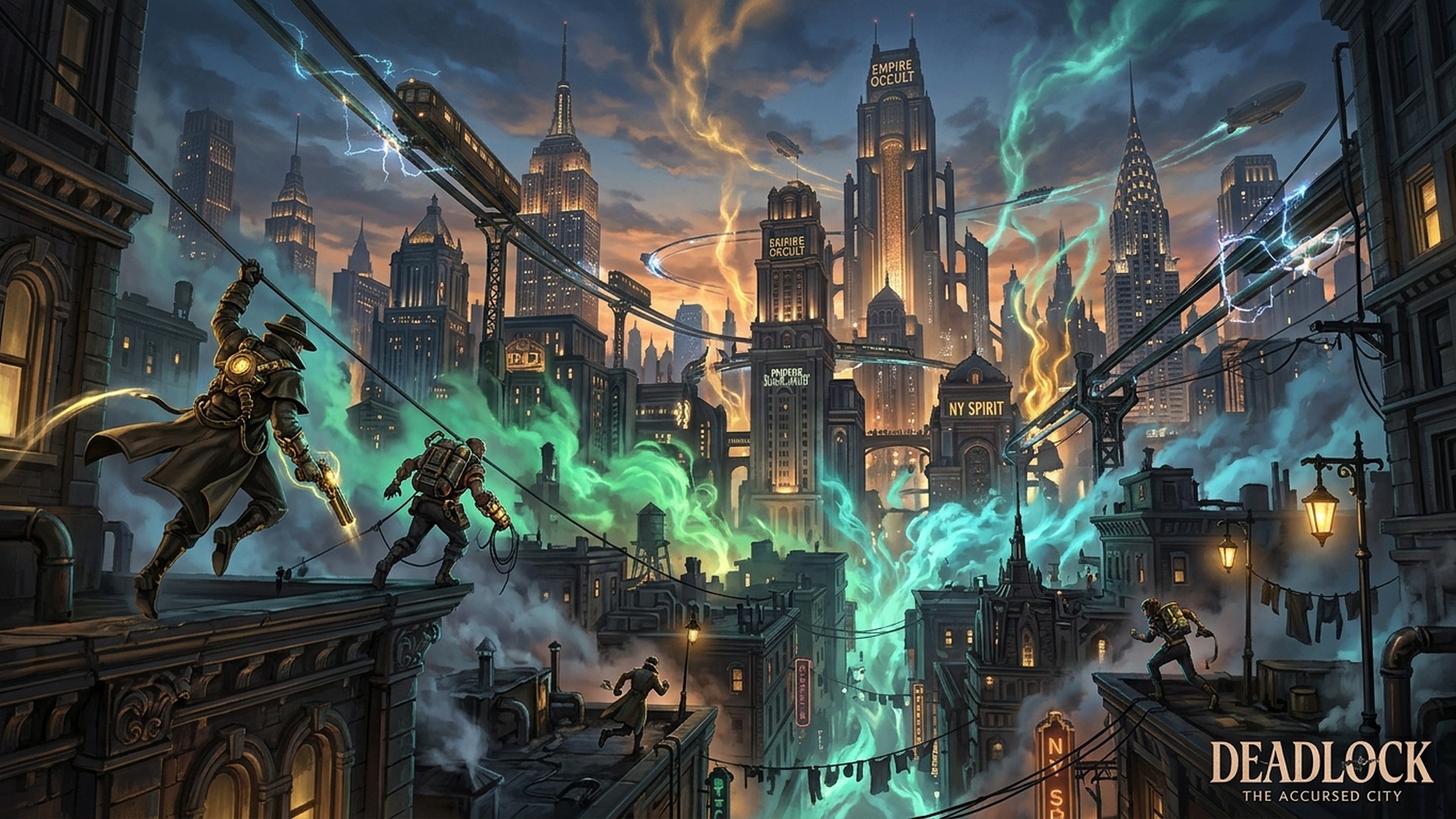
Esports Competitive Evolution: Valve Unveils Deadlock Ranked
Valve’s genre-bending 6v6 third-person MOBA shooter Deadlock has reached a monumental milestone in its closed development journey. In an expansive surprise server update deployed over the weekend, Valve officially rolled out the game’s inaugural Competitive Ranked Mode. Introducing an intricate 11-tier medal progression hierarchy, hero-specific Matchmaking Ratings (Hero MMR), and dynamic zip-line lane rebalancing, the competitive landscape has fundamentally transformed. Bridging the mechanical depth of Dota 2 with the kinetic verticality of Team Fortress 2, here is the comprehensive breakdown of Deadlock’s ranked requirements, lane assignment algorithms, and essential meta item builds.
Ranked Entry Gate & The 50-Match Calibration Requirement
To protect competitive integrity and prevent smurf accounts from terrorizing early brackets, Valve has established stringent qualifying criteria. Players cannot simply queue into Ranked upon launching the game; accounts must meet the following mandatory prerequisites:
- A minimum of 50 unranked matches completed with zero behavior penalties or intentional abandonment strikes.
- Steam Guard Mobile Authenticator actively enabled on the associated account for at least 14 days.
- Completion of seven dedicated placement matches evaluated across individual soul collection efficiency, objective damage, and defensive peeling.
Hero-Specific MMR & Dynamic Lane Allocation
The most technically innovative feature introduced in Deadlock’s ranked deployment is Individual Hero MMR Calibration. Recognizing that a player who achieves Eternus rank on Seven may perform like an Initiate when piloting Infernus or Ivy, matchmaking evaluates your proficiency per character. When you queue with a less-played hero, the matchmaking algorithm adjusts the lobby’s average skill threshold to ensure balanced, fair engagements.
Furthermore, Valve has restructured the opening laning phase across Deadlock’s four distinct zip-line lanes (Yellow, Orange, Blue, and Purple). The game’s automated draft engine now balances dual-solo and dual-duo configurations based on hero match-ups, pairing poke-heavy characters against squishy hyper-carries to ensure competitive friction from the opening wave of Trooper souls.
Ranked Meta Tier List & Itemization Optimization
In high-MMR ranked lobbies, several heroes have emerged as undisputed priority picks due to their scaling potential and utility:
Season 1 Deadlock Ranked Meta Hierarchy
- S-Tier (Insta-Pick / Ban): Seven (Colossal map-wide lightning ultimate and wave clear), Dynamo (Game-winning black hole Singularity crowd control), and Haze (Lethal assassination scaling with Silencer and Ricochet).
- A-Tier (Strong Core Carries): Warden (Anti-carry binding traps), Pocket (High-mobility burst damage and escape invulnerability), and Kelvin (Ice Dome patron defense and team healing).
- Mandatory Counter Items: In high-rank play, rush Debuff Remover against Seven’s stun, slot Curse to silence channeling ultimates, and equip Knockdown to interrupt flying heroes like Vindicta.
The Mid-Boss & Soul Urn Economy: Macro Objective Mastery
In high-tier competitive Deadlock, individual gun skill is frequently secondary to macro objective timing. The match tempo revolves around two critical neutral objectives: the Soul Urn and the colossal Mid-Boss. At the 10-minute mark, the Soul Urn spawns on one side of the map, requiring a player to physically carry it to the opposing altar across hostile territory.
Carrying the Urn silences your weapons and abilities, transforming the runner into a vulnerable target that demands total squad escort. Successfully depositing the Urn grants your entire team +25% bonus Trooper souls and unlocks an instantaneous Ability Point for every allied player. In close matches, securing consecutive Urn deliveries generates a massive 15,000 soul lead, allowing carries to unlock their 6,200-tier luxury items ten minutes ahead of schedule.
Similarly, the Mid-Boss appearing inside the subterranean central pit at the 15-minute mark provides the ultimate game-ending siege tool: the Rejuvenator Crystal. Destroying the Mid-Boss drops the crystal, which must be secured via a heavy melee smash. The Rejuvenator halves your team’s respawn timers by 50%, grants your lane Troopers +50% health, and accelerates zip-line travel speed, enabling an unstoppable push directly into the enemy Patron’s throne room.
Advanced Movement Mechanics: Stamina Economy & Wall Jumps
Mastering Deadlock’s kinetic movement system is the defining characteristic that separates mid-tier players from Eternus champions. Unlike standard tactical shooters with flat geometry, Deadlock’s gothic urban architecture features multi-story building rooftops, interior air shafts, and continuous overhead zip-lines.
By executing a Slide-Cancel into a Wall Jump, players preserve forward momentum without expending full stamina bars. Initiating a slide down inclined street ramps grants unlimited speed without stamina drain. Tapping jump precisely at the edge of the decline converts the slide into a high-arc leap, allowing high-mobility heroes like Pocket and Yamato to traverse between outer lanes in under eight seconds to execute surprise flanking maneuvers on overextended enemy solo laners.
Itemization Curves: Navigating the 3,000 & 6,200 Soul Tiers
Understanding soul expenditure curves dictates mid-game teamfight viability in Deadlock. Items are categorized across three disciplines: Weapon (Orange), Vitality (Green), and Spirit (Purple). While 500-soul starting items like Restorative Shot and Extra Health provide essential laning sustain, mid-game supremacy is established in the 3,000-soul bracket.
Carries must prioritize Pristine Emblem and Warp Stone for aggressive initiation, while supports rush Rescue Beam to pull stunned teammates out of lethal ultimate combos. When reaching the late-game 6,200-soul tier, game-altering upgrades like Leech (omnivamp), Colossus (crowd control immunity and health scaling), and Refresher (instantaneous ability cooldown reset) dictate the outcome of high-stakes base sieges, allowing coordinated teams to obliterate the opposing Patron in seconds.
Hero Synergies & Coordinated Teamfight Combos
Drafting synergistic hero compositions is paramount in high-MMR play. The most devastating combo in the current meta pairs Dynamo’s Singularity with Seven’s Storm Cloud. When Dynamo teleports into a five-man cluster and activates his black hole, Seven ascends into the air, raining down apocalyptic electrical strikes that wipe entire squads before the stun duration expires. By communicating ability cooldowns and coordinating utility items like Curse to silence counter-initiators, disciplined squads can climb the ranked ladder with unprecedented win streaks.
Jungle Farming Routes & Secret Shop Telemetry
Between minion waves, maximizing your soul economy requires clearing neutral jungle camps efficiently. Deadlock’s sprawling urban subterranean sewers and abandoned alleyways contain tier-1, tier-2, and tier-3 neutral creature nests.

Carries should weave through jungle camps adjacent to their primary lane, utilizing area-of-effect abilities to farm neutral souls while lane creeps clash. Furthermore, locating the clandestine Secret Shops tucked away in the central underground corridors allows players to purchase critical active items without expending precious minutes traveling all the way back to their home base spawn fountain, maintaining unrelenting map pressure.
Communication Etiquette & Voice Ping Protocol
Because Deadlock features 3D spatial verticality, standard 2D minimap pings are often insufficient for relaying tactical danger. Valve has introduced a contextual 3D wheel ping system that marks exact rooftop snipers, subterranean ambushers, and active healing stations. Maintaining concise verbal communication and calling out enemy ultimate cooldown timers ensures your squad initiates teamfights with overwhelming positional superiority, securing victory in every ranked bracket.
Frequently Asked Questions: Deadlock Ranked
Q: Can players queue for ranked matches as a full 6-stack party?
A: Valve currently permits solo, duo, and full 6-stack parties, but 6-stacks are strictly matched against other full pre-made teams to prevent unfair coordination advantages.
Q: How often do ranked medals update?
A: Medals update weekly every Tuesday at 8:00 PM GMT based on your aggregate 7-day performance across all ranked matches.
Q: When will Deadlock exit closed playtesting and release publicly?
A: Industry projections anticipate an open beta transition in early 2027, followed by a full free-to-play launch on Steam later that year.
Related posts:
 Valve’s ‘Deadlock’ Datamine: 3 Unreleased Heroes Leaked in Patch
 Steam Weekend Dispatch: Autumn Sale Countdown Dates, Top Trending Deck Verified Games & Free-to-Play Weekend Trials
 Steam Store Adds Real-World Average FPS Data as Epic Games Confirms Native SteamOS & Linux Launcher
 Valve Steam Machine Surges Ahead of PS6 and Next Xbox in Developer Support
