
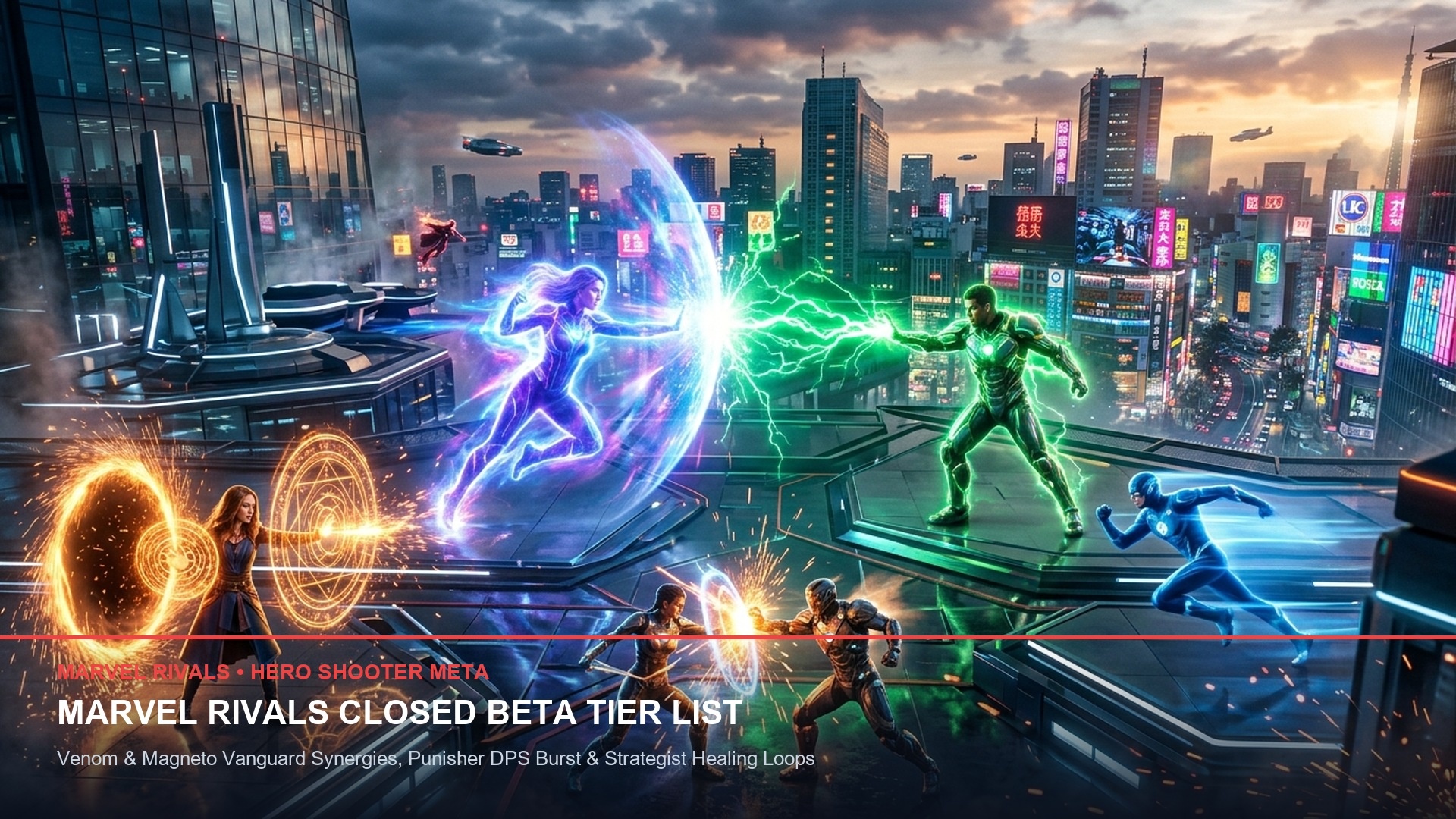
Competitive Hero Shooter Meta: Conquering Season 1 Ranked
The official global launch of NetEase and Marvel Games’ 6v6 superhero shooter Marvel Rivals has ignited a fierce competitive revolution. Combining third-person hero shooter mechanics with destructible environments and the groundbreaking Team-Up Synergy mechanic, Season 1 has established an intensely strategic ranked meta. Whether battling across the towering cybernetic spires of Tokyo 2099 or the celestial grandeur of Yggsgard, understanding hero tier viability and counter-picks is the difference between languishing in Bronze and ascending to Eternity rank. Complementing our earlier analysis on pro input latency and high-refresh-rate hardware, here is the definitive Season 1 meta tier list, hero breakdown, and synergistic team composition guide.
Season 1 Definitive Hero Tier List Overview
Our tier rankings are calibrated based on top-500 competitive win rates, high-tier tournament pick rates, and mechanical survivability under coordinated dive engagements:
Vanguard Spotlight: The Anchors of Victory
Doctor Strange: The Ultimate Utility Shield
Doctor Strange stands as the undisputed king of control-point frontline engagements. His Shield of the Seraphim provides an impenetrable barrier against projectile spam, while his dark magic levitation allows him to contest high ground effortlessly. Most decisively, Strange’s Portal Gate ability allows entire squads to bypass narrow chokepoints and drop directly onto capture objectives, turning entrenched defensive setups into instant slaughter zones.

Venom: The Unkillable Dive Disruptor
With an astronomical 800 base health pool bolstered by his cellular regeneration shielding, Venom functions as the premiere dive tank. Capable of web-swinging deep into enemy backlines and executing an earth-shattering ground slam, Venom completely disrupts enemy Strategists, isolating healers before swinging safely back to allied support range.
Duelist Mastery: Precision Hitscan & Aerial Chaos
The Punisher: High-Sustained DPS Monster
Frank Castle is the premier tank-buster of Season 1. Armed with an automatic assault rifle and an emergency shotgun swap for close-range duels, Punisher shreds shields in seconds. His deployable Turret Emplacement denies entire objective corridors, and his ultimate—deploying dual shoulder-mounted missile pods—routinely secures team-wipe victories during overtime pushes.
Spider-Man: High-Skill Ceiling Assassin
While Peter Parker possesses one of the highest mechanical skill ceilings in the game, mastering his web-zip momentum cancel and uppercut combo allows players to eliminate squishy supports in under 1.2 seconds. His spider-sense passive alerts players to incoming flankers, granting elite survivability in chaotic team fights.
Game-Winning Team-Up Synergies
The defining mechanic of Marvel Rivals is Team-Up Synergy, where specific hero combinations unlock passive bonuses or unique active abilities:
Essential Season 1 Team-Up Combos
- Rocket Raccoon & Groot – “Shoulder Gunner”: Rocket can ride on Groot’s shoulders, gaining massive damage reduction while firing an automated mini-turret that shreds dive assassins.
- Magneto & Scarlet Witch – “Metallic Chaos Overdrive”: Magneto imbues Wanda’s chaos magic with metallic resonance, allowing her to fire homing projectile swords that pierce enemy barriers.
- Hulk & Iron Man – “Gamma Beam Overcharge”: Hulk charges Tony Stark’s arc reactor with gamma radiation, converting Iron Man’s Uni-Beam into an apocalyptic wide-angle green laser.
Map Control & Ultimate Economy in Tokyo 2099
In competitive hero shooters, ultimate economy dictates match outcomes. Staggering ultimates rather than expending all six in a single engagement ensures your squad retains defensive deterrence. On vertical maps like Tokyo 2099, utilizing destructible building bridges to drop enemy players off map boundaries provides immense tempo advantages. By coordinating Doctor Strange portals with Luna Snow’s invulnerability dance, squads can consistently secure point captures and climb the ranked ladder with ease.
Counter-Pick Matrix & Situational Adaptations
No team composition operates in a vacuum. Climbing through Diamond, Grandmaster, and Eternity ranks requires mastering real-time hero swaps to counter opponent strengths. The dynamic counter-pick matrix below outlines how to shut down the most prevalent competitive threats:
Destructible Geometry & High-Ground Control
Unlike traditional hero shooters featuring static geometry, Marvel Rivals features a dynamic destruction engine powered by Unreal Engine 5’s Chaos physics. On urban maps like Tokyo 2099 and medieval strongholds like Yggsgard, smart players exploit environmental destruction to reshape combat choke points.

If an enemy team entrenches themselves atop an elevated balcony with dual healers and a turret, do not attempt a frontal assault up the staircase. Instead, coordinate with your Vanguard—such as Hulk executing a thunderclap or Punisher firing an explosive grenade—to collapse the structural pillars beneath the balcony. Bringing the roof down inflicts massive crushing damage, instantly dislodges defensive snipers into the open street, and turns entrenched positions into chaotic rubble where your dive Duelists can clean up easily.
Strategist Peeling & Backline Preservation Tactics
In high-tier competitive play, matches are frequently decided not by which team secures the first elimination, but by which team protects its support line most effectively. High-mobility dive characters like Spider-Man and Venom exist solely to assassinate isolated healers before objective team fights begin. To maintain support uptime, competitive squads must establish dedicated peeling protocols.
Vanguards must never abandon their Strategists to pursue overextended eliminations. Utilizing Doctor Strange’s dark magic shielding to cordon off backline corridors or positioning Mantis within close proximity to The Punisher’s deployable turret ensures that any enemy assassin attempting a dive is immediately met with sleep crowd control and overwhelming point-blank hitscan firepower. Maintaining rigid spacing and prioritizing defensive peeling transforms vulnerable backlines into impenetrable defensive bastions.
Furthermore, communicating ultimate charge percentages allows supports to stagger their survival abilities. Activating Luna Snow’s invulnerability dance and Mantis’s area healing aura simultaneously wastes vital defensive cooldowns. By alternating defensive ultimates across consecutive team fights, squads guarantee continuous survivability, enabling steady climbs through competitive ranked divisions.
Ranked Progression & Competitive MMR Calibration
NetEase has engineered a competitive matchmaking rating (MMR) system that rewards objective contribution and team-up synergy utilization alongside raw elimination statistics. Players who actively trigger collaborative combo abilities, absorb lethal damage with Vanguard shielding, and secure high-ground control receive significant performance rating bonuses, accelerating tier promotions even during closely contested overtime matches.

As the Season 1 meta stabilizes, maintaining flexibility across multiple hero archetypes remains the ultimate competitive virtue. Understanding when to swap off a dive Duelist to adopt a hitscan defensive posture allows teams to counter aggressive enemy adaptations and secure sustained winning streaks across high-stakes ranked divisions.
By mastering these core synergies, fine-tuning your mechanical execution, and coordinating ultimate economies with your teammates, you can dominate the competitive ladder and cement your legacy among the top players in Marvel Rivals Season 1.
Frequently Asked Questions: Marvel Rivals Meta
Q: Is the 2 Vanguard, 2 Duelist, 2 Strategist (2-2-2) team composition mandatory?
A: While 2-2-2 is the most stable standard composition, aggressive “Triple Dive” (1 Tank, 3 DPS, 2 Healers) is viable on assault maps with tight flank routes.
Q: How do you counter an enemy Venom that keeps diving your backline?
A: Pick Mantis to sleep him with her spore dart, and run The Punisher to melt his massive health hitbox before his cellular shield activates.
Q: What graphics settings provide the lowest input lag in Marvel Rivals?
A: Enable NVIDIA Reflex to ‘On + Boost’, set DLSS to ‘Performance’, and disable motion blur and screen space reflections for optimal frame pacing.
Related posts:
 Marvel Rivals Season 11 Pro Tier List & Team-Up Ability Guide: Best Vanguard, Duelist & Strategist Comps for Ranked Climb
 Marvel Rivals Season 11 Launches Tomorrow (Nov 13): Nightcrawler Strategist Kit, 18v18 & Free 2,500 Units
 Zero Hour PS5 & Xbox Series Release Date Locked for Dec 3 at $24.99 With Cross-Play & K9 Companion
 Call of Duty Warzone Nov 12 Patch Analysis: Smoke Aim-Assist Removal & Black Ops 7 M10 Breacher Meta Breakdown
