
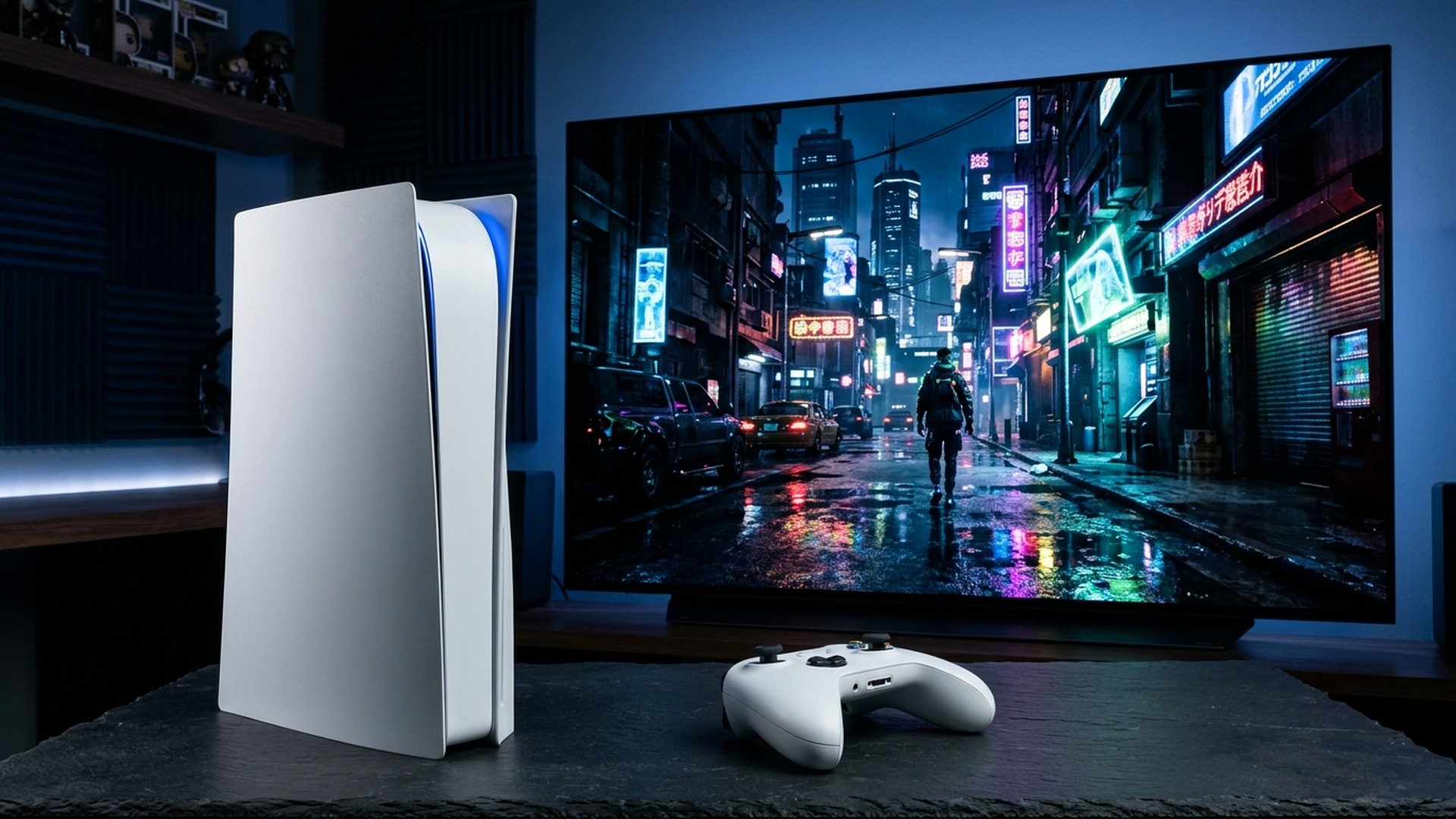
With the arrival of the PlayStation 5 Pro and its proprietary machine-learning upscaler, PlayStation Spectral Super Resolution (PSSR), the technical gulf between console gaming and ultra-enthusiast PC hardware has entered a captivating new era. Promising crisp 4K visual reconstruction, enhanced ray-traced reflections, and fluid 60 FPS performance, the PS5 Pro represents Sony’s boldest push toward closing the visual fidelity gap against monstrous custom PC rigs. To evaluate how Sony’s AI upscaling and enhanced RDNA ray tracing hardware withstands true peak graphics workloads, we conducted exhaustive head-to-head benchmarking against full PC Ray Tracing Overdrive (Full Path Tracing) using Remedy Entertainment’s graphical showcase, Alan Wake 2.
This technical shootout unfolds against the backdrop of an evolving silicon landscape where mobile and desktop hardware architectures are converging rapidly, from handheld innovations like Microsoft’s official Xbox gaming handheld initiative to record-shattering desktop processors like the AMD Ryzen 7 9800X3D. Analyzing frametime consistency, image reconstruction artifacts, and ray bounces reveals exactly what console gamers gain—and where enthusiast PC silicon remains untamed.

Understanding PSSR: Sony’s Dedicated Machine Learning Upscaler
Unlike standard spatial upscalers like AMD FSR 2 or checkerboard rendering, PSSR utilizes a dedicated machine-learning Neural Processing Unit (NPU) integrated directly into the PS5 Pro’s custom AMD APU, delivering roughly 16.7 teraflops of dedicated AI computing power. PSSR operates similarly to NVIDIA’s acclaimed DLSS (Deep Learning Super Sampling), analyzing temporal motion vectors, jittered input frames, and prior frame history through trained neural network models to infer high-frequency surface detail from a lower internal rendering resolution.
In Alan Wake 2, the PS5 Pro renders internally at approximately 1200p in Performance Mode and 1440p in Quality Mode, with PSSR reconstructing an output frame targeting a native 4K (3840×2160) canvas. In motion, PSSR exhibits remarkable edge stability, virtually eliminating the temporal shimmering on telephone wires, chain-link fences, and forest foliage that plagued the base PS5’s FSR 2 implementation.
Visual Fidelity Shootout: Ray Traced Reflections vs Full Path Tracing
While the PS5 Pro achieves dramatic visual gains, dissecting Remedy’s rendering pipeline exposes the clear boundary between console hybrid ray tracing and PC path tracing. On the PS5 Pro, ray tracing is deployed selectively: hardware-accelerated BVH (Bounding Volume Hierarchy) traversal handles opaque reflections on wet asphalt in the Pacific Northwest forests and glassy skyscraper surfaces in the Dark Place.
In contrast, an ultra-enthusiast PC rig running Alan Wake 2’s Ray Tracing Overdrive mode deploys Full Path Tracing powered by NVIDIA DLSS 3.7 Ray Reconstruction (CNN-based denoiser). On PC, every single ray of light—including direct illumination, multi-bounce indirect diffuse lighting, specular reflections, subsurface scattering, and volumetric fog shadows—is simulated physically through unified path tracing. The result on PC is breathtakingly photorealistic indirect ambient occlusion in dark corners and perfectly diffused colored light bouncing off neon motel signs onto wet timber, subtle physical phenomena that hybrid console ray tracing simply cannot replicate.
| Hardware Test Configuration | Resolution & Upscaler Mode | Average Framerate | 1% Low Frametime Stability | Ray Tracing Pipeline Level |
|---|---|---|---|---|
| PlayStation 5 Pro (60 FPS Performance) | Dynamic 1200p upscaled to 4K via PSSR | 59.4 FPS | 51.2 FPS (Minor dips in dense woods) | Hybrid RT Reflections & Ambient Occlusion |
| PlayStation 5 Pro (30 FPS Quality) | Dynamic 1440p upscaled to 4K via PSSR | 30.0 FPS | 29.1 FPS (Rock-solid frame pacing) | High RT Reflections, RT Transparent Glass |
| Base PlayStation 5 (Performance) | Dynamic 1080p upscaled via AMD FSR 2 | 54.2 FPS | 42.6 FPS (Noticeable temporal sizzle) | Screen Space Reflections (No HW Ray Tracing) |
| Enthusiast PC (RTX 4080 / 9800X3D) | Native 4K + DLSS Quality + Frame Gen | 84.6 FPS | 72.4 FPS (Silky smooth frametimes) | Full Path Tracing Overdrive + Ray Reconstruction |
| Enthusiast PC (RTX 4090 / 9800X3D) | Native 4K + DLSS Balanced + Frame Gen | 108.2 FPS | 88.5 FPS (Unmatched visual perfection) | Full Path Tracing Overdrive Max + DLSS RR |
Frametime Consistency & Image Reconstruction Artifacts
Frametime pacing is where the PS5 Pro earns its strongest accolades. In Quality Mode, frame delivery maintains a near-flat 33.3ms line across the entire playthrough, ensuring that controller inputs feel responsive and stutter-free. In 60 FPS Performance Mode, frametimes fluctuate comfortably between 16.6ms and 18.2ms, exhibiting minor frame pacing hiccups only during heavy volumetric particle explosions when combatting Taken cultists.


However, PSSR is not entirely immune to early-generation machine learning artifacts. In dark, high-contrast scenes—such as shining Alan’s flashlight through misty Pacific Northwest evergreen needles—close inspection reveals subtle ‘temporal fizzle’ and minor disocclusion ghosting trailing behind fast-moving character silhouettes. NVIDIA’s DLSS Ray Reconstruction demonstrates superior temporal stability in these edge cases, attributable to its fourth-generation Tensor cores and mature multi-year neural training datasets.
Memory Architecture & Silicon Bandwidth Comparison
To understand the performance divergence between the PS5 Pro and top-tier PC graphics cards, one must examine memory bandwidth pipelines. The PlayStation 5 Pro features a unified memory pool consisting of 16GB of high-speed GDDR6 memory operating across a 256-bit bus delivering 576 GB/s of bandwidth, augmented by 2GB of auxiliary DDR5 memory dedicated to the console operating system. While unified architecture provides remarkable efficiency, sharing this bus between CPU game logic, audio processing, and heavy GPU path-tracing buffers inevitably creates bandwidth contention.
In contrast, an enthusiast PC equipped with an NVIDIA GeForce RTX 4090 features 24GB of dedicated ultra-high-speed GDDR6X video memory delivering over 1,008 GB/s of bandwidth, entirely independent of the motherboard’s 32GB or 64GB of dual-channel system RAM. This massive VRAM headroom allows the PC to maintain uncompressed 4K path-tracing BVH trees, high-resolution shadow maps, and multiple ray bounce caches without evicting active geometry or forcing temporal resolution cuts.
Economic Calculus: Console Value vs Enthusiast PC Investment
When assessing this graphical faceoff, the economic reality cannot be ignored. At an MSRP of $699 (or approximately $780 when paired with the optional disc drive and vertical stand), the PS5 Pro offers an astonishingly cost-effective entry point into modern AI upscaling and hardware ray tracing. Building an enthusiast PC capable of running Alan Wake 2’s Full Path Tracing Overdrive with DLSS at equivalent 4K framerates commands an investment upwards of $2,200 to $2,800. For mainstream gamers, the PS5 Pro delivers 80% of the PC’s visual splendor at less than a third of the total financial cost.


The Verdict: A Massive Leap for Consoles, But PC Retains the Crown
At a $699 price point, the PS5 Pro punches far above its weight class, delivering an image reconstruction experience that decisively outclasses standard temporal anti-aliasing and FSR. For console enthusiasts seeking pristine 4K image clarity on 65-inch OLED televisions without sacrificing 60 FPS fluidity, the upgrade is undeniable. However, for enthusiasts demanding absolute visual reality—where light bounces naturally through glass and fog without compromise—a dedicated high-end PC rig running full path tracing remains in an untouchable graphical stratosphere.
Frequently Asked Questions About PS5 Pro PSSR vs PC Ray Tracing
What is PlayStation Spectral Super Resolution (PSSR)?
PSSR is Sony’s proprietary AI-driven temporal upscaler built for the PS5 Pro. It utilizes an onboard Neural Processing Unit (NPU) to reconstruct clean 4K visuals from lower base resolutions, delivering superior clarity and stability compared to AMD FSR.
Does the PS5 Pro support Full Path Tracing like high-end PCs?
No, the PS5 Pro utilizes hybrid ray tracing for selective reflections and ambient occlusion. Full Path Tracing (simulating all light rays simultaneously) requires the immense compute and VRAM bandwidth of top-tier desktop GPUs like the RTX 4080 and RTX 4090.
Is Alan Wake 2 playable at 60 FPS on PS5 Pro with ray tracing?
In Alan Wake 2’s Performance Mode on PS5 Pro, the game runs at a smooth target of 60 FPS utilizing PSSR upscaling, while full ray-traced reflections are prioritized in the 30 FPS Quality Mode.
How does PSSR compare to NVIDIA DLSS 3.7?
While PSSR is a massive upgrade over FSR and approaches DLSS in edge stability, NVIDIA DLSS 3.7 still holds an advantage in fine foliage reconstruction and incorporates Ray Reconstruction technology that denoises path-traced lighting more cleanly.
Related posts:
 Horizon Zero Dawn Remastered PC & PS5 Pro Optimization: Nixxes Decima Engine Benchmarks, $10 Upgrade Path & Best Graphic Presets
 PS5 Pro vs RTX 4080 Super Saturday Night Hardware Benchmark: PSSR AI Upscaling Telemetry in Phantom Blade Zero, Marvel’s Blade Engine Specs & HDMI 2.1 VRR Calibration
 Metaphor: ReFantazio Complete Battle System & Archetype Strategy Guide: Turn Press Synergies, MP Conservation & Royal Lab
 Golden Joystick Awards 2026 Winners: Resident Evil Requiem Sweeps Ultimate Game of the Year & 4 Trophies
