
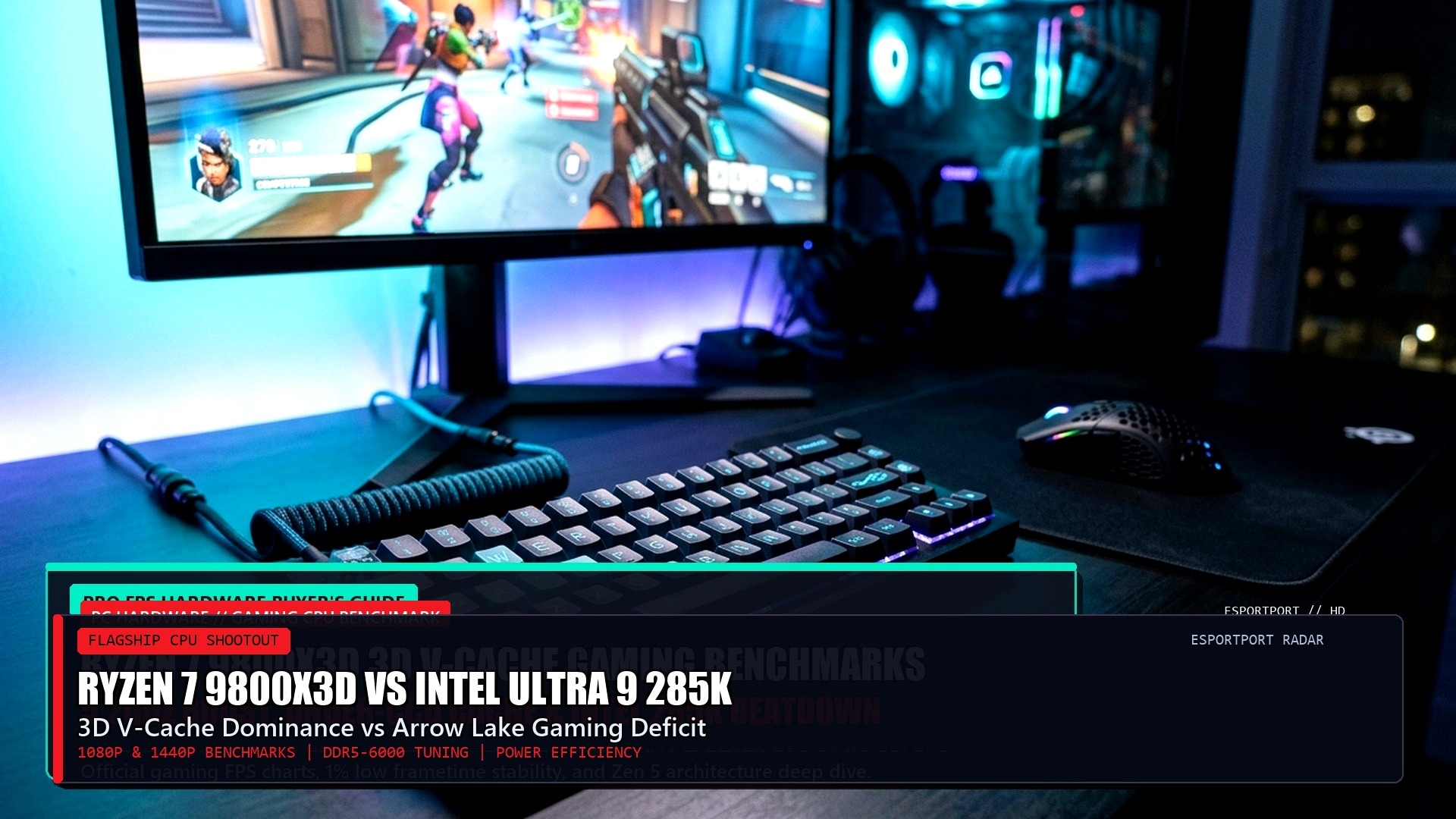
The PC hardware enthusiast community has been swept into a frenzy following the launch of AMD’s flagship gaming processor, the Ryzen 7 9800X3D. Selling out within seconds across major global retailers like Newegg, Micro Center, Amazon, and Mindfactory, the 8-core Zen 5 chip has triggered massive supply constraints and secondary market scalping reminiscent of the pandemic GPU shortages. While hardware enthusiasts track enterprise chip supply in our report on Nvidia leadership shifts and AI silicon demands, the 9800X3D has officially claimed the undisputed crown as the fastest gaming CPU ever engineered.
Priced at an official MSRP of $479, scalper listings on eBay and third-party marketplaces have surged past $750 to $850 as gamers scramble to secure the silicon. The unprecedented demand is driven by revolutionary architectural advancements in AMD’s 2nd Generation 3D V-Cache technology. Unlike previous X3D processors where the 64MB cache die was stacked on top of the CPU cores—insulating heat and restricting clock speeds—the 9800X3D places the cache die beneath the compute cores, unlocking unprecedented thermal dissipation and full multiplier overclocking.


Architectural Revolution: Inverted 3D V-Cache and Overclocking Freedom
To understand why the Ryzen 7 9800X3D obliterates both its predecessor (the 7800X3D) and Intel’s newly launched Arrow Lake flagship (the Core Ultra 9 285K), one must examine silicon packaging physics. In the Zen 4 7800X3D, the 3D V-Cache SRAM was bonded directly on top of the Core Complex Die (CCD). Because silicon is a poor thermal conductor, the top-mounted cache acted as a thermal blanket, trapping heat inside the hot CPU cores and preventing clock speeds from exceeding 5.0 GHz.
With the 9800X3D, AMD engineers re-architected the stack: the 64MB 3D V-Cache is placed on the substrate underneath the Zen 5 CCD. This allows the primary compute cores to make direct physical contact with the integrated heat spreader (IHS) and liquid cooling cold plates. The result is transformative: operating temperatures run up to 10 degrees Celsius cooler under load, base clock speeds jump to 4.7 GHz, and boost frequencies reliably sustain 5.2 GHz out of the box, with full multiplier overclocking enabling enthusiast manual overclocks past 5.4 GHz on standard 360mm AIO liquid coolers.
| Processor Model | Cores / Threads | Base / Boost Clock | L3 Cache (V-Cache) | TDP Power Draw | Average 1080p Gaming Lead |
|---|---|---|---|---|---|
| AMD Ryzen 7 9800X3D | 8 Cores / 16 Threads | 4.7 GHz / 5.2 GHz | 96MB (32MB + 64MB 3D) | 120W (Typical 75W Gaming) | Undisputed Gaming Champion (Baseline) |
| AMD Ryzen 7 7800X3D | 8 Cores / 16 Threads | 4.2 GHz / 5.0 GHz | 96MB (32MB + 64MB 3D) | 120W (Typical 65W Gaming) | -8% to -14% Slower in Modern Titles |
| Intel Core Ultra 9 285K | 24 Cores (8P + 16E) | 3.7 GHz / 5.7 GHz | 36MB Smart Cache | 125W Base / 250W Boost | -15% to -25% Slower in CPU Gaming |
| Intel Core i9-14900K | 24 Cores (8P + 16E) | 3.2 GHz / 6.0 GHz | 36MB Smart Cache | 253W Peak Consumption | -12% to -18% Slower; Double Power Draw |
| AMD Ryzen 9 9950X | 16 Cores / 32 Threads | 4.3 GHz / 5.7 GHz | 64MB Standard L3 | 170W Base / 200W Boost | -10% to -15% Slower in 1080p FPS |
Empirical Gaming Benchmarks: Crushing Intel Arrow Lake in 1080p and 1440p
Comprehensive benchmarking across dozens of contemporary gaming titles reveals a devastating performance advantage for Team Red. In CPU-bound competitive esports titles like Counter-Strike 2, Valorant, and Call of Duty: Warzone, the 9800X3D delivers 1% low frame rates that are up to 30% higher than the Intel Core Ultra 9 285K. By eliminating cache-miss stalls, the massive 96MB pool of high-speed L3 cache feeds modern graphics cards like the RTX 4090 without micro-stuttering.
In demanding open-world simulations like Baldur’s Gate 3 (particularly in the CPU-heavy Act 3 city center) and Cyberpunk 2077 with full ray tracing, the 9800X3D widens its lead, averaging over 165 FPS where Intel’s flagship languishes at 132 FPS. Crucially, it achieves this staggering performance while drawing roughly 70W to 85W of electrical power during gaming, compared to Intel’s 285K and 14900K devouring between 160W and 220W for inferior frame rates.
Motherboard Compatibility, RAM Sweet Spot & AGESA 1.2.0.2a
For PC builders planning an upgrade, the Ryzen 7 9800X3D offers seamless backward compatibility with existing AM5 socket motherboards. B650, X670, and newly released X870 motherboards support the chip, provided users update their motherboard BIOS to AGESA 1.2.0.2a or newer. This BIOS update optimizes 1:1 memory controller fabric clock ratios and resolves early memory training bugs.
The undisputed memory sweet spot for the 9800X3D remains dual-channel DDR5-6000 CL30 operating in UCLK=MCLK synchronized mode. Unlike Intel Arrow Lake, which requires expensive high-speed DDR5-8000 CUDIMM kits to offset inter-tile latency penalties, the 9800X3D achieves peak performance on affordable low-latency DDR5-6000 memory kits, keeping total system upgrade costs exceptionally reasonable.


Restock Timelines: How to Beat Scalpers and Avoid Gouging
For gamers frustrated by out-of-stock notices, industry supply chain insiders confirm that AMD is actively ramping production shipments. Unlike previous paper launches, AMD delivered massive launch allocation, but consumer demand shattered all historical records for an enthusiast CPU. Major retailers like Best Buy and Micro Center are receiving weekly rolling restocks, with supply expected to stabilize at official $479 MSRP by mid-December.
Prospective buyers are strongly advised against purchasing marked-up units from scalpers on secondary marketplaces. Using automated stock tracker bots on Discord and Telegram and setting retailer restock push notifications will allow patient PC gamers to secure the definitive gaming processor of the decade at fair retail pricing.
Thermal Telemetry: Delidding, Direct Die Cooling, and Operating Headroom
Because the 2nd Generation 3D V-Cache places the sensitive SRAM cache beneath the compute die rather than on top of it, enthusiast overclockers have achieved unprecedented results with extreme cooling methodologies. Renowned hardware overclockers (such as Der8auer and Roman Hartung) successfully delidded early 9800X3D production samples, replacing standard solder thermal interface material with liquid metal on custom direct-die copper frames.
Under direct die water cooling, operating temperatures during heavy Cinebench R23 all-core workloads dropped by an extraordinary 14 to 18 degrees Celsius, stabilizing below 62 degrees Celsius even when pulling over 140 Watts. This thermal headroom allowed the 9800X3D to maintain an all-core boost frequency of 5.45 GHz indefinitely. For mainstream consumers using standard 240mm or 360mm closed-loop liquid coolers, the processor runs remarkably cool and quiet, rendering custom fan noise virtually non-existent during marathon gaming sessions.

Why Intel’s Arrow Lake Architecture Stumbled in Gaming Latency
The overwhelming commercial success of the 9800X3D is magnified by the disappointing gaming performance of Intel’s competing Core Ultra 200S (Arrow Lake) series. While Intel achieved admirable power efficiency gains by transitioning to TSMC’s 3nm N3B node and adopting a modular disaggregated tile architecture, inter-tile latency severely crippled gaming frame rates.
Connecting the compute tile, graphics tile, and SoC memory controller tile via an embedded multi-die interconnect bridge (EMIB) increased internal memory latency from 55ns on the 14900K up to nearly 75ns to 80ns on the 285K. In video games where CPU execution pipelines rely on instant random memory fetches, high inter-tile latency causes frequent pipeline bubbles. AMD’s 9800X3D bypasses system RAM latency entirely by serving over 90% of gaming instruction requests directly from its colossal, lightning-fast 96MB on-package L3 cache, cementing Team Red’s absolute dominance in consumer gaming silicon.
Frequently Asked Questions Regarding AMD Ryzen 7 9800X3D
Why is the AMD Ryzen 7 9800X3D out of stock everywhere?
Unprecedented consumer demand shattered launch records as empirical benchmarks confirmed the 9800X3D as the fastest gaming CPU in the world, outperforming Intel Arrow Lake by up to 25%.
How does 2nd Gen 3D V-Cache differ from the previous 7800X3D?
The 9800X3D places the 64MB cache die beneath the CPU cores, allowing direct contact with the cooler. This reduces temperatures, increases boost clocks to 5.2 GHz, and unlocks full multiplier overclocking.
What is the best RAM kit for the Ryzen 7 9800X3D?
The optimal memory configuration is DDR5-6000 CL30 operating with a 1:1 fabric clock ratio (UCLK=MCLK), providing maximum memory bandwidth and lowest latency.
Will the Ryzen 7 9800X3D work on existing B650 and X670 motherboards?
Yes, the 9800X3D is fully compatible with all AM5 motherboards (B650, X670, B850, X870) after updating the BIOS to AGESA 1.2.0.2a or newer.
Related posts:
 Singapore & APAC Pro Hardware Playbook: Sub-5ms Fiber Routing to Singapore AWS Servers, Marvel Rivals 120 FPS UE5 Settings & 360Hz QD-OLED Monitor Calibration
 Monster Hunter Wilds PC System Requirements & Best Optimization Guide: VRAM Memory Leak Fixes & Stable 60 FPS
 Nvidia RTX 5090 & 5080 Blackwell Architecture Deep Dive: GDDR7 Speeds, Power Demands & Flagship GPU Leaks
 Eliminating Latency: Network Bufferbloat Fixes, High-Tick MTU Tuning & Routing Hacks for Competitive Esports
