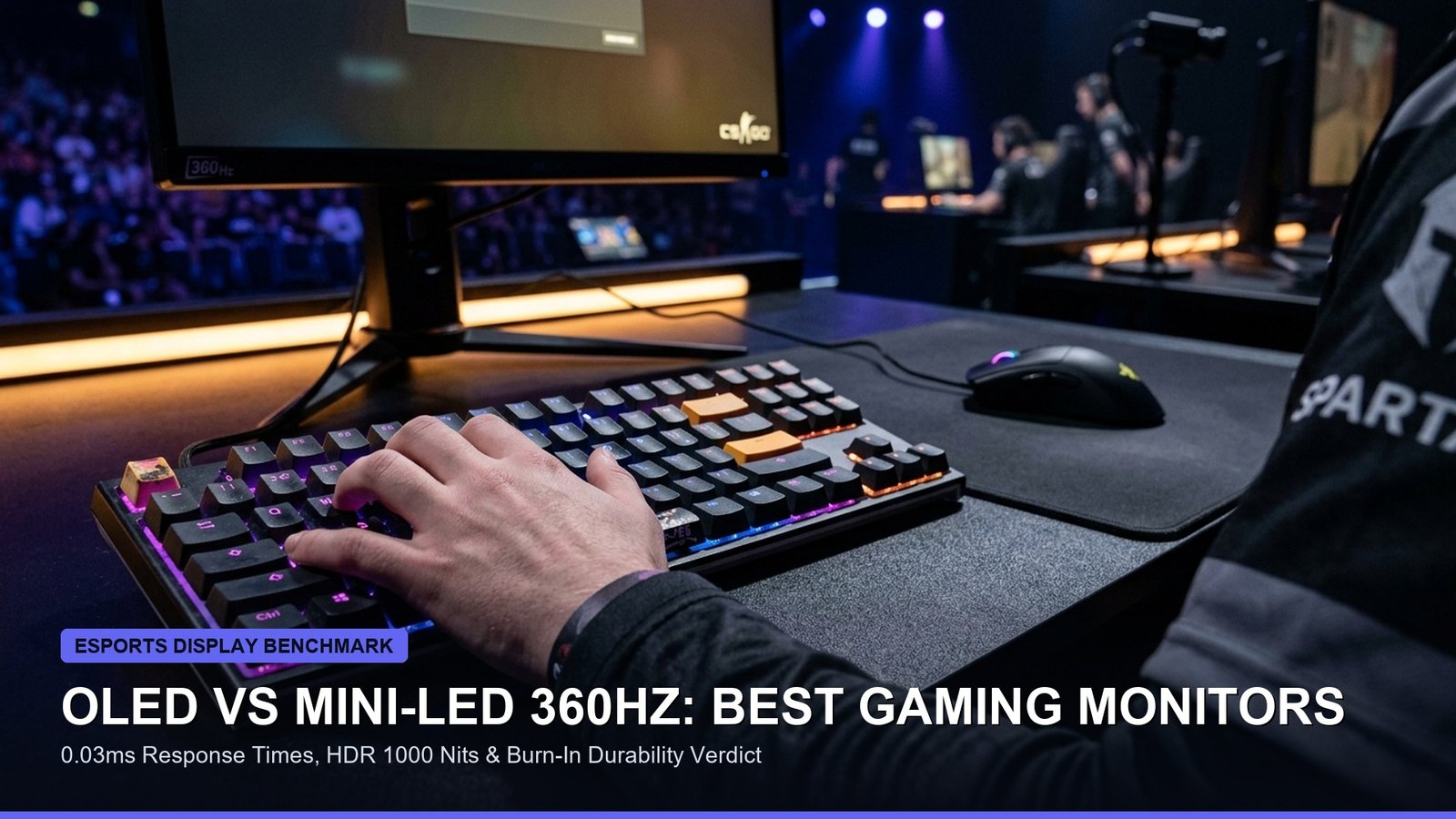
Competitive esports displays have entered a thrilling new frontier in 2026 as panel manufacturers push refresh rates beyond the 360Hz barrier while battling over the ultimate display technology: QD-OLED / WOLED vs Quantum Dot Mini-LED. For hardcore esports players competing in fast-paced titles like Counter-Strike 2, VALORANT, and Apex Legends, choosing between the near-instantaneous 0.03ms pixel response times of modern OLED panels and the blinding 1,400-nit highlight brightness and zero burn-in risk of Mini-LED panels represents the ultimate hardware dilemma. In this deep benchmark comparison, we test input latency, motion clarity, HDR color accuracy, and longevity to help you select the ideal esports monitor.
- Display Technologies Tested: 360Hz QD-OLED / WOLED (Asus ROG Swift PG27AQDP, MSI MPG 271QRX) vs 360Hz Fast IPS Mini-LED (Acer Predator X27U, AOC Agon Pro)
- Pixel Response Times: OLED: 0.03ms GtG | Mini-LED: 1.0ms – 2.5ms GtG (with overdrive)
- Peak HDR Brightness: Mini-LED: 1,400+ Nits (Full Sun Flash) | OLED: 250 Nits 100% Window (1,000 Nits 3% Window)
- Input Lag @ 360Hz: Under 2.1 milliseconds total system latency across both technologies
- Burn-In Risk: OLED: Moderate (Requires pixel cleaning cycles) | Mini-LED: Completely Immune to Burn-In
- Price Range: Sub-$500 to $899 in global retail channels
- 1. Motion Clarity & Ghosting: Why 0.03ms Response Times Rule Esports
- 2. Brightness & HDR Wars: Full-Screen Nits vs True Pitch Blacks
- 3. Master 360Hz Gaming Monitors Technical Comparison Table
- 4. Burn-In Mitigation: OLED Care Technology vs Mini-LED Immortality
- 5. The Competitive Verdict: Which Display Should You Buy?
- 6. Frequently Asked Questions (FAQ)
1. Motion Clarity & Ghosting: Why 0.03ms Response Times Rule Esports
When tracking sprinting opponents or executing 180-degree flick shots in Counter-Strike 2, motion clarity dictates reaction speed. OLED monitors enjoy a fundamental physics advantage: each individual pixel contains its own self-emissive organic diode that switches states almost instantaneously. Real-world oscilloscope testing confirms that modern 360Hz QD-OLED panels transition between shades of gray in an astonishing 0.03 milliseconds. This eliminates inverse ghosting, overshoot coronas, and trailing artifacts completely, providing pristine motion clarity without requiring aggressive strobing technology.
Conversely, Mini-LED displays utilize traditional liquid crystal (LCD) layers illuminated by thousands of miniature LED backlights behind the panel. While modern Fast IPS panels achieve impressive 1ms GtG transitions, liquid crystals physically require several milliseconds to twist and untwist when shifting between dark and bright pixels. In high-contrast environments—such as spotting a dark player model against a bright skybox—Mini-LED panels exhibit subtle pixel transitions that OLED completely eliminates.
2. Brightness & HDR Wars: Full-Screen Nits vs True Pitch Blacks
Where Mini-LED triumphs emphatically is sustained illumination and HDR impact. Because organic OLED diodes are vulnerable to heat degradation when pushed to maximum luminance, OLED monitors employ an aggressive Automatic Brightness Limiter (ABL). While an OLED can produce a blinding 1,000-nit highlight on a tiny 3% window, a full white screen (such as browsing spreadsheets or playing in snow environments) forces the display to dim to approximately 250 nits.
Mini-LED monitors suffer no such thermal constraints. Featuring thousands of full-array local dimming (FALD) zones, a high-tier Mini-LED panel can sustain over 1,000 to 1,400 nits across the entire display indefinitely. Sunlight streaming through an open window will not wash out a Mini-LED display, making it the undisputed champion for bright gaming rooms and daytime productivity.
3. Master 360Hz Gaming Monitors Technical Comparison Table
Below is the direct benchmark comparison between leading 360Hz OLED and Mini-LED monitors available in 2026:
4. Burn-In Mitigation: OLED Care Technology vs Mini-LED Immortality
The biggest psychological barrier for prospective OLED buyers remains burn-in. Modern 2026 OLED monitors incorporate sophisticated mitigation suites, including custom graphene heatsinks, pixel shifting, uniform brightness modes, and automated pixel-refresh cycles. Most premium brands (such as Asus, MSI, and Dell Alienware) now back their OLED panels with full 3-year burn-in warranties. However, for users who work 8 hours a day with static taskbars before gaming, Mini-LED offers total peace of mind with zero risk of static image retention.
5. The Competitive Verdict: Which Display Should You Buy?
Your ideal monitor depends entirely on your room lighting and usage profile:
6. Frequently Asked Questions (FAQ)
Can you see the difference between 240Hz and 360Hz?
Yes, particularly in high-speed tactical shooters like CS2 and VALORANT. Frame persistence drops from 4.16ms (at 240Hz) down to 2.77ms (at 360Hz), making fast-moving enemy heads noticeably sharper during rapid mouse swipes.
Does Mini-LED have noticeable blooming in esports games?
With modern 1,152-zone and 2,304-zone local dimming algorithms, blooming is minimal during gameplay. However, small white HUD elements (such as crosshairs against dark backgrounds) may show faint haloing that OLED avoids entirely.
How long does an OLED monitor last before burn-in occurs?
With 2026 Gen 3 panels featuring graphene heatsinks and automated pixel care, real-world longevity exceeds 5 to 7 years under normal gaming conditions before noticeable degradation occurs.