
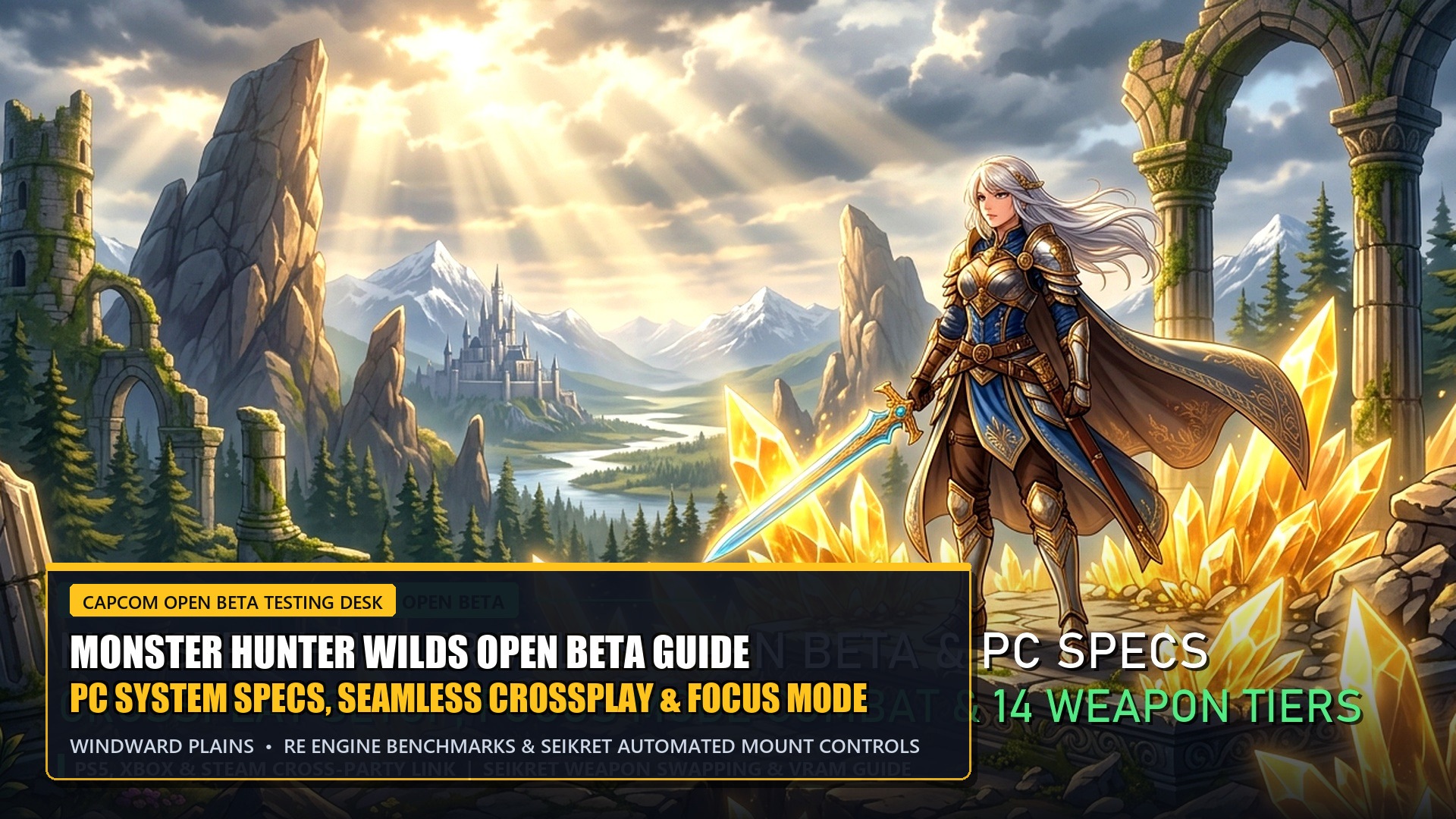
Capcom’s Monster Hunter Wilds has completed its highly anticipated Open Beta 2 test across PC, PlayStation 5, and Xbox Series X|S, giving millions of global hunters their second hands-on encounter with the Windward Plains, the Scarlet Forest, and the ferocious flagship predator Arkveld. While the beta showcased jaw-dropping weather transitions and visceral creature battles, PC telemetry revealed severe CPU thread bottlenecks, Frame Generation requirements, and drastic weapon balance adjustments. Our comprehensive analytical dossier breaks down definitive PC benchmark optimizations alongside the complete 14-weapon tier list powered by the revolutionary Focus Strike mechanic.
Monster Hunter Wilds Open Beta 2: Definitive 14-Weapon Tier List
The introduction of Focus Mode and Focus Strikes has revolutionized Capcom’s combat flow. By holding the Focus trigger, hunters can precisely aim strikes, reveal monster wounds (scars created by sustained damage), and trigger explosive finishing moves that flinch apex monsters. Below is the consensus competitive tier ranking based on DPS output, defensive safety, wound popping efficiency, and speedrun hunt times.
| Tier Ranking | Weapon Class | Primary Strengths & Meta Role | Focus Strike Synergy | Difficulty Rating |
|---|---|---|---|---|
| S-Tier (Top Meta) | Great Sword | Devastating True Charged Slash damage; new Offset Attack counter-parry | Instant wound detonation with massive stagger values | High (Timing Dependent) |
| S-Tier (Top Meta) | Bow | Blistering sustained DPS; Tracer Arrow homing shots; high mobility | Precision targeting of aerial and grounded monster weakpoints | Medium |
| S-Tier (Top Meta) | Long Sword | Effortless Spirit gauge building; Foresight Slash & Helm Breaker fluidity | Crimson Slash wound follow-ups that preserve red spirit meter | Medium |
| A-Tier (High Impact) | Charge Blade | Savage Axe mode returns; supreme shield blocking and SAED burst | Axe-mode multi-hit wound carving with phial detonations | Very High (Complex) |
| A-Tier (High Impact) | Heavy Bowgun | Autocannon ignition mode; explosive cluster and pierce ammunition | Sniper stance Focus Strike with high armor-break values | Low to Medium |
| B-Tier (Balanced) | Dual Blades | Relentless elemental application; Demon Flight repositioning | Spine-riding Heavenly Blade Dance wound shredding | Low (Beginner Friendly) |
| B-Tier (Balanced) | Hammer | Unmatched blunt KO impact; spinning aerial bludgeons | Golf-swing Focus Strike with guaranteed head flinches | Medium |
The Great Sword Renaissance: Offset Attacks & Focus Parries
No weapon experienced a greater glow-up in Open Beta 2 than the iconic Great Sword. In previous entries, Great Sword hunters were heavily reliant on hit-and-run tackle mechanics and predicting monster turns seconds in advance. In Wilds, Capcom added the ‘Offset Attack’—a well-timed charging slash that clashes directly against an incoming monster charge, knocking the beast backward into a dazed recoil.
When combined with Focus Strike wound targeting, a skilled Great Sword hunter can loop True Charged Slashes with unprecedented frequency. In speedrun trials against the apex predator Doshaguma, coordinated Great Sword squads cleared hunts in under 4 minutes, establishing the weapon as the undisputed monarch of high-tier damage output.
PC Performance Telemetry: Overcoming the CPU Bottleneck
While the RE Engine delivers breathtaking lighting and cloth physics, the PC beta exhibited severe CPU thread scaling challenges. The dynamic environmental simulation—including hundreds of herd animals navigating sandstorms simultaneously—placed immense strain on CPUs with fewer than 8 cores / 16 threads.
Players pairing fast graphics cards like the RTX 4070 or Radeon 7800 XT with older processors experienced framerate drops below 45 FPS inside crowded hunter camps. Frame Generation (DLSS 3 or FSR 3) proved essential to achieving a consistent 60+ FPS experience at 1440p and 4K resolutions.
Just as technical execution dictates outcomes in high-stakes esports tournaments like the CS2 Singapore Major deciders, Capcom’s engineering teams must prioritize direct CPU multithreading optimizations ahead of the game’s February 2027 global launch.
Key Settings to Boost PC FPS in Monster Hunter Wilds
To stabilize your framerate without sacrificing character and monster model detail, apply these proven configuration adjustments:
- DirectX 12 API: Ensure Windows HAGS (Hardware Accelerated GPU Scheduling) is toggled ON.
- Mesh Quality: High (Setting to Highest taxes CPU draw calls heavily during weather shifts).
- Foliage Sway & Simulation: Medium (Reduces ambient grass physics overhead during sandstorms).
- Upscaler: Set DLSS or FSR to ‘Quality’ with Sharpening at 0.6 to counter temporal softness.
Focus Strike Parry Mechanics: Mastering Frame-Perfect Offsets
The revolutionary Focus Strike system in Monster Hunter Wilds elevates the combat ceiling to tournament-level precision. When a monster enters an enraged charging animation, Great Sword and Long Sword hunters can execute a frame-perfect ‘Offset Attack’ directly into the incoming beast’s skull. Landing an Offset Attack triggers a dramatic clash animation that shatters the monster’s momentum and opens massive wound cavities along its hide.
Targeting these glowing red wounds in Focus Mode triggers a high-damage Focus Strike finisher that detonates the scar tissue, yielding rare carving materials and inducing extensive monster flinch animations. Coordinated hunting parties that sequence their Focus Strikes can maintain continuous stun-locks on apex predators, dramatically reducing hunt completion times in high-rank investigations.

Capcom RE Engine CPU Threading & DirectStorage 1.2
Detailed performance profiling of the Open Beta 2 client indicates that Capcom’s RE Engine is undergoing significant re-engineering to handle vast open-world biomes. The seamless transition between the arid Windward Plains and sudden catastrophic sandstorms generates millions of dynamic particle draw calls, placing heavy demands on CPU thread synchronization.
Capcom’s engineering team has confirmed that the final launch build incorporates DirectStorage 1.2 GPU decompression, shifting texture streaming from the central processor to GPU compute pipelines. This optimization is projected to eliminate the frametime spikes observed during weather transitions in the beta, ensuring stable 60 FPS presentation on recommended mid-range gaming rigs.
The Seikret Mount Secondary Weapon Meta
The ability to carry a secondary weapon on the Seikret mount introduces unprecedented tactical versatility. Competitive hunters are pairing high-damage, heavy melee weapons (such as the Great Sword or Charge Blade) with high-mobility ranged weapons (such as the Bow or Light Bowgun). Hunters can initiate encounters by softening monster hide and applying elemental status ailments from horseback before dismounting to deliver devastating True Charged Slashes to exposed weak points.
Elemental Status Buildup & Hunting Party Synergy
Deep-dive testing during Open Beta 2 revealed Capcom’s sophisticated elemental status scaling mechanics. In Monster Hunter Wilds, monsters do not merely suffer flat damage over time from status ailments; rather, environmental weather conditions dynamically amplify status effectiveness. During intense thunderstorms in the Windward Plains, lightning-element attacks gain expanded area-of-effect discharge arcs, while water and ice weaponry inflict crippling stamina drains on hyper-aggressive monsters struggling through mud and sand.
Coordinated four-player hunting parties can construct devastating tactical synergies by staggering elemental loadouts. A frontline Hammer or Hunting Horn user applies continuous blunt exhaust damage to the head, creating dazed knockdown windows during which Dual Blades and Bowgun users saturate the monster’s hide with paralysis and blast status buildup. Once immobilized, Great Sword and Charge Blade wielders execute synchronized Focus Strikes on exposed wounds, maximizing hunt speed and resource drop efficiency.
Apex Monster AI & Ecological Turf Battles
The dynamic creature interactions in Monster Hunter Wilds elevate the series’ signature ecosystem simulation to breathtaking heights. Apex predators like Arkveld and Doshaguma do not simply roam predetermined patrol splines; they actively stalk smaller herbivore herds, defend territorial boundaries against rival monsters, and seek refuge in subterranean caves when severe weather strikes the Windward Plains.

Witnessing a chaotic three-way turf war erupt between competing alpha beasts amidst a swirling electrical sandstorm represents one of the most thrilling spectacles in modern gaming. Savvy hunters can manipulate monster pathfinding using flash pods and scent trails, luring formidable beasts into natural environmental hazards—such as collapsing rock arches and unstable quicksand pits—to deal catastrophic damage before engaging with their primary weapon loadout.
Furthermore, weapon affinity and sharpness degradation mechanics have been refined to reward aggressive weakpoint targeting. Hunters who consistently execute clean Focus Strike follow-ups maintain peak purple sharpness longer, maximizing sustained damage output during demanding high-rank multi-monster expeditions.
Frequently Asked Questions
What is Focus Mode in Monster Hunter Wilds?
Focus Mode allows hunters to manually aim weapon strikes, highlight monster wounds in red, and trigger high-damage Focus Strikes that pop scars for massive burst damage and flinches.
Why did the PC Open Beta 2 suffer from CPU stutters?
The simulation of massive animal herds, dynamic sandstorms, and complex AI pathfinding heavily choked CPUs with limited core counts, making multithreaded optimization a top priority for Capcom.
Can I carry two weapons on hunts in Monster Hunter Wilds?
Yes, the Seikret mount carries a secondary weapon pouch, enabling hunters to swap between two different weapon classes (such as Great Sword and Bow) on the fly during active hunts.
When is the official release date for Monster Hunter Wilds?
Monster Hunter Wilds officially launches worldwide on February 28, 2027, across PC (Steam), PlayStation 5, and Xbox Series X|S with full cross-play support.
Related posts:
 Cyberpunk 2077 NightCoop Review: 8-Player Multiplayer Mod, PvP Battles & Edgerunners Season 2 Revival
 Best Gaming Laptops Under ₹85,000 / $1,000 in Late 2026: Lenovo LOQ vs ASUS TUF Gaming A15 vs Acer Nitro V 16 Benchmark
 Metaphor: ReFantazio Complete Battle System & Archetype Strategy Guide: Turn Press Synergies, MP Conservation & Royal Lab
 AMD Ryzen 7 9800X3D vs. Intel Core Ultra 9 285K: Ultimate Gaming Benchmark & Latency Verdict
