
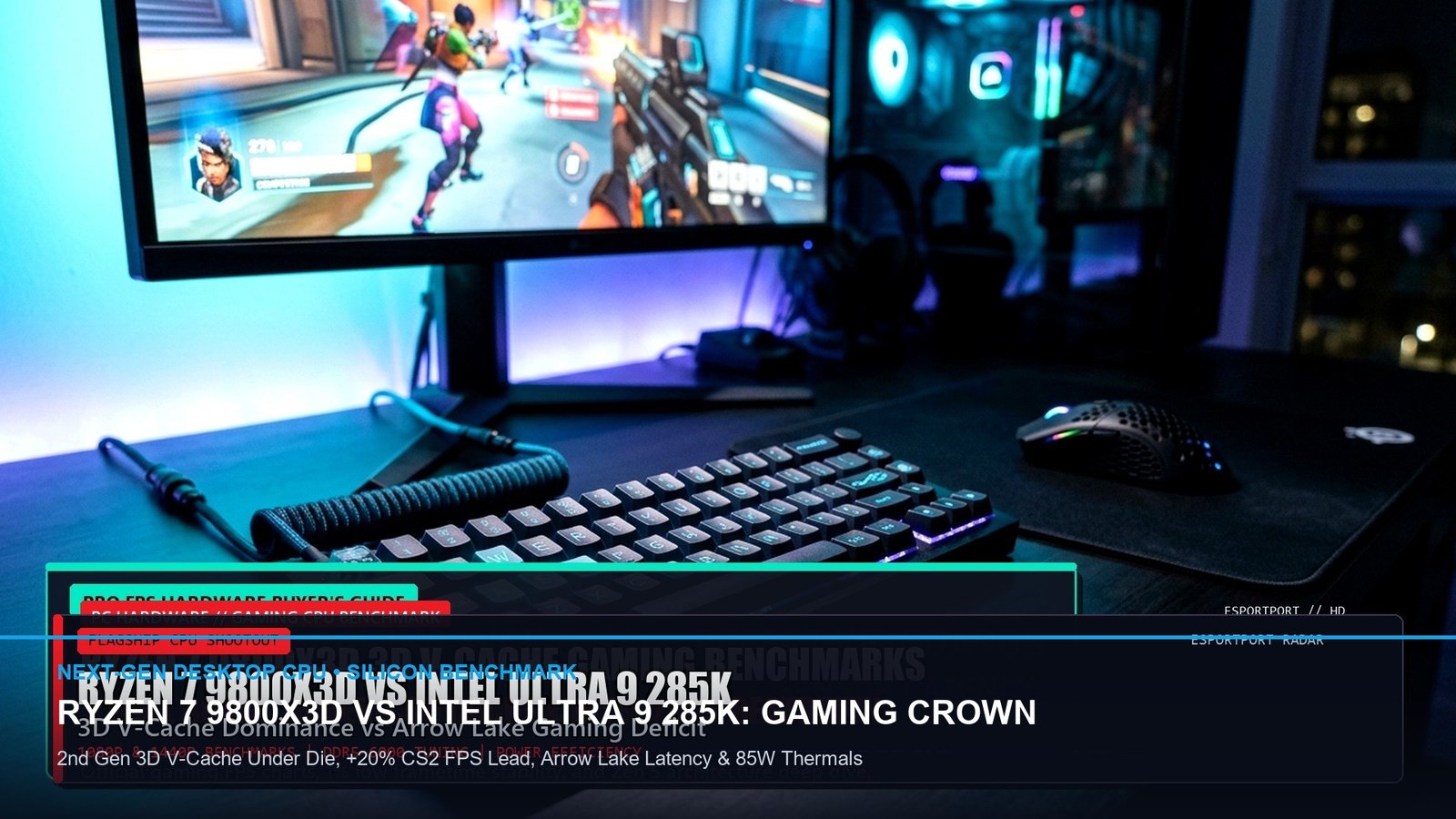
2nd Gen 3D V-Cache Below Die
CS2 & Black Ops 6 Benchmarks
Impressive Efficiency vs 14900K
Multi-Die Communication Overhead
🇺🇸 Intel Core Ultra 285K: Live at Retail ($589 MSRP)
🇺🇸 AMD Ryzen 7 9800X3D: Launching Nov 7 ($479 MSRP)
🇪🇺 CET: Pre-Orders Active
🇮🇳 IST: ₹48,999 Est.
🇯🇵 JST: Available Nov 7
The Next-Gen Desktop CPU Battlefield Decided
The PC hardware industry has entered a monumental transition point. Intel has officially launched its brand new desktop architecture—the Core Ultra 200S “Arrow Lake” series, spearheaded by the Core Ultra 9 285K. By ditching Hyper-Threading and transitioning to a modular TSMC N3B tile-based package, Intel achieved remarkable reductions in power consumption and thermal heat. However, for hardcore esports competitors and gamers, AMD has counterpunched with the imminent release of the Ryzen 7 9800X3D.
Following our popular coverage in AMD Ryzen 7 9800X3D Launch Details and our PC Gaming Optimization Masterclass, this technical head-to-head compares gaming framerates, 1% low frame consistency, memory latency, and thermal efficiency between both silicon flagships.
2nd Gen 3D V-Cache: Why the 9800X3D Sweeps Gaming
The architectural breakthrough of the Ryzen 7 9800X3D lies in how AMD stacked its 64MB 3D V-Cache. On older processors (like the 7800X3D and 5800X3D), the SRAM cache sat directly on top of the CPU cores, acting as an insulating blanket that forced AMD to lock voltage and restrict boost clocks. On the 9800X3D, AMD inverted the physical layout: the 3D V-Cache now sits underneath the core complex die (CCD). This places the Zen 5 computing cores directly against the integrated heat spreader (IHS), allowing all eight cores to boost to a blisteringly fast 5.2 GHz while supporting full manual overclocking and Precision Boost Overdrive 2 (PBO2) curve optimizer tuning.
Intel Arrow Lake’s Latency Dilemma in Competitive Titles
While the Core Ultra 9 285K is an undeniable triumph of multi-threaded productivity and rendering efficiency (matching the 14900K while consuming 80W less electricity), its gaming performance suffers from multi-tile memory latency. By separating the Compute Tile from the Memory/SoC Tile, inter-core communication latency increases to approximately 78 nanoseconds (compared to 58ns on monolithic 14th gen Raptor Lake). In cache-sensitive esports titles like Counter-Strike 2, Valorant, and Call of Duty: Black Ops 6, this latency penalty prevents the 285K from converting its raw IPC gains into higher framerates.
💡 Hardware Buyer Verdict: Gaming vs. Hybrid Productivity
Pure Gaming Build: Buy the Ryzen 7 9800X3D ($479). With 96MB of total L3 cache, full multiplier overclocking, and support on existing AM5 motherboards through 2027+, it is undeniably the fastest, most future-proof gaming processor in the world.
Content Creation & Workstation Build: The Core Ultra 9 285K ($589) is an exceptional choice if you spend 70% of your time in Premiere Pro, Blender, and code compilation, offering cool 250W peak thermals and zero stability issues compared to 14th gen.
Platform Cost, Thermal & Efficiency Comparison
For laptop gamers seeking high-refresh performance on a budget, consult our guide to the Best Gaming Laptops Under ₹85,000 / $1,000.
Related posts:
 Best Gaming Laptops Under ₹85,000 / $1,000 in Late 2026: Lenovo LOQ vs ASUS TUF Gaming A15 vs Acer Nitro V 16 Benchmark
 Google Play Pass vs Apple Arcade November 2026 Lineups: Best Offline Mobile Games & Monthly Subscription Value Audit
 Cloud Gaming in Late 2026: GeForce NOW Ultimate RTX 4080 vs Xbox Cloud Gaming: 240 FPS AV1 Streaming & Latency Audit
 Dragon Age: The Veilguard PC Optimization Guide: Ray Tracing Sliders, Strand Hair Physics & DLSS 3.7 vs FSR 3.1