
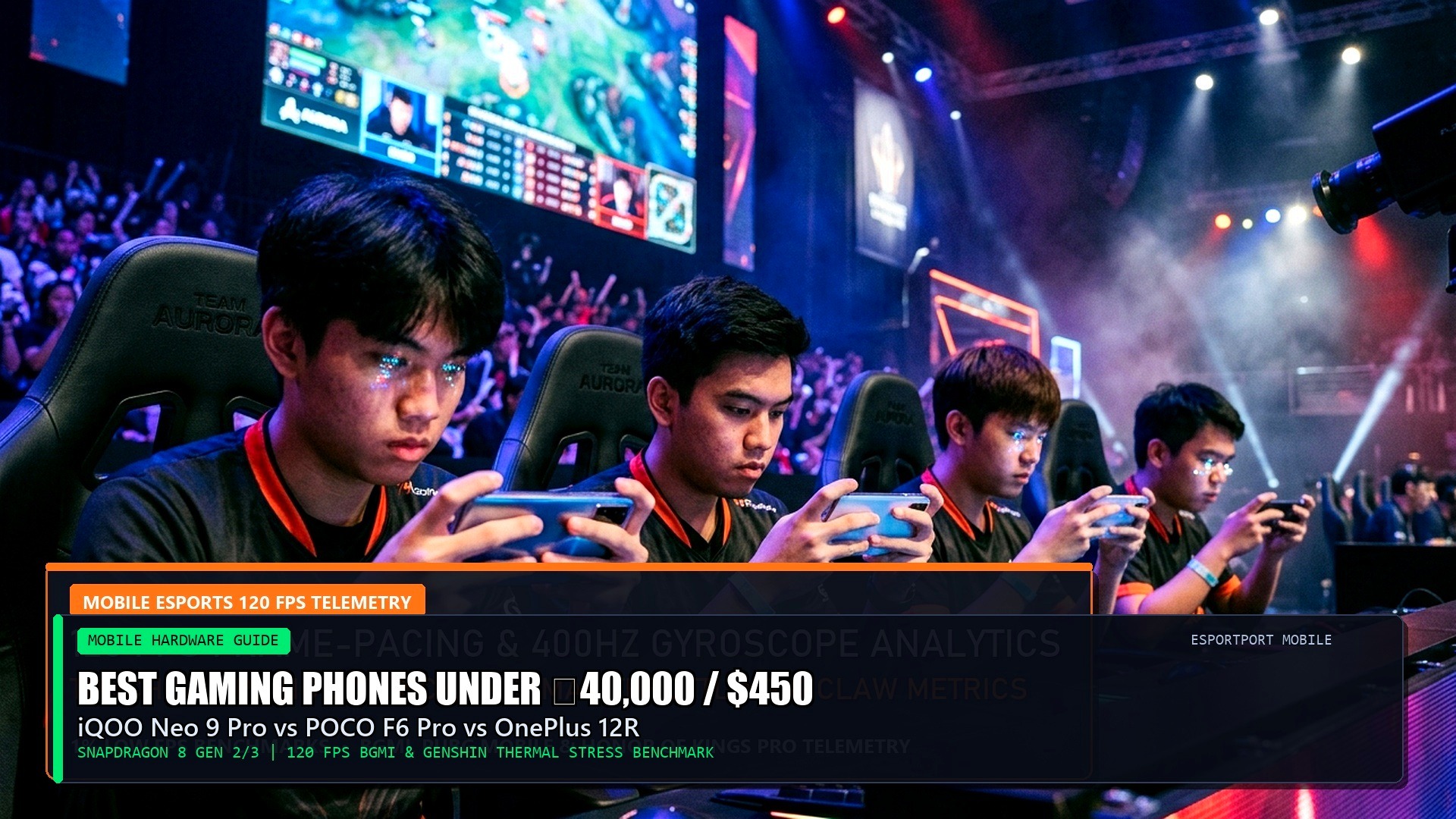
Mobile gaming hardware has reached a historic inflection point in late 2026. The arrival of Qualcomm’s revolutionary Snapdragon 8 Elite (featuring custom Oryon CPU cores) and MediaTek’s Dimensity 9400 (powered by an all-big-core architecture) has bridged the computational gap between portable smartphones and dedicated handheld consoles. With full hardware-accelerated ray tracing, AI-driven neural super-sampling, and sustained 120 FPS to 165 FPS refresh rates in competitive shooters, modern flagship gaming phones deliver astonishing desktop-grade visual fidelity.
Whether you are competing in high-stakes Battlegrounds Mobile India (BGMI) tournaments, climbing the ranked ladders of Call of Duty: Warzone Mobile, or running graphically intensive open-world epics like Genshin Impact and Wuthering Waves, choosing the right silicon and thermal cooling system is critical. Here is our comprehensive performance comparison of the top flagship gaming phones dominating the market in late 2026.
The Silicon Battle: Snapdragon 8 Elite vs. MediaTek Dimensity 9400
At the beating heart of late 2026 gaming flagships are two titan mobile platforms fabricated on TSMC’s second-generation 3nm (N3E) lithography. Both chips abandon legacy efficiency clusters in favor of extreme, high-frequency performance cores:
Qualcomm Snapdragon 8 Elite Architecture
Qualcomm’s Snapdragon 8 Elite features two prime Oryon performance cores clocked at an extraordinary 4.32 GHz, flanked by six performance cores running at 3.53 GHz. Paired with the redesigned Adreno 830 GPU boasting sliced architecture and dedicated command processors, the chip shatters historical mobile benchmarks, surpassing 3.1 million points in AnTuTu v10 while reducing graphics power draw by 40% compared to previous generations.
MediaTek Dimensity 9400 Architecture
MediaTek counters with its second-generation “All Big Core” design, led by a colossal ARM Cortex-X925 prime core operating at 3.62 GHz, three Cortex-X4 cores, and four Cortex-A720 cores. Its flagship Immortalis-G925 GPU introduces 12-core ray-tracing hardware, delivering phenomenal thermal stability during multi-hour gaming sessions with exceptionally smooth frame pacing.
| Device Model | Processor (SoC) | Display & Refresh Rate | Battery & Charging | Special Gaming Hardware |
|---|---|---|---|---|
| Asus ROG Phone 9 Pro | Snapdragon 8 Elite | 6.78″ 185Hz LTPO AMOLED | 5,800 mAh / 65W Bypass | AirTrigger ultrasonic buttons, AniMe Vision LED |
| Nubia RedMagic 10 Pro+ | Snapdragon 8 Elite | 6.85″ 144Hz Under-Display OLED | 7,050 mAh / 100W Fast | Built-in 22,000 RPM internal cooling fan |
| iQOO 13 5G | Snapdragon 8 Elite | 6.82″ 2K 144Hz BOE Q10 | 6,150 mAh / 120W Flash | Supercomputing Chip Q2, 3D Vapor Chamber |
| Xiaomi 15 Pro | Snapdragon 8 Elite | 6.73″ 2K 120Hz LTPO AMOLED | 6,100 mAh / 90W Hyper | Leica Summilux optics, Wing-type cooling pump |
| Vivo X200 Pro | Dimensity 9400 | 6.78″ 1.5K 120Hz Zeiss OLED | 6,000 mAh / 90W Flash | V3+ ISP imaging chip, BlueCrystal thermal matrix |
1. Asus ROG Phone 9 Pro: The Undisputed Tournament Champion
Asus continues its reign over dedicated mobile gaming hardware with the ROG Phone 9 Pro. Engineered specifically for competitive esports athletes, the device pairs the Snapdragon 8 Elite with an industry-first 185Hz LTPO AMOLED display capable of 2,500 nits peak outdoor brightness. Touch sampling reaches an ultra-responsive 720Hz, delivering sub-millisecond input registration during critical sniper flicks and tap-firing exchanges.
The ROG Phone 9 Pro retains Asus’s signature AirTrigger ultrasonic capacitive shoulder buttons, allowing players to map four-finger claw controls directly to the frame without cluttering the screen with digital on-screen buttons. Furthermore, Asus’s GameFX dual front-facing stereo speakers feature Dirac Virtuo spatial audio, enabling pinpoint acoustic positioning of enemy footsteps in Warzone Mobile and Free Fire MAX.
2. Nubia RedMagic 10 Pro+: Extreme Active Cooling & Battery Giant
If pure, sustained performance without thermal throttling is your primary objective, the Nubia RedMagic 10 Pro+ stands in a league of its own. Unlike conventional smartphones that rely strictly on passive copper heat pipes, RedMagic integrates an active, waterproof 22,000 RPM turbofan alongside an oversized 3D ice-step vapor chamber. This active cooling assembly keeps the Snapdragon 8 Elite’s Oryon cores operating at peak boost clocks even after two consecutive hours of un-capped gaming.


The RedMagic 10 Pro+ also eliminates camera notches entirely, utilizing an under-display 16MP front camera beneath a seamless 6.85-inch 1.5K OLED panel with razor-thin 1.25mm bezels. Backed by a massive 7,050 mAh silicon-carbon anode battery, you can easily sustain six to seven continuous hours of intense Battle Royale gaming on a single charge.
3. iQOO 13: The Value Flagship Esports Contender
For gamers seeking flagship performance without paying specialized luxury gaming phone premiums, the iQOO 13 offers unmatched value. Featuring the Snapdragon 8 Elite alongside vivo’s custom Q2 gaming co-processor, the iQOO 13 uses onboard neural frame interpolation to upscale native 60 FPS mobile games up to a fluid 144 FPS with minimal latency overhead.
The device sports a gorgeous 6.82-inch 2K 144Hz BOE Q10 display with 2592Hz high-frequency PWM dimming to prevent eye strain during late-night competitive scrims. Supported by a dual-cell 6,150 mAh battery and 120W FlashCharge, the iQOO 13 recharges from 1% to 100% in just 26 minutes.
Essential Features to Look for in a Modern Gaming Phone
When selecting your next gaming device, prioritize these critical hardware capabilities over raw megapixel camera counts:


- Charge Bypass (Direct Motherboard Powering): Premium gaming phones include charge bypass functionality. When plugged in during gaming sessions, current flows directly to the internal circuitry rather than through the battery cell, preventing battery degradation and reducing internal thermal heat generation by up to 8°C.
- Touch Sampling Rate (720Hz+): While display refresh rates govern visual fluidity (120Hz–185Hz), the touch sampling rate determines how fast the screen registers your finger inputs. Higher rates ensure instantaneous response during close-quarters duels.
- Silicon-Carbon Battery Chemistry: Late 2026 flagships have transitioned to high-density silicon-carbon batteries, packing 6,000 mAh to 7,000 mAh capacities into ultra-slim chassis profiles without adding uncomfortable weight.
Software Game Optimizers & Frame Interpolation Telemetry
Modern mobile gaming performance is as much about software optimization as raw hardware horsepower. Both Asus and nubia feature proprietary gaming overlay engines—Asus Armoury Crate and RedMagic Game Space—that allow fine-grained customization of individual CPU and GPU performance profiles. Within these suites, gamers can manually configure thermal throttling thresholds, lock target frame rates to 60, 90, 120, or 144 FPS, adjust anisotropic filtering filters, and override display refresh rates on a per-game basis.
Furthermore, chipmakers have integrated neural motion estimation and motion compensation (MEMC) algorithms directly into the silicon display processing units. In graphically taxing titles like Genshin Impact and Honkai: Star Rail, the device natively renders gameplay at an energy-efficient 60 FPS while the onboard display coprocessor calculates and inserts intermediate frames, delivering a perceived 120 FPS visual experience without incurring heavy battery drain or thermal runaway penalties.
Frequently Asked Questions (FAQ)
Is the Snapdragon 8 Elite better than the Dimensity 9400 for mobile gaming?
Both chipsets deliver extraordinary top-tier performance, but the Snapdragon 8 Elite holds a slight 8% to 12% advantage in peak GPU gaming performance and emulation thanks to Qualcomm’s Adreno 830 architecture and broader developer optimization. The Dimensity 9400 excels in thermal efficiency and sustained multi-core battery endurance.
Can mobile gaming phones play PC and console games?
Yes. Powered by desktop-class 3nm architectures and hardware ray tracing, flagships running the Snapdragon 8 Elite and Dimensity 9400 natively run console titles like Assassin’s Creed Mirage, Resident Evil 4 Remake, and Death Stranding, as well as high-performance PC emulation layers via specialized Android runtimes.
Does using an external cooling fan really improve mobile gaming FPS?
Yes. High-performance smartphones inevitably throttle CPU and GPU frequencies when internal temperatures exceed 44°C to protect components. Attaching an active semiconductor Peltier cooling fan (like the AeroActive Cooler or Black Shark MagCooler) lowers surface temperatures by 10°C to 15°C, ensuring permanent 120 FPS frame rate stability.
What is bypass charging and why does it matter for gamers?
Bypass charging directs electrical power straight from the charging cable to the phone’s processor and display, completely bypassing the lithium battery. This eliminates the intense heat generated by traditional chemical battery charging, keeping the phone cool and preventing thermal throttling during extended gameplay sessions.
Related posts:
 Pro Mobile Gaming Hacks: How to Unlock 120 FPS on Budget Android & iOS Devices (Safe Guide)
 Rapid Trigger Hall-Effect Keyboard Tuning & 8000Hz Polling Rate Hacks: Eliminate Input Latency in Competitive FPS
 Brawl Stars World Finals 2026 Tournament Meta: Hypercharge Tier List, Draft Bans & Best Team Compositions
 Call of Duty: Mobile Season 10 (7th Anniversary) Drops Verdansk & Gulag as Poison Ivy GIZY Wins Manila GBRC Title
