
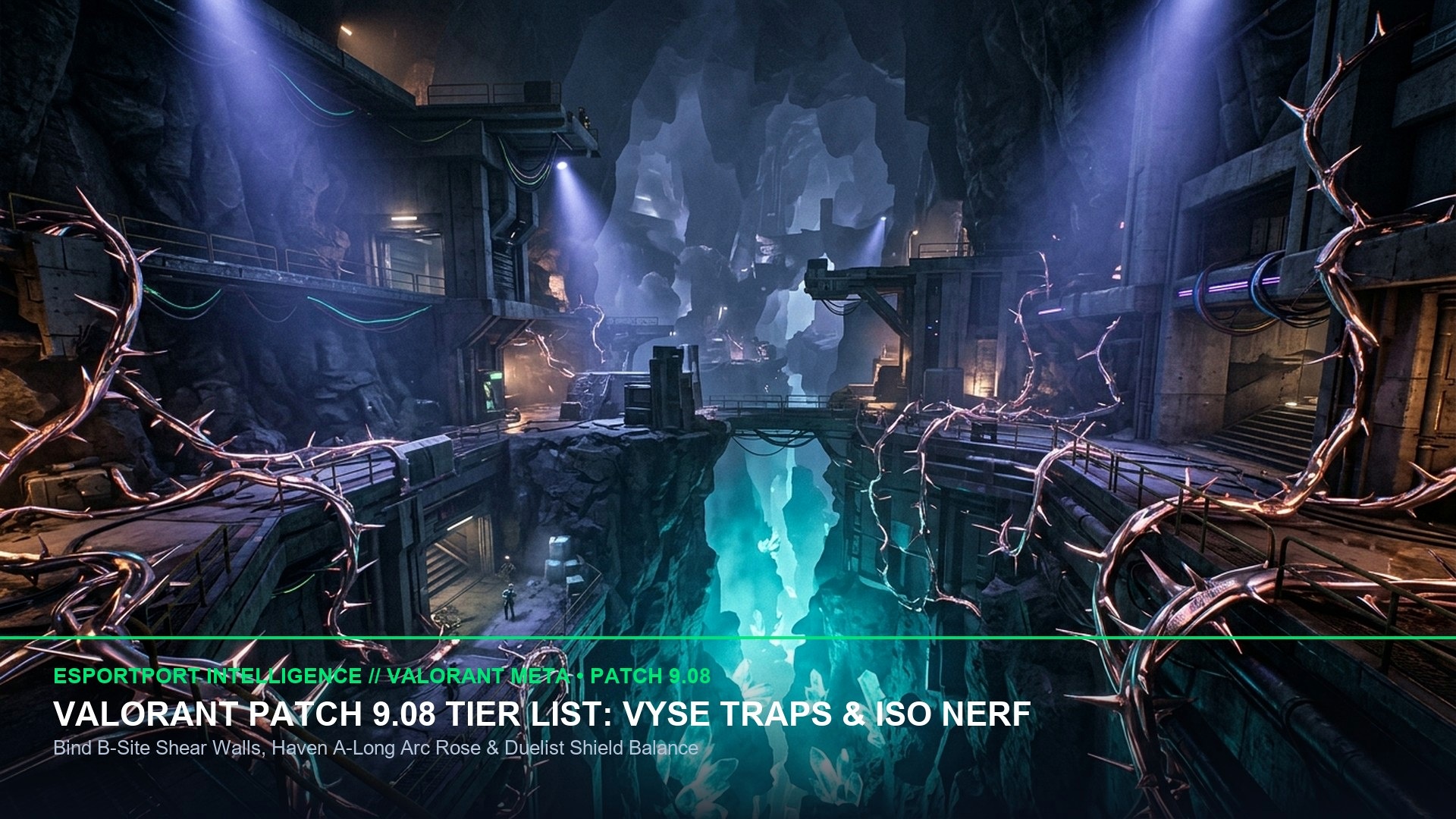
Riot Games has officially deployed Valorant Patch 9.10, delivering one of the most consequential competitive meta shakeups of the 2026 season. Headlined by significant utility nerfs to dominant sentinel Cypher, substantial buffs to metallic trapper Vyse, and extensive geometric redesigns across the contested Sunset map, Patch 9.10 directly addresses community complaints regarding passive trap-stalling and uncounterable defensive setups. Expanding upon our competitive fundamentals guide in common esports mistakes and crosshair discipline, analyzing the updated agent balance notes reveals how tactical execs and site retakes will evolve across both VCT pro play and ranked queues.
For months, sentinel agent Cypher has maintained an oppressive stranglehold on competitive team compositions. His ability to anchor entire bomb sites with unbreakable Trapwires and remote Spycams effectively shut down fast offensive pushes on maps like Sunset and Ascent, forcing attacking teams into tedious utility-clearing routines. With Patch 9.10 dialing back Cypher’s stall potential while elevating Vyse’s flash-and-isolate toolkit, the competitive sentinel hierarchy is undergoing a radical realignment.


Cypher Trapwire Adjustments: Reintroducing Counterplay
The core change in Patch 9.10 targets Cypher’s signature Trapwire. Previously, an enemy caught in a wire was immediately tethered and concussed if they failed to shoot the device within a razor-thin window, while the wire automatically re-armed after a short delay. In Patch 9.10, Riot has extended the initial concuss wind-up timer by 0.5 seconds, giving trapped attackers a fair opportunity to destroy the device before experiencing movement impairment.
Furthermore, the automatic re-arm mechanic has been completely removed. Once an enemy triggers a Trapwire, the wire is permanently expended regardless of whether the trapped player is eliminated. This fundamental adjustment prevents Cypher from passively locking down flank routes for thirty consecutive seconds with a single utility piece, forcing defensive players to take active gunfights rather than relying entirely on automated gadgetry.
| Agent / Map Element | Patch 9.10 Modification | Previous Value / Status | New Patch 9.10 Value | Competitive Tactical Impact |
|---|---|---|---|---|
| Cypher (Trapwire) | Concuss Delay Timer | 1.5 Seconds to Concuss | 2.0 Seconds (Increased Window) | Allows attackers time to destroy wire before stun |
| Cypher (Trapwire) | Automatic Re-Arming | Re-arms after 1.5 seconds | Completely Removed (Expended) | Eliminates infinite flank stall on B-site defense |
| Vyse (Arc Rose) | Blind Flash Duration | 1.4 Seconds Flash Duration | 1.8 Seconds Flash Duration | Provides reliable entry isolation during executes |
| Vyse (Shear Wall) | Deployment Placement Range | 8 Meters Maximum Range | 12 Meters Maximum Range | Allows deeper off-site post-plant stall positioning |
| Sunset (B-Main Chokepoint) | Pillar Geometry & Cover Box | Narrow doorway with deep corner | Widened doorway with removed cubby | Prevents uncheck-able close-range shotgun traps |
Vyse Upgrades: Elevating the Metallic Sentinel Meta
To compensate for Cypher’s reduced dominance, Riot has injected substantial utility power into their newest sentinel, Vyse. Vyse’s signature flash, Arc Rose, receives an extended blind duration from 1.4 seconds up to 1.8 seconds, ensuring that blinded defenders cannot simply hold down mouse buttons with high-damage sidearms to deter pushes.
Additionally, Vyse’s Shear Wall deployment range has been increased by 50%, allowing her to cast isolation barriers from safer, deeper positions. When attackers commit to a bomb site, Vyse can now deploy the wall behind the entry fragger from across the site, severing attacking trade lines and allowing her teammates to secure easy 1v1 conversion duels.
Sunset Map Geometry Overhaul: Rebalancing B-Site Defense
Beyond individual agent kits, Patch 9.10 introduces crucial structural changes to the Sunset map layout. The B-Main entrance—previously notorious for creating impenetrable Cypher trap setups and close-range Judge shotgun ambushes—has been widened significantly. Riot removed the oppressive deep cubby box inside B-Main, allowing attacking teams to slice angles cleanly without being forced to expend three pieces of clearing utility just to step onto the site.
In mid-courtyard, additional architectural cover has been added along the courtyard corridor, giving attacking squads safe sightlines to contest defensive Operator snipers without exposing themselves to simultaneous crossfires from B-Bob and Market.
Pro Esports Meta Analysis: VCT Masters Bangkok Team Compositions
As the international Valorant Champions Tour (VCT) circuit prepares for Masters Bangkok, professional coaching staffs are intensely analyzing Patch 9.10’s impact on team compositions. On Sunset and Ascent, where double-sentinel setups previously dominated, teams are experimenting with hybrid compositions pairing Vyse’s flash isolation with aggressive initiator recon from Sova or Fade.
Professional entry fraggers like Aspas and Derke will benefit immensely from Cypher’s delayed wire concuss timers, allowing explosive duelists like Jett and Raze to dash onto bomb sites and clear defensive anchors before crowd control effects take hold.
Sentinel Role Evolution: Moving Away from Passive Anchoring
Patch 9.10 marks a broader philosophical evolution in Riot’s design for the Sentinel class. Rather than encouraging players to set up automated gadgets and hide in safe corners, modern sentinels must actively engage in gunfights and trade frags alongside their teammates. Mastering dynamic wall placements and coordinated flash timings transforms sentinels from static defense posts into versatile playmakers.

Sunset B-Site Execute Strategies Without Cypher Stall
With Cypher’s Trapwires no longer automatically re-arming, attacking strategies on Sunset have evolved from slow default clearing into explosive site hits. Attacking teams now utilize double-initiator utility sets—such as Sova recon darts combined with Breach flashpoints—to overwhelm B-site defenders before defensive utility can be deployed.
By coordinating smokes across Market and CT spawn, attacking squads can isolate the site anchor and secure rapid Spike plants, forcing defenders into difficult retakes against fortified post-plant positions.
Post-Plant Defense: Vyse Shear Wall Isolations and Flash Timings
On defense, Vyse has emerged as the definitive post-plant disrupter. Her extended Shear Wall range allows her to place barriers across defusal chokepoints, cutting off retaking defenders from their teammates. By flashing with Arc Rose through the metal wall just as enemies attempt to defuse the Spike, Vyse players can blind defusers through cover, stalling the defusal clock and sealing crucial round victories.
Beyond sentinel balance, Patch 9.10 incorporates critical quality-of-life improvements to ranked match pacing and competitive integrity. Riot’s Vanguard anti-cheat engine receives updated kernel-level heuristic detections targeting subtle hardware mouse macros and triggerbot software, ensuring ranked leaderboards reflect genuine player skill.
Additionally, visual clarity during chaotic ability executes has been prioritized: smoke edges and flash detonation particles have been adjusted to prevent visual clutter, allowing players to track moving character outlines cleanly through clearing utility clouds. Aspiring Radiant players must adapt their team compositions swiftly to thrive under the updated meta.
Riot’s map design team has also emphasized that post-plant crossfire setups on Sunset will undergo ongoing telemetry audits throughout the upcoming patch cycle. By monitoring defensive win rates across competitive ranked brackets and international VCT scrimmages, developers aim to maintain an equitable 50-50 round balance between attacking executes and defensive site retakes.
Adapting your hero pool and understanding utility cooldown pacing will be the decisive factor in climbing competitive ranked tiers throughout the Patch 9.10 competitive season.


Staying proactive with loadout customization and monitoring developer patch telemetry ensures your tactical preparation remains ahead of shifting competitive metas.
Mastering spatial awareness, audio cues, and strategic resource conservation forms the foundation of consistent tournament-level success.
Coordinated team utility clearing and disciplined crosshair placement will triumph over isolated solo plays in high-elo ranked matches.
Frequently Asked Questions
What happened to Cypher’s Trapwire in Valorant Patch 9.10?
Cypher’s Trapwire concuss timer was increased by 0.5 seconds to give trapped enemies more time to shoot it, and the automatic re-arming mechanic was permanently removed.
What buffs did Vyse receive in Patch 9.10?
Vyse’s Arc Rose flash duration was increased to 1.8 seconds, and her Shear Wall placement range was increased from 8 meters to 12 meters, allowing deeper defensive setups.
How was the Sunset map changed in Patch 9.10?
The B-Main entrance on Sunset was widened, the deep shotgun cubby was removed, and additional cover was added in Mid to balance attacking site entries.
Is Cypher still viable in competitive Valorant?
Yes, Cypher remains a premier sentinel for global camera information, but teams must now actively support his sites rather than relying on automated trap re-arms.
Related posts:
 Fortnite FNCS Global Championship 2026 Finals Points Table: Winner Payouts, Siphon Meta & Final Game 12 Recap
 LoL Worlds 2026 Knockout Stage Schedule & Swiss Final Scorecard: Dplus KIA vs BLG, Karmine Corp vs T1, Gen.G vs LYON & Bo5 Fearless Draft Guide
 CS2 Shanghai Major 2026 Elimination Stage Highlights: FaZe, Spirit & MongolZ Bracket Standings
 Competitive Gaming Common Mistakes: Crosshair Placement, Tilt Management & Minimap Awareness
