
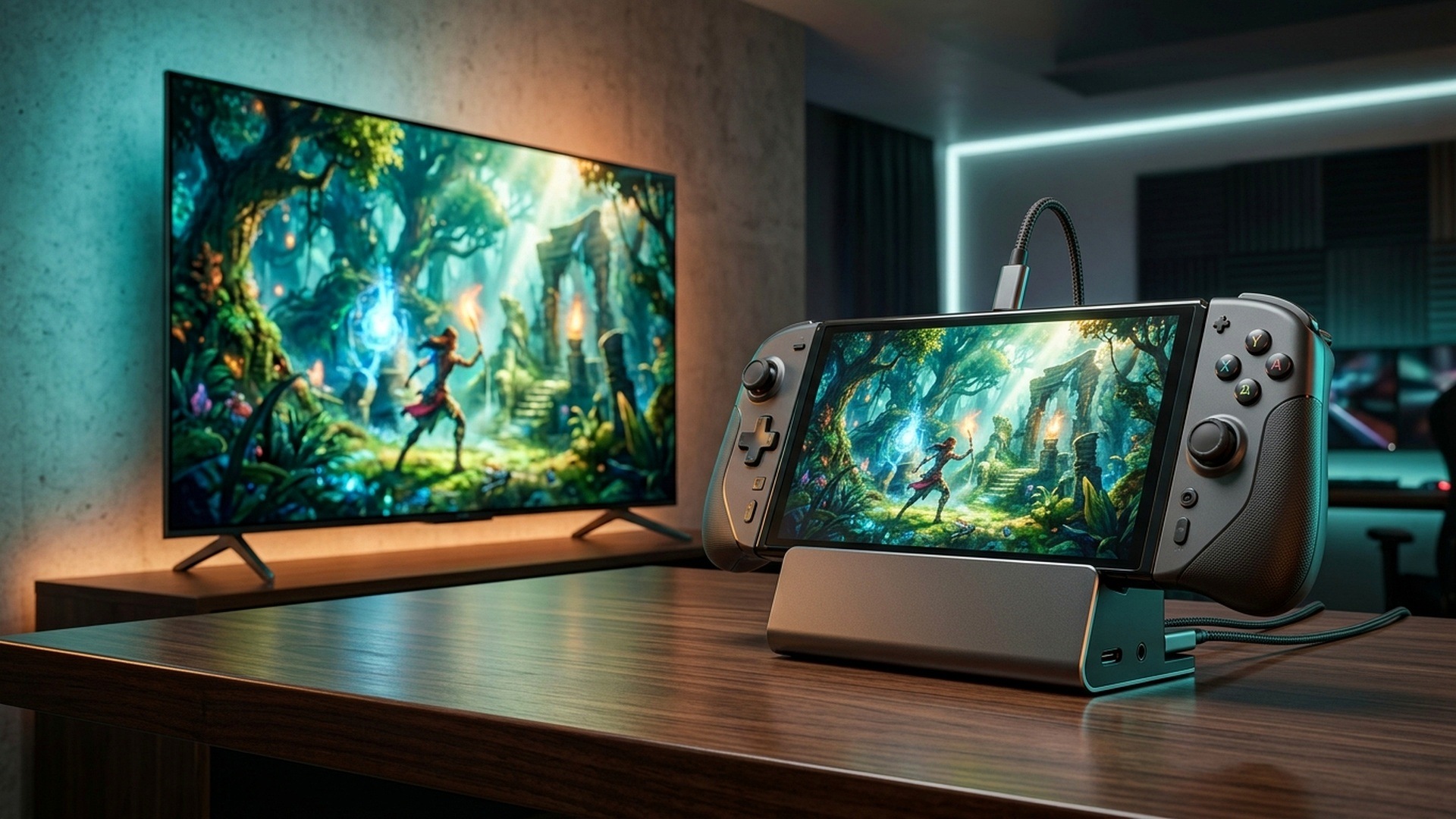
The gaming hardware landscape is vibrating with anticipation as fresh supply chain disclosures and component manifests from Taiwan and Japan reveal comprehensive technical specifications for Nintendo’s next-generation hybrid console, widely referred to as the Nintendo Switch 2. Anchored by a bespoke, custom-designed Nvidia Tegra T239 processor, 12GB of high-speed LPDDR5X RAM, and hardware-accelerated DLSS upscaling, the successor to the monumentally successful original Switch represents a seismic technological leap. Expanding upon our hardware analysis of next-gen esports displays and mobile processors, examining Nintendo’s silicon architecture, confirmed backward compatibility frameworks, and launch-window software lineup demonstrates how Kyoto plans to dominate the handheld market throughout the late 2020s.
For over seven years, the original Nintendo Switch defied hardware power conventions through unmatched first-party software execution. However, as modern open-world gaming engines demand advanced shader throughput and higher memory footprints—exemplified by generational leaps in titles like GTA 6 console architectures—a hardware refresh has become mandatory. With Nintendo officially confirming that an announcement will occur before the conclusion of the current fiscal year, dissecting the leaked motherboard schematics, custom Nvidia silicon, and backward compatibility protocols provides enthusiasts with a definitive technical roadmap.

The Custom Nvidia Silicon: Tegra T239 ‘Drake’ Architecture
At the beating heart of the Switch 2 lies a customized System-on-Chip (SoC) codenamed T239, developed in close multi-year partnership with Nvidia. Manufactured on an advanced Samsung 8nm/5nm fabrication node, the processor features an eight-core ARM Cortex-A78C CPU cluster paired with an Nvidia Ampere-generation GPU comprising 1,536 CUDA cores. This architectural configuration grants the Switch 2 nearly ten times the raw compute throughput of the aging Tegra X1 processor found in the 2017 original.
Crucially, the Ampere GPU integration unlocks hardware features previously unimaginable on a dedicated handheld. The inclusion of dedicated Tensor Cores enables Deep Learning Super Sampling (DLSS 3.1) and Deep Learning Anti-Aliasing (DLAA). In docked television mode, the console can render games internally at 1080p and utilize AI temporal reconstruction to output crisp, artifact-free 4K imagery to modern living-room displays, while docked power consumption remains comfortably under 30 Watts.
| Hardware Specification | Original Nintendo Switch (2017) | Nintendo Switch 2 (2026/2027) | Generational Multiplier | Gameplay & Performance Impact |
|---|---|---|---|---|
| System Processor (SoC) | Nvidia Tegra X1 (Maxwell 20nm) | Custom Nvidia Tegra T239 (Ampere 8nm) | ~8x – 10x Compute Leap | Enables modern multi-platform AAA ports |
| CPU Architecture | 4x ARM Cortex-A57 @ 1.02 GHz | 8x ARM Cortex-A78C @ ~1.6 – 2.0 GHz | 4x Multi-Threaded Power | Eliminates CPU physics & AI bottlenecking |
| GPU CUDA Cores | 256 Maxwell Cores @ ~768 MHz | 1,536 Ampere Cores @ ~1.0 GHz | 6x Rasterization Throughput | Supports hardware ray tracing & mesh shaders |
| System Memory (RAM) | 4GB LPDDR4 (25.6 GB/s) | 12GB LPDDR5X (102 GB/s) | 3x Capacity / 4x Bandwidth | Allows massive open-world texture streaming |
| Internal Storage | 32GB / 64GB eMMC 5.1 | 256GB / 512GB UFS 3.1 Storage | 8x Capacity / 10x Speed | Near-instant loading & fast travel transitions |
| Handheld Display Panel | 6.2″ / 7.0″ 720p 60Hz LCD/OLED | 8.0″ 1080p 120Hz VRR LCD Screen | Full HD + VRR Smoothness | Eliminates screen tearing and judder |
Seamless Backward Compatibility and Software Library Preservation
For Nintendo’s executive leadership, the single most critical strategic directive for the Switch 2 is the total preservation of the 140-million-unit user base through comprehensive backward compatibility. Official statements from Nintendo President Shuntaro Furukawa have reaffirmed that the existing Nintendo Account ecosystem will transition seamlessly to the next-generation platform, allowing digital libraries, cloud save states, and friend lists to carry over without friction.
Furthermore, developer leaks confirm that the Switch 2 features physical backward compatibility via an updated dual-cartridge slot architecture, accepting legacy Switch game cards alongside higher-density next-gen cartridges. Thanks to the massive memory bandwidth and CPU upgrades, legacy masterpieces—including The Legend of Zelda: Tears of the Kingdom, Pokémon Scarlet and Violet, and Metroid Prime 4—will reportedly receive enhanced performance patches, unlocking locked 60 FPS frame rates and elevated 1080p handheld rendering without dynamic resolution scaling drops.
Thermal Engineering, Battery Life, and Magnetic Joy-Con Redesign
Maintaining a comfortable handheld thermal profile while managing an 8-inch screen and 12GB of RAM requires sophisticated thermal engineering. Supply chain leaks indicate that Nintendo has implemented a dual-heatpipe cooling solution with a high-efficiency ultra-thin centrifugal blower fan, expelling warm air through enlarged top vents. Operating in handheld mode, the SoC throttles power draw down to 10–12 Watts, ensuring battery longevity remains in the healthy 3.5 to 6.5 hour range depending on graphical load.
Additionally, the controversial sliding rail mechanism of the original Joy-Cons has been completely replaced with a robust magnetic attachment locking system. The redesigned Joy-Con 2 controllers snap securely onto the chassis using electromagnetic clamps, eliminating the physical rail wobble and wear-and-tear of previous models. The analog thumbsticks have also been upgraded to magnetic Hall Effect sensors, permanently banishing analog stick drift to the history books.
Projected Release Window and First-Party Software Pipeline
While component manufacturing is actively ramping across partner factories in Vietnam and China, industry analysts project an official commercial launch in spring 2027. Nintendo is deliberately accumulating massive retail inventory—targeting over ten million units available during the launch quarter—to completely neutralize scalping networks and satisfy global consumer demand.

The software launch lineup is anticipated to be the strongest in Nintendo history. Anchored by an all-new 3D Super Mario adventure developed by the Super Mario Odyssey team, alongside expanded third-party support from Square Enix, Capcom, and Ubisoft, the Switch 2 is primed to bridge the divide between handheld flexibility and living-room visual spectacle.
Cartridge Storage Technology and Digital Game Downloads
To accommodate the massive asset footprints of next-generation titles without subjecting consumers to mandatory massive day-one downloads, Nintendo is adopting high-density 64GB and 128GB flash memory cartridges for Switch 2 software. Developed in partnership with Macronix, these advanced game cards boast read speeds comparable to standard solid-state drives, eliminating prolonged texture loading pauses.
Furthermore, internal storage has been upgraded to 256GB of high-speed UFS 3.1 storage out of the box, with support for micro-SD Express memory cards. This enables rapid digital library downloads and seamless background updating, ensuring players can jump directly into their favorite adventures without storage management friction.
Operating System and Social Hub Integration
The system software of the Switch 2 introduces a completely modernized user interface. Retaining the lightning-fast responsiveness of the original Switch OS, the new dashboard integrates dynamic game activity cards, integrated party voice chat, and system-level Discord integration, allowing seamless communication with friends across PC and console ecosystems.
Display Battery Governance and Handheld Power Efficiency
Balancing an 8-inch Full HD display with advanced silicon compute demands intelligent power management. Nintendo has engineered custom firmware that dynamically modulates screen refresh rate between 40Hz, 60Hz, and 120Hz based on in-game activity. During static dialogue sequences, the refresh rate drops to conserve battery, ramping up to 120Hz during fast-paced platforming and racing encounters.
This adaptive display governance ensures players enjoy ultra-fluid visuals while preserving over four hours of battery life during intensive gaming sessions.
The transition to custom Nvidia Ampere silicon cements Nintendo’s technological longevity, ensuring that the Switch 2 remains a versatile, cutting-edge hybrid gaming platform throughout the upcoming decade.
Frequently Asked Questions
Will original Nintendo Switch games play on Switch 2?
Yes, Nintendo has confirmed that the Switch 2 features comprehensive backward compatibility for both digital library downloads and physical game cards, with select titles receiving performance upgrades.
What processor does the Nintendo Switch 2 use?
The Switch 2 is powered by a custom Nvidia Tegra T239 processor built on Ampere architecture, featuring 8 CPU cores, 1,536 CUDA GPU cores, and dedicated DLSS AI tensor cores.
Will the Switch 2 support 4K resolution?
Yes, in docked mode, the Switch 2 utilizes Nvidia DLSS AI upscaling to reconstruct 1080p internal resolutions up to crisp 4K output on modern televisions.
Does the Switch 2 fix Joy-Con stick drift?
Supply chain manifests indicate the redesigned Joy-Con 2 controllers incorporate magnetic Hall Effect thumbsticks, which eliminate physical sensor friction and permanently solve stick drift.
Related posts:
 Pro Gaming Hardware Upgrades: Best OLED 240Hz Monitors, Rapid Trigger Keyboards & Mouse DPI Settings
 Jensen Huang Reinstated as Nvidia CEO: Board Reversal, Trump Intervention & AI Stocks Surge
 Competitive Gaming Common Mistakes: Crosshair Placement, Tilt Management & Minimap Awareness
 EA Sports FC 25 Ultimate Team Tuesday Market Crash & SBC Solutions: Black Friday Pre-Crash Trading Tips
