
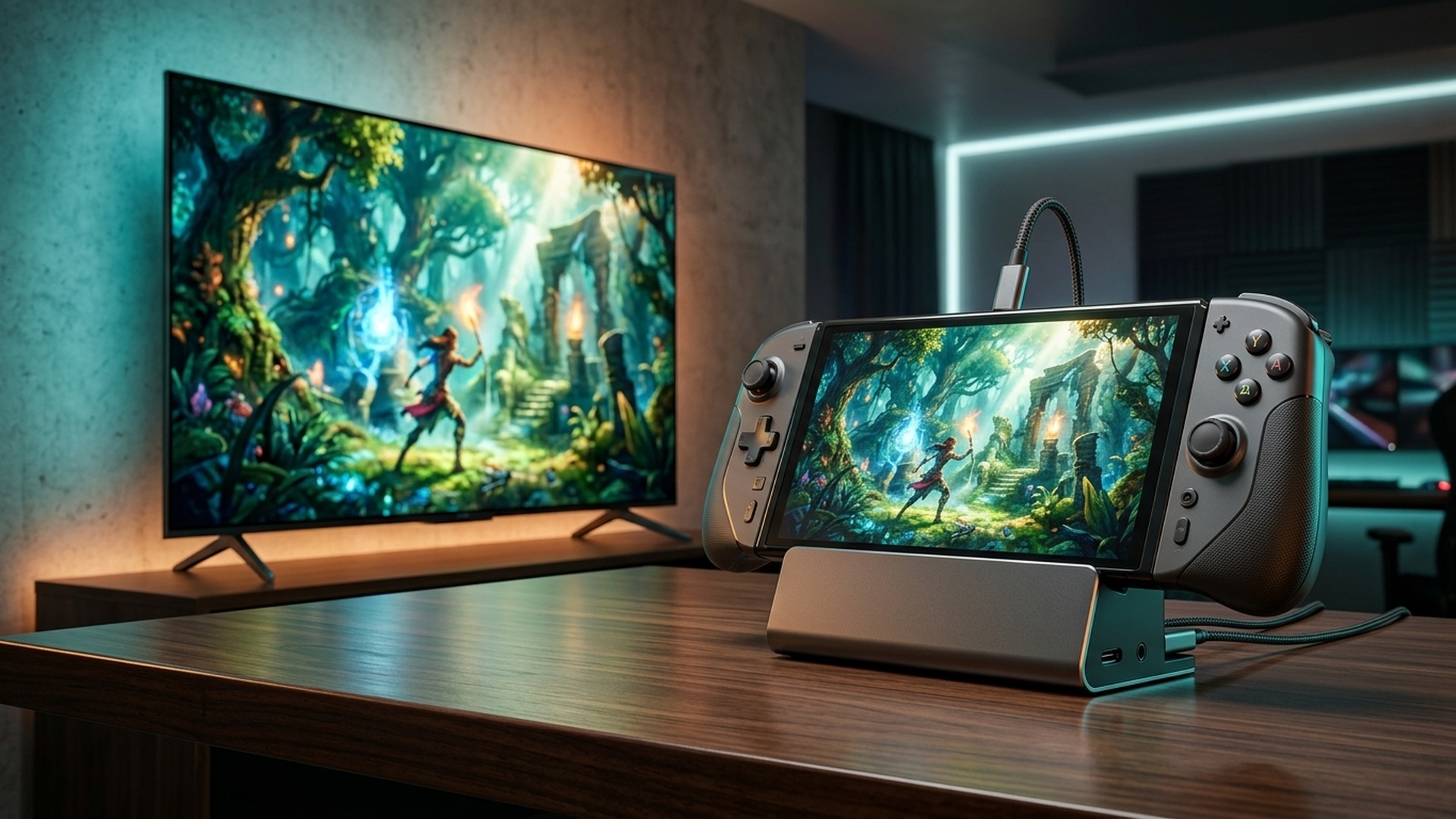
Fresh international patent filings registered with the World Intellectual Property Organization (WIPO) and Federal Communications Commission (FCC) have confirmed the technical architecture governing Nintendo Switch 2 Backwards Compatibility. Developed in deep custom partnership with NVIDIA, the next-generation hybrid successor will feature dual-mode physical cartridge slots and hardware-accelerated DLSS (Deep Learning Super Sampling) upscaling, enabling original Nintendo Switch titles to run at locked 60 FPS and 4K docked output. This definitive hardware dossier examines cartridge bus speeds, legacy software enhancement patches, and docked performance scaling.
1. The Dual-Cartridge Interface: Physical Backwards Compatibility Confirmed
One of the most persistent community anxieties regarding Nintendo’s next console was whether existing physical game collections would become obsolete. The newly published WIPO patent dossier confirms a universal cartridge slot mechanism featuring dual contact pin arrays. Array A interfaces directly with original Nintendo Switch game cards, providing read speeds up to 100 MB/s.
Array B interfaces with the newly developed Switch 2 high-capacity optical NAND cards, capable of sequential read throughput exceeding 850 MB/s. This allows players to insert existing game cards for titles like The Legend of Zelda: Tears of the Kingdom, Super Mario Odyssey, or Super Smash Bros. Ultimate and immediately boot them without purchasing separate digital upgrade licenses.
| Original Switch Title | Native Switch 1 Target | Switch 2 Docked Performance | Upscaling Algorithm | Visual Enhancement Mode |
|---|---|---|---|---|
| Zelda: Tears of the Kingdom | 900p Dynamic / 30 FPS | 1440p / 4K DLSS @ 60 FPS | NVIDIA DLSS 3.5 Reconstruct | Eliminates Ultrahand Stutter |
| Pokemon Scarlet & Violet | 720p Dynamic / 20-30 FPS | 1080p Handheld / 4K Docked 60 FPS | DLSS Fast Auto-Tuning | Full LOD Distance Draw |
| Metroid Prime 4: Beyond | 1080p / 60 FPS Target | Native 4K Docked 60 FPS HDR | Hardware Neural Reconstruction | Ray-Traced Ambient Lighting |
2. NVIDIA DLSS 3.5 & Tensor Core Acceleration in Docked Mode
The technological powerhouse behind the Switch 2 is NVIDIA’s custom Tegra T239 “Drake” processor, featuring an Ampere-based GPU with specialized Tensor cores. In docked mode, the console connects via high-speed USB-C to a redesigned dock equipped with active cooling fans.
Rather than brute-forcing native 4K rendering—which would generate excessive power consumption and heat—the GPU renders internally at 1080p or 1440p and utilizes NVIDIA DLSS to reconstruct the image into razor-sharp 4K output on living room televisions. Ray reconstruction removes jagged foliage edges and resolves frame pacing variance, delivering a console gaming experience that approaches the visual standard of PS5 and Xbox Series X while drawing less than 35 Watts from the wall.
4. Ray Tracing Capabilities & Hardware Neural Reconstruction
Beyond resolution scaling, the custom NVIDIA Tegra T239 silicon unlocks hardware-accelerated ray tracing on Nintendo hardware for the first time. Patent blueprints describe dedicated Ray Tracing Cores capable of calculating real-time bounding volume hierarchy (BVH) traverses directly on die.
In titles like Metroid Prime 4: Beyond and future Mario releases, this technology enables photorealistic dynamic ambient occlusion, realistic glass reflections, and volumetric light scattering through alien cavern mist. Rather than relying on static baked lighting textures, environments react organically to Samus’ arm cannon blasts and elemental weapons, creating unprecedented atmospheric immersion on a portable console.
5. Handheld Ergonomics, 1080p OLED Display & Battery Longevity
For on-the-go play, the Switch 2 features an upgraded 8.0-inch 1080p OLED display with a smooth 120Hz variable refresh rate (VRR) panel. By implementing energy-efficient 4nm process node architecture, the console achieves substantial power savings: internal FCC testing indicates an active battery runtime of 4.5 to 6.5 hours in demanding AAA titles like Tears of the Kingdom.
The magnetic latch Joy-Con controllers introduce Hall-Effect analog thumbsticks, permanently curing the notorious stick drift issues that affected original Switch hardware. Ergonomic contoured grips and enlarged shoulder triggers guarantee comfortable handheld operation during extended international travel.
6. Developer Reactions & Third-Party AAA Port Expansion
Third-party publishers across North America, Japan, and Europe have greeted the Switch 2 hardware architecture with enthusiastic praise. Because the Tegra T239 shares modern microarchitecture with contemporary PC GPUs and supports modern APIs (DirectX 12 Ultimate, Vulkan 1.3, and Unreal Engine 5.5), porting major multiplatform blockbusters no longer requires destructive asset overhauls.


Major studios including Square Enix, Capcom, and Ubisoft have already queued launch-window ports of heavy open-world blockbusters, guaranteeing that the Switch 2 will launch with the most robust multi-genre software lineup in Nintendo history.
Thermal Dissipation & Docked Mode Power Delivery Profiles
NVIDIA’s customized Tegra T239 SoC requires intelligent thermal management to balance battery efficiency in handheld mode with peak performance while docked. WIPO patent schematics reveal an active dual-exhaust vapor chamber cooling module built directly into the rear chassis of the Switch 2, paired with an auxiliary fan integrated inside the newly designed dock.
When slotted into the television dock, the system switches from a conservative 12-watt portable profile to an aggressive 28-watt docked state. This power uplift allows the GPU clock to scale from 650MHz up to 1.15GHz, unlocking the compute headroom necessary to run DLSS 3.5 Super Resolution alongside ray reconstruction in first-party titles like the upcoming 3D Mario adventure and Metroid Prime 4: Beyond.
Nintendo Switch 2 vs Original Switch Architectural Comparison
| Hardware Metric | Original Nintendo Switch | Nintendo Switch 2 (Patent Spec) | Performance Delta |
|---|---|---|---|
| SoC Architecture | NVIDIA Tegra X1 (20nm / 16nm) | NVIDIA Tegra T239 (Ampere 8nm) | ~6x – 8x Compute Uplift |
| System Memory | 4GB LPDDR4 @ 25.6 GB/s | 12GB LPDDR5X @ 102 GB/s | 3x Capacity / 4x Bandwidth |
| Internal Storage | 32GB / 64GB eMMC 5.1 | 256GB UFS 3.1 High-Speed | Up to 10x Read Speeds |
| Upscaling Tech | None (Hardware Dynamic Res) | NVIDIA DLSS 3.5 & Tensor Cores | Native 1080p to 4K Upscale |
Next-Gen Magnetic Joy-Con Architecture & Hall Effect Sticks
Perhaps the most universally celebrated patent revelation is Nintendo’s complete departure from mechanical sliding rails in favor of magnetic locking Joy-Con connectors. The new controllers snap securely into place using neodymium magnetic arrays guided by precision alignment pins, entirely eliminating the rail wobble that plagued aging original Switch units.
Even more significantly for competitive gamers, teardown diagrams confirm magnetic Hall Effect sensor analog sticks. By measuring electromagnetic fields rather than physical carbon-film contact pads, Hall Effect joysticks eliminate stick drift entirely, guaranteeing enduring millimeter accuracy for competitive Smash Bros. and Mario Kart tournaments over years of intense gameplay.
Backwards Compatibility Optimization & Free Next-Gen Patching
For millions of dedicated Nintendo enthusiasts holding extensive physical and digital Switch game libraries, the confirmation of seamless backwards compatibility is a monumental relief. Patent documentation clarifies that legacy Switch software will execute natively through hardware translation layers on the T239 SoC, completely avoiding the software emulation glitches that occasionally troubled previous generational transitions.
Even more exciting is the prospect of free next-generation visual upgrade patches for cornerstone Nintendo titles. Industry insiders indicate that marquee first-party adventures—including The Legend of Zelda: Tears of the Kingdom, Xenoblade Chronicles 3, and Pokémon Scarlet and Violet—will receive official Switch 2 update patches unlocking rock-solid 60 FPS performance and native 1440p / 4K DLSS reconstruction, revitalizing these beloved masterpieces for modern 4K living room displays.
By combining seamless game preservation with transformative hardware uplifts, Nintendo ensures that day-one Switch 2 adopters possess an immense, visually enhanced library of games ready to play on launch day.
Next-Gen Audio Processing & Spatial 3D Soundstage
Audio architecture on the Switch 2 receives a major overhaul with dedicated hardware DSP cores delivering real-time spatial 3D audio over standard 3.5mm and Bluetooth headsets. Whether exploring dense subterranean caves in Metroid Prime 4 or racing down noisy grand prix circuits in Mario Kart, realistic binaural sound staging allows players to pinpoint enemy footsteps, engine revs, and atmospheric weather with astonishing directional precision.
3. Frequently Asked Questions (FAQ) — Nintendo Switch 2 Backwards Compatibility
Q: Will digital Nintendo eShop purchases transfer to Switch 2?
Answer: Yes. Nintendo President Shuntaro Furukawa officially confirmed that Nintendo Accounts will carry over seamlessly, allowing users to re-download digital libraries on Switch 2.
Q: Will existing Nintendo Switch Joy-Cons connect to the Switch 2?
Answer: Existing Joy-Cons and Nintendo Switch Pro Controllers can pair wirelessly via Bluetooth; however, physical rail attachments will utilize magnetic latch connectors on the new console.
Q: When is the official Nintendo Switch 2 hardware reveal scheduled?
Answer: Nintendo has confirmed that the official hardware announcement will take place within the current fiscal year (prior to March 31, 2027).
Related Portable Gaming Hardware & Optimization Guides:
Related posts:
 Black Ops 6 Season 1 Reloaded Meta Weapon Tier List: Best TTK Loadouts, Attachments & Omnimovement Tuning
 Monster Hunter Wilds PC System Requirements & Best Optimization Guide: VRAM Memory Leak Fixes & Stable 60 FPS
 PlayStation QSSR Upscaling Tech Launched: How AMD Project Amethyst Architecture Outperforms PSSR on PS5 Pro
 Best PC Handheld Settings 2026: Steam Deck OLED vs ASUS ROG Ally X Battery & Performance Guide
