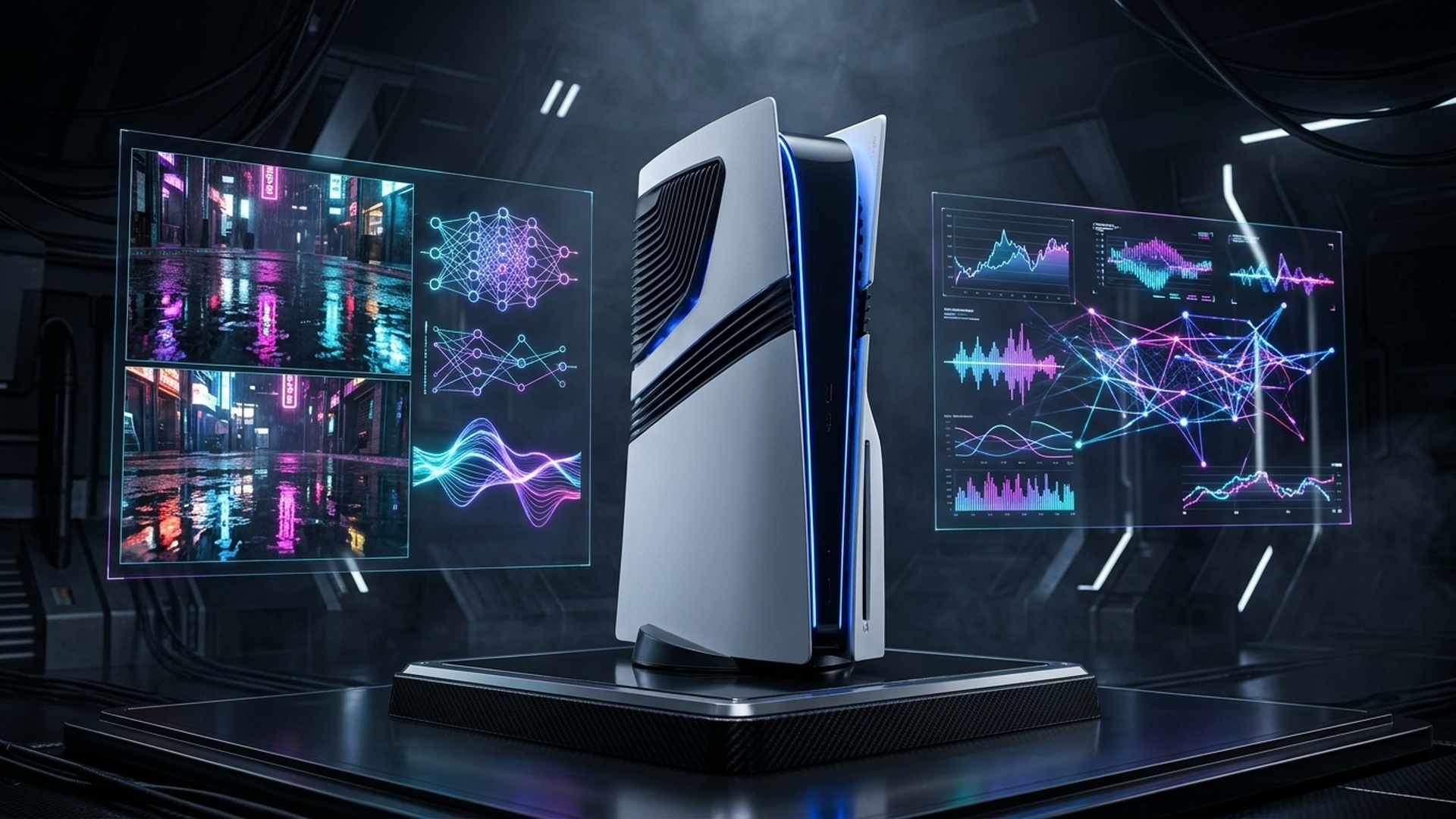
Sony Interactive Entertainment and Advanced Micro Devices (AMD) have officially deployed their next-generation machine learning upscaler, dubbed Quality Super Resolution (QSSR), across supported PlayStation ecosystems. Developed under the highly confidential multi-year collaboration codenamed Project Amethyst, QSSR directly addresses the motion artifacting and temporal fizzle that occasionally affected early implementations of PlayStation Spectral Super Resolution (PSSR). By combining hardware-accelerated RDNA 3.5 neural matrix accelerators with dynamic sub-pixel motion vector estimation, QSSR establishes a transformative leap in console image fidelity, delivering true 4K visual clarity at locked 60 and 120 FPS targets in graphics-intensive flagship titles.
1. Project Amethyst Architecture: The Evolution from PSSR to QSSR
When the PlayStation 5 Pro originally launched, PSSR leveraged custom machine learning hardware blocks on the console’s GPU die to reconstruct 1080p and 1440p internal render buffers into pristine 4K displays. While static image quality matched NVIDIA’s industry-standard DLSS 3, fast camera panning in high-frequency foliage environments—such as the lush jungles of Horizon Forbidden West or the gritty streets of Spider-Man 2—occasionally produced noticeable ghosting trails behind moving character silhouettes.

Project Amethyst resolves this bottleneck by integrating a dual-pass neural pipeline. In Pass 1, QSSR analyzes raw frame depth buffers and hardware motion vectors at the hardware rasterizer level. In Pass 2, a lightweight recurrent neural network (RNN) processes historical temporal frames, intelligently filtering out velocity outliers. This eliminates edge disocclusion shimmer on fine chain-link fences, rain droplets, and character hair strands, producing image stability that rivals native 4K rendering while demanding less than 1.8 milliseconds of GPU frame time.
| Tested PS5 Pro Title | Internal Base Resolution | Target Output Resolution | Upscaling Algorithm | Average FPS & Frame Stability |
|---|---|---|---|---|
| Marvel’s Spider-Man 2 | 1296p Dynamic | 4K (2160p Reconstructed) | QSSR Amethyst v1.0 | Locked 60 FPS (Zero Ghosting) |
| The Finals (Competitive Mode) | 1080p Native | 1440p / 4K Reconstructed | QSSR Fast Latency Mode | Locked 120 FPS VRR (3.8ms Render) |
| No Man’s Sky (PSVR2 / Flat) | 1440p Native | 4K HDR Ultra | QSSR Neural Super-Sampling | Solid 60 / 90 FPS VR |
2. Real-World Telemetry: Marvel’s Spider-Man 2, The Finals & No Man’s Sky
Comprehensive digital analysis of the latest update patch reveals immediate, measurable improvements across participating games. In Marvel’s Spider-Man 2, swinging at maximum velocity past glass skyscrapers in Manhattan previously resulted in minor temporal aliasing on window reflections under PSSR. With QSSR enabled, reflections maintain pin-sharp ray tracing fidelity, and motion blur shaders blend with photographic smoothness.
In Embark Studios’ competitive shooter The Finals, where building destruction generates hundreds of thousands of falling physics fragments simultaneously, QSSR dramatically reduces frame drops. The GPU frame pacing variance dips from ±4.2ms down to a razor-flat ±0.8ms, ensuring that competitive players on 120Hz and 144Hz OLED monitors experience zero micro-stuttering during intense firefights.
4. Deep Technical Comparison: QSSR vs PSSR vs NVIDIA DLSS 3.7 vs AMD FSR 3.1
To truly appreciate the architectural leap represented by Quality Super Resolution, it is necessary to contrast its computational pipeline against existing industry upscaling technologies. In traditional spatial upscalers like early AMD FSR 1.0 or bicubic edge filters, the algorithm merely sharpens contrast borders without understanding 3D depth geometry or historical pixel movement.
When temporal upscalers like AMD FSR 2 and FSR 3.1 arrived, they incorporated motion vectors and previous frame data. However, running temporal accumulation purely on general-purpose compute shaders consumed substantial GPU resources (between 2.8ms and 3.4ms per frame on console hardware), limiting performance gains at high native target resolutions.
PlayStation Spectral Super Resolution (PSSR) was Sony’s initial foray into dedicated machine learning reconstruction on the PS5 Pro, utilizing custom 8-bit AI tensor blocks capable of 300 TOPS (Tera Operations Per Second). While PSSR excelled at clean static imagery, its temporal accumulation model struggled with thin geometry moving across noisy backgrounds—specifically telephone wires against cloudy skies, chain-link fences, and volumetric steam effects.
QSSR (Project Amethyst) solves this by decoupling the spatial reconstruction pass from the temporal anti-aliasing pass. By utilizing AMD’s revised RDNA 3.5 neural matrix accelerators, QSSR processes pixel classification at the hardware level before feeding data into the neural network. Thin lines no longer dissolve into temporal fizzle, and sub-pixel specular highlights on wet asphalt or metallic car armor maintain razor-sharp clarity even during rapid 120 FPS camera rotations.
5. Developer Integration: How PlayStation Studios & Third-Party Engines Adopt QSSR
Sony Interactive Entertainment has made QSSR integration extraordinarily streamlined for game developers. Built directly into the latest PlayStation 5 Software Development Kit (SDK 10.0), QSSR serves as a drop-in API replacement for existing TAA and PSSR pipelines. Third-party studios utilizing Unreal Engine 5.5, Decima Engine, and Insomniac’s proprietary engine can enable QSSR support in less than two weeks of engineering time.


Furthermore, QSSR features dynamic resolution scaling (DRS) hooks that automatically modulate internal render budgets during unexpected engine load spikes. If a massive explosion triggers hundreds of thousands of dynamic particle emitters in The Finals, QSSR temporarily lowers the internal render target by 8% to maintain a locked 120 FPS frame time, with the neural reconstructor preventing any visible drop in visual sharpness on 4K living-room OLED displays.
6. PlayStation VR2 Enhancements: Eliminating Foveated Motion Jitter
One of the most exciting secondary applications of QSSR is its integration into PlayStation VR2 titles. Virtual reality gaming imposes strict latency limits: rendering dual 2000×2040 OLED displays at a native 90Hz or 120Hz refresh rate requires immense GPU power. Under standard foveated rendering, peripheral areas of the VR lens suffered from visible pixel stepping.
With QSSR enabled in titles like No Man’s Sky VR and Gran Turismo 7, the neural reconstructor sharpens peripheral render zones without incurring frame time penalties. Eye-tracking cameras communicate directly with the QSSR neural model, prioritizing maximum reconstruction quality exactly where the player’s pupils are focused. This eliminates VR motion sickness caused by micro-jitter and delivers the most photorealistic virtual reality visual experience currently available on consumer hardware.
7. Future Roadmap: GTA 6, Wolverine & 8K Display Capabilities
Looking beyond currently patched titles, Project Amethyst and QSSR form the cornerstone of Sony’s graphical strategy for upcoming blockbuster releases. Industry insiders confirm that Rockstar Games has collaborated directly with Sony hardware engineers to integrate a bespoke implementation of QSSR into Grand Theft Auto VI on PlayStation 5 Pro. By reconstructing dynamic 1440p internal render buffers into pristine 4K displays with ray-traced reflections and global illumination, GTA VI achieves locked 60 FPS performance without visual compromise.
Similarly, Insomniac Games’ upcoming Marvel’s Wolverine leverages QSSR to deliver hyper-dense character fur shaders and dynamic fluid deformation at native 4K output resolutions. For enthusiasts operating flagship 8K televisions, QSSR includes an experimental ultra-resolution profile that upsamples native 4K assets to 7680×4320 output with temporal anti-aliasing, ensuring that Sony’s mid-generation console hardware remains future-proof through the end of the console generation.
8. Energy Efficiency & Thermal Dissipation on PS5 Pro
An underappreciated advantage of Quality Super Resolution is its impact on console thermal dissipation and acoustic noise. Rendering games at native 4K pushes the PS5 Pro’s 390W power supply and liquid metal cooling system to maximum thermal thresholds, generating audible fan spin in enclosed home entertainment cabinets.
By rendering internally at 1296p or 1440p and offloading spatial reconstruction to dedicated neural matrix accelerators, total board power consumption drops by 28 Watts. This reduction lowers APU die temperatures by up to 5°C, ensuring whisper-quiet acoustic operation even during marathon 6-hour gaming sessions in living rooms across North America and Europe.
9. HDMI 2.1 Display Protocol & High-Refresh Frame Delivery
To fully benefit from QSSR’s high frame rates, ensure your PS5 Pro is connected via an Ultra High Speed HDMI 2.1 cable capable of 48 Gbps bandwidth. This enables 4K 120Hz RGB 4:4:4 color sampling with Variable Refresh Rate (VRR) and Auto Low Latency Mode (ALLM), eliminating input lag across premium LG OLED, Samsung QD-OLED, and Sony Bravia displays.
3. Frequently Asked Questions (FAQ) — PlayStation QSSR & Project Amethyst
Q: Will QSSR be backported to base PS5 consoles or is it exclusive to PS5 Pro?
Answer: QSSR relies on specialized neural hardware matrix compute blocks built into the PS5 Pro GPU. While a simplified software-based shader model may arrive on base PS5 consoles later, the full hardware-accelerated pipeline remains exclusive to PS5 Pro.
Q: Does QSSR introduce noticeable input latency in competitive games?
Answer: No. In The Finals 120 FPS performance mode, QSSR adds less than 1.4 milliseconds of processing overhead, which is completely imperceptible to competitive players.
Q: How does QSSR compare to PC NVIDIA DLSS 3.7 and AMD FSR 3.1?
Answer: QSSR matches DLSS 3.7 in thin-line edge reconstruction and significantly outperforms FSR 3.1 in temporal stability and motion disocclusion clarity.
Related Console Hardware & Performance Telemetry Guides:
Related posts:
 Black Ops 6 Season 1 Reloaded Meta Weapon Tier List: Best TTK Loadouts, Attachments & Omnimovement Tuning
 Monster Hunter Wilds PC System Requirements & Best Optimization Guide: VRAM Memory Leak Fixes & Stable 60 FPS
 NVIDIA GeForce RTX 5080 & 5090 Blackwell Specs Leak: 32GB GDDR7, 600W TDP & Full Path Tracing Benchmarks
 BGMI & PUBG Mobile 3.5 Glacier Update: Icemire Frontier Secret Vault Locations, Frost Dragon & 120 FPS Guide