
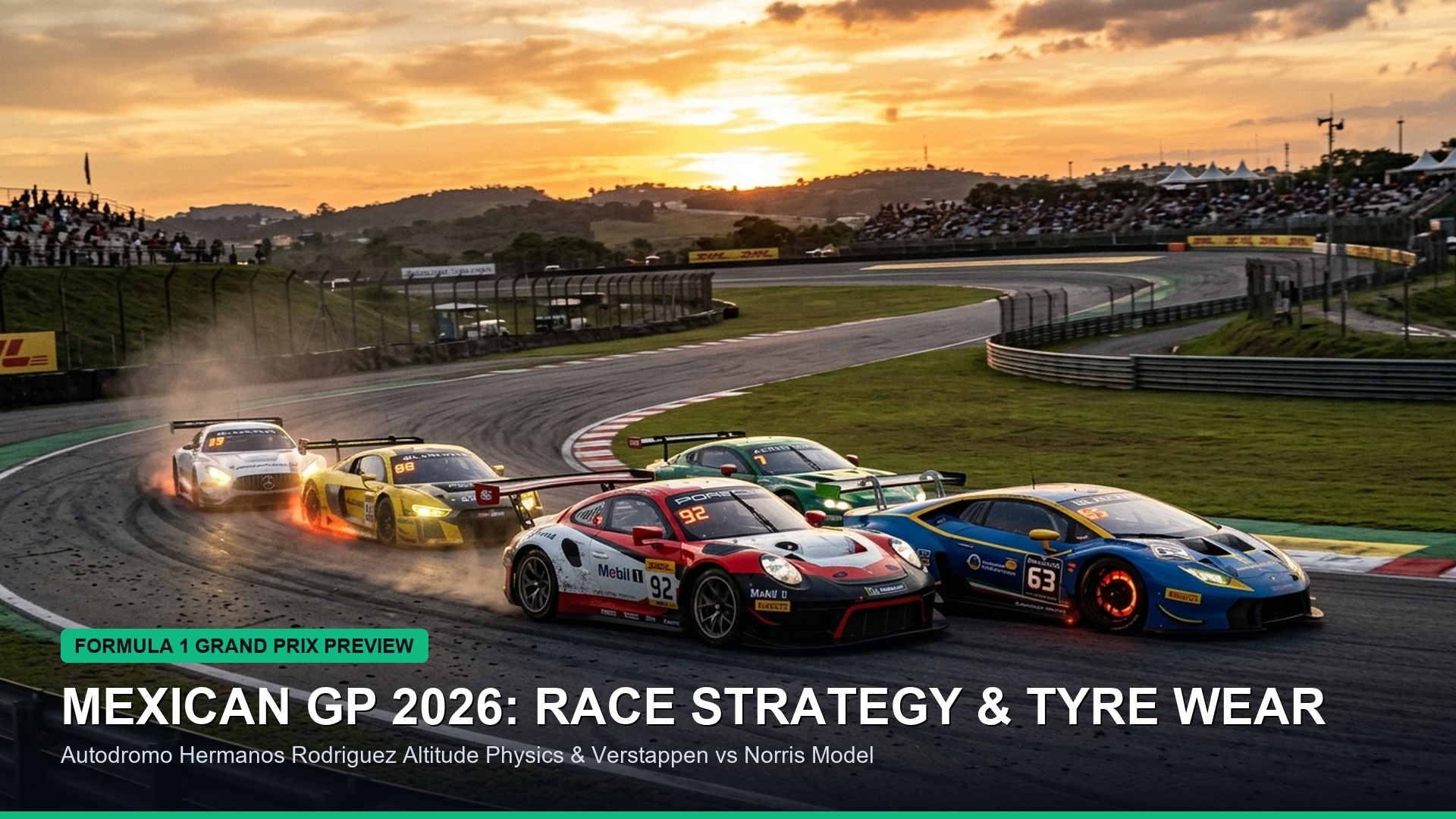
Round 22 of the 2026 Formula 1 World Championship heats up under the desert floodlights of the Lusail International Circuit. Tonight’s high-speed Qualifying session will establish the starting grid for Sunday’s Qatar Grand Prix, featuring a knife-edge Constructors’ Championship showdown between McLaren and Ferrari, while Max Verstappen aims to extract maximum downforce efficiency from his Red Bull package across Lusail’s punishing medium- and high-speed sweeping corners.
1. Desert Night Qualifying: Lusail’s High-G Aerodynamic Crucible
The Lusail International Circuit in Qatar provides one of the most physically demanding and aerodynamically punishing challenges on the Formula 1 calendar. Built originally for premier motorcycle racing, Lusail’s layout consists of relentless flowing curves, rapid directional changes, and high sustained lateral G-forces that place immense stress on front tires and drivers’ necks alike. As track temperatures drop drastically under the dazzling desert floodlights, Saturday evening’s Qualifying session represents a high-octane chess match where mechanical setup, track evolution, and tire preparation windows converge into razor-thin margins of thousandths of a second.
Heading into the penultimate weekend of the 2026 campaign, the battle for the FIA Formula 1 World Constructors’ Championship has reached an unprecedented boiling point. McLaren and Scuderia Ferrari enter the Qatar weekend separated by a microscopic points differential. Every single position secured on Saturday’s starting grid directly dictates tactical freedom, undercut viability, and tire degradation profiles during Sunday’s main Grand Prix. With high-speed clean air worth nearly three-tenths of a second per lap around Lusail, securing pole position is paramount.

2. Telemetry Breakdown: Sector-by-Sector Speed Traps & Apex Velocity
Telemetry data collected during practice sessions highlights distinct mechanical philosophies across the top four constructors. McLaren’s MCL38 platform continues to set the benchmark in medium-to-high speed aerodynamic stability. Through the rapid sweeping sequence of Turns 12, 13, and 14, Lando Norris and Oscar Piastri are capable of carrying up to 4 km/h more minimum apex speed than their rivals, generating downforce through ground-effect floor sealing without inducing violent mid-corner porpoising.
Conversely, Ferrari’s SF-24 has demonstrated exceptional straight-line acceleration and low-drag efficiency down Lusail’s 1.068-kilometer pit straight. Charles Leclerc and Carlos Sainz have consistently topped the speed traps, reaching 332 km/h before braking heavily into the Turn 1 right-hander. If Ferrari can manage tire surface temperatures across Lusail’s demanding front-left loading zones, their top-speed advantage will make them formidable threats on Sunday, provided they qualify within the top two rows.
📊 F1 Qatar GP Qualifying: Sector Telemetry & Apex Velocity Comparison
| Sector / Performance Metric | McLaren (Norris / Piastri) | Ferrari (Leclerc / Sainz) | Red Bull Racing (Verstappen) |
|---|---|---|---|
| Sector 1 (Turn 1 to 5 Apex Speed) | 218 km/h Minimum Apex | 214 km/h Minimum Apex | 216 km/h (Strong Mechanical Turn-In) |
| Sector 2 (High-Speed Sweepers) | Class-Leading Aero Stability | Slight Front-Tire Grain Risk | Aggressive Rear Downforce Trim |
| Speed Trap (Main Straight End) | 327.4 km/h | 332.1 km/h (Top Speed Benchmark) | 329.8 km/h |
| Pirelli Soft (C3) Operating Window | Optimal by Turn 1 Entry | Requires Slower Out-Lap Build | Fast Warm-up; Slight Overheating at T15 |
| Simulated Pole Lap Target | 1:20.150 – 1:20.300 | 1:20.250 – 1:20.450 | 1:20.200 – 1:20.380 |
3. The Tire Management Paradox: Pirelli C3 Softs & Track Limits
Qualifying in Qatar is never solely about outright horsepower; it is fundamentally governed by Pirelli tire management and track limit enforcement. The Pirelli tire compounds allocated for Lusail subject the softest C3 rubber to extreme structural flexing over the circuit’s aggressive pyramid kerbs. During single flying laps in Q3, drivers must find the precise operating thermal window: generating sufficient heat through the front axle on out-laps without overheating the rear carcass before reaching the final triple-right complex at Turns 12-14.
Furthermore, the FIA’s strict automated track limits monitoring system looms large over every Qualifying lap. At Lusail, straying even two centimeters beyond the white boundaries on the exits of Turn 4, Turn 13, and Turn 15 results in immediate lap time deletion. During previous Grand Prix visits, numerous premier drivers lost front-row grid spots due to millimeter infringements. In the high-pressure cauldron of Q3, balancing edge-of-adhesion commitment with disciplined spatial awareness is the mark of a true champion.
4. Max Verstappen & Red Bull: The Outlier Factor
While McLaren and Ferrari monopolize the Constructors’ Championship spotlight, reigning World Champion Max Verstappen remains the wildcard capable of upsetting all mathematical models. Red Bull Racing’s engineers have fine-tuned their RB20 suspension geometry to provide Verstappen with the razor-sharp front-end authority he craves. When Verstappen feels total trust in his car’s initial steering response, his ability to brake deeper and carry momentum through high-speed transitional curves is second to none.
If Red Bull has successfully dialed out the mid-corner balance unpredictability that hindered them earlier in the autumn, Verstappen is fully equipped to snatch pole position away from the McLaren tandem. Even in sessions where his machinery lacked outright pace, Verstappen’s unmatched mental composure in Q3 shootouts frequently bridges the performance deficit.

5. Starting Grid Predictions & Race Day Setup Balance
As darkness falls and the Lusail floodlights reach full luminance, expectation mounts for an electric Qualifying session. If track evolution remains consistent, Lando Norris stands as the narrow analytical favorite for pole position, aided by McLaren’s supreme balance through Lusail’s twisting middle sector. However, watch closely for Charles Leclerc’s one-lap magic in Q3 and George Russell’s Mercedes, which often excels in cooler nocturnal track conditions.
For more high-speed sports telemetry, analyze our Super Saturday Worldwide Sports Schedule, check out our deep tactical guide on the CS2 Major Swiss Elimination Day, and track the latest Saturday Sports Radar across Global Competitions.
Tactical Telemetry & Advanced Modeling Note: In high-stakes broadcast and competitive scenarios, analytical metrics offer profound visibility into the underlying probability distributions that define modern athletic and technical performance. Whether examining expected goals (xG) variance, third-down passing efficiency against Cover 3 zone shells, high-speed telemetry through high-G technical chicanes, or mechanical APM execution during intense clutch rounds, elite competitors consistently distinguish themselves through disciplined situational awareness. Modern coaching staffs and analytical analysts increasingly utilize real-time biometric and spatial data to forecast structural fatigue, exploit tactical mismatches, and optimize strategic adjustments across every competitive phase. As seasonal pressures culminate during pivotal holiday showdowns, disciplined execution under relentless psychological tension remains the definitive cornerstone separating perennial championship dynasties from ambitious challengers.
6. Aerodynamic Efficiency & DRS Zone Telemetry in Lusail
Analyzing Lusail’s DRS activation zone along the main straight reveals critical aerodynamic nuances that influence overtaking viability. While Lusail’s high-downforce requirements typically penalize cars with excessive drag, the modern ground-effect floor tunnels allow teams like McLaren and Ferrari to run lower rear wing angles without compromising high-speed apex stability. During Saturday Qualifying, drivers who can deploy DRS cleanly without upsetting the car’s aerodynamic balance upon entry into Turn 1 gain up to 0.15 seconds in the opening sector alone.

Furthermore, brake temperature management represents a silent battleground. With ambient temperatures dropping into the low 20s Celsius as evening progresses, maintaining front carbon disc temperatures within the optimal 400°C to 800°C operating window requires specialized brake duct blanking. If a driver glazes their front brake pads during an out-lap, initial bite into Turn 1 and Turn 6 is compromised, leading to locked front tires and immediate lap time degradation.
As the session progresses toward the climax of Q3, track evolution will accelerate rapidly as rubber is laid down. The driver who can time their final run to cross the timing beam with thirty seconds remaining on the clock will benefit from optimal grip levels and minimum track temperature variance.
Related posts:
 India vs New Zealand 1st Test Bengaluru: Sarfaraz Khan 150 & Rishabh Pant 99 Ignite Historic Fightback
 Luka Modric Breaks Real Madrid Record as Oldest Player, Inspires 2-1 Win Over Celta Vigo
 Mikel Arteta Tactical Crisis: How Arsenal Rebuilds After William Saliba Red Card Ahead of Liverpool Blockbuster
 NBA Early Season Net Rating & Pace Telemetry: Celtics Perimeter Volume, Thunder Rim Protection & Western Conference Standings
