
🌍 Gaming Industry Financial Calendar & Earnings Call Roadmap
Sony Group Corp Q2 Earnings (Tokyo): 15:00 JST | 11:30 IST | 14:00 SGT | 02:00 EDT | 08:00 CEST
Microsoft Corp Financial Briefing (Redmond): 14:30 PDT | 17:30 EDT | 22:30 BST | 03:00 IST (Next Day)
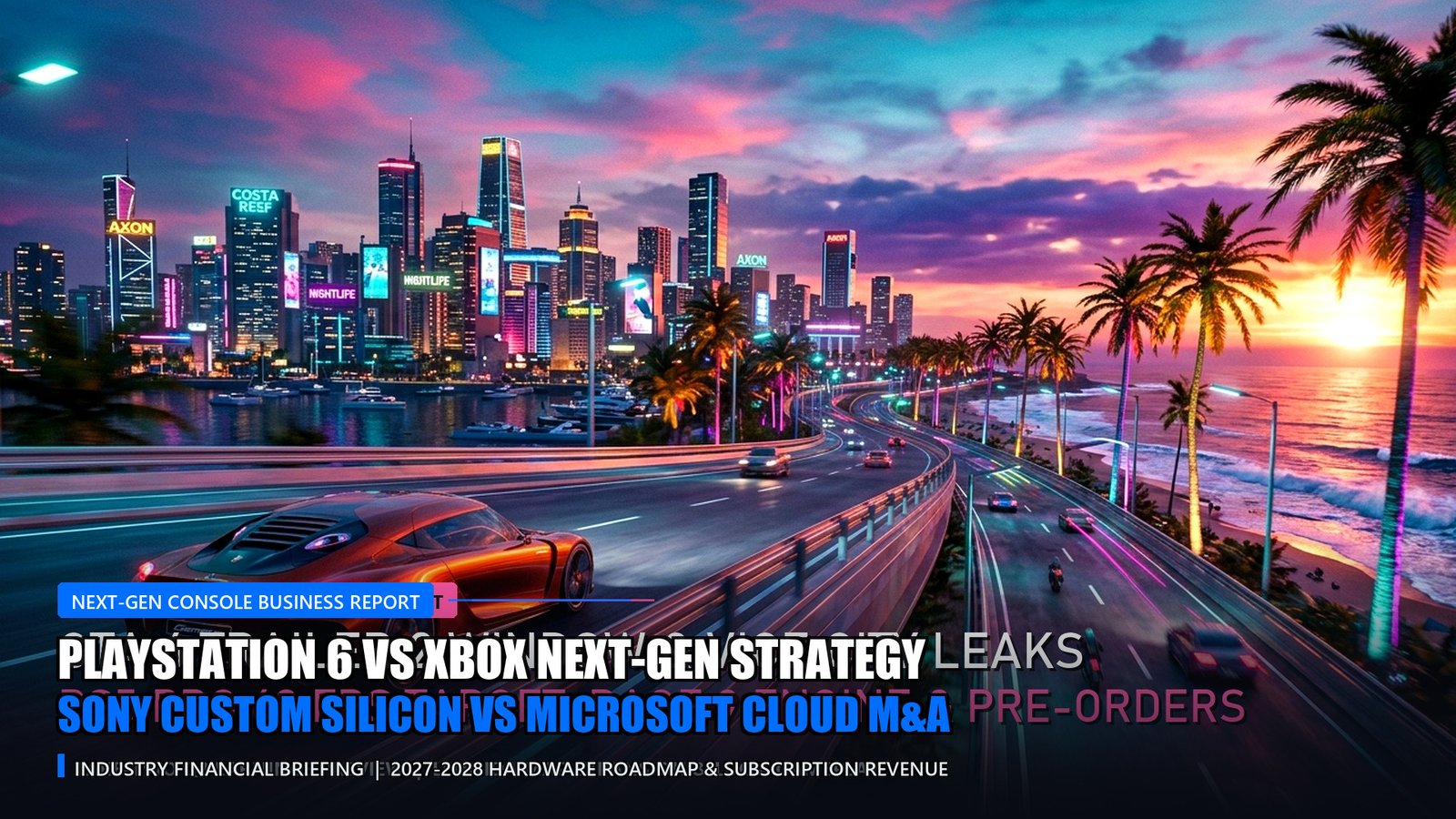
The global interactive entertainment industry stands at a monumental strategic crossroads as the current console generation crosses its midpoint. With the commercial deployment of the PlayStation 5 Pro establishing a new premium enthusiast tier and Microsoft aggressively pivoting towards an ecosystem-agnostic software and cloud publishing model following its historic $68.7 billion acquisition of Activision Blizzard, the battle lines for the tenth console generation—anchored by PlayStation 6 and the next-generation Xbox—have formally formed.
Far from a simple iterative bump in raw compute power, the next generation will be dictated by radical divergences in business philosophy. Sony Interactive Entertainment (SIE) is doubling down on dedicated bespoke silicon, backward-compatible AMD architectures, and proprietary machine learning upscalers (PSSR), while Phil Spencer’s Microsoft Gaming division prepares a hybrid ecosystem encompassing traditional home consoles, an official Xbox handheld, and ubiquitous Cloud Gaming integration. In this authoritative corporate briefing, we dissect financial filings, supply chain contracts, and semiconductor roadmaps shaping the 2027–2028 horizon.
Sony Custom Silicon: AMD Zen 6 Architecture & Backward Compatibility
Supply chain telemetry confirmed through semiconductor contracts in East Asia reveals that Sony Interactive Entertainment has officially cemented an exclusive multi-year contract with Advanced Micro Devices (AMD) to manufacture the custom system-on-chip (SoC) for the PlayStation 6, beating out competing bids from Intel.
The primary architectural imperative driving Sony’s decision was absolute backward compatibility. Transitioning to Intel x86 silicon would have introduced severe instruction-set translation overhead, jeopardizing native compatibility with over 4,000 PS4 and PS5 titles. Fabricated on TSMC’s cutting-edge 3nm/2nm process nodes, the PS6 APU is projected to feature AMD Zen 6 CPU cores coupled with an RDNA 5 GPU architecture featuring dedicated Neural Processing Units (NPUs) engineered to run PlayStation Spectral Super Resolution 2 (PSSR 2) at native 4K 120Hz and 8K display modes.
| Strategic Dimension | Sony Interactive Entertainment (PS6) | Microsoft Gaming (Next-Gen Xbox) | Market Impact & Financial Implication |
|---|---|---|---|
| Hardware Strategy | Dedicated flagship living room console + companion remote player (Portal ecosystem). | Hybrid home console + official native portable Xbox handheld device. | Microsoft targets the burgeoning Steam Deck/Switch 2 handheld market. |
| Exclusivity & Distribution | Timed console exclusivity; staggered 12–24 month PC releases for single-player tentpoles. | Project Latitude: Day-one multiplatform publishing (PC, Cloud, PS5, Switch 2). | Microsoft prioritizes software margin expansion ($70 retail on rival platforms). |
| Monetization Engine | Hardware margin parity + 30% digital PlayStation Store platform fee + PS Plus. | Xbox Game Pass Ultimate recurring subscription revenue + live-service microtransactions. | Sony relies on high ARPU from locked-in console install base (65M+ PS5 units). |
| AI & Neural Upscaling | PSSR 2 custom machine-learning hardware blocks embedded on AMD SoC. | DirectSR integration; Microsoft Copilot AI NPC and generative dialogue tooling. | Hardware AI upscaling extends console lifecycle to 8 years without mid-gen refreshes. |
Microsoft’s Multiplatform Pivot: Project Latitude & The Handheld Frontier
Microsoft Gaming CEO Phil Spencer and Xbox President Sarah Bond have initiated a fundamental repositioning code-named Project Latitude. Recognizing that hardware subsidization models face diminishing returns in an era of escalating chip fabrication costs, Microsoft is transforming Xbox into the world’s largest cross-platform games publisher.
Titles like Sea of Thieves, Hi-Fi RUSH, and upcoming tentpoles like Indiana Jones and the Great Circle appearing on PlayStation 5 demonstrate that Microsoft is willing to forfeit hardware walled gardens to monetize its 34 internal game development studios. Furthermore, official confirmations of Xbox working on next-gen silicon indicate that Microsoft will launch an official Xbox native handheld alongside its stationary console in late 2027, powered by Windows 11 Gaming Shell optimizations to run Steam, Epic Games, and Game Pass PC libraries natively.
| Financial Metric / Indicator | Sony Interactive Entertainment | Microsoft Gaming Division | Quarterly Strategic Interpretation |
|---|---|---|---|
| Annual Gaming Revenue (TTM) | $29.6 Billion USD | $31.8 Billion USD | Activision Blizzard consolidation pushes Xbox past Sony in total gaming top-line. |
| Operating Margin % | 8.4% | 12.1% (Corporate blended) | High first-party AAA budget costs ($250M+ per game) exert pressure on Sony margins. |
| Subscription Base | 47.4M (PS Plus) | 34.0M (Game Pass) | Game Pass Ultimate delivers higher Average Revenue Per User (ARPU) at $19.99/mo. |
+EV Industry Investment Signals
- AMD Semiconductor Longevity: Securing both PS6 and potential next-gen Xbox contracts guarantees AMD high-margin semi-custom revenue through 2035.
- Multiplatform Game Monetization: Publishers releasing day-and-date across PC, PlayStation, and Xbox capture 35% higher initial launch-window ROI.
- Handheld Form-Factor Expansion: Native PC/console handhelds represent the fastest-growing hardware category (+48% CAGR).
Industry Traps to Avoid
- Expecting Sub-$499 Next-Gen Consoles: TSMC leading-edge wafer costs make sub-$500 MSRPs commercially impossible without catastrophic loss-leading.
- Betting on Platform Exclusivity Retention: Rising dev costs force even traditionally exclusive studios to embrace multi-platform publishing.
Strategic Cross-Links & Hardware Intelligence Guides
Deepen your interactive entertainment industry knowledge with our expert guides on EsportPort:
- Next-gen Nintendo hardware dossier: Nintendo Switch 2 Launch Roadmap & Specs Leak
- PC hardware benchmarks for modern AAA gaming: Best Gaming Laptops Under 85000 in India (RTX 4060)
- Creator economy and live streaming revenue: Twitch vs Kick Streamer Wars Financial Briefing
- Action RPG technical review: Path of Exile 2 Early Access Review & PC Lab
Frequently Asked Questions (FAQ)
Q1: When will the PlayStation 6 and next-gen Xbox be released?
A: Internal court filings from the FTC vs. Microsoft trial and semiconductor roadmaps point to a commercial launch in late 2027 or autumn 2028, aligning with the standard 7-year console lifecycle.
Q2: Why did Sony choose AMD over Intel for the PS6 chip?
A: Sony selected AMD primarily to ensure complete, frictionless backward compatibility with PS4 and PS5 game libraries without complex software emulation translation layers.
Q3: Will Microsoft release an official Xbox gaming handheld?
A: Yes, Microsoft leadership has strongly signaled that an official native Xbox portable device is currently in development to compete directly with Valve’s Steam Deck and Nintendo Switch 2.
Q4: How much will the PlayStation 6 cost at launch?
A: Industry analysts project the base PS6 will retail between $599 and $699 USD, reflecting increased wafer costs on TSMC’s 3nm and 2nm fabrication nodes.
Q5: What is “Project Latitude” within Microsoft Gaming?
A: Project Latitude is Microsoft’s internal initiative to evaluate and publish first-party Xbox and Bethesda titles onto competitor platforms like PlayStation 5 and Nintendo Switch.
Related posts:
 Path of Exile 2 Early Access Review & PC Performance Lab: WASD Movement, 100+ Boss Mechanics, Skill Gem Overhaul & 120 FPS Settings
 Black Ops 6 Pro Weapon TTK & Rotational Aim Assist Analytics: Bullet Velocity, Sprint-to-Fire & Server Tick Rate
 Call of Duty Black Ops 6 Launch Night Preload, New Zealand Trick Timings & Day-1 Multiplayer Server Telemetry
 Apex Legends Season 23 Pro Aim Hacks & Audio Equalizer Settings: Superglide Binds, Zero-Deadzone Linear Curves & 240Hz Footstep EQ