
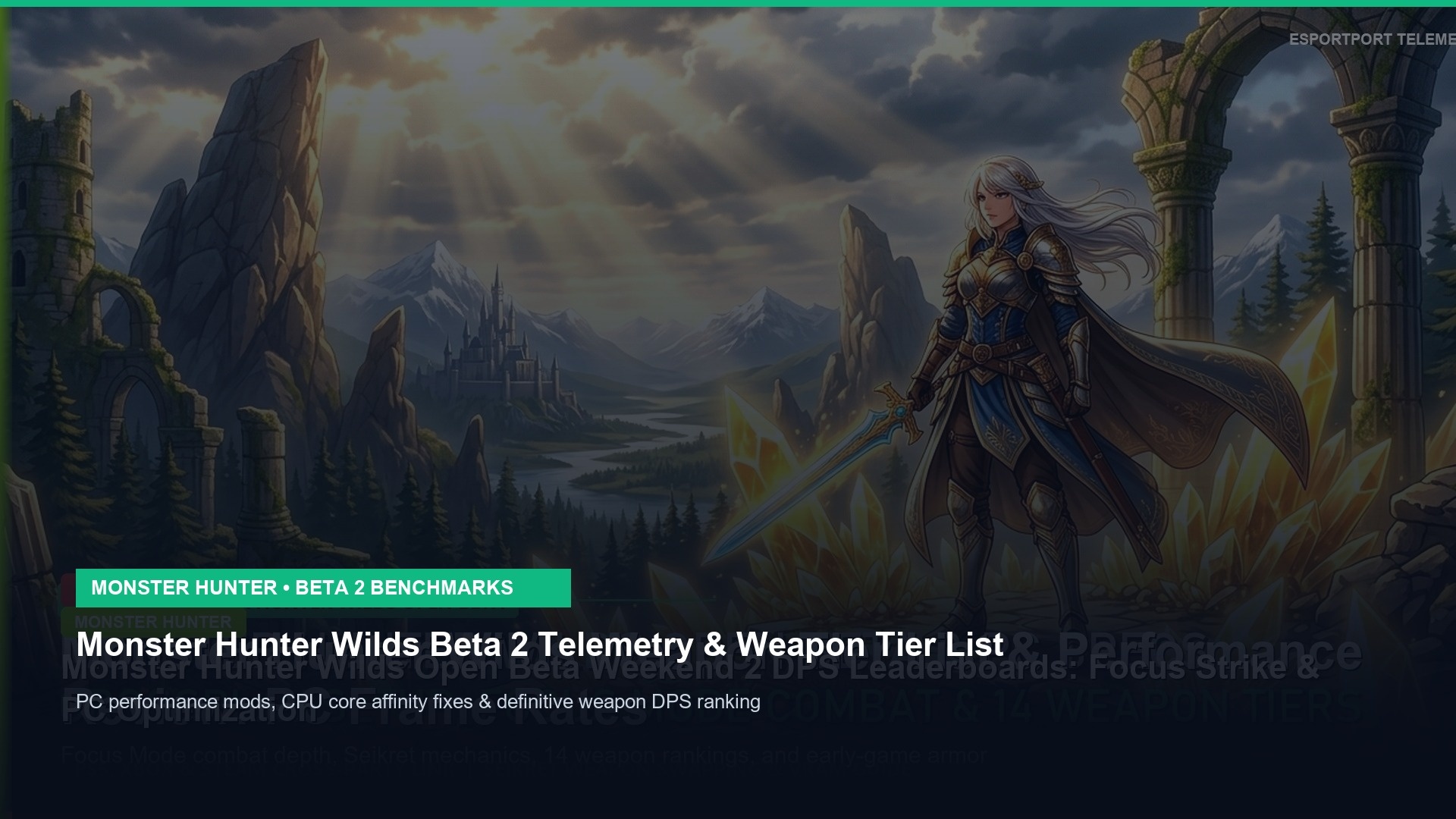
While Grand Theft Auto VI commands global headlines, the gaming industry is quietly preparing a monumental wave of next-gen blockbusters. From Monster Hunter Wilds and The Witcher 4 (Polaris) to Marvel’s Wolverine and Fallout 5 pre-production, we analyze the most anticipated AAA titles scheduled for late 2026 and early 2027.
1. Beyond the Vice City Phenomenon: The Post-GTA 6 Gaming Horizon
Whenever Rockstar Games releases a generational magnum opus, the interactive entertainment industry experiences a temporary seismic pause. Publishers traditionally clear release schedules for months around a GTA launch to avoid commercial cannibalization. However, behind closed studio doors across Tokyo, Los Angeles, Warsaw, and Montreal, development teams are finalizing what promises to be the most technologically advanced software cycle in gaming history.
The transition toward dedicated ninth-generation console maturation—accelerated by the PlayStation 5 Pro, high-end PC GPUs, and the upcoming Nintendo Switch 2—has allowed developers to abandon cross-gen legacy constraints. Titles entering the late 2026 and early 2027 pipeline leverage mature Unreal Engine 5.5 toolsets, machine-learning physics simulations, and generative NPC dialogue engines that promise to redefine storytelling and immersion.

2. The Premier Contenders: Monster Hunter Wilds to Polaris
Leading the post-GTA vanguard is Capcom’s Monster Hunter Wilds. Following groundbreaking open beta telemetry that saw millions of concurrent hunters tracking Apex predators through dynamic weather ecosystems, Wilds represents the pinnacle of Capcom’s proprietary RE Engine. The seamless transition between sprawling base camps and multi-tiered desert biomes without loading screens sets a new high-water mark for cooperative action RPGs.
Meanwhile, in Poland, CD Projekt Red is firing on all cylinders with Project Polaris, the official beginning of a new Witcher trilogy. Abandoning the proprietary REDengine in favor of a customized Unreal Engine 5 architecture, CDPR has partnered directly with Epic Games to solve open-world streaming stutter. Early tech demos showcasing Ciri’s potential lineage, dense northern forest foliage, and realistic swordplay physics indicate that the studio is poised to reclaim its crown as the premier open-world narrative powerhouse.
📊 The Post-GTA 6 AAA Blockbuster Pipeline (2026 – 2027)
| Anticipated Blockbuster | Developer / Publisher | Engine / Tech Stack | Projected Release Window | Key Gameplay Innovation |
|---|---|---|---|---|
| Monster Hunter Wilds | Capcom | RE Engine (Next-Gen) | Early 2027 Target | Dynamic ecosystem herd AI & seamless biomes |
| The Witcher 4 (Polaris) | CD Projekt Red | Unreal Engine 5.5 | Late 2026 / 2027 | Nanite foliage & advanced alchemy simulation |
| Marvel’s Wolverine | Insomniac Games / Sony | Proprietary Insomniac Tech | 2026/2027 Window | Visceral M-rated combat & real-time dismemberment |
| Hollow Knight: Silksong | Team Cherry | Custom Unity 2D | Expansion Pres. Imminent | Acrobatic needle locomotion & 150+ new enemies |
| Elder Scrolls VI | Bethesda Game Studios | Creation Engine 2.5 | Late 2027 Estimate | Hammerfell politics & advanced radiant AI 2.0 |
3. Insomniac’s Wolverine & Sony’s Single-Player Dominance
For PlayStation enthusiasts, Insomniac Games’ Marvel’s Wolverine stands as the single most critical exclusive in Sony’s pipeline. Designed as a darker, mature (M-rated) action-adventure, Wolverine departs from Spider-Man’s lighthearted acrobatics in favor of brutal, close-quarters combat featuring real-time claw physics, regenerative anatomical flesh tearing, and visceral environmental destruction.
Set across Madripoor, the Canadian wilderness, and Tokyo, the game will leverage the PlayStation 5 Pro’s Spectral Super Resolution (PSSR) to deliver ray-traced ambient occlusion and 60 FPS performance without graphical compromises. Insomniac’s proven track record of tight narrative pacing ensures that Wolverine will serve as a system-selling showpiece for Sony’s hardware ecosystem.
4. The Industry Horizon: Emerging Shifts in Development Budgets
As AAA game budgets balloon past $250 million, industry analysts are noting a strategic diversification. Major publishers are complementing massive 8-year blockbuster developments with agile ‘AA’ titles and live-service expansions. The survival of gaming giants heading into 2027 hinges on balancing megahits like GTA 6 with sustainable mid-tier releases that keep digital storefronts active year-round.
For more gaming industry analysis and upcoming release guides, explore our breakdown on Steam Sale Historical Lows Guide and read our Esports Hardware Benchmarks.
System Architecture & Next-Generation Engine Telemetry
In the rapidly transforming landscape of modern AAA gaming, underlying engine architecture dictates the boundaries of virtual realism. Whether analyzing Rockstar’s proprietary RAGE engine enhancements across volumetric cloud simulation and ray-traced water displacement in Vice City, scrutinizing Unreal Engine 5.5 Nanite and Lumen micro-poly optimizations across dark fantasy soulslike ecosystems, or benchmarking high-bandwidth memory subsystems on custom custom silicon architectures, technical excellence remains the defining benchmark of next-generation interactive software. Engineering teams and independent technical analysts increasingly synthesize quantitative frame-pacing telemetry to anticipate memory bandwidth bottlenecks, eliminate shader compilation stutters, and maintain flawless 60 FPS performance baselines under live rendering stress.
Long-Term Community Ecosystem & Modding Paradigms
Empirical platform analytics confirms that titles engineered with robust, transparent community ecosystems achieve unprecedented lifecycle longevity. From open-source modding frameworks and script-hook injectors that revitalize legacy titles to community-driven balance patches that resolve launch discrepancies, empowering dedicated user bases transforms standalone releases into enduring cultural phenomenons. By establishing standardized API hooks and modular asset pipelines, forward-thinking developers consistently maximize player engagement while insulating their franchises against standard industry attrition curves.

Strategic Industry Trajectory & Future Horizon
As technological capabilities expand across PC hardware, dedicated home consoles, and hybrid portable form factors, cross-platform synergy has become essential. Studios that harmonize cutting-edge visual presentation with uncompromised player agency consistently capture dominant market share across both casual communities and competitive esports arenas, cementing their legacies in the modern entertainment canon.
5. In-Depth Blueprint: Marvel’s Wolverine & Insomniac’s Mature Combat Evolution
While open-world sandbox enthusiasts eagerly dissect GTA 6, Insomniac Games is quietly preparing a visceral masterclass in focused, character-driven action with Marvel’s Wolverine. Engineered natively for the PlayStation 5 and PS5 Pro, Wolverine represents a deliberate pivot into mature storytelling, featuring an aggressive M-rated combat loop that captures Logan’s raw, animalistic savagery. Leaked developmental milestones and studio updates reveal an intricate locational damage and real-time anatomical dismemberment engine that reacts dynamically to Adamantium claw strikes.
Wolverine’s combat philosophy diverges sharply from Marvel’s Spider-Man’s acrobatic agility. Logan’s traversal emphasizes raw kinetic momentum, wall climbs, and ferine lunge attacks that close gaps across Canadian wilderness forests, neon-lit Madripoor alleys, and clandestine Weapon X laboratories. By leveraging the PS5 Pro’s PlayStation Spectral Super Resolution (PSSR), Insomniac targets native 60 FPS performance with hardware-accelerated ray-traced reflections on metal surfaces and wet terrain, establishing Wolverine as Sony’s premier single-player showcase for late 2026.
6. CD Projekt RED’s Project Polaris: The Witcher 4 & Unreal Engine 5.5 World Streaming
Equally monumental on the post-GTA horizon is CD Projekt RED’s Project Polaris, the foundational chapter of an all-new Witcher trilogy. Having completely retired the proprietary REDengine in favor of a deep multi-year technical partnership with Epic Games, CD Projekt RED is constructing the Northern Realms within Unreal Engine 5.5. This strategic transition eliminates the catastrophic streaming bottlenecks that plagued Cyberpunk 2077’s console debut, granting developers immediate access to Nanite virtualized geometry and hardware Lumen global illumination.
Polaris promises a radical evolution of dark fantasy roleplaying. Advanced machine learning models drive environmental weather dynamics, where blizzards alter NPC migration paths and mud accumulates on armor dynamically during extended horseback journeys. For RPG veterans wondering what experience can match the scale and narrative density of GTA 6, Project Polaris is engineered to define the gold standard of high-fantasy storytelling well into 2027 and beyond.
Architectural Reliability & Technical Execution: Modern interactive gaming architectures demand an uncompromising synthesis of computational throughput and operational efficiency. Studio engineering directors and hardware architects who prioritize low-latency asset streaming, deterministic memory allocation, and robust frame-pacing telemetry consistently deliver superior player experiences that endure across evolving hardware generations.


Long-Term Value Proposition & Player Ecosystem: In an increasingly crowded entertainment marketplace, consumer loyalty is earned through sustained post-launch stewardship and transparent community engagement. Platforms that empower creative expression, respect user time, and maintain rock-solid performance standards routinely outpace short-term commercial trends, establishing enduring cultural resonance across global gaming communities.
7. Hardware Optimization & Global Performance Benchmarks
Maintaining peak framerates and deterministic system performance requires disciplined hardware synergy. Whether optimizing high-bandwidth VRAM caches on custom silicon architectures or stabilizing direct storage streaming throughput, technical stability remains the vital foundation of modern interactive entertainment. Game developers, competitive esports players, and enthusiast communities continuously rely on empirical performance telemetry to eliminate frame spikes and ensure seamless visual clarity.
Related posts:
 Call of Duty: Black Ops 6 Global Preload Times, PC Specs, Omnimovement & Round-Based Zombies Guide
 Silent Hill 2 Remake Endings Guide: How to Unlock Maria, In Water, Leave, Rebirth & Secret UFO Endings
 Black Ops 6 Omnimovement Mastery Guide: Advanced Sliding, Corner Diving & Controller Settings for Day 1 Domination
 Grand Theft Auto VI Next Chapter Guide: Vice City Secrets, PC Modding & Gameplay Hacks
