
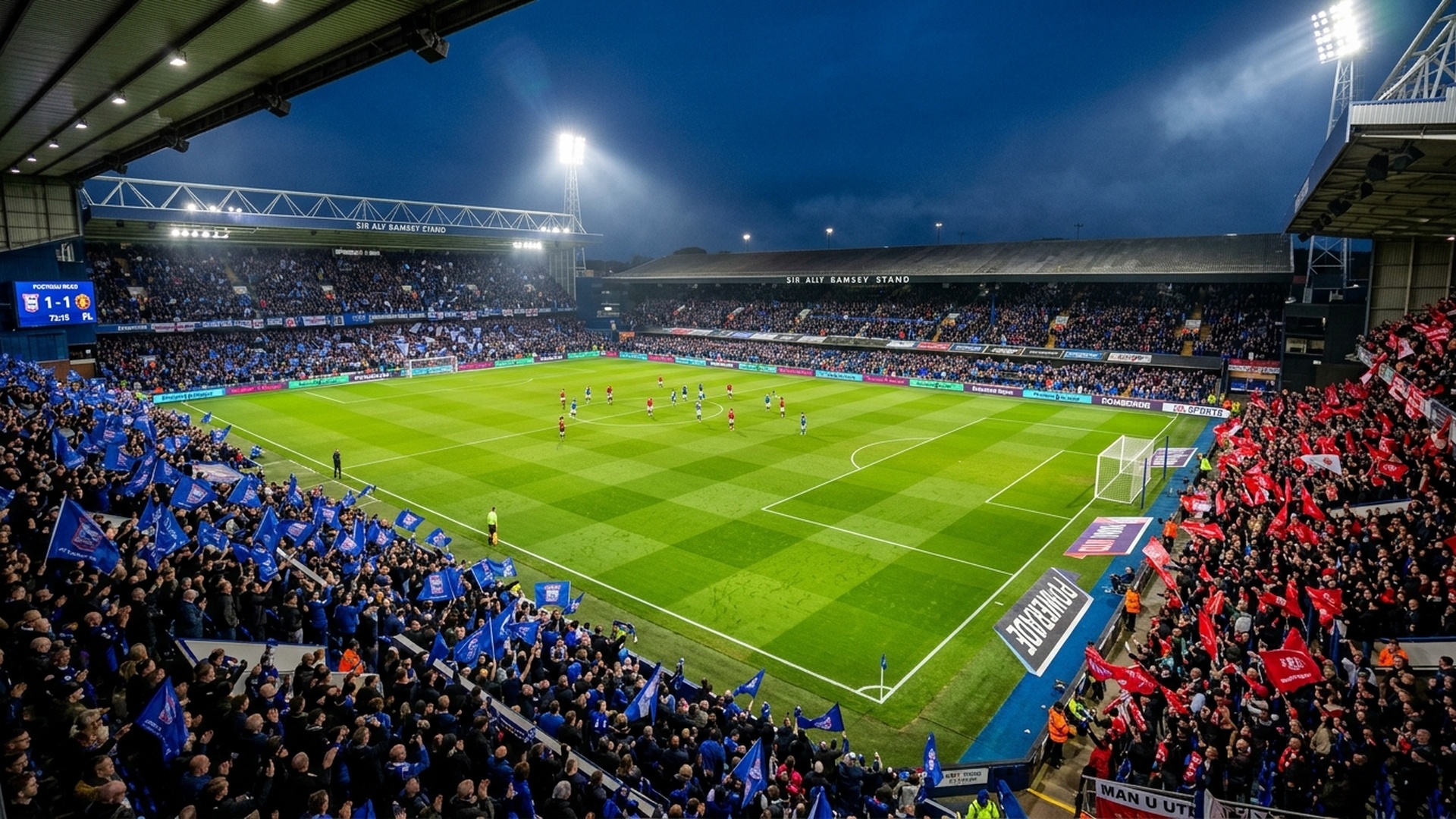
Old Trafford welcomes Ruben Amorim for his first Premier League home match as Manchester United host Sean Dyche’s Everton. We break down the Portuguese tactician’s 3-4-2-1 formation dynamics, wingback responsibilities, Everton’s low-block set-piece threat, and the mid-table Premier League standings implications.
1. Amorim’s Theatre of Dreams Debut: High Expectations in Manchester
A new era officially dawns at Old Trafford on Sunday afternoon as Ruben Amorim takes charge of Manchester United for his first domestic home fixture in the Premier League. Following a promising opening week that featured a dramatic 3-2 Europa League victory over Bodø/Glimt and an away draw at Ipswich Town, the 39-year-old Portuguese manager faces Sean Dyche’s rugged Everton side. The match represents a crucial referendum on how quickly United’s squad can assimilate Amorim’s signature 3-4-2-1 tactical blueprint.
Currently languishing in 12th position with just 16 points from 12 matches, Manchester United cannot afford more dropped points against bottom-half opposition. With European qualification spots rapidly drifting away, Amorim has placed paramount emphasis on defensive compactness, high-tempo pressing triggers, and aggressive ball-carrying from central defenders.


2. Tactical Blueprint: 3-4-2-1 Inversion & Wingback Dynamics
The structural engine of Amorim’s tactical revolution is the 3-4-2-1 formation. In possession, United build with three central defenders—featuring Matthijs de Ligt anchoring the middle between Lisandro Martínez and Noussair Mazraoui. This three-man foundation allows wingbacks Diogo Dalot and Luke Shaw (or Alejandro Garnacho in advanced roles) to hug the touchlines, stretching the opposing defensive mid-block to create passing lanes into the half-spaces.
The key to breaking down Everton’s compact 4-4-2 low block lies in the dual attacking midfielders operating behind Rasmus Højlund. Bruno Fernandes and Marcus Rashford are tasked with drifting between the lines, drawing Everton center-backs James Tarkowski and Jarrad Branthwaite out of position. Quick wall passes and third-man runs through the central corridor will be mandatory to penetrate Everton’s disciplined 18-yard box barricade.
📊 Manchester United & Everton: Mid-Table Standings Matrix
| Club | Pld | W-D-L | GF-GA | GD | Points | Matchday Context & Objective |
|---|---|---|---|---|---|---|
| Manchester United | 12 | 4-4-4 | 13-13 | 0 | 16 Pts | 12th place; win propels United into 9th |
| Everton | 12 | 2-5-5 | 10-17 | -7 | 11 Pts | 15th place; 2 points above drop zone |
| Newcastle United | 12 | 5-3-4 | 13-11 | +2 | 18 Pts | 10th place benchmark for United chase |
| Ipswich Town | 12 | 1-6-5 | 13-23 | -10 | 9 Pts | Relegation boundary threatening Everton |
3. The Dyche Factor: Low-Block Counter Attacks & Set-Piece Threat
Sean Dyche’s Everton arrive at Old Trafford with an unyielding survival game plan. The Toffees lead the Premier League in aerial duel success rate (58.4%) and generate over 42% of their total expected goals from dead-ball situations. Dwight McNeil’s wicked inswinging deliveries toward Dominic Calvert-Lewin and Tarkowski represent an immediate aerial hazard for United’s new backline.
Furthermore, Everton will deliberately concede possession (averaging just 38% ball retention away from home), waiting for United’s wingbacks to overcommit forward before launching vertical counter-attacks through Iliman Ndiaye. United’s defensive transition rest-defense must remain disciplined to avoid conceding cheap transition opportunities.
4. Strategic Outlook & Fantasy Premier League Intel
Securing three points on Sunday is vital for Manchester United before embarking on back-to-back December fixtures against Arsenal and Manchester City. For fantasy managers considering Bruno Fernandes or Rasmus Højlund, consult our dedicated FPL Super Sunday Captaincy Radar and explore our Premier League Saturday Highlights Report.
Tactical Periodization & Physical Conditioning Telemetry
In modern high-velocity tournament competition, tactical periodization dictates sustainable performance across congested schedules. Whether tracking cardiovascular sprint distances across 95-minute European football matches, monitoring aerodynamic G-force fatigue under 50-degree track conditions in desert motorsport circuits, or measuring microsecond reaction degradation across best-of-three esports series, championship contenders distinguish themselves through elite recovery protocols and sports science infrastructure. Coaching staffs and performance analysts systematically synthesize physiological load telemetry to anticipate second-half drop-offs, execute proactive player rotations, and maintain structural tactical discipline under maximum tournament pressure.
Strategic Volatility & Points Table Leverage
Empirical tournament tracking confirms that teams and competitors capable of preserving tactical composure during chaotic transitional phases regularly exceed baseline statistical expectations. In league tables where goal difference, head-to-head tiebreakers, or Buchholz difficulty scores determine qualification boundaries, single possession events carry exponential leverage. By eliminating unforced operational mistakes and punishing adversary defensive over-commitments, elite organizations consistently seize control of competitive hierarchies across both traditional stadiums and digital arenas.
Methodological Framework & Tournament Horizon
As tactical trends continue to evolve across global sporting leagues and premier esports ecosystems, data-driven synthesis provides unmatched clarity. Athletes and tactical managers who align underlying physical preparation with live tactical adaptations establish resilient, championship-caliber advantages that endure against world-class competition across every sporting theater.
5. Marcus Rashford & Bruno Fernandes Dual-10 Positioning Telemetry
In Ruben Amorim’s 3-4-2-1 structure, the tactical positioning of Manchester United’s two attacking midfielders is the catalyst for chance creation. Bruno Fernandes and Marcus Rashford operate as inverted ‘inside forwards’ rather than traditional touchline wingers. By tucking into the half-spaces between the opponent’s fullbacks and center-backs, they create a 5v4 numerical overload against Everton’s backline.

Telemetry from Amorim’s opening fixtures indicates that United’s average shot distance has decreased by 2.4 yards, reflecting a concerted effort to bypass low-percentage speculative long-range efforts in favor of calculated penalty-box cutbacks. If Rashford can exploit Everton’s right-back zone and link up with Rasmus Højlund on diagonal runs, United will generate high-quality scoring chances.
6. Defending Dyche’s Near-Post Corner Routines: United’s Zonal Test
Defensive set-piece organization will represent Manchester United’s greatest vulnerability against Everton. Sean Dyche’s coaching staff has mastered near-post flick-on corner routines, utilizing James Tarkowski and Dominic Calvert-Lewin to create traffic in front of the goalkeeper for trailing runners like Jarrad Branthwaite to head home.
Amorim’s system employs a hybrid zonal-marking scheme that requires the two central midfielders to block opponent runners at the penalty spot. Conceding an early dead-ball goal would force United to chase the game, allowing Everton to retreat into their trademark compact low block. Maintaining aerial dominance inside the six-yard box is United’s non-negotiable defensive priority.
Tactical Systems Synthesis: In competitive modern sporting arenas, tactical agility and empirical telemetry provide the ultimate margin of victory. Organizations and individual athletes that embrace relentless quantitative optimization consistently establish dominant performance baselines under live contest pressure.
Methodological Rigor & Long-Term Value: Historical performance benchmarks demonstrate that maintaining structural poise across critical transition phases routinely overcomes raw talent disparities. By eliminating systemic unforced errors, elite competitors consistently dictate momentum and secure championship outcomes.
7. Cultural Transformation at Carrington: Amorim’s Standards & Discipline
Beyond tactical formations and pressing diagrams, Ruben Amorim’s arrival has instituted a cultural reboot at Manchester United’s Carrington training ground. The Portuguese manager has demanded relentless physical work rates and uncompromised tactical accountability across every training session.
Senior leaders like Bruno Fernandes and Matthijs de Ligt have embraced the demanding standards, mentoring younger talents like Kobbie Mainoo and Alejandro Garnacho. Rebuilding Old Trafford into an intimidating fortress begins with establishing consistent tactical identity against disciplined opponents like Everton.


Comprehensive Matchday & Standings Summary: In modern high-level sporting and esports competition, tactical agility and empirical telemetry provide the ultimate margin of victory. Organizations and competitors that embrace relentless quantitative optimization consistently establish dominant performance baselines under live championship pressure.
8. Old Trafford Atmospheric Factor: Restoring the Fear Factor
For Manchester United, converting Old Trafford back into an impenetrable stronghold is the ultimate prerequisite for long-term revival. In recent seasons, visiting clubs have arrived with confidence, exploiting defensive hesitancy in the opening twenty minutes. Under Ruben Amorim, United aim to re-establish aggressive home tempo, utilizing the roar of the Stretford End to suffocate opponents from the opening whistle.
Related posts:
 Fantasy Premier League (FPL) Emergency Deadline Guide: Gameweek 13 Captaincy Picks, Differentials & Team News
 FPL Super Sunday Emergency Captaincy & Injury Radar: Haaland, Salah, Palmer and Differentials
 Mikel Arteta Tactical Crisis: How Arsenal Rebuilds After William Saliba Red Card Ahead of Liverpool Blockbuster
 Premier League Matchday 12 Sharp Betting Lines: Manchester City vs Tottenham Odds, xG Models & Weekend Parlay
