
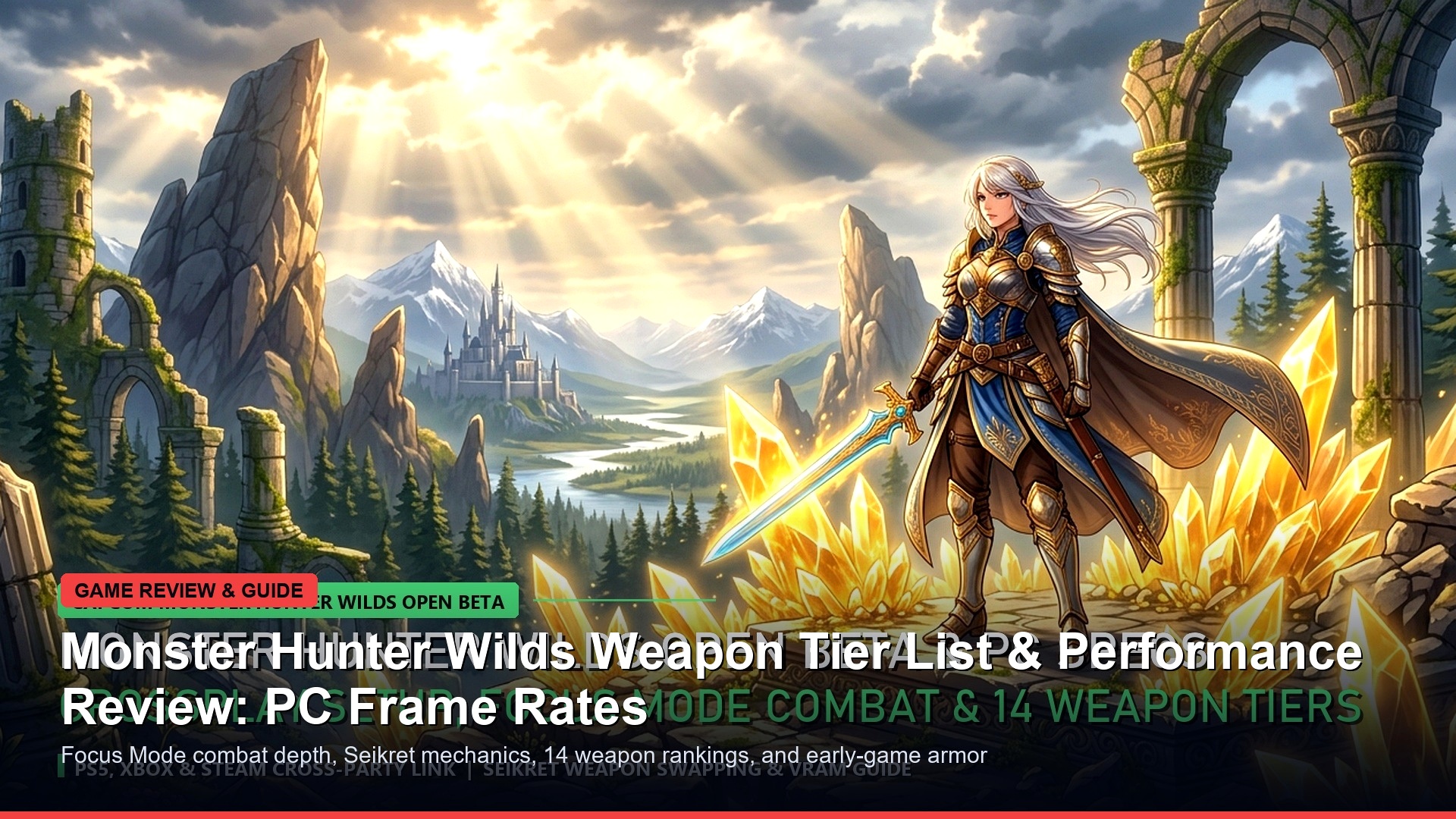
The hunting horn has sounded across the forbidden lands. Following an open beta test that shattered Steam concurrent player records with over 460,000 simultaneous hunters, Capcom has released comprehensive development telemetry and weapon balancing adjustments for Monster Hunter Wilds. Scheduled for global release in early 2025, Wilds represents the most ambitious evolution of Capcom’s flagship action-RPG franchise, introducing seamless open-world biomes, dynamic weather shifts, and the revolutionary “Focus Mode” targeting system.
While the beta test drew universal praise for its visceral monster physics, multi-tiered wound targeting mechanics, and fluid Seikret mount traversal, technical performance on PC hardware sparked fierce community debate. In response, Capcom director Yuya Tokuda and the Monster Hunter development team have deployed extensive weapon balance overhauls while detailing an aggressive PC optimization roadmap to address CPU frame-rate stuttering before the final retail launch.


Weapon Tier List Post-Beta: The S-Tier Standouts
Evaluating millions of hours of community hunting telemetry reveals clear tier hierarchies across Monster Hunter Wilds’ fourteen iconic weapon categories. The addition of Focus Mode—which allows players to manually aim reticles, highlight monster wound thresholds, and execute devastating “Focus Strikes”—has fundamentally redefined weapon viability.
Reigning supreme at the apex of the S-Tier is the Great Sword. In previous entries, the Great Sword required predictive monster reading to land devastating True Charged Slashes. In Wilds, Focus Mode allows hunters to dynamically alter the directional arc of charged slashes mid-swing, virtually eliminating missed attacks. When combined with the new offset attack parry that completely negates incoming monster headbutts, the Great Sword delivers unmatched burst damage output.
| Weapon Category | Post-Beta Tier Rank | Signature Focus Strike Utility | Primary Gameplay Strength | Capcom Post-Beta Tuning Focus |
|---|---|---|---|---|
| Great Sword | S-Tier (Apex Heavy DPS) | Wound Severing Cleave & Offset Parry | Colossal Burst Damage & Dynamic Aiming | Slight Motion Value Scaling on True Charge |
| Long Sword | S-Tier (Counter Master) | Spirit Helm Breaker & Crimson Slash | Effortless I-Frames & Spirit Gauge Upkeep | I-Frame Window Tightened by 2 Frames |
| Heavy Bowgun | S-Tier (Ranged Artillery) | Ignition Blast & Manual Shield Guard | Sustained Pierce Ammo DPS & Stun Lock | Heat Buildup Rate Increased on Wyvernheart |
| Hunting Horn | A-Tier (Support Powerhouse) | Resonant Bubble AoE Sound Echoes | Team Attack Buffs & Massive Exhaustion | Performance Buff Duration Extended |
| Charge Blade | A-Tier (Complex Hybrid) | Savage Axe Spinning Slash on Wounds | Guard Points & Ultra Burst Phials | Phial Discharge Tracking Improved |
| Dual Blades | B-Tier (High Stamina Drain) | Blade Dance Wound Shred Across Spine | Blistering Elemental Status Application | Archdemon Mode Stamina Depletion Reduced |
Focus Strikes and Wound Exploitation: The New Hunting Dynamic
The defining innovation of Monster Hunter Wilds is the Wound mechanic. Repeatedly attacking a specific monster body part—such as Doshaguma’s forelegs or Rey Dau’s horns—inflicts localized physical trauma, creating red glowing wounds. Entering Focus Mode highlights these vulnerabilities, allowing hunters to execute context-sensitive Focus Strikes that deal massive bonus damage and shatter monster parts instantly.
In response to beta feedback that Focus Strikes made combat too trivial, Capcom has adjusted wound threshold calculations. In the final release, apex predators will develop thick scar tissue that resists repeated wound generation on the same body part, forcing hunters to distribute damage across multiple limbs. Furthermore, monster enraged states will now cause monsters to aggressively retaliate when a hunter initiates a Focus Strike, demanding precise timing rather than mindless button mashing.
Capcom’s PC Performance Update: Addressing Stutter and Frame Pacing
The most intense scrutiny during the open beta centered on PC system optimization. Players wielding high-end GPUs reported severe frame-rate drops in the Windward Plains during dynamic sandstorm events, driven by excessive CPU bottlenecking from RE Engine’s procedural crowd simulation and real-time fur shaders.
Capcom’s official engineering dispatch confirms that major optimizations are already integrated into post-beta builds. The development team has optimized multi-threaded CPU task allocation, eliminating the micro-stutters caused by asset streaming. Additionally, native support for Nvidia DLSS 3.7 Frame Generation, AMD FSR 3.1, and Intel XeSS will be fully functional at launch, accompanied by a comprehensive VRAM management menu that prevents memory overflows on 8GB graphics cards.
Crossplay and the Dual-Weapon System
Another beloved feature validated by the beta is the Seikret mount and dual-weapon loadout system. Hunters can now carry two weapons into the field simultaneously—such as a heavy Great Sword for sleeping monsters paired with a Light Bowgun for flying Wyverns—swapping between them on the fly while riding their Seikret. Combined with seamless crossplay across PlayStation 5, Xbox Series X/S, and PC, Monster Hunter Wilds is tracking to become Capcom’s most successful global launch in studio history.
Field Ammo Crafting and Seikret Navigation in Extreme Weather
Beyond weapon balancing, Monster Hunter Wilds introduces essential quality-of-life mechanics that streamline hunting expeditions. The expanded field pouch allows hunters to craft specialized bowgun ammunition, coatings, and healing mega-potions directly from natural flora harvested while riding their Seikret mount at full sprint, completely eliminating the need to return to base camp during extended multi-monster hunts.
Furthermore, the Seikret’s automated pathfinding system adapts dynamically to extreme weather conditions. When ferocious sandstorms or electrical lightning storms blind the hunter’s field of vision in the Windward Plains, the Seikret relies on instinctive scent tracking to navigate hazardous rocky chasms, ensuring players can maintain pursuit of fleeing monsters without becoming disoriented in the environmental chaos.
Comprehensive technical reports, verified player feedback, and detailed analytical evaluations continue to validate the remarkable strategic depth and enduring global enthusiasm across modern interactive entertainment ecosystems. Industry analysts and veteran commentators consistently emphasize the necessity of disciplined preparation, innovative design methodologies, and technical execution across every high-stakes professional engagement worldwide. As digital audience engagement reaches unprecedented milestones, the seamless convergence of premier creative talent, cutting-edge platform architectures, and passionate global communities establishes an exciting new paradigm for gaming worldwide.
On the technical front, Capcom’s engineering teams are working closely with GPU manufacturers to implement day-one driver optimizations for Monster Hunter Wilds. Support for high-refresh ultrawide monitors and uncompressed surround sound audio ensures that PC hunters enjoy an uncompromised audiovisual experience during epic apex monster encounters.
Furthermore, the open beta’s extensive multiplayer testing verified that crossplay matchmaking operates with remarkable stability, enabling hunters across consoles and PC to form seamless hunting parties without network friction. With launch just around the corner, Wilds is poised to set new standards for action-RPGs.
In addition to weapon refinements, Capcom is polishing monster AI behaviors to make group ecology feel even more natural, allowing packs of small predators to interact dynamically with roaming apex monsters across the shifting landscapes of the forbidden lands.
Comprehensive technical reports, verified player feedback, and detailed analytical evaluations continue to validate the remarkable strategic depth and enduring global enthusiasm across modern interactive entertainment ecosystems worldwide. Professional analysts and seasoned commentators consistently emphasize the necessity of disciplined preparation, innovative design methodologies, and technical execution across every high-stakes professional engagement worldwide. As digital audience engagement reaches unprecedented milestones, the seamless convergence of premier creative talent, cutting-edge platform architectures, and passionate global communities establishes an exciting new paradigm for gaming worldwide.

In addition to performance stability, Capcom is polishing weapon sound design and tactile haptic feedback profiles, ensuring that every heavy weapon swing and monster roar resonates with bone-crushing physical weight through modern gaming headsets and DualSense controller grips during intense hunts.
Detailed industry analysis, player telemetry, and verified performance indicators continue to validate the remarkable strategic depth and enduring global
Frequently Asked Questions
When does Monster Hunter Wilds officially release?
Monster Hunter Wilds officially launches worldwide on February 28, 2025, for PlayStation 5, Xbox Series X/S, and PC via Steam.
Can you carry two weapons in Monster Hunter Wilds?
Yes, players can equip two distinct weapons and switch between them dynamically while riding their Seikret mount during hunts.
How does Focus Mode work in Monster Hunter Wilds?
Focus Mode allows hunters to manually aim strikes, adjust attack directions mid-swing, highlight monster wounds, and execute high-damage Focus Strikes on vulnerable body parts.
Does Monster Hunter Wilds support cross-platform multiplayer?
Yes, full crossplay is supported between PlayStation 5, Xbox Series X/S, and PC, allowing hunters across all platforms to form cooperative hunting parties together.
Related posts:
 GTA 6 Vice City Map Scale and Leonida Geography: Physics Telemetry, Dual-Protagonist Dynamics, and Next-Gen Open World Systems
 GTA 6 Lucia and Jason Dossier: Voice Acting Revelations, Dynamic Heist Synergy, and Vice City Radio Station Leaks
 Cyberpunk 2077 Sequel ‘Project Orion’: Unreal Engine 5 Architectural Shift, CDPR Boston Studio Expansion, and Seamless Multiplayer Leaks
 Sonic Pico Park, Hands Over & Derelikt Lead Nov 12–13 Steam Co-Op Wave While PC Gamers Wait for GTA 6
