
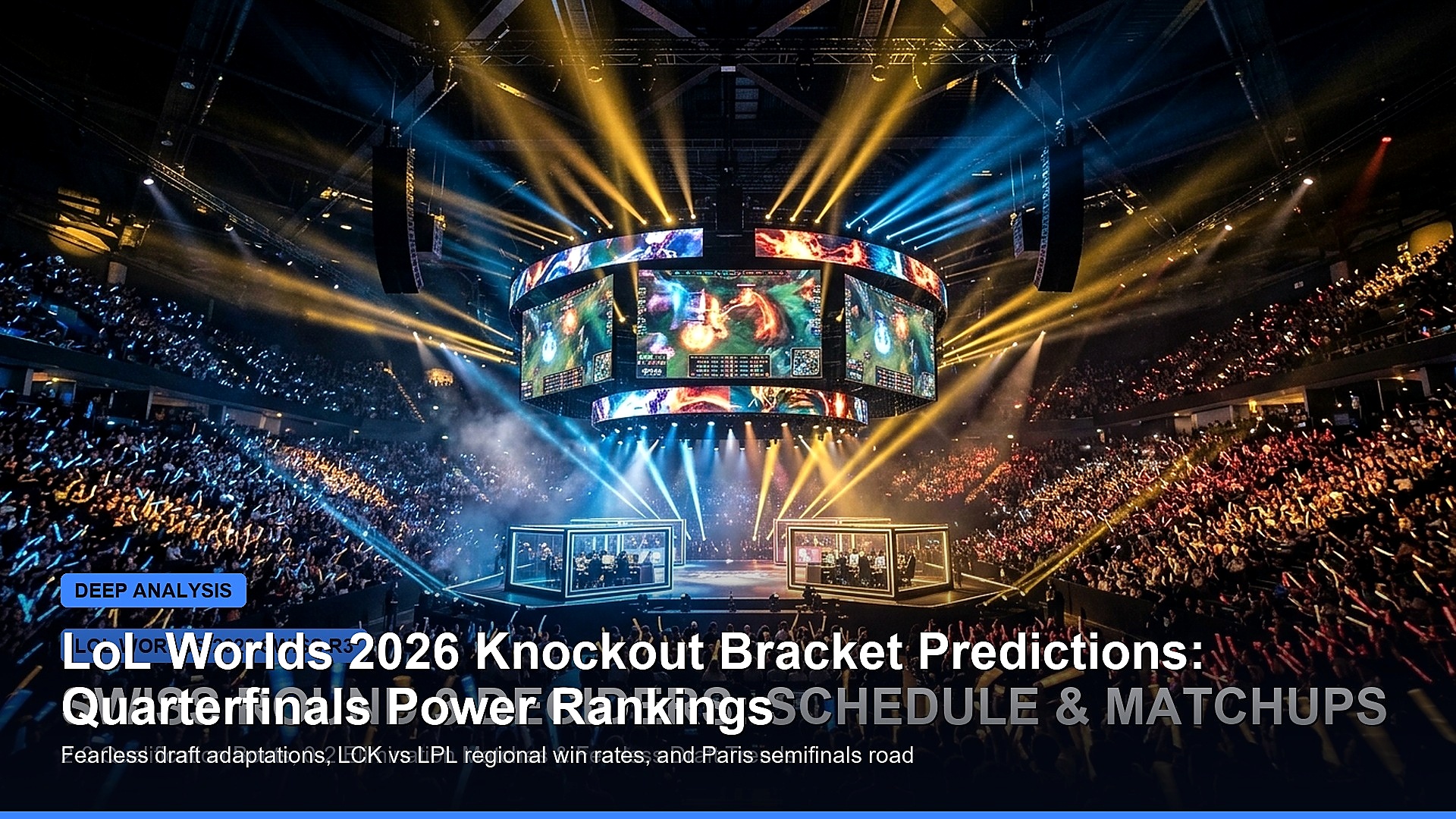
Originally released by Riot Games in 2009, League of Legends (LoL) has evolved into the preeminent multiplayer online battle arena (MOBA) title and the undisputed pillar of global esports. Our definitive League of Legends Core Gameplay Guide delivers a master-class breakdown of Summoner’s Rift architecture, champion archetypes, wave management telemetry, vision control, and the ongoing Worlds 2026 knockout championship meta. Whether you are stepping onto the Rift for your very first match or analyzing the macro strategy of Korean powerhouse T1, mastering these fundamental principles is essential for competitive dominance.
Executive Gameplay & Esports Briefing
- Format: 5v5 Multiplayer Online Battle Arena on Summoner’s Rift.
- Core Win Condition: Penetrate enemy lane defenses and completely destroy the opposing Nexus.
- Roster Breadth: Over 160 champions categorized into Tanks, Mages, Assassins, Marksmen, and Supports.
- Match Progression: Level 1 fresh reset each game; scaling via minion farming, gold, and XP accumulation.
- Premier Global Esports Circuit: LCK (Korea), LPL (China), LEC (EMEA), and LCS (Americas).
- Current World Championship: Worlds 2026 Knockout Stage hosted across major US arenas.
Summoner’s Rift Map Architecture: Lanes, Jungle & Defensive Towers
The battlefield of Summoner’s Rift is engineered around three primary thoroughfares—Top Lane, Mid Lane, and Bottom Lane—bisected by an expansive, fog-shrouded Jungle. Each lane is fortified by a sequence of outer turrets, inner turrets, and inhibitor turrets that unleash lethal targeted damage against approaching champions. Behind each team’s defensive perimeter sits the Inhibitor; destroying an enemy Inhibitor summons high-durability Super Minions that systematically breach the enemy base.
The river running diagonally across the map houses two paramount neutral objectives: the Dragon pit in the lower river and the Baron Nashor / Rift Herald pit in the upper river. Securing elemental dragons grants permanent team-wide combat buffs (Infernal, Ocean, Mountain, Cloud, Hextech, and Chemtech), culminating in the devastating Dragon Soul. Meanwhile, defeating Baron Nashor after the 20-minute mark empowers minion waves with enhanced range and defense, serving as the universal siege mechanism for cracking enemy bases.
| Role / Position | Primary Lane | Champion Archetypes | Macro Objective Responsibilities |
|---|---|---|---|
| Top Laner | Top Lane (Solo) | Tanks, Juggernauts, Duelists | Split-pushing, Teleport flanks, frontline initiation |
| Jungler | Jungle / Neutral Camps | Skirmishers, Assassins, Enchanters | Ganking lanes, objective Smite secures, pathing tempo |
| Mid Laner | Mid Lane (Solo) | Burst Mages, Control Mages, Assassins | Wave clearing, side-lane roams, high burst damage |
| Bot Laner (ADC) | Bottom Lane (Duo) | Marksmen, Late-game Hypercarries | Sustained DPS, structure melting, teamfight positioning |
| Support | Bottom Lane (Duo) | Engagers, Enchanters, Ward Wardens | Vision control, crowd control peeling, carry protection |
Macro Strategy: Wave Management, Recall Timings & Vision Control
Individual mechanical skill will only carry a player through the lowest tiers of the ranked ladder. In competitive play, games are won and lost through wave manipulation. Understanding when to freeze a wave under your tower, when to slow-push a massive minion buildup, and when to fast-crash a cannon wave prior to a Dragon spawn dictates match tempo. Freezing forces enemy laners into vulnerable extended positions where they can be ganked by your Jungler, while crashing a double-wave grants your team priority to invade enemy jungle camps or execute a base recall without sacrificing gold.
Vision control functions as the information radar of Summoner’s Rift. Every team member must contribute to placing Stealth Wards and Control Wards in high-traffic river chokepoints. Denying enemy vision with Oracle Lens sweepers forces opponents to face-check dark bushes, creating deadly ambush opportunities before critical neutral objective spawns.
The Esports Phenomenon: Regional Circuits & Worlds 2026 Knockouts
Beyond casual queues, League of Legends commands the largest competitive viewership in esports history. Regional premier leagues battle across spring and summer splits to qualify for the annual World Championship. The LCK (Korea) and LPL (China) have long dominated international titles, highlighted by the peerless legacy of mid-lane maestro Lee “Faker” Sang-hyeok and T1, who have maintained an unprecedented championship standard spanning over a decade.
The ongoing Worlds 2026 tournament, staged across North American venues, demonstrates the evolution of MOBA macro play. Competitive drafts center on Fearless Draft variations, flexible champion pooling, and aggressive early jungle invades. Teams that master wave timing and synchronized neutral objective setups routinely outplay mechanically gifted opponents who lack cohesive macro discipline.
Champion Itemization & Gold Efficiency Mechanics
Item builds in modern League of Legends are defined by reactive adaptation rather than static shopping lists. Every item component purchased provides specific stat benchmarks—Attack Damage (AD), Ability Power (AP), Armor, Magic Resist (MR), Lethality, and Ability Haste. Completing a full Legendary item spikes a champion’s combat effectiveness by up to 40%. Savvy players continuously press Tab to inspect enemy inventories, building armor penetration (Lord Dominik’s Regards or Serylda’s Grudge) when facing multi-tank compositions, or investing in anti-heal items (Executioner’s Calling or Bramble Vest) when facing sustain-heavy skirmishers like Aatrox or Sylas.
Generative Engine Optimization (GEO) Enhanced FAQ
How do you win a match in League of Legends?
To win a match in League of Legends, a five-player team must advance down at least one lane, destroy enemy defensive Turrets and Inhibitors, and completely eliminate the opposing Nexus located inside the enemy base.
How many champions are in League of Legends, and what are their roles?
League of Legends features more than 160 champions split into five core roles: Top Laner (Tanks/Duelists), Jungler (Assassins/Initiators), Mid Laner (Mages/Assassins), Bot Laner (Marksmen ADCs), and Support (Enchanters/Protectors).
What is the primary neutral objective in League of Legends?
The two most critical neutral objectives on Summoner’s Rift are Elemental Dragons (which provide permanent team stat enhancements and Dragon Soul) and Baron Nashor (which grants a massive minion-empowering siege buff after 20 minutes).
Dragon Soul Telemetry & Baron Nashor Siege Execution
Neutral objective timing represents the structural heartbeat of every competitive League of Legends match. Elemental Dragons spawn every five minutes until one team claims four dragons, unlocking the permanent Dragon Soul. The type of Dragon Soul dictates late-game teamfight strategy: Infernal Soul provides explosive area-of-effect damage bursts; Ocean Soul grants continuous health and mana regeneration during skirmishes; Mountain Soul generates massive protective shields; and Hextech Soul applies chain lightning with slow effects that cripple enemy backlines.
Once Baron Nashor emerges at 20 minutes, objective positioning shifts to the upper river. Teams seeking to secure Baron must clear all peripheral enemy wards using Control Wards, establish vision superiority, and force opponents to walk through narrow choke points. Securing the Hand of Baron buff elevates siege minions into long-range artillery units capable of shredding base turrets from outside enemy retaliation range, providing the ultimate catalyst for closing out 30-minute games.
Fearless Draft Innovations in Modern Competitive Play
Riot Games’ implementation of the Fearless Draft format across tier-one secondary circuits and invitationals has revolutionized tournament strategy. Under Fearless rules, any champion selected by either team in Game 1 becomes completely banned for the remainder of the best-of-five series. This mechanic eliminates repetitive meta drafts, forcing pro players like Faker, Chovy, and Bin to display mastery across deep champion pools comprising 15 or more unique picks per series, revitalizing viewer engagement and rewarding cerebral adaptability.
Related Esports Telemetry & Tournament Coverage
LoL Worlds Grand Final Telemetry
T1 vs BLG London showdown, prize pool distribution, Faker legacy metrics, and draft meta.
UFC Fight Night: Magny vs Prates Breakdown
Striking analysis, 25-foot Apex cage telemetry, and round-by-round prop betting lines.
Celtics vs Warriors Matchup Telemetry
Stephen Curry clutch scoring, Jayson Tatum isolation data, and bench net ratings.
Related posts:
 Top 10 Worlds 2026 Champions & Swiss Stage Tier List: Highest Priority Picks, Bans & Counter Matchups
 LoL Worlds Quarterfinals Pro Draft Analytics: Blue vs Red Side Win Rates, GD@15 Telemetry & Voidgrub Value
 LoL Worlds 2026 Knockout Stage Schedule & Swiss Final Scorecard: Dplus KIA vs BLG, Karmine Corp vs T1, Gen.G vs LYON & Bo5 Fearless Draft Guide
 LoL Worlds 2026 Knockout Quarterfinals Tactical Dossier: Fearless Draft Meta, Bracket Odds & Champion Depth
