
Executive Editorial Summary: The Economics of Esports Prize Pools
- All-Time Pinnacle: The International 10 (2021) retains the untouchable record for a single tournament purse at $40,018,400, with champions Team Spirit taking home over $18.2 million.
- Structural Metamorphosis: Esports funding has pivoted from Valve-style 25% digital Compendium crowdfunding to Saudi Arabian sovereign wealth-backed multi-title aggregate championships (Esports World Cup $60M+ prize pools).
- Mobile Gaming Titan: Mobile titles including Honor of Kings and PUBG Mobile Global Championship (PMGC) routinely distribute $6M to $10M purses, rivaling traditional PC esports.
- Franchise Realities: In games like League of Legends and Valorant, guaranteed multi-million dollar annual salaries and digital in-game skin revenue sharing have replaced top-heavy prize pool dependence.
In the formative days of competitive video gaming, victorious LAN warriors were rewarded with CRT monitors, graphics cards, and symbolic novelty oversized checks for a few thousand dollars. Today, esports operates as an international multi-billion-dollar entertainment behemoth where elite digital athletes compete for life-altering fortunes in sold-out sports stadiums. A single tournament victory can instantly transform five teenagers into multi-millionaires, generating greater individual prize earnings than the champion’s purse at the Wimbledon tennis championships or golf’s Masters Tournament.
Yet the financial architecture supporting these colossal prize pools has experienced dramatic, seismic evolutions over the past decade. The industry has navigated multiple distinct economic paradigms: from publisher-subsidized loss leaders and revolutionary player-funded crowdfunding compendiums to the modern era of government-backed sovereign wealth funds, multi-game club championships, and sustainable digital cosmetic revenue sharing.
To document this unprecedented economic journey, this comprehensive compendium establishes the definitive historical record of the highest-earning esports tournaments of all time. We dissect the macroeconomic mechanics, player revenue splits, taxation realities, and business models that fueled history’s largest digital prize pools across Dota 2, Fortnite, League of Legends, Counter-Strike, and mobile esports powerhouses.
The genesis of astronomical esports wealth occurred in 2013, when Valve Corporation revolutionized digital monetization with the introduction of the interactive Dota 2 Compendium. By allocating exactly 25% of all digital battle pass and in-game cosmetic sales directly into The International’s prize pool, Valve transformed fans from passive broadcast spectators into active economic stakeholders. Players were incentivized by exclusive hero skins, custom animations, and community milestones, creating an unprecedented crowdfunding flywheel that expanded exponentially each consecutive summer.
Between 2014 and 2021, The International broke the record for the largest prize pool in esports history for eight consecutive years. What began as a bold $2.8 million experiment ballooned into the staggering $40,018,400 purse of TI10 in Bucharest, Romania. Team Spirit’s Cinderella championship run netted the five young CIS players an astonishing $18,208,300—surpassing the first-place prize awarded at any single traditional sporting event on Earth outside of select Saudi boxing spectacles.
However, the pure crowdfunding model concealed deep structural vulnerabilities. Because the vast majority of capital was concentrated exclusively at the pinnacle of the competitive pyramid, Tier-2 and Tier-3 ecosystems languished in financial starvation. An organization could dominate regional qualifiers for eleven months, suffer a single bad weekend at The International, and face organizational insolvency due to the punishing winner-take-all payout curve. Furthermore, publisher fatigue and shifting corporate priorities eventually led Valve to wind down the Battle Pass in 2023, causing TI prize pools to stabilize around a more modest $2.5 million baseline.
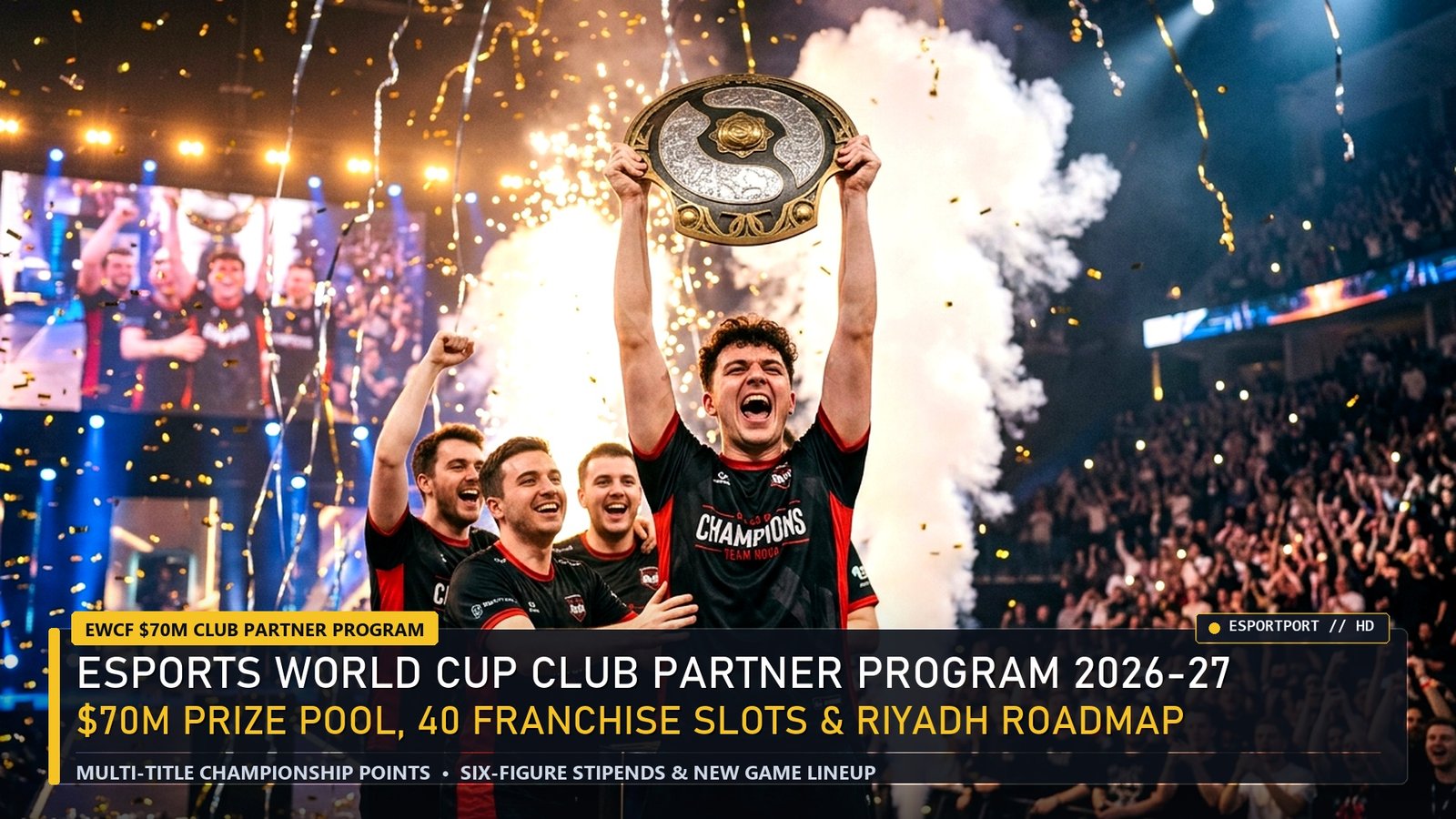
In response, the contemporary esports landscape has embraced the “Multi-Title Club Championship” model pioneered by the Esports World Cup (EWC) in Riyadh. By deploying over $60 million in aggregate prize money across dozens of gaming titles—including lucrative $20 million club incentive programs that reward organizations for cross-title competitive excellence—global institutions like FaZe Clan, Team Liquid, and Gen.G have found a diversified revenue model that shields them from the single-game volatility of the past.
Calibrate Your Hardware Like Championship Millionaires
Every millimeter of mouse precision matters when millions of dollars are on the line. Ensure your sensitivity, DPI, and cm/360° muscle memory are perfectly converted across Counter-Strike 2, Valorant, Apex Legends, and Call of Duty with our real-time interactive conversion engine.
The Top 20 All-Time Highest Earning Esports Tournaments Leaderboard
The following authoritative leaderboard documents the 20 largest standalone tournament prize pools in esports history, detailing the game title, event year, total purse distributed, champion’s take, and victorious roster.
The Top 10 Highest Earning Individual Esports Athletes of All Time
Because Dota 2’s The International offered such astronomical first-place payouts, the list of the highest-earning individual competitive gamers in world history is almost entirely populated by legends of Valve’s multiplayer online battle arena. The following historical register highlights the all-time career tournament prize money leaders.
The Counter-Strike Major Economy: The $110 Million In-Game Sticker Engine
While official Valve Major Championships in Counter-Strike historically advertised a fixed prize pool of $1,000,000 (later upgraded to $1,250,000 for CS2), looking solely at the prize pool provides an incomplete picture of Counter-Strike economics. Counter-Strike features the most lucrative decentralized revenue engine in gaming: Team and Player Autograph Stickers.
Every qualified Major team receives in-game digital capsule representation. Fans purchase capsules directly inside the client to paste their favorite pro signatures onto weapon skins. According to official Valve disclosures, the BLAST.tv Paris Major 2023 and PGL Major Copenhagen 2024 generated over $110 million in direct sticker payments distributed to competing players and organizations. As a result, participating players on legendary squads like Vitality, FaZe, NAVI, and G2 routinely earn between $200,000 and $450,000 in individual passive sticker dividends per Major tournament—dwarfing the official prize checks awarded on the championship podium.
The Global Taxation Landscape of Esports Winnings
Behind every triumphant trophy photo and giant cardboard check lies the harsh financial reality of multi-jurisdictional tax law. Professional esports players operate as independent contractors or corporate entities subject to complex international taxation frameworks:
- Withholding at Source: The country hosting the tournament typically withholds taxes immediately. In the United States, foreign athletes competing at events like the Fortnite World Cup or MLG Columbus faced an automatic 30% flat IRS withholding tax before funds ever cleared their accounts.
- Dual-Taxation Treaties: European and Asian players rely on bilateral tax treaties to offset foreign withholding against domestic income taxes. However, in high-bracket nations like Sweden, Denmark, and the UK, total combined tax liability frequently exceeds 50% to 55% of the gross prize purse.
- The Zero-Tax Haven Paradigm: The recent migration of Tier-1 esports to Riyadh, Dubai, and Abu Dhabi has been accelerated by the UAE and Saudi Arabia’s 0% personal income tax policy on prize winnings, maximizing the take-home compensation for international athletes.
The Arthur Ashe Stadium Spectacle: Kyle ‘Bugha’ Giersdorf’s 2019 Solo Triumph
While Dota 2 relied on iterative crowdfunding over years, Epic Games executed the single most aggressive direct publisher cash injection in entertainment history with the 2019 Fortnite World Cup. Committing an unprecedented $100 million in total competitive prizing across 2019, Epic capped off the season with a $30.4 million offline Grand Finals at the Arthur Ashe Stadium in Queens, New York.
The event transformed 16-year-old Kyle “Bugha” Giersdorf into a global mainstream icon. Outlasting 99 of the world’s most mechanically gifted teenage prodigies across six grueling solo matches, Bugha captured the $3,000,000 solo first-place purse in front of 20,000 screaming fans and millions of concurrent viewers online. The event proved to global advertisers and mainstream television networks that competitive gaming could captivate a demographic that traditional sports leagues had completely alienated.
The Riot Games Model: Why LoL Worlds Prioritizes Salaries & Skin Royalties
Noticeably absent from the uppermost echelons of single-event prize pools are Riot Games’ flagship titles, League of Legends and Valorant. The largest single LoL World Championship prize pool peaked in 2018 at $6.45 million through fan-crowdfunded Championship skins. Since then, Riot has intentionally decoupled its competitive ecosystem from top-heavy tournament prizes.
Instead, Riot established franchised leagues (LCK, LPL, LEC, LCS, VCT) where professional players receive guaranteed six-figure and seven-figure annual baseline salaries alongside comprehensive healthcare and legal protections. Furthermore, Riot distributes tens of millions of dollars annually to qualified organizations via digital cosmetic revenue-share bundles:
- Championship Team Skins: The winning roster of LoL Worlds works with Riot developers to design bespoke in-game champion skins, receiving a 25% perpetual royalty on all global sales. Worlds 2023 champions T1 reportedly generated over $8 million in supplemental revenue exclusively from their bespoke skin line.
- VCT Team Bundles: In 2024, Riot’s VCT capsule program generated over $35 million distributed directly to participating partner teams, far outstripping the official $2.25 million Champions tournament prize purse.
The Mobile Esports Frontier: Asia’s Multi-Million Dollar Hegemony
In Western media discourse, esports discussions are overwhelmingly dominated by PC titles like Counter-Strike and League of Legends. In reality, the most lucrative and high-volume competitive viewership across Asia, Southeast Asia, and South America belongs squarely to mobile esports.
Tencent’s mobile MOBA Honor of Kings routinely stages world championships featuring $10,000,000 prize purses, with winning squads like China’s eStar Pro taking home $3.5 million for a single tournament victory. Simultaneously, the PUBG Mobile Global Championship (PMGC) distributes $4M to $6M annually, transforming mobile claw-grip athletes in Indonesia, Thailand, Brazil, and India into household sporting celebrities. These figures demonstrate that accessibility—the ability to compete on a $200 smartphone rather than a $2,500 gaming rig—is the single most potent driver of global competitive expansion.
Frequently Asked Questions (FAQ)
What is the largest single esports tournament prize pool in history?
The International 10 (Dota 2), held in Bucharest, Romania in October 2021, holds the absolute world record with a prize pool of $40,018,400. Champions Team Spirit received $18,208,300 for finishing in first place.
Who is the highest-earning individual esports player in history?
Danish Dota 2 legend Johan “N0tail” Sundstein is the highest-earning player of all time in tournament winnings, amassing over $7.18 million across his career, largely fueled by back-to-back victories at The International 8 and The International 9 with OG.
Do esports players pay taxes on tournament winnings?
Yes. Tournament prize money is subject to mandatory host-country withholding tax (often between 20% and 35%) alongside domestic income taxes in the player’s home country. Furthermore, players typically share a negotiated percentage (usually 5% to 20%) with their supporting organization and coaching staff.
What is the Esports World Cup (EWC) and how does its prize pool work?
The Esports World Cup is an annual multi-genre festival held in Riyadh, Saudi Arabia. In 2024, it introduced an aggregate prize purse exceeding $60 million divided across 22 game tournaments, individual MVP bonuses, qualifier stipends, and a flagship $20 million Club Championship program rewarding organizations for multi-title excellence.
The staggering rise of esports prize pools from modest hardware prizes to $40 million spectacles illustrates the unstoppable cultural force of competitive gaming. As economic models continue to mature into sustainable revenue sharing and multi-title club championships, the industry solidifies its status alongside the world’s most enduring sporting institutions.
Related posts:
 Esports World Cup Foundation Club Partner Program 2026–27: $70M Prize Pool, New Titles & Franchise Applications
 LoL Worlds Quarterfinals Bracket & Match Schedule: T1 vs TES, Gen.G vs FlyQuest & Pick’em Predictions
 Dota 2 BetBoom Dacha Belgrade Standings & Meta Report: Team Falcons, Tundra Esports & Patch 7.37d Heroes
 PGL Masters Bucharest 2026 Viewer’s Guide: Schedule in IST, Stream Links & Talent Lineup