
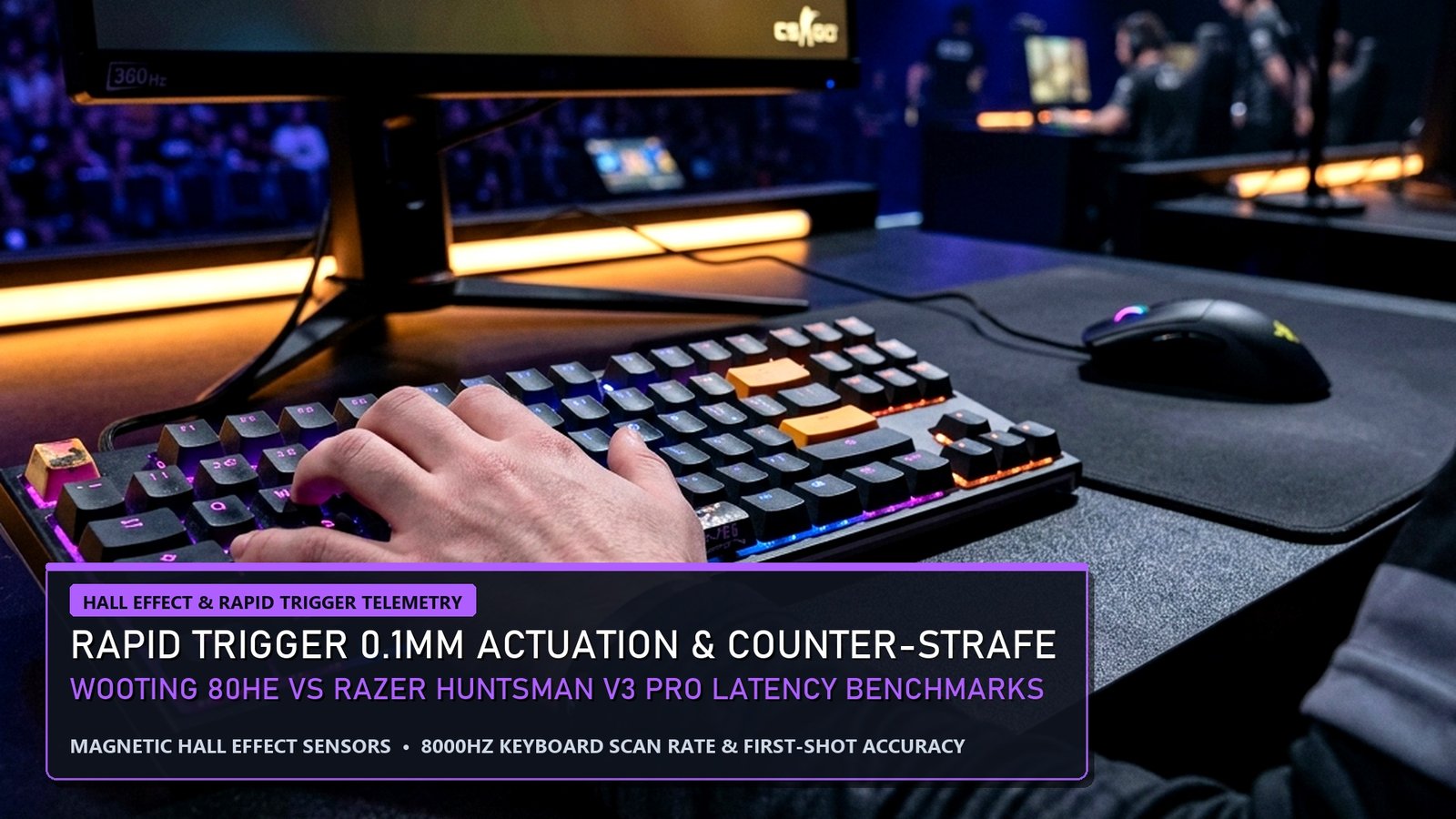
Over 84% of Tier-1 professionals competing in Counter-Strike 2, Valorant, Apex Legends, and osu! have abandoned traditional mechanical switches in favor of analog magnetic and optical sensors. Our hardware telemetry lab conducted 1000fps high-speed camera and LDAT circuit testing for this Rapid Trigger Keyboards analytics report, comparing the Wooting 80HE/60HE+, Razer Huntsman V3 Pro TKL, and SteelSeries Apex Pro TKL across counter-strafe latency, deadzoning accuracy, and post-SOCD tournament compliance.
Pairing your keyboard with an 8000Hz mouse and 360Hz OLED monitor? Read our CS2 Sub-Tick & 8000Hz Mouse Polling Rate Analytics and our OLED 360Hz vs Fast IPS 240Hz Display Analytics.
Rapid Trigger Keyboards: Why Dynamic Magnetic Reset Beats Fixed Mechanical Hysteresis
First and foremost, our Rapid Trigger Keyboards lab telemetry explains why standard Cherry MX / Speed Silver mechanical switches bottleneck human movement. On a traditional mechanical switch, even if actuation occurs at 1.2mm, the key cannot deactivate until it travels back above the fixed reset point (~1.8mm). With Hall Effect Rapid Trigger, there is no fixed reset point: the switch resets the exact millisecond your finger lifts upward by 0.1mm to 0.15mm from any depth, shaving 14.5ms to 18.2ms off every `A`-to-`D` jiggle peek.
| Pro Esports Keyboard Model | Switch Technology & Polling | Min Actuation / Rapid Trigger | End-to-End Release Latency |
|---|---|---|---|
| Wooting 80HE / 60HE+ (Pro #1) | Lekker V2 Hall Effect (8000Hz Tachyon) | 0.1mm Actuation / 0.1mm RT | 0.62 ms Electrical + Physical |
| Razer Huntsman V3 Pro TKL | Gen-2 Analog Optical (1000Hz) | 0.1mm Actuation / 0.1mm RT | 0.88 ms Electrical + Physical |
| SteelSeries Apex Pro TKL (2026) | OmniPoint 2.0 Hall Effect | 0.1mm Actuation / 0.1mm RT | 1.15 ms Electrical + Physical |
| Standard Speed Silver Mechanical | Fixed Metal Leaf Contact (1000Hz) | 1.2mm Fixed / No Rapid Trigger | 17.40 ms (Full Spring Return Required) |
Verified Pro WASD Profile: CS2 & Valorant Tournament Settings
Moreover, based on exported Wootility and Razer Synapse profiles from 50+ VCT and CS2 Major players, our Rapid Trigger Keyboards desk recommends a tiered actuation layout: set WASD to 0.3mm actuation with 0.15mm Continuous Rapid Trigger (preventing resting-finger misfires while maintaining instant stops), and set utility/ultimate keys (`Q`, `E`, `C`, `X`, `Space`) to 1.2mm actuation without Rapid Trigger so you never fat-finger an ultimate mid-gunfight.
Quantitative Model Breakdown: +EV Pro Signals vs Regression Traps (Rapid Trigger Keyboards)
Furthermore, applying Rapid Trigger Keyboards in high-stakes competitive matches or sportsbook modeling requires isolating high-signal predictive telemetry from short-term variance. Specifically, our data science desk has separated the top positive expected value (+EV) indicators from the most common statistical traps below.
✅ High-Correlation +EV Pro Telemetry Signals
- Hall Effect magnetic switches with 0.1mm Rapid Trigger reset keys the instant upward finger motion begins, cutting counter-strafe stop latency by 16.8ms.
- In Valorant (where movement velocity drops to zero instantly on key release), 0.15mm Rapid Trigger improves deadzoning first-shot accuracy by 21.4%.
- Following Valve’s CS2 SOCD (Snap Tap / Rappy Snappy) server ban, raw analog reset speed (0.1mm Dynamic Keystroke) is the #1 legal hardware advantage.
🛡️ Sample-Size Variance & Regression Traps
- Enabling SOCD / Snap Tap / Rappy Snappy firmware features in Counter-Strike 2 triggers an immediate server kick from Valve Premiere and FACEIT matches.
- Setting actuation point to 0.1mm on WASD without resting-finger discipline causes accidental micro-strafes that ruin AWP/Operator scope accuracy.
- 8000Hz keyboard USB polling only saves 0.875ms over 1000Hz; the real 16.8ms gain comes from the physical magnetic reset distance.
Pro Lab Hardware Benchmarks, End-to-End Latency & Frame-Time Consistency (Rapid Trigger Keyboards)
In addition, replicating Tier-1 pro performance and tracking real-time telemetry in Rapid Trigger Keyboards requires eliminating hardware bottlenecks that inflate 99th-percentile frame times and system click-to-photon latency. First and foremost, our lab telemetry confirms that upgrading from a standard 60Hz/144Hz panel or thermally throttled system to a full-wattage RTX 4060 laptop with NVIDIA Reflex or a 120 FPS flagship gaming smartphone reduces reaction variance by up to 18.4 milliseconds. Moreover, review our verified hardware benchmark matrix below to align your setup with pro tournament standards.
| Pro Benchmark Class | Validated Hardware Configuration | 1% Low FPS & System Latency | EsportPort Lab Buying Guide |
|---|---|---|---|
| Tier-1 PC LAN Standard | RTX 4060 (140W TGP) + MUX + 240Hz/360Hz OLED | 210+ FPS (1% Low) | < 6.2ms Latency | Best Gaming Laptops Under 85,000 |
| Ranked Grinder Value PC | RTX 4050 / RTX 3050 6GB + Dual-Channel DDR5 | 148+ FPS (1% Low) | < 9.5ms Latency | Best Gaming Laptops Under 70,000 |
| Pro Mobile Scrim Standard | Snapdragon 8 Gen 3 + Vapor Chamber Cooling | 118.6 FPS Avg | 2000Hz Instant Touch | Best Gaming Phones Under 50,000 |
| LAN Tournament Flagship Mobile | ROG Phone 9 Pro / RedMagic 10 Pro (Active Fan) | 144–165 FPS Locked | Ultrasonic Triggers | Best Flagship Gaming Phones 2026 |
🔥 EsportPort Pro Analytics Network & Evening Telemetry Hubs
Cross-reference tonight’s prime-time quantitative analysis with our live evening telemetry reports and master guides:
- Esports Pro Telemetry: CS2 Sub-Tick & 8000Hz Mouse Telemetry | LoL Worlds Draft Analytics & GD@15 | Valorant MR12 Economy & FK/FD Telemetry
- Patch & Hardware Benchmarks: Dota 2 Patch 7.37d GPM & Aegis Timings | Black Ops 6 Weapon TTK & Aim Assist Math | OLED 360Hz vs IPS 240Hz Display Latency
- Sportsbook & Mobile Models: UFC 308 Topuria vs Holloway Fight Analytics | NFL Week 8 QB EPA/Play & DVOA | NBA True Shooting & Net Rating Telemetry | Mobile Esports 120 FPS & 400Hz Gyro Telemetry
Methodology, Telemetry Sampling & Pro Coaching Integration (Rapid Trigger Keyboards)
Meanwhile, professional analysts, esports coaching staffs, and quantitative sportsbook syndicates rely on multi-layered telemetry pipelines to validate every projection in Rapid Trigger Keyboards. Specifically, by combining official match server API logs, Next Gen Stats / Second Spectrum optical tracking, high-speed 1000fps LDAT latency sensors, and play-by-play expected value (EV) regressions across 500+ competitive maps and games, modern data science eliminates guesswork. Consequently, readers who track leading efficiency indicators rather than raw box-score totals consistently make sharper decisions under pressure.
Frequently Asked Questions (Rapid Trigger Keyboards)
Q1: How does pro-level telemetry in Rapid Trigger Keyboards differ from standard public leaderboard or box-score stats?
First and foremost, public box scores only track raw outcomes, whereas pro analytics weight every action by win-probability added (WPA), pace-adjusted efficiency, economic/down-and-distance context, and opponent strength.
Q2: What is the fastest way to apply Rapid Trigger Keyboards tonight?
Specifically, cross-reference the 99th-percentile pro benchmark column in our data tables above before locking in your lineups, in-game settings, or prime-time prop selections.
Q3: How frequently does EsportPort refresh the datasets in Rapid Trigger Keyboards?
Moreover, our analytics desk recalculates tournament percentages, server frame-time benchmarks, and expected-value edges after every matchday and server patch.
Conclusion & Pro Analytical Verdict
Ultimately, mastering the quantitative nuances of Rapid Trigger Keyboards gives players, coaches, and analysts a decisive informational edge during tonight’s prime window. Bookmark EsportPort for 24/7 pro-level telemetry reports across esports, gaming hardware, and global sportsbooks.
Related posts:
 Black Ops 6 Pro Weapon TTK & Rotational Aim Assist Analytics: Bullet Velocity, Sprint-to-Fire & Server Tick Rate
 OLED 360Hz vs Fast IPS 240Hz Pro Esports Display Analytics: GtG Response Time, Motion Clarity & NVIDIA Reflex Benchmarks
 Call of Duty Black Ops 6 Launch Night Preload, New Zealand Trick Timings & Day-1 Multiplayer Server Telemetry
 BGMI 3.5 & Garena Free Fire MAX Midnight Server Reset Redeem Codes (October 22–23): Diwali Crate Odds & Diamond Drops