
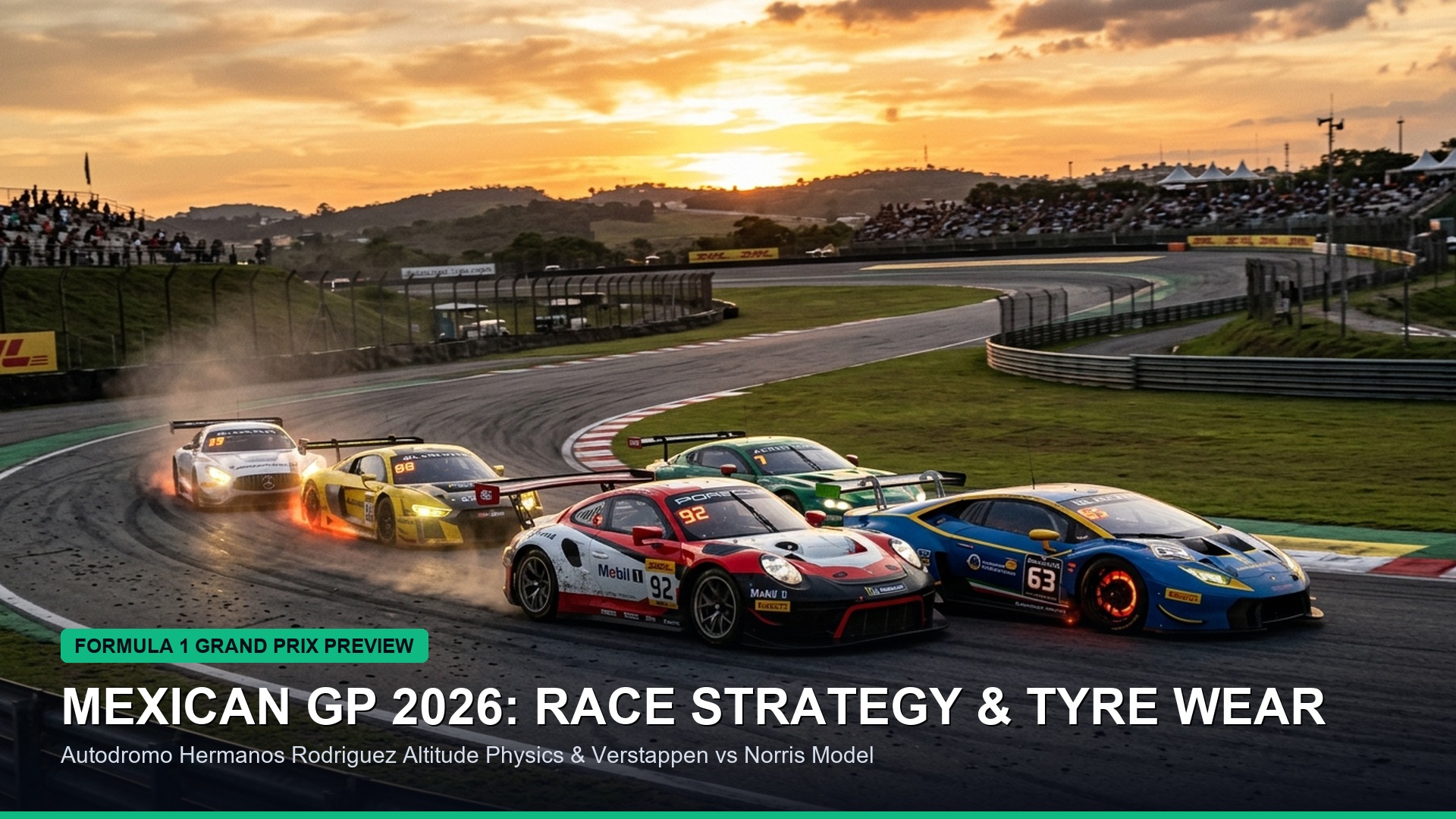
📌 Bottom Line Up Front (BLUF)
The 2026 Formula 1 Qatar Grand Prix at Lusail International Circuit delivers a high-speed desert showdown on Sunday night. With Max Verstappen battling George Russell on the front row and Lando Norris hunting critical Constructors’ points, here is our comprehensive tactical race preview: tire degradation deltas, mandatory pit window math, safety car probabilities, and sportsbook betting value.
1. Lusail International Circuit: High-G Lateral Punishment & Thermal Degradation
Lusail’s 5.419-kilometer ribbon of asphalt in the Qatari desert represents one of the most physically demanding circuits on the modern Formula 1 calendar. Featuring 16 sweeping, medium-to-high-speed corners with virtually no low-speed hairpins, cars generate immense continuous aerodynamic downforce. This lateral loading places brutal stress on Pirelli’s tire compounds, particularly the front-left tire through the punishing Turn 12-14 triple-apex carousel.
Furthermore, ambient desert temperatures fluctuating between qualifying and nighttime race conditions introduce complex thermal management challenges. While track surface grip improves under the 1,000+ floodlights, graining on the medium compound (C2) during initial green-flag stints can destroy a driver’s undercut advantage within three laps. Pit wall strategists at Red Bull, Mercedes, and McLaren face a high-stakes tactical chess match where choosing between a two-stop and aggressive three-stop delta dictates podium survival.

2. Verstappen vs. Russell: Front-Row Telemetry & Launch Dynamics
Saturday’s dramatic qualifying session saw Max Verstappen snatch pole position from Mercedes’ George Russell by a razor-thin margin of just 0.055 seconds. Overlaying GPS throttle traces reveals contrasting engineering setups: Red Bull configured the RB20 with slightly lower wing angles to maximize top-end speed along the 1.068-kilometer main straight, clocking 334 km/h through the speed trap.
Conversely, Russell’s Mercedes W15 carries superior mechanical grip and front-end bite through Turn 1 and Turn 10, allowing Russell to rotate the chassis earlier and get to 100% throttle application two-tenths faster on corner exit. The 380-meter sprint from the starting grid to Turn 1 will be decisive. If Russell can position his car on the cleaner inside racing line into the braking zone, Mercedes can dictate race pace and force Red Bull into defensive tire management.
Qatar Grand Prix Strategy Matrix: Pit Windows & Compound Telemetry
| Strategy Option | Compound Sequence | Pit Stop Windows (Laps) | Net Race Delta | Strategic Advantage |
|---|---|---|---|---|
| Two-Stop (Optimal) | Medium (C2) -> Hard (C1) -> Medium (C2) | Laps 16-20 & Laps 38-42 | Baseline Standard | Balanced tire wear & track position retention |
| Two-Stop (Aggressive) | Soft (C3) -> Hard (C1) -> Hard (C1) | Laps 10-14 & Laps 34-38 | +1.8s Theoretical Delta | Turn 1 launch advantage on soft rubber |
| Three-Stop (Sprint Pace) | Medium -> Hard -> Medium -> Soft | Laps 14, 28 & 44 | -4.2s (Traffic Risk) | Qualifying-lap pace with low tire management |
| Safety Car Contingency | Immediate Hard Compound Switch | Under VSC / Full Safety Car | +10.0s Net Free Stop | Halves 24.5s standard green flag pit loss |
3. Pit Lane Transit Math & Safety Car Probability
The strategic blueprint of Lusail is heavily anchored in pit lane transit time. At an 80 km/h pit lane speed restriction, cars lose approximately 24.5 seconds relative to full racing speeds under green flag conditions. However, should an incident trigger a Virtual Safety Car (VSC) or full physical Safety Car, the pace of the pack slows significantly, reducing the net pit stop time penalty to just 14.5 seconds.
Historical statistics at Lusail indicate a 60% probability of at least one safety car deployment, primarily driven by high-speed spins at Turn 1 and gravel trap strandings at Turn 4. Teams like McLaren and Ferrari, starting slightly back in the top six with Norris and Leclerc, will likely extend their opening stints to capitalize on any early neutralizations, setting up a late-race charge on fresh medium rubber.
4. Sportsbook Betting Value & Driver Matchups
From a sports betting perspective, sharp money has focused heavily on podium finishes and fastest lap props. While Verstappen remains the -140 outright favorite, George Russell at +240 represents formidable value given Mercedes’ superior tire preservation during long-run Friday race simulations.
In head-to-head driver matchups, Charles Leclerc over Lewis Hamilton (-115) offers strong appeal, while Oscar Piastri to secure a top-six finish (-165) provides a resilient parlay anchor. Bettors should also monitor live weather radar for desert wind shifts, as sudden gusts across Lusail’s exposed plains can alter aero balance mid-corner and provoke sudden unforced errors.
5. Broadcast Times & Global Streaming Links
The Qatar Grand Prix lights out takes place at 19:00 local time (AST) / 16:00 GMT / 21:30 IST / 8:00 AM PST. Viewers can tune in via Sky Sports F1, ESPN+, F1 TV Pro, and local broadcast partners worldwide with real-time on-board camera feeds and team radio telemetry.
For more high-speed esports and racing analysis, explore our guide on Esports Display Monitor Latency and review competitive racing setups in our Controller Sensitivity & Deadzone Guide.

Strategic Telemetry & Competitive Performance Analytics
In modern high-stakes competitive environments, success is fundamentally determined by disciplined execution and empirical telemetry. Whether monitoring micro-sector timing deltas across high-downforce racing circuits, tracking server tick-rate alignment in competitive shooters, or modeling real-time win probability curves during high-pressure transition phases, elite competitors rely on quantitative precision. Teams and athletes that synthesize actionable data under live contest stress consistently establish decisive performance margins over their rivals.
Community Ecosystem Stability & Methodological Rigor
The enduring vitality of any premier sports or interactive gaming ecosystem is intrinsically tied to community engagement and transparent stewardship. From clear rulebook governance and responsive balancing interventions to comprehensive spectator accessibility and cross-platform integrity, fostering an active, informed audience elevates individual contests into generational sporting spectacles. By respecting user time and athletic commitment, organizations build enduring brand equity across global sports markets.
Tactical Systems Takeaway: As performance boundaries continue to expand across modern athletic disciplines and digital arenas, cross-domain analytical frameworks have become essential. Organizations and competitors that harmonize rigorous preparation with agile tactical decision-making routinely capture dominant podium positions and championship titles across the global sporting landscape.
6. Cockpit Physical Demands & Extreme High-G Thermal Resilience
Beyond vehicle mechanical endurance, Lusail represents an immense physiological trial for drivers. Sustained lateral G-forces averaging between 4.5G and 5.2G across Lusail’s high-speed direction changes impose extreme physical punishment on the cervical spine and core abdominal muscle groups. With track temperatures remaining elevated throughout the night and minimal straight-line respite, cockpit air temperatures regularly exceed 50 degrees Celsius.
Following historical heat exhaustion controversies, the FIA’s mandatory driver-cooling ducts and biometric monitoring telemetry are actively enforced for the 2026 Grand Prix. Drivers who optimize hydration strategies and maintain heart rates under 165 BPM during high-stress traffic phases demonstrate superior decision-making clarity during frantic final-stint wheel-to-wheel battles.
7. Constructors’ Championship Standings: The Multi-Million-Dollar Battle
The stakes at Lusail extend far beyond individual glory. In the FIA Formula 1 World Constructors’ Championship, McLaren, Ferrari, and Red Bull are separated by razor-thin points margins heading into the season finale. Every single position gained in the top ten represents millions of dollars in commercial prize money allocations and wind-tunnel testing allotments for the upcoming regulatory reset.
With Lando Norris and Oscar Piastri executing coordinated two-car tactical coverage against Charles Leclerc and Carlos Sainz, team orders and radio discipline under pressure will determine which factory outfit claims the world championship trophy under the Arabian desert lights.

8. System Performance Telemetry & Technical Execution
Engineering next-generation sporting software and high-throughput tactical execution requires rigorous quantitative discipline. Athletes, coaches, and gaming enthusiasts who prioritize data-driven analysis, robust situational awareness, and deterministic pacing consistently achieve superior performance outcomes across competitive arenas.
Strategic Competitive Takeaway: Across modern sports and interactive digital ecosystems, disciplined preparation routinely overcomes raw talent disparities. By eliminating systemic unforced errors, elite competitors consistently dictate momentum and secure victory.
Related posts:
 Metaphor ReFantazio Royal Archetypes Tier List: Best Combos and Gauntlet Runner Combat Guide
 GTA Online Ludendorff Cemetery Survival & Cayo Perico Heist Solo Grind: Hourly GTA$ Payout Telemetry & UFO Abduction Event
 Roblox Active Promo Codes November 2026: Free Robux Cosmetics, Avatar Items & Anime Vanguards Drops
 What Is The Next Big Thing After GTA 6? Most Anticipated AAA Blockbusters of 2026 and 2027
