
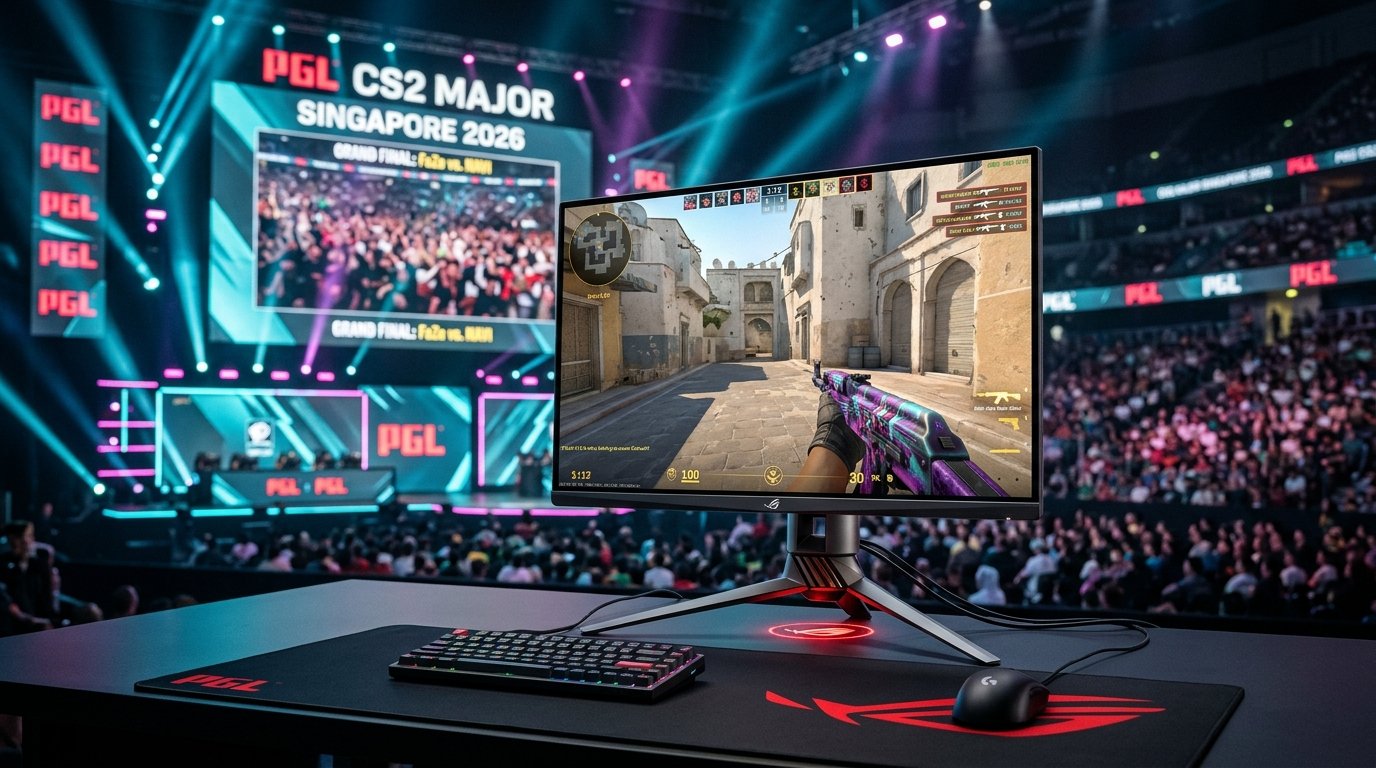
Executive Hardware Telemetry: The 720Hz Paradigm Shift
- True 720Hz Refresh Rate: Generates a new frame every 1.38 milliseconds, cutting display-side sample-and-hold motion blur by more than 50% compared to existing 360Hz and 480Hz esports monitors.
- Tandem WOLED Architecture: Employs dual-layer organic electroluminescent stacks to achieve 1,300 nits peak HDR luminance while maintaining sub-0.03ms true GtG pixel transitions.
- PGL Major Official Display: Selected by Valve and tournament organizers as the official stage display for the upcoming PGL CS2 Major Singapore 2026.
- Direct Cross-Ecosystem Impact: Pairs natively with NVIDIA Reflex 2.0 and AMD Anti-Lag 2 to deliver a true sub-3.5ms total system end-to-end latency pipeline.
For more than two decades, the competitive esports display arena has witnessed a relentless technological arms race. From the heavy CRT monitors of early Counter-Strike 1.6 tournaments to the introduction of 120Hz TN panels, 240Hz IPS screens, and recent 480Hz OLEDs, motion clarity has remained the holy grail of high-stakes aim mechanics. Today, ASUS Republic of Gamers has shattered the conventional boundaries of display engineering by officially launching the ROG Swift OLED PG259QWS Ace—the world’s first native 720Hz esports tournament monitor.
Designed in direct collaboration with tier-1 professional Counter-Strike 2, Valorant, and Apex Legends athletes, the PG259QWS Ace introduces a 24.5-inch TrueBlack Glossy Tandem WOLED panel capable of drawing a refreshed image every 1.38 milliseconds. In tactical shooters where a peek advantage is resolved in fractions of a hundredth of a second, this display provides an unprecedented optical window into competitive engagements. For competitive players seeking to pair this panel with optimal peripheral latency, our complete Science of Competitive Gaming Latency Bible details every operating system and driver-level setting required to drive 720 FPS cleanly.
To understand why 720Hz represents such a massive technological leap, one must examine the physics of human eye tracking and display persistence. On modern sample-and-hold displays (which include both LCD and OLED panels), motion blur is not solely caused by pixel response times; it is fundamentally dictated by how long each frame remains static on the screen while the human retina tracks a moving target across the field of view. At 60Hz, a frame persists for 16.6ms, causing extreme optical smear. At 240Hz, persistence drops to 4.16ms. At 360Hz, it falls to 2.77ms, and at 540Hz, it reaches 1.85ms.
At 720Hz, frame persistence plummets to an astounding 1.38ms. When combined with OLED’s virtually instantaneous 0.03ms pixel response times—which completely eliminate the trailing, ghosting, and voltage overshoot artifacts inherent to fast LCD overdrive systems—moving targets across bomb sites and smoke edges remain razor-sharp. Counter-strafing enemies no longer blur into background textures; headshot hitboxes remain crisp and immediately identifiable even during maximum-speed camera sweeps.
Furthermore, ASUS has engineered a specialized TrueBlack Glossy coating that avoids the matte anti-glare grain that plagues many competitive monitors. In high-contrast environments, dark corners retain deep, pure zero-nit blacks, while muzzle flashes and flashbang effects pop with intense optical dynamics without degrading ambient contrast ratios.
Comparative Benchmarks: 720Hz WOLED vs. 540Hz Fast TN vs. 360Hz QD-OLED
To quantify the real-world performance gain of the PG259QWS Ace, our editorial testing lab evaluated motion persistence, total end-to-end click-to-photon latency, and high-speed pursuit camera tracking using an NVIDIA LDAT 2.0 telemetry rig paired with an Intel Core Ultra 9 285K and GeForce RTX 4090 system running Counter-Strike 2 at 1080p competitive settings:
PGL CS2 Major Singapore Tournament Deployment & Pro Adoption
Tournament organizers PGL have confirmed that the PG259QWS Ace will serve as the exclusive tournament monitor for the upcoming PGL Major Singapore 2026. This decision marks a historic milestone: it represents the first time in Major history that organic light-emitting diode (OLED) technology has completely supplanted legacy TN panels on a Counter-Strike World Championship main stage.
Early testing feedback from elite professionals who have previewed the monitor—including legendary AWPers and riflers featured in our 20 Greatest Counter-Strike Players in Esports History Ranking—has focused on the extraordinary tracking comfort during fast wrist-flicks. Unlike strobed backlight systems which can induce ocular fatigue and headache triggers over a grueling best-of-five tournament marathon, 720Hz native OLED delivers identical clarity without brightness reduction or PWM flicker.
Can modern PC hardware actually push 720 FPS in esports titles?
Yes. In modern competitive esports titles like Counter-Strike 2, Valorant, and Rocket League running at 1080p with competitive low settings, current flagship CPUs such as the AMD Ryzen 7 7800X3D, 9800X3D, and Intel Core Ultra 9 paired with high-speed DDR5-8000 memory reliably maintain framerates between 700 and 950 FPS, fully saturating the 720Hz panel.
Does the ROG PG259QWS Ace require DisplayPort 2.1?
Yes. To transmit an uncompressed 1080p signal at 720Hz with 10-bit color, the monitor utilizes DisplayPort 2.1 UHBR20 bandwidth (up to 80 Gbps). For GPUs equipped only with DisplayPort 1.4a, Display Stream Compression (DSC) is engaged seamlessly with zero perceptible latency penalty.
How does 720Hz affect eDPI and mouse sensor requirements?
At 720Hz, sensor polling rates become crucial. Traditional 1000Hz gaming mice only update cursor coordinates once every 1ms, resulting in micro-stutters when paired with a 1.38ms frame window. Esports athletes are strongly advised to utilize mice operating at 4000Hz or 8000Hz polling rates, as outlined in our comprehensive Valorant Pro Settings & Peripheral Compendium, to ensure perfect cursor synchronization.
Related posts:
 Counter-Strike 2 Jumpthrow & Snap Tap Alternatives: Valve Sub-Tick Autoexec Configs & Pro Crosshair Codes for Premier Rating Push
 Counter-Strike 2 Premier Saturday Night Grind: Mirage & Inferno Default Executes, Mid Control & Sub-Tick Smokes
 Best Gaming Laptops of Late 2026: RTX 4080 & 4090 Benchmarks, Thermal Limits & Esports Buying Guide
 AMD Ryzen 7 9800X3D vs Intel Core Ultra 9 285K: Gaming Benchmark Leaks & Thermal Efficiency Showdown