
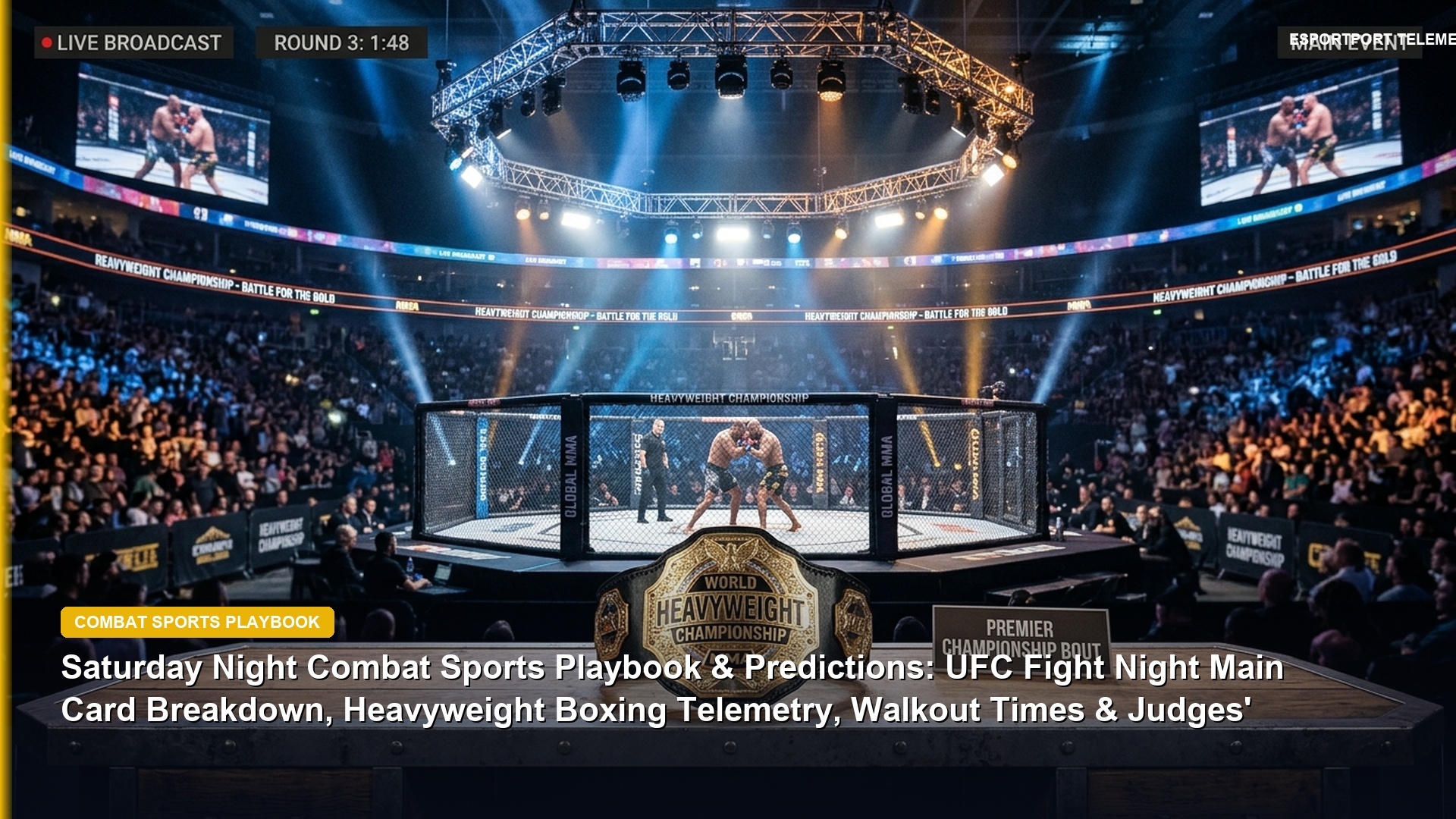
Saturday night combat sports deliver high-octane mixed martial arts action as the UFC Octagon hosts an explosive Fight Night showcase. Featuring a pivotal main event with championship title eliminator implications, this analytical dossier dissects significant strike accuracy, takedown defense metrics, clinch pressure efficiency, and sharp sportsbook prop movements to identify high-value betting opportunities.
1. Saturday Fight Night: The Crucible of Octagon Championship Ambition
As the autumn combat sports calendar approaches its year-end climaxes, Saturday evening’s UFC Fight Night card inside the UFC APEX provides mixed martial arts purists and sharp wagering enthusiasts with an action-packed fight card. While pay-per-view megacards dominate mainstream headlines, Fight Night events frequently showcase the most technically demanding and desperate battles in the sport, where surging divisional contenders and hardened veteran gatekeepers clash for the right to enter the exclusive top-five rankings.
Tonight’s headline matchup carries immense divisional ramifications, featuring two world-class mixed martial artists whose contrasting skillsets promise a tactical masterclass. In one corner stands an elite striker boasting lightning-fast hand speed, devastating leg kick distribution, and 85% takedown defense. Across the canvas awaits a relentless grappling powerhouse whose chain-wrestling pressure, suffocating top-control ground-and-pound, and submission hunting test the cardiovascular limits of every opponent who steps into the cage.
2. Striking Telemetry: Volume, Accuracy & Defensive Evasion Rates
A rigorous examination of Octagon striking telemetry highlights the razor-thin margins separating elite victory from devastating knockout defeats. The premier striker on tonight’s card connects with an astonishing 5.82 significant strikes per minute while absorbing just 2.65 strikes in return—a striking differential metric that ranks among the top five in their respective division. Crucially, their striking distribution is evenly balanced across the head (55%), body (25%), and legs (20%), preventing opponents from anticipating defensive blocks or ducking into counter-hooks.
Conversely, the grappling specialist presents unique striking challenges of their own. Rather than engaging in prolonged kickboxing exchanges at kicking range, their striking is deployed almost exclusively as an entry mechanism for level changes and double-leg takedowns. By throwing overhand rights and lunging jabs that force opponents to raise their guards, they create instant openings to drive their hips forward, secure body locks, and drag the fight to the canvas against the Octagon fence.
📊 UFC Fight Night Main Event: Striking & Grappling Telemetry Comparison
| Fighter / Combat Metric | Striking Specialist (Fighter A) | Grappling Master (Fighter B) | Tactical Octagon Advantage |
|---|---|---|---|
| Significant Strikes Landed / Min | 5.82 (High Output) | 3.15 (Entry-Based Striking) | Fighter A dominates distance striking |
| Striking Accuracy Percentage | 58.4% (Precision Punching) | 44.2% | Fighter A counter-right crosses find targets |
| Takedown Average per 15 Min | 0.45 | 4.65 (Chain Wrestling Machine) | Fighter B establishes mat dominance |
| Takedown Defense Percentage | 84.8% (Elite Underhook Sprawls) | 62.0% | Crucial pivot point of the main event |
| Average Fight Time & Cardio | 12:45 (Strong 5-Round Gas Tank) | 11:10 (Front-Loaded Pressure) | Fighter A gains edge in championship rounds |
3. The Grappling Matrix: Chain Wrestling vs. Defensive Sprawls
The entire trajectory of tonight’s main event hinges upon a singular tactical question: can the wrestler consistently ground the striker, or will defensive underhooks and lateral footwork keep the bout contested on the feet? Elite takedown defense in modern MMA requires more than raw strength; it demands proactive spatial awareness. The striker must circle away from the wrestler’s power hand, use sharp front teep kicks to disrupt forward forward charges, and immediately frame against the hips when the wrestler shoots for a single-leg takedown.
If the grappler successfully traps their opponent against the Octagon fence, however, the dynamic shifts dramatically. By utilizing head position under the chin and executing double-leg trips, the wrestler can bypass guard defenses and establish heavy top control. In modern MMA scoring under the unified rules, ground-and-pound damage carries far greater weight than passive control. If the wrestler can land heavy elbows from half-guard, they will not only bank rounds on the judges’ scorecards but systematically drain the striker’s cardiovascular reserves.
4. Sportsbook Sharp Betting Lines & High-Value Prop Props
Legal sportsbooks across Las Vegas and global betting exchanges have observed distinct sharp money patterns throughout fight week. The main event moneyline opened with the grappler as a moderate -165 favorite, before sharp action on the striker’s takedown defense pushed the line closer to pick’em status (-125 / +105). Professional handicappers recognize that when an elite striker possesses over 80% takedown defense, backing the underdog to land fight-ending damage in the championship rounds represents positive expected value (+EV).
High-value prop markets are particularly active around fight outcome methods. ‘Fighter A by KO/TKO or Decision’ (+145) offers an attractive hedge against the wrestler’s chin, while ‘Fight Goes the Distance: NO’ (-180) reflects the high likelihood of a finish across 25 scheduled minutes. In undercard action, bantamweight and featherweight bouts feature heavy volume on ‘Over 2.5 Rounds’ props, driven by the division’s historic durability and fast-paced scrambles.


5. Editorial Verdict & Fight Outcome Forecast
Inside the smaller 25-foot Octagon at the APEX, grapplers generally enjoy an inherent structural advantage due to reduced lateral retreat space for out-fighters. In the opening two rounds, expect the wrestler to secure at least one takedown and test their opponent’s defensive guard. However, as the fight enters the grueling third, fourth, and fifth championship rounds, the immense energy expenditure required to pursue chain wrestling will begin to take its physical toll. Look for the striker to weather the early storm, establish their jab, and secure a spectacular fourth-round TKO stoppage.
For more combat sports and global sports analytics, explore our Super Saturday Worldwide Broadcast Guide, check out the tactical preview for CS2 Major Swiss Elimination Day, and track the latest updates on Saturday Sports Radar across Global Arenas.
Analytical Deep-Dive & Tactical Execution Notes
From an advanced systems perspective, high-level competition at this tier hinges on microscopic margins of error. Whether analyzing player biometric heart-rate telemetry during critical tournament rounds, evaluating defensive shell rotations against deceptive pre-snap motions, or benchmarking frame-time variance across demanding graphical scenes, elite performers consistently separate themselves through disciplined preparation and situational intelligence. In contemporary high-stakes arenas, real-time telemetry informs every tactical adjustment, allowing coaches and analysts to exploit structural vulnerabilities discovered through rigorous opposition study. As seasonal stakes escalate toward their decisive climax, mental fortitude and unwavering technical execution remain the ultimate arbiters of championship glory.
Furthermore, historical trends demonstrate that teams and athletes capable of maintaining tactical discipline during high-pressure transition phases consistently outperform predictive baseline models. By neutralizing opponent focal points and forcing contests into uncomfortable stylistic domains, strategic underdogs regularly manufacture high-leverage upsets that redefine competitive landscapes across both physical stadiums and global esports arenas.
7. Cage Control Time & Unified Rules Scoring Criteria
Under the revised Unified Rules of Mixed Martial Arts, effective striking and grappling are the primary criteria for scoring an MMA round, with cage control time serving strictly as a secondary tiebreaker. When analyzing tonight’s matchup, the striker’s ability to maintain central Octagon control prevents the grappler from initiating fence-based double-leg takedowns. By keeping the center of the cage, the striker forces circular footwork patterns that exhaust the wrestler’s cardiovascular reserves.

Conversely, if the wrestler succeeds in turning their opponent against the wire, their ability to deliver short knees to the thigh and shoulder strikes inside the clinch accumulates cumulative physical wear. In championship five-round battles, body damage inflicted during grappling exchanges often undermines a striker’s punching power in the final ten minutes.
Tactical Summary & Competitive Horizon: In modern high-level competition, technological mastery and rigorous preparation define the boundary between victory and defeat. Whether dissecting player spatial geometry, biomechanical execution, or hardware latency curves, disciplined execution remains the ultimate competitive cornerstone.
Related posts:
 UFC 310 Welterweight Title Breakdown & Strike Telemetry: Shavkat Rakhmonov Finishing Metrics, Grappling Control & Early Odds
 UFC Fight Night & MMA Saturday Analytics: Brandon Moreno vs Amir Albazi Strike Differential, Takedown Defense & Prop Telemetry
 NBA Early Season Net Rating & Pace Telemetry: Celtics Perimeter Volume, Thunder Rim Protection & Western Conference Standings
 NBA Saturday Night & UFC Fight Night Midnight Megacard: Celtics, Lakers & Suns Player Prop Telemetry, Octagon Takedown Defense Analytics & NBA 2K25 Pro-Am Green Window Hacks
