
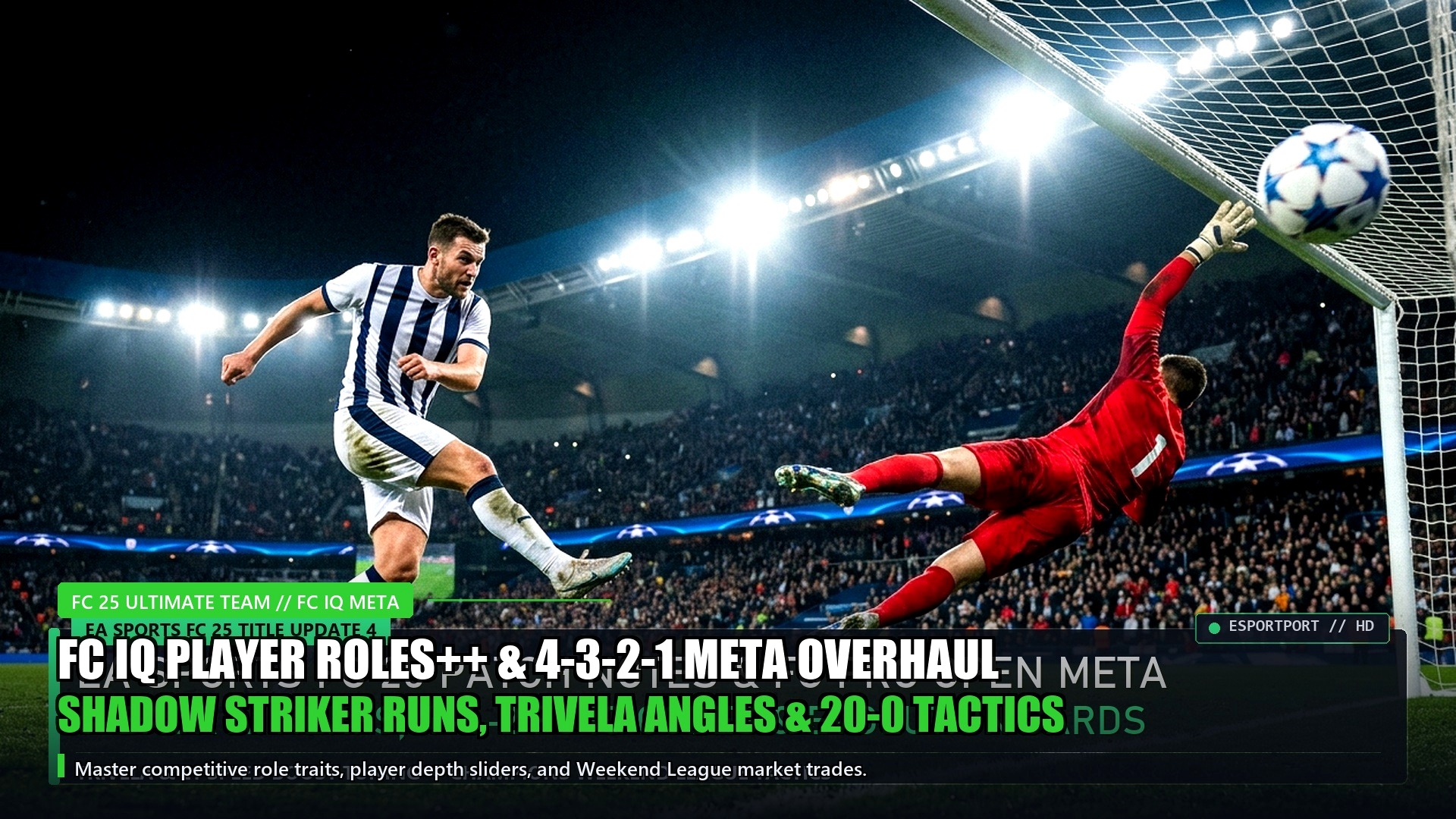
The competitive virtual football arena has entered an evolutionary phase with the launch of EA SPORTS FC 25. Powered by EA’s groundbreaking FC IQ tactical engine—which replaces legacy work rates with modern Player Roles, Position Focuses, and Team Smart Tactics—the game demands a sophisticated understanding of spatial geometry, passing mechanics, and defensive pressing traps. As professional esports athletes across the globe battle through qualifiers for the prestigious EA SPORTS FC Pro World Championship and FIFAe World Cup, the competitive meta has crystallized around specific tactical formations and high-percentage mechanics.
Following our ongoing analytical coverage of top-tier sports strategy and performance—such as our deep dives into advanced game engine simulations and mechanics—mastering EA FC 25 requires more than simple button combinations. It demands an intimate mastery of the driven ground pass, the trivela outside-of-the-foot finishing arc, manual second-man pressing, and custom role assignments that overload opponent half-spaces during high-stakes Weekend League and tournament play.

The FC IQ Revolution: Player Roles, Focuses, and Dynamic Formations
The centerpiece of EA FC 25’s mechanical overhaul is the introduction of FC IQ. In legacy FIFA titles, player movement was governed by static High/Medium/Low work rates, which frequently caused players to drift out of position unpredictably. FC IQ replaces work rates with over 50 specific Player Roles, categorized by Role Familiarity (Role, Role+, and Role++).
A player assigned a Role++ (such as Jude Bellingham as a Shadow Striker or Rodri as a Deep-Lying Playmaker) executes sophisticated real-time AI behaviors that mirror their real-world tactical intelligence. Furthermore, each role features distinct Focuses (e.g., Attack, Balanced, Roaming, or Defend). In the competitive meta, assigning fullbacks to the Falseback (Build-up) role tucks them into central midfield during possession, creating an impenetrable 3-2-4-1 numerical overload that completely neutralizes opponent counter-attacking passing lanes.
| Formation & Role Meta | Key Tactical Assignment | Role Familiarity Focus | Pro Tournament Strategic Advantage |
|---|---|---|---|
| 4-3-2-1 Narrow Overload | Dual CFs as Inside Forwards | Role++ (Attack Focus) | Creates overwhelming 3-man central channel overloads |
| 4-4-2 Balanced Press | One ST as Advanced Forward; one Target Forward | Role++ (Complete Focus) | Rock-solid defensive shape with direct crossing outlets |
| Left Back: Falseback Role | Tucks into central holding midfield in possession | Role+ (Build-Up Focus) | Forms a defensive 3-man rest-defense against counters |
| Central Mid: Deep-Lying Playmaker | Drops between center backs to dictate tempo | Role++ (Defend Focus) | Shields backline and launches pinpoint driven balls |
| Right Wing: Inside Forward | Cuts diagonally inside between CB and fullback | Role++ (Attack Focus) | Opens wide channel for overlapping attacking fullbacks |
| Goalkeeper: Sweeper Keeper | Rushes out to clear over-the-top through balls | Role+ (Balanced Focus) | Eliminates fast breakaways against high defensive lines |
The 4-3-2-1 Meta: Dominating the Half-Spaces
In high-tier Champions Weekend League and official FC Pro Open tournaments, the 4-3-2-1 formation remains the undisputed champion of the meta. The system operates as a fluid chameleon: when defending, the formation drops into a compact 4-4-2 flat block with one of the Center Forwards dropping wide into midfield. When transitioning into attack, the formation expands into a devastating 3-2-4-1 shape.
To configure the 4-3-2-1 effectively, assign your central Striker as an Advanced Forward (Attack) to push the opponent’s defensive line backward into their penalty box. Flank them with two Center Forwards set to Inside Forward (Attack). These inside forwards exploit the half-spaces between the opponent’s center backs and fullbacks, creating easy tap-in angles from low driven crosses and cutbacks.
High-Percentage Scoring Mechanics: The Driven Ground Pass and Trivela
Scoring consistently against elite defenders who utilize manual jockeying requires clinical finishing mechanics. Foremost among these is the Driven Ground Pass (R1 + X / RB + A). Standard ground passes travel too slowly in FC 25, allowing AI defenders with Intercept PlayStyles to step in front and steal possession. Driven ground passes travel with immense velocity, puncturing compact defensive blocks and reaching your strikers’ feet before center backs can react.
For finishing outside the penalty area, the Trivela Shot (L2 + Shoot / LT + Shoot) remains exceptionally lethal, particularly for players possessing the Trivela PlayStyle (such as Luka Modrić or Antoine Griezmann). When approaching the top of the box on your player’s strong foot, angling your run 45 degrees away from the near post and triggering a Trivela curls the ball with wicked outside-spin into the far top corner, completely bypassing outstretched goalkeepers.
Defensive Mastery: Manual Jockeying and Second-Man Press Traps
Defending in EA FC 25 is strictly manual; relying on AI auto-tackles will lead to lopsided defeats. Elite competitors utilize Manual Jockeying (L2 / LT) combined with micro-sprint bursts to mirror the dribbler’s hip orientation. Never dive into reckless standing tackles; instead, maintain a two-yard distance and corral the attacker toward the touchline.

To suffocate opposing attacks, master the Second-Man Press (Holding R1 / RB). A green indicator appears above a nearby AI teammate who closes down the ball carrier, while you manually control your defensive holding midfielder (using the right analog stick) to cut off the attacker’s primary passing lane. This dual-layered pressure forces hasty turnovers in the midfield third, sparking immediate counter-attacking opportunities.
Skill Moves Tier List: Stepovers, Ball Roll Drags, and Elastico
While flashy five-star skill moves may look entertaining in casual matches, competitive FC 25 players rely on three foundational skills that deliver instant acceleration bursts. Foremost is the Stepover and Sprint Exit: rolling the right stick 90 degrees forward and immediately pressing the sprint trigger propels your attacker forward with an uncatchable speed boost, bypassing aggressive fullbacks along the touchline.
In congested penalty boxes, the Ball Roll Drag and Elastico (Reverse Elastico) allow you to shift the ball’s angle in fractions of a second, opening clean shooting windows through crowded leg corridors. Combined with calm shot-canceling to bait sliding defenders, mechanical mastery of these core inputs separates tournament finalists from early qualifier casualties.
Set Piece Mastery: Whipped Cross Corners and Trivela Free Kicks
Set pieces in EA FC 25 offer guaranteed scoring avenues when executed with repeatable tactical precision. Corner kicks, in particular, have been revolutionized by players equipped with the Whipped Pass PlayStyle+ (such as Trent Alexander-Arnold or Lauren James). By aiming the trajectory cursor near the six-yard box and applying 3 to 3.5 bars of crossing power, the ball curves with vicious pace and dipped trajectory directly onto the forehead of target forwards possessing the Aerial+ PlayStyle.
For direct free kicks within 25 yards, utilizing the outside-of-the-foot Trivela curve bypasses human goalkeeper positioning. By rotating the right analog stick to select an outside foot spin trajectory, angling the reticle slightly outside the defending post, and achieving green-timed finishing precision, the ball dips sharply over the defensive wall into the top corner, punishing opponents who commit cynical fouls outside their penalty area.
Goalkeeper Movement: Manual Right-Stick Sweeping and Far-Post Anticipation
Perhaps the most decisive defensive skill in elite FC 25 competition is Manual Goalkeeper Movement (Holding R3 / Right Stick Click). Standard AI goalkeepers remain static in the center of the net, making them easy prey for angled finesse shots and near-post driven blasts. By clicking down and nudging the right stick toward the far post as an attacker winds up to shoot, you can manually position your goalkeeper to intercept shots that would otherwise fly uncontested into the side netting.
However, goalkeeper movement requires psychological discipline. If you move your goalkeeper too early, an observant attacker will notice the shift and easily slide the ball into the wide-open near post. The art of competitive goalkeeping lies in waiting until the shooter begins their final plant-foot animation before executing a subtle two-step shuffle toward the expected shooting angle, pulling off impossible match-winning saves in extra time.
Frequently Asked Questions Regarding EA SPORTS FC 25 Pro Tactics
What is FC IQ and how does it replace legacy work rates in FC 25?
FC IQ replaces work rates with Player Roles and Focuses, using real-world tactical data to dictate how players position themselves dynamically in attack, defense, and build-up play.
What is the most effective formation in EA FC 25 esports tournaments?
The 4-3-2-1 remains the most dominant formation, defending in a compact 4-4-2 shape and attacking as a 3-2-4-1 with Inside Forwards exploiting central half-spaces.
How do you perform a Driven Ground Pass in FC 25?
Hold R1 on PlayStation (or RB on Xbox) while pressing the ground pass button (X/A) to fire high-velocity passes that pierce compact defensive lines without getting intercepted.
How does the Second-Man Press work on defense?
Hold R1/RB to have an AI teammate apply pressure to the ball carrier while you manually control another midfielder to intercept the primary passing lane.
Related posts:
 EA Sports FC 27 Title Update v1.2.0 Tactical Guide: 95-Depth Nerfs, Kick-Off Fixes & November Promo Calendar
 AMD Ryzen 7 9800X3D Benchmark Leak & Arrow Lake Shootout: 2nd-Gen 3D V-Cache Under CCD, 5.2GHz Boost & 96MB L3 Gaming Domination
 NBA Saturday Night & UFC Fight Night Midnight Megacard: Celtics, Lakers & Suns Player Prop Telemetry, Octagon Takedown Defense Analytics & NBA 2K25 Pro-Am Green Window Hacks
 Warzone & Black Ops 6 Season 1 Reloaded Meta Tier List: Best Weapons, Omnimovement Perks & Loadouts
