
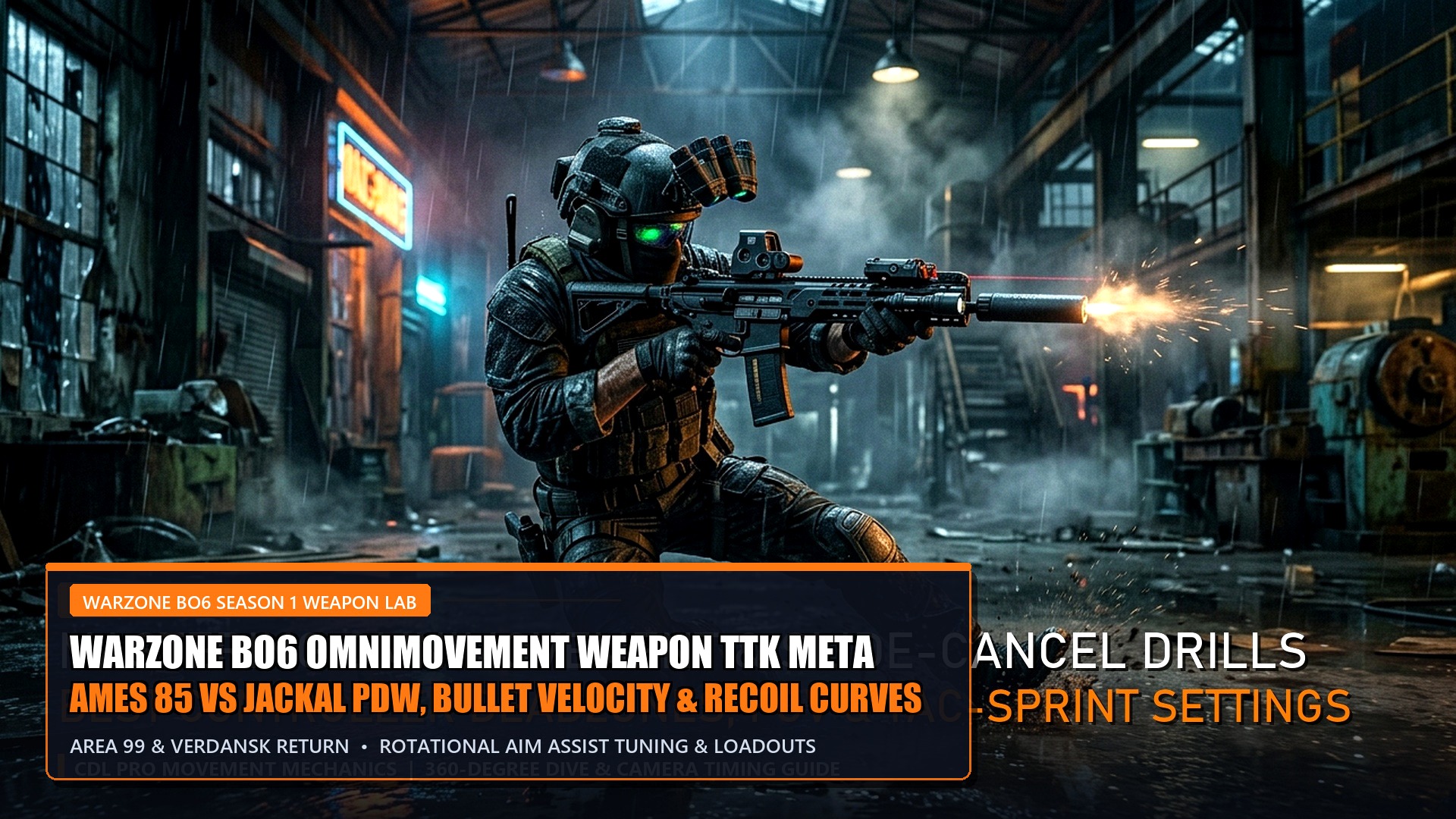
The mechanical skill ceiling in modern first-person shooters has experienced a tectonic evolution. Gone are the days when competitive shooters rewarded static corner-holding and purely positional marksmanship. Across high-stakes Battle Royale titles like Call of Duty: Warzone, Apex Legends, and Fortnite, movement has evolved into both the ultimate offensive weapon and the ultimate defensive shield. As explored in our tactical analysis of Warzone BO6 Season 1 Ranked Play meta weapons and movement techniques, mastering engine kinematics is mandatory for climbing competitive ranks.
Whether it is exploiting physics tick rates to execute frame-perfect tap-strafes in Apex Legends or mastering Treyarch’s revolutionary 360-degree Omnimovement system in Black Ops 6, elite movement breaks enemy camera tracking, disrupts aim assist bubbles, and enables aggressive players to disengage from fatal crossfires. This masterclass deconstructs the foundational physics, input sequences, and tactical timing required to execute professional movement mechanics across modern battle royale arenas.
Engine Physics: Source Engine Air Acceleration vs IW Engine Kinematics
To master advanced movement, one must first comprehend the game engine powering the simulation. Apex Legends is built on a heavily modified version of Valve’s legendary Source Engine. The Source Engine features an idiosyncratic air acceleration formula: when a player jumps, pressing a directional key while smoothly rotating the mouse or camera transfers forward velocity into sharp lateral redirection without losing kinetic momentum. This architectural anomaly forms the bedrock of bunny hopping, air-strafing, and tap-strafing.
Conversely, Call of Duty operates on Activision’s proprietary IW 9 engine. Unlike Source, the IW engine enforces strict friction coefficients upon landing, penalizing consecutive jumps with progressive fatigue slowdowns. However, Black Ops 6 circumvents traditional constraints through the Omnimovement system, allowing full sprint, slide, and dive kinematics in any 360-degree vector. Recognizing whether your game engine emphasizes momentum preservation (Source) or omni-directional velocity bursts (IW) dictates your tactical input rhythm.
| Movement Technique | Game Engine & Title | Input Execution Sequence | Tactical Advantage & Camera Disruption |
|---|---|---|---|
| Omnimovement Slide-Cancel | Call of Duty (IW 9 Engine) | Sprint Lateral > Slide > Change Vector > Aim | Breaks enemy camera tracking around 90-degree corners |
| Backward Supine Dive | Call of Duty (IW 9 Engine) | Sprint Backward > Dive > Maintain 360 Aim | Allows armor plating while retreating and holding sightlines |
| Scroll-Wheel Tap-Strafing | Apex Legends (Source Engine) | Slide-Jump > Release W > Scroll Forward + A/D | Executes instant 180-degree mid-air directional turns |
| Super-Glide Mantle | Apex Legends (Source Engine) | Climb Ledge > Jump + Crouch (Same Frame) | Propels character forward at maximum horizontal velocity |
| Wall-Bounce Repositioning | Apex Legends / Titanfall | Slide-Jump toward Wall > Release Keys > Jump | Launches player off vertical walls without climbing penalty |
| Prone-Drop Shot Cancel | Multi-Shooter Universal | ADS Fire > Instant Prone > Micro-Strafe | Drops player hitbox below incoming headshot crosshair level |
Mastering Omnimovement: Breaking Enemy Centering in Warzone
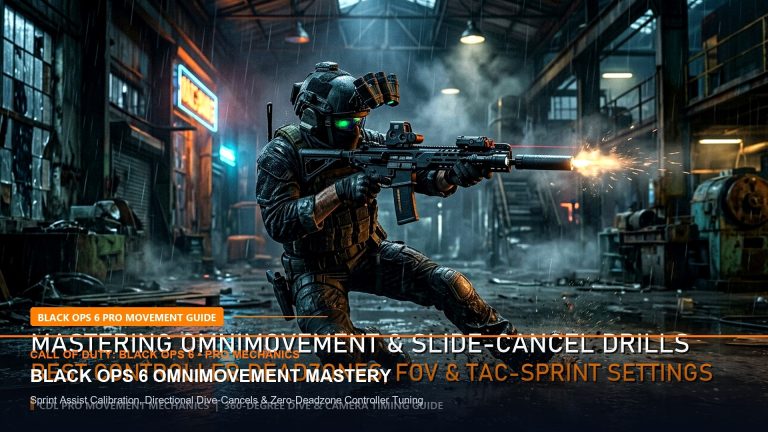
In Black Ops 6 Warzone, Treyarch eliminated the legacy constraint that required players to sprint exclusively forward. Players can now initiate a tactical sprint while moving sideways or directly backward. The most lethal application of this engine freedom is the Lateral Omnidirectional Slide-Cancel.
When breaching a room where an enemy is pre-aiming a doorway, sprinting laterally and sliding at a 45-degree angle propels your character past the enemy’s reticle faster than standard human visual reaction time. Because enemy aim assist curves are tuned for gradual target crossing, a high-velocity omni-directional slide-cancel breaks their rotational aim assist bubble, forcing them into a panicked manual readjustment while you maintain stable hipfire or ADS tracking.
The Backward Dive While Plating: The Ultimate Survival Hack
Surviving third-party ambushes in Warzone often hinges on managing armor plate economy while under fire. In legacy Warzone installments, tactical sprinting required turning your back to the enemy, leaving you completely blind to pursuit vectors. With Omnimovement, players can execute a Backward Tactical Dive.
When caught in an open field or hallway, initiating a backward sprint and diving instantly launches your character backward into a supine prone posture while keeping your eyes firmly locked on the enemy. You can simultaneously insert armor plates with your left hand while tracking incoming threats. Once behind cover, your character can rotate 360 degrees on their back without having their weapon forced down, allowing you to surprise aggressive pushers with immediate retaliatory fire.

Apex Legends: The Anatomy of the 180-Degree Tap-Strafe
In the high-speed arena of Apex Legends, the tap-strafe remains the undisputed pinnacle of mechanical evasion. By binding ‘Move Forward’ to your mouse scroll wheel, spinning the wheel during a jump inputs dozens of micro-forward keypresses in fractions of a second. When combined with a directional key (A or D) and smooth mouse tracking, the Source Engine’s air acceleration redirects your entire forward velocity into an instant 90-degree or 180-degree mid-air turn without losing sprint speed.
Skilled players utilize tap-strafing to dance around shotgun blasts, whip around tight building corners to escape incoming sniper fire, and redirect trajectory mid-air after launching from jump pads. On controller, while native tap-strafing requires specialized Steam input configurations, mastering the Super-Glide—pressing Jump and Crouch on the exact final frame of a ledge mantle—grants a similar instantaneous burst of horizontal speed that catches enemies completely off guard.
Building Muscle Memory: Drills and Keybind Optimization
Executing high-level movement under the pressure of final-circle tournament situations requires flawless muscle memory. To achieve mechanical consistency, players should optimize their control bindings. On keyboard, binding Jump to Mouse Wheel Down and Crouch to a comfortable thumb or pinky key (e.g., C, V, or Left Ctrl) is essential for fluid sliding. On controller, adopting a claw grip or utilizing back paddles mapped to Jump and Slide ensures your right thumb never leaves the aiming joystick during airborne acrobatics.
Dedicate fifteen minutes daily in the practice firing range to isolated movement drills: practice wall-bouncing off varied geometric angles, sliding laterally through narrow doorways, and chaining backward dives into immediate sprint-cancels. In modern competitive shooters, raw aim will win isolated duels, but fluid, camera-breaking movement mastery will win championships.
Additionally, camera centering discipline forms the invisible spine of elite movement mechanics. When executing high-velocity slide-cancels or aerial tap-strafes, novice players often let their crosshairs drift toward the floor or sky. Professional competitors train their peripheral vision to maintain crosshair placement strictly at chest and head level throughout complex multi-directional acrobatic sequences, ensuring that the instant a movement transition concludes, their reticle is already pre-aligned on the enemy’s vital hitboxes.

Frame Rate Scaling, Physics Ticks, and Movement Input Consistency
An underappreciated dimension of mechanical movement is the relationship between display refresh rates, system frame rates, and internal game engine tick rates. In engines like Source (Apex Legends) and IW 9 (Call of Duty), certain movement physics—such as mantle timing windows and air deceleration curves—interact directly with frame rendering intervals. Running unconstrained frame rates with erratic fluctuations causes micro-variances in input registration, leading to missed super-glides and botched slide-cancels.
To establish rock-solid mechanical consistency, esports pros cap their in-game frame rates to an exact multiple of their monitor’s refresh rate (or slightly below G-Sync/FreeSync maximum thresholds, such as 237 FPS on a 240Hz display). Maintaining an unwavering frame time graph (flat 4.16ms on 240Hz) guarantees that the muscle memory developed during training drills translates into identical tactile feedback during chaotic late-game tournament circles, ensuring your movement inputs never drop or stutter when everything is on the line.
Frequently Asked Questions Regarding Pro Movement Mechanics
What makes Omnimovement different from legacy shooter movement?
Omnimovement allows players to sprint, slide, and dive in any 360-degree direction (forward, backward, laterally) without penalty, completely removing traditional linear movement restrictions.
How do you perform a tap-strafe in Apex Legends?
Slide-jump, release W, hold A or D while simultaneously scrolling Mouse Wheel Forward (bound to Move Forward) and turning your mouse to redirect your momentum mid-air.
Why does sliding laterally break enemy aim assist?
High-velocity lateral movement exceeds the maximum tracking acceleration of standard rotational aim assist bubbles, forcing opposing players to manually re-center their crosshairs.
What is the most effective controller setup for advanced movement?
Using back paddles or a Tactical bumper layout mapped to Jump and Slide allows players to execute jumps, slides, and dives without ever lifting their thumb off the right aiming stick.
Related posts:
 Call of Duty Black Ops 6 Omnimovement Tech Guide: Slide-Cancel Combos, Velocity Stacking & Aim Assist Hacks
 Call of Duty Warzone Nov 12 Patch Analysis: Smoke Aim-Assist Removal & Black Ops 7 M10 Breacher Meta Breakdown
 Black Ops 6 Season 1 Reloaded Meta Weapon Tier List: Best TTK Loadouts, Attachments & Omnimovement Tuning
 Warzone & Black Ops 6 Season 1 Reloaded Meta Tier List: Best Weapons, Omnimovement Perks & Loadouts
