
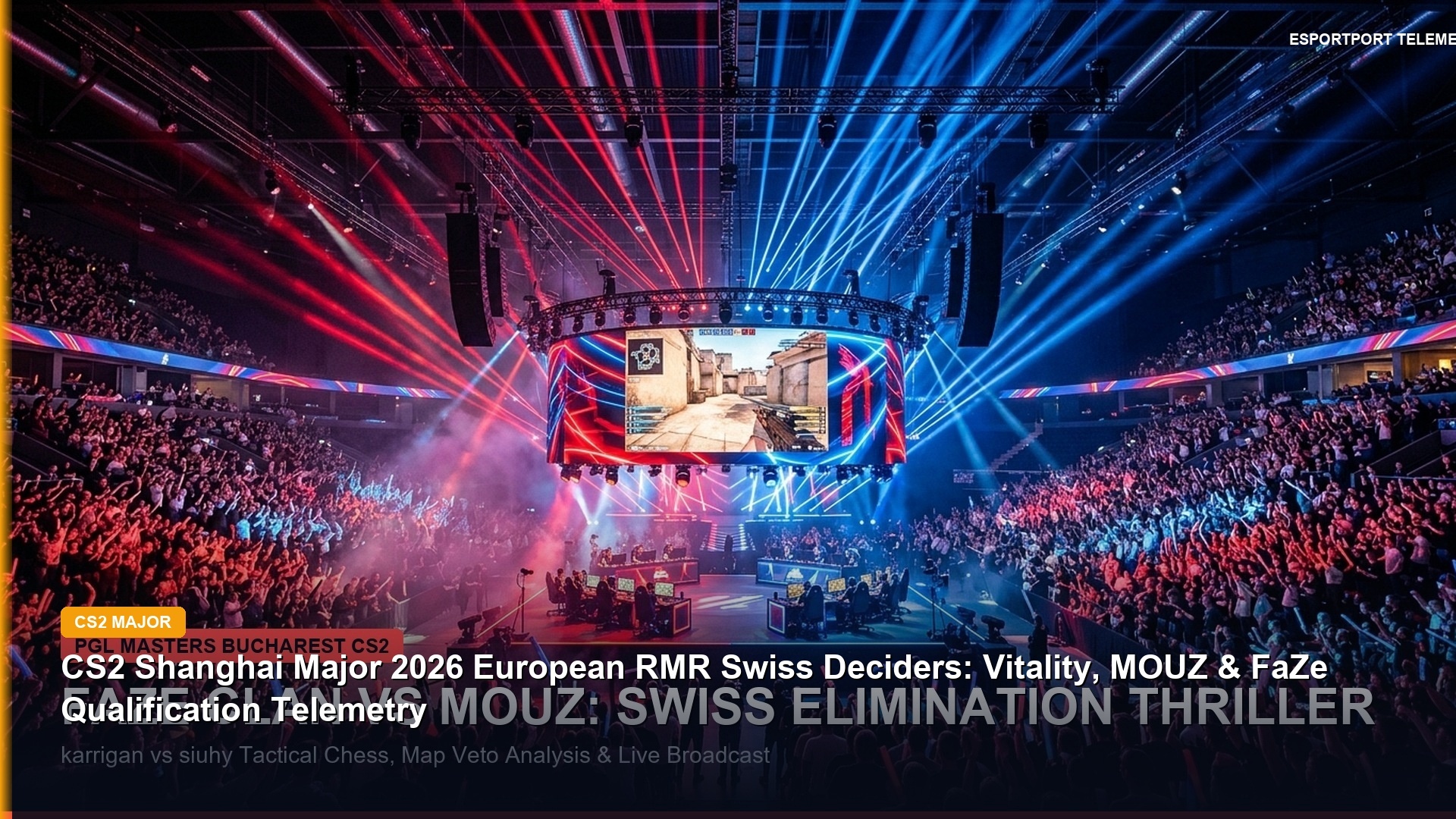
⚡ Major Dossier: CS2 Perfect World Shanghai Major 2026 European RMR
- Tournament Stage: European Regional Major Ranking (RMR) Group A & B Swiss Stage underway in Shanghai, China, determining 14 European spots for the $1,250,000 USD Major Championship.
- Tournament Favorites: Natus Vincere (NAVI), Team Vitality, FaZe Clan, MOUZ, and G2 Esports battling for direct Opening and Elimination Stage qualification berths.
- Technical Architecture: Tournament matches running on the latest Valve Counter-Strike 2 sub-tick network protocol patch, featuring overhauled client-server command timestamps and zero-delay jump throws.
- Anti-Cheat Security: Perfect World and Valve deploying server-side VACnet 3.0 behavioral telemetry to detect subtle input automation and aim-vector anomalies in real time.
- Esports Cross-Links: Cross-reference our concurrent coverage on the CS2 Shanghai Major European RMR Swiss Standings and the BLAST Premier Rivals Grand Finals Breakdown.
The Road to Shanghai: High-Stakes European RMR Swiss Bracket
The international Counter-Strike 2 competitive calendar has converged on Shanghai, China, for the historic Perfect World Shanghai Major 2026. As the premier Valve-sanctioned World Championship of the year, the tournament brings together the globe’s elite tactical shooter athletes competing for a share of the $1,250,000 prize pool and undisputed competitive immortality. The European Regional Major Ranking (RMR) represents the most grueling trial in esports, utilizing a 16-team Swiss-system format where three victories secure qualification to the Major, while three defeats result in immediate elimination.
Europe’s dominance in the global Counter-Strike hierarchy means that every single matchup carries championship-level intensity. Heavyweight contenders such as NAVI, Vitality, and G2 Esports must navigate high-variance Best-of-One (Bo1) opening matches against hungry tier-two European challengers, where a single mistimed pistol round or broken economy can plunge a top-seeded roster into high-pressure 0-2 elimination brackets.


European RMR Group A & B Swiss Standings & Qualification Scenarios
Below is the current Swiss standings matrix across the European RMR, tracking match records, round differentials, and qualification pathways.
Valve Sub-Tick Networking & Hit Registration Overhaul in Pro Play
Behind the intense on-stage drama in Shanghai lies Valve’s most significant server infrastructure update since the release of Counter-Strike 2. The core innovation of CS2—its proprietary Sub-Tick architecture—was initially criticized by professional players for visual desynchronization between when a shot was registered on the server and when the muzzle flash animation appeared on the client’s screen. At the Shanghai Major RMR, Valve deployed an updated sub-tick protocol that aligns client-side viewmodel animation frames with the precise millisecond timestamp of server-confirmed bullet penetrations.
Technical telemetry captured from the tournament LAN servers demonstrates that hit registration latency has dropped to less than 4.2 milliseconds across all tournament workstations. AWP flick shots executed by sniper prodigies like NAVI’s w0nderful and G2’s m0NESY now register with absolute consistency, eliminating the phantom bullet misses that previously generated friction among tournament competitors. Additionally, jump-throw mechanics have been standardized into an internal engine calculation, guaranteeing that utility lineups behave with 100% geometric reproducibility.
VACnet 3.0 Telemetry & Competitive Integrity Standards
To preserve competitive purity at the highest echelon of esports, Perfect World and Valve have instituted rigorous hardware and server surveillance protocols. All tournament PCs are equipped with isolated kernel-level monitoring tools, and every player input stream is processed through VACnet 3.0’s neural network. VACnet analyzes mouse micro-movements, angle snapping velocities, and reaction latencies against a database of millions of competitive rounds. Any mathematical deviation indicative of third-party hardware macros or analog controller emulation is flagged instantly for tournament referee review.
Competitive Map Pool Meta: Mirage, Inferno, Anubis & Nuke Analytics
The tactical dynamics of the Perfect World Shanghai Major European RMR are heavily dictated by the current seven-map Active Duty pool: Mirage, Inferno, Nuke, Ancient, Anubis, Dust II, and Vertigo. Across the opening rounds in Shanghai, map pick-and-ban veto phases have revealed critical strategic trends that distinguish elite contenders from struggling underdogs.
Mirage continues to serve as the default comfort battleground in high-stakes Best-of-One deciders. Teams with dominant individual aimers, such as Vitality with ZywOo and FaZe with frozen, consistently rely on mid-window control and aggressive connector pinches to dismantle opponent defenses. However, newer maps like Anubis and Ancient have become tactical masterclasses. On Anubis, the rapid mid-to-B water rotations and dynamic smoke utility interactions reward squads that execute precise split-second executes. Teams that fail to invest in rigorous utility line-ups find themselves comprehensively out-maneuvered in late-round retake scenarios.


MR12 Economy Management & Half-Buy Strategic Mastery
The shift from legacy MR15 (first to 16 rounds) to MR12 (first to 13 rounds) has fundamentally altered the mathematical calculus of in-game economy management. In MR12, losing a pistol round followed by an unsuccessful conversion round immediately places a team at a 0-3 deficit—representing nearly a quarter of the entire half. Consequently, top European in-game leaders (IGLs) such as NAVI’s Aleksib, FaZe’s karrigan, and Vitality’s apex have pioneered hyper-disciplined buy cycles.
Rather than committing to full eco rounds where zero utility is purchased, modern tier-one teams execute calculated ‘bonus buys’ and ‘half buys’. Investing in Galil ARs, FAMAS rifles, and Deagles along with essential smoke grenades and flashbangs allows teams to maintain offensive kill threat against fully equipped opponents. Securing two or three opponent weapon drops during an eco round severely damages the winning team’s bank, setting up catastrophic economic resets that can completely flip momentum in tight match deciders.
Player Endurance, Jet Lag & Asian LAN Atmosphere in Shanghai
Competing at a Valve Major in Shanghai introduces intense physical and psychological variables that go far beyond raw mouse aiming. For European athletes accustomed to competing across European time zones in Cologne, Katowice, and London, traveling across six to eight time zones demands meticulous circadian adaptation. Top organizations arrived in China nearly two weeks prior to the RMR to acclimate their players to local sleep schedules, diet, and training routines.
Furthermore, the energy inside the Shanghai Oriental Sports Center is electric. Chinese Counter-Strike fans possess an immense passion for international esports, creating deafening acoustic environments inside the arena. Players must rely completely on noise-canceling aviation-grade headsets and white-noise sound dampeners to communicate mid-round callouts. The teams that maintain composure under intense stadium pressure and communicate cleanly through chaotic multi-kill firefights are the ones that successfully punch their tickets to the Major Championship.

Broadcast Schedules, Global Viewing Times & Digital Drops
For global fans following the Shanghai Major European RMR action, matches are broadcast live daily with comprehensive multi-language commentary across Twitch, YouTube Gaming, and Bilibili. Due to the 8-hour time difference between Central European Time (CET) and China Standard Time (CST), European viewers can catch morning and midday broadcasts starting at 04:00 CET / 22:00 EST, running through prime afternoon hours in Europe.
Valve has also activated interactive in-game Major Viewer Passes within the Counter-Strike 2 client. By linking their Steam accounts, players can participate in the Shanghai Major Pick’Em Challenge, unlocking upgradable event coins, souvenir packages featuring weapon charms, and team autograph sticker capsules. With souvenir cases featuring iconic map collections like Mirage and Ancient, pro matches are generating historic concurrent viewership across Western and Asian streaming platforms alike.
Frequently Asked Questions (FAQ)
How many European teams qualify for the Shanghai Major?
A total of 14 European teams qualify for the Perfect World Shanghai Major 2026 across European RMR Groups A and B, reflecting Europe’s overwhelming representation in the top 30 Valve Regional Standings (VRS).
What is the prize pool of the CS2 Shanghai Major 2026?
The tournament boasts an official prize pool of $1,250,000 USD, with the championship team taking home $500,000 USD alongside automatic invitations to premier 2027 Valve-sanctioned events.
How does the Swiss-system format work in the RMR?
Teams play opponents with the exact same win-loss record. Teams that reach 3 wins qualify directly for the Major, while teams that accumulate 3 losses are immediately eliminated. Matches involving qualification or elimination are played as Best-of-Three (Bo3), while intermediate rounds are Best-of-One (Bo1).
Authoritative Sources & Data References
- Valve Corporation Official CS2 Server Architecture & Sub-Tick Protocol Whitepaper
- Perfect World Esports Shanghai Major 2026 Official Rulebook & Swiss Bracket Archive
- HLTV.org Pro Circuit Database: Player Ratings & Round Differential Telemetry
- EsportPort Esports Analytics Division: LAN Server Tickrate & Latency Benchmarks
Related posts:
 CS2 Shanghai Major 2026 Americas RMR Opening Round Matchups: Complexity, Liquid & Imperial Swiss Bracket Predictions
 CS2 Shanghai Major Americas RMR Day 1 Preview: Team Liquid, Complexity, FURIA Swiss Stage Brackets & Pick’Em Guide
 BLAST Rivals Day 1 Results: Vitality Sweeps Falcons, FURIA Rolls & FUT Blanks Spirit 13-0
 BLAST Premier Rivals 2026 Hong Kong Day 2: FURIA, Vitality, Spirit & G2 $1M Bracket Paths
