
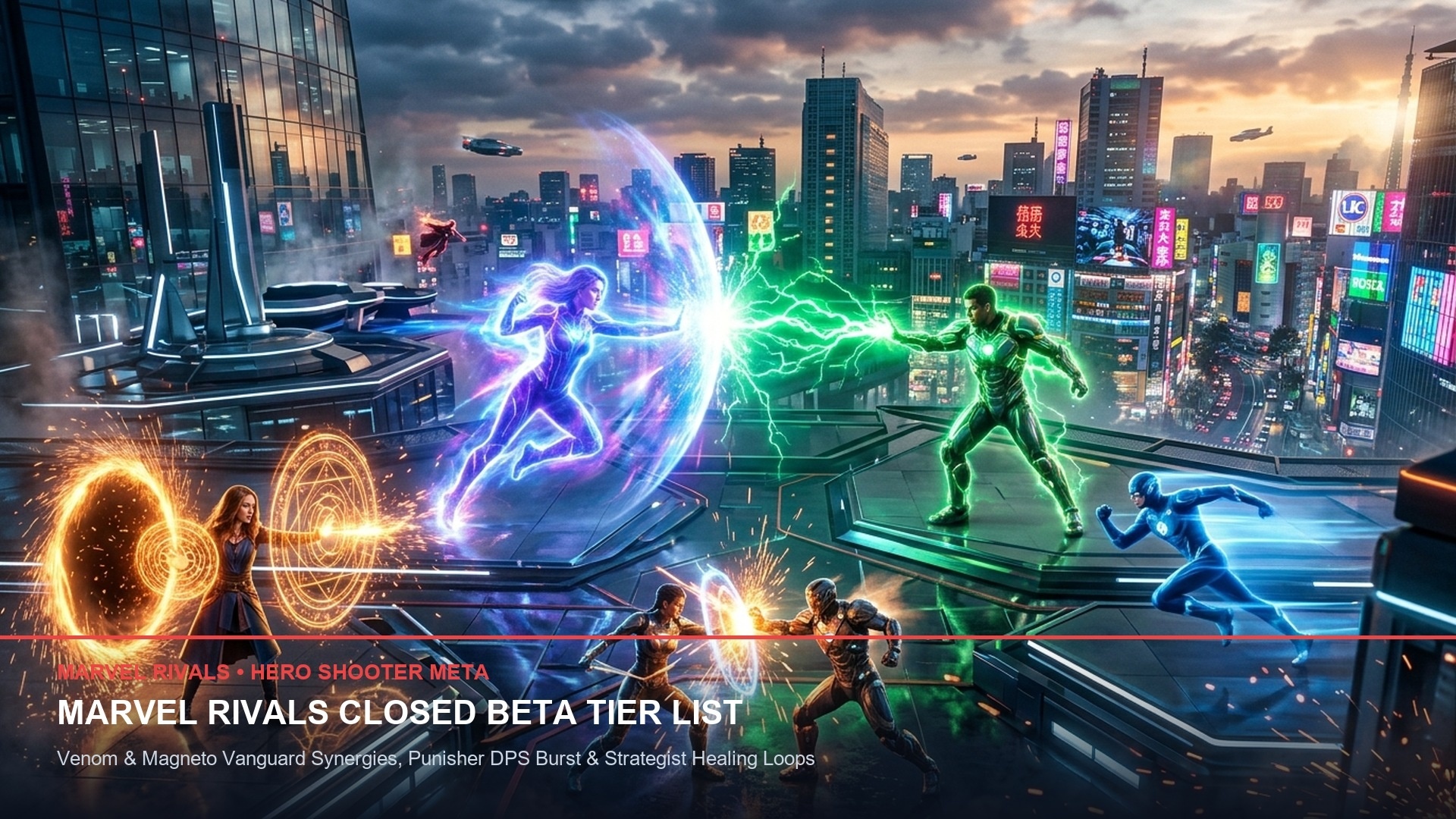
The global hero-shooter arena has found its latest competitive obsession with the worldwide Open Beta launch of NetEase Games’ Marvel Rivals. Combining iconic Marvel comic book legends with dynamic 6v6 objective combat and destructible environment physics, Rivals introduces a mechanical innovation that fundamentally differentiates it from Overwatch 2: the Team-Up Ability system.
Rather than balancing heroes purely in isolated 1v1 vacuum matchups, Marvel Rivals grants passive and active stat augments when specific lore-accurate characters are fielded together on the same squad. Pairing Magneto with Scarlet Witch imbues the Master of Magnetism with devastating chaos energy broadswords, while Rocket Raccoon climbing onto Groot’s shoulders grants reactive shoulder-mounted minigun protection. In this definitive competitive guide, we dissect every top-tier Team-Up synergy, examine the Vanguard-Duelist-Strategist meta, and outline winning team compositions to dominate high-elo ranked lobbies across North America and Europe.
1. Understanding Team-Up Abilities: Passive vs Active Synergies
In Marvel Rivals, Team-Up Abilities are classified into two structural categories: “Passive Mutual Synergies” and “Active Operator Triggers.” Passive synergies activate automatically the microsecond both heroes exit the spawn room, granting permanent stat enhancements such as increased movement speed, health pool shields, or elemental resistance. Active triggers require one player to target their bonded teammate, activating a specialized third ability key with its own tactical cooldown.
What makes this system strategically profound is its influence on hero drafting. Choosing an A-tier Duelist like the Punisher might seem standard, but pairing him with Rocket Raccoon elevates the Punisher into S+ God-Tier status because Rocket’s Ammo Beacon grants infinite non-reloading ammo arrays. Drafting around these synergistic multipliers dictates match outcomes in competitive scrims.
Top 5 Competitive Team-Up Synergies in Marvel Rivals
| Hero Pairing | Role Classes | Synergy Ability Name | Tactical Impact & Buff Multipliers | Meta Tier |
|---|---|---|---|---|
| Magneto + Scarlet Witch | Vanguard + Duelist | Metallic Chaos Fusion | Magneto receives Chaos Greatsword (+120 AoE cleave) | S+ Tier |
| Groot + Rocket Raccoon | Vanguard + Strategist | Symbiotic Bastion | Rocket rides Groot; grants 30% damage reduction | S+ Tier |
| The Punisher + Rocket | Duelist + Strategist | Infinite Munitions | Ammo beacon gives Punisher 10s of zero reload time | S Tier |
| Hulk + Iron Man | Vanguard + Duelist | Gamma Repulsor Charge | Hulk charges Iron Man’s armor with Gamma beam | S Tier |
| Venom + Spider-Man | Vanguard + Duelist | Symbiote Resonance | Grants Spidey dark symbiote spikes during dive attacks | A Tier |
2. The 2-2-2 Meta Composition: Vanguard, Duelist & Strategist Harmony
While Marvel Rivals allows flexible role composition, competitive tournaments overwhelmingly converge on a structured 2-2-2 format (two Vanguards, two Duelists, and two Strategists). Deviating into triple-Duelist setups frequently leaves backlines vulnerable to aggressive dive tanks like Venom and Hulk, whose massive 800+ HP pools and crowd-control knockbacks displace fragile damage dealers.
The current tournament standard composition pairs Doctor Strange (Main Vanguard) and Magneto (Off-Vanguard) to form an impenetrable defensive barrier matrix. Doctor Strange’s Cloak of Levitation and Dark Dimension Portals allow the entire squad to bypass deadly choke points on maps like Yggsgard and Tokyo 2099. Behind this frontline shield wall, Hela and The Punisher provide sustained hitscan burst, while Loki and Mantis rotate immortality runes and damage-boosting buffs.
3. Environmental Destruction: Turning Buildings into Tactical Weapons
A defining mechanical feature of Marvel Rivals is its physics-driven environmental destruction. Concrete bridges, cathedral pillars, and multi-story corporate towers are not static geometric boundaries; they can be chipped, fractured, and brought crashing down with heavy kinetic attacks.
If an enemy team fortifies a high-ground bridge above the payload with sniper cover, a coordinated Vanguard strike from Hulk or Thor can destroy the support pillars below, collapsing the entire masonry structure. Crushing falling rubble deals up to 250 physical impact damage to enemies standing below while instantly exposing the enemy backline to aerial flanking fire from Iron Man or Storm. Mastering environmental demolition turns standard siege defense into a high-stakes demolition derby.
4. High-Refresh PC Settings & Input Latency Optimization
Because Marvel Rivals features high-velocity three-dimensional vertical movement—with Spider-Man web-slinging at extreme speeds and Star-Lord jetpack-strafing—maintaining stable frame rates above 144 FPS is essential for aim tracking.
Inside the graphics settings menu, set Shadow Quality and Volumetric Fog to Low, while keeping Model Detail and Particle Quality at Medium. Enable NVIDIA Reflex Low Latency or AMD Anti-Lag to “On + Boost”, which cuts driver buffer latency by up to 14ms. Gamers utilizing our recommended Hall Effect Rapid Trigger keyboards will enjoy immediate counter-strafing snappiness when dodging Hela’s lethal soul swords during mid-range shootouts.


Ultimate Economy & Stagger Retake Coordination
Just like in professional Overwatch and Valorant, ultimate ability economy dictates match pacing in Marvel Rivals. Novice squads often panic during contested overtime scenarios and deploy four or five ultimates simultaneously (“over-ulting”), leaving their team defenseless during the immediate subsequent push.
Top competitive shotcallers enforce a strict “two-ultimate ceiling” per team fight. Combining a crowd-control initiation ultimate—such as Magneto’s Meteor M gravity singularity—with a high-burst area finisher like Scarlet Witch’s Reality Erasure or Iron Man’s Invincible Pulse Cannon guarantees team wipes with zero surplus energy expenditure.
Furthermore, tracking enemy ultimate percentages through scoreboard damage telemetry allows your Strategists (Loki and Mantis) to pre-position defensive invulnerability fields seconds before enemy dive tanks commit their engagements. Mastering this cognitive pacing transforms chaotic public scrimmages into calculated, predictable victories.
Crosshair Customization & Colorblind Visibility Modes
With particle effects and dynamic destructible debris creating intense visual chaos during team fights, custom reticle tuning is vital for tracking heads. In the gameplay options menu, configure a compact static dot crosshair in high-visibility neon green or magenta, setting center dot opacity to 100% and outline thickness to 1.
Furthermore, enabling the “Tritanopia” or “Deuteranopia” colorblind profile alters enemy health bars from dark red to bright yellow or cyan. This subtle visual tweak makes enemy silhouettes pop against dark urban environments and flaming rubble, reducing target acquisition latency by precious milliseconds during frantic payload retakes.
By refining your interface and mastering your chosen hero’s specific team-up synergies, you and your squad will consistently out-coordinate disorganized opponents across all competitive tiers.
Audio Spatialization & Directional Acoustic Cues
In high-elo Marvel Rivals matches, acoustic awareness is just as vital as raw mechanical aiming. Sound cues for enemy footsteps, Iron Man repulsor hums, and Spider-Man web-zips are rendered with distinct three-dimensional spatial panning. Setting your sound profile to “Night Mode” or “Studio Headphones” compresses loud explosion spikes while boosting subtle footstep frequencies, allowing your Strategists to hear stealth flankers approaching behind cover before they can unleash devastating surprise backline assassinations.

5. Ranked Play Readiness & Season 0 Roadmap
NetEase Games has confirmed that all 33 launch heroes in Marvel Rivals will remain 100% free and permanently unlocked for all players, avoiding the controversial hero-gating monetization that frustrated the Overwatch community. Competitive Season 0 will feature structured rank tiers running from Bronze to Eternity, with seasonal tournament invitations awarded to the top 500 squads in each global region.
By combining comic book authenticity with deep tactical synergies and pro-esports infrastructure, Marvel Rivals is poised to dominate the hero-shooter landscape across North America and Europe throughout 2026.
Frequently Asked Questions (Marvel Rivals Open Beta)
Q1: Do Team-Up Abilities activate if teammates are far apart?
Passive Team-Up abilities (like Magneto’s sword) remain active anywhere on the map as long as both heroes are picked. However, active abilities (like Rocket riding Groot) require physical proximity within 15 meters.
Q2: Is Marvel Rivals cross-platform between PC and consoles?
Yes, Marvel Rivals supports full crossplay across PC, PlayStation 5, and Xbox Series X|S for unranked modes. In competitive ranked playlists, console players can opt to match strictly against controller lobbies.
Q3: Which Strategist (Healer) provides the highest single-target healing?
Luna Snow delivers the highest sustained single-target healing per second with her ice skates and rhythmic healing beams, followed closely by Mantis’s regenerative nature spores.
Q4: Does environmental destruction regenerate during matches?
No, destroyed walls, bridges, and buildings remain permanently demolished for the duration of the match round, fundamentally altering sightlines and flanking routes over time.
Related posts:
 Valorant Patch 13.02 Hidden Meta: The Phoenix Economy Shift
 The Southeast Asian ‘Diablo Killer’: Why ARPG Fans Are Obsessed With Ghostlore
 Black Ops 6 Ranked Play Season 1 Launch: Skill Divisions, CDL Rules & Meta Loadouts
 Path of Exile 2 Early Access: Class Tier List, Dual Specialization & Boss Guide
