
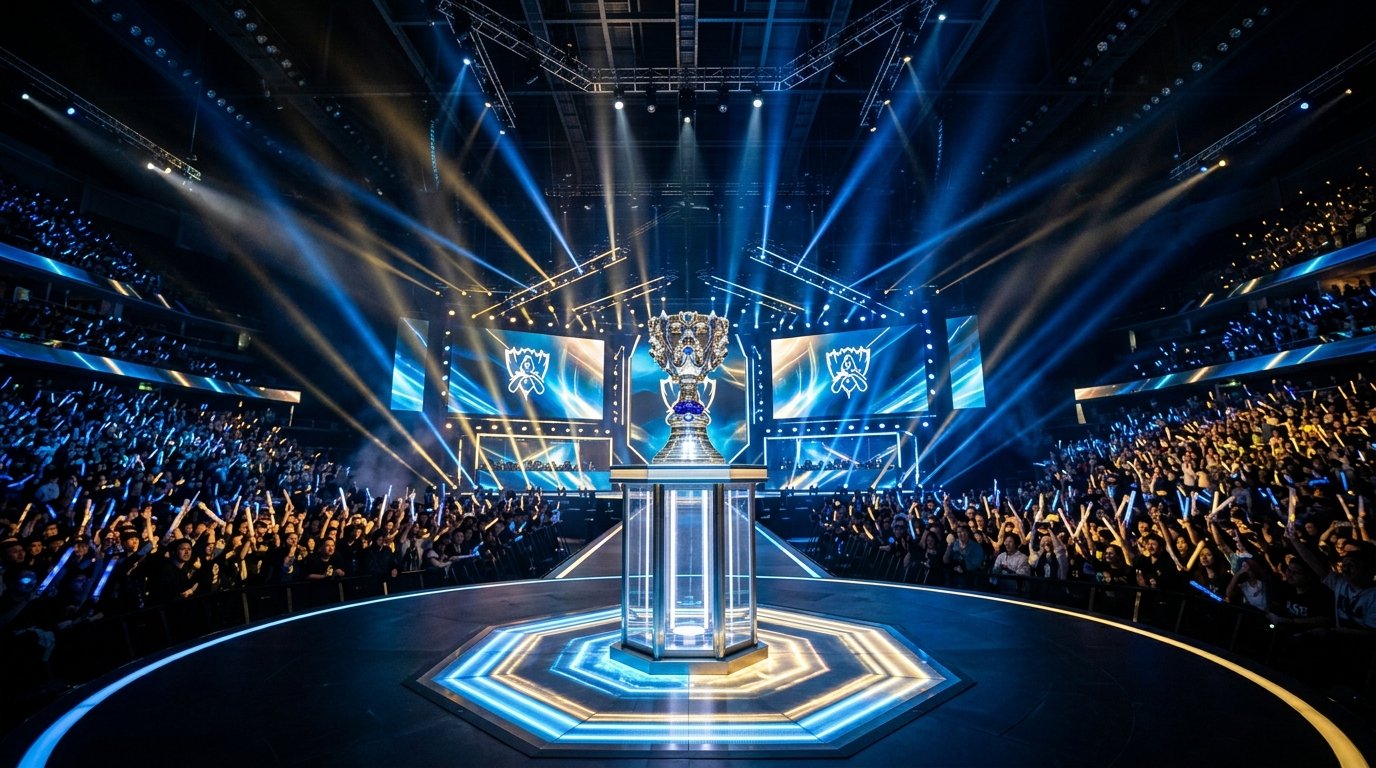
Executive Editorial Summary: The Legacy of the Summoner’s Cup
- The Unkillable Demon King: Lee “Faker” Sang-hyeok stands as the undisputed titan of League of Legends, capturing four World Championships (2013, 2015, 2016, 2023) across an unprecedented eleven-year competitive window.
- Regional Hegemony: South Korea’s LCK (8 titles) and China’s LPL (3 titles) have held an unbreakable duopoly over the Summoner’s Cup since Season 3, setting the global standard for mechanical innovation and macro discipline.
- The Miracle Narrative: DRX’s historic 2022 Cinderella run—from regional fourth seed and Play-In stage qualifiers all the way to hoisting the Cup in San Francisco—remains the greatest underdog journey in sporting history.
- Economic Legacy: Bespoke Championship team skin bundles generate tens of millions in perpetual royalties for players, cementing their in-game legacy directly into Runeterra lore.
Every autumn, as leaves turn golden and competitive circuits around the world conclude their grueling regional splits, the global electronic sports community converges on a single, sacred spectacle: the League of Legends World Championship. Known colloquially as “Worlds,” the tournament represents the pinnacle of strategic depth, mechanical virtuosity, and international cultural pageantry in PC gaming. The ultimate prize—the iconic 70-pound silver Summoner’s Cup—carries the weight of hundreds of thousands of hours of sacrifice, heartbreak, and generational genius.
From its humble origins at DreamHack Summer 2011 inside a Swedish convention hall with folding chairs and a few hundred spectators, Worlds has evolved into an Olympic-scale touring festival filling the Beijing Bird’s Nest, the Seoul World Cup Stadium, and London’s O2 Arena with tens of thousands of screaming fans and concurrent online broadcasts eclipsing 100 million viewers. To lift the Summoner’s Cup is to ascend into the permanent pantheon of digital immortals.
Yet beyond the fireworks and deafening arena decibels, each World Championship is defined by its distinct tactical era. The history of Worlds is a dynamic narrative chronicle of evolving game philosophies: from early European roam-heavy setups and Korean vision-control strangleholds to the hyper-aggressive Chinese solo-lane carry revolutions, the infamous Ardent Censer bot-lane meta, and modern objective-focused neutral monster skirmishing.
To truly appreciate the magnitude of this Hall of Fame, one must examine how the game’s competitive architecture has transformed across generations. In the early seasons, League of Legends was characterized by individual lane dominance and asymmetrical vision warfare. Teams like Taipei Assassins in Season 2 shocked the world by pioneering the “split-push” strategy with Stanley’s Shen and Nidalee, exposing the tactical limitations of slow, grouping Western rosters.
When the Korean LCK entered the international arena in Season 3, the sport underwent a permanent professionalization revolution. Organizations backed by telecommunication giants (SK Telecom, KT Rolster, Samsung) instituted rigid training schedules, multi-man coaching staffs, and scientific lane-swap protocols. In 2014, Samsung White produced what remains statistically the most suffocating, perfect macro gameplay ever recorded, systematically carpeting the entire enemy jungle with sight wards to choke out opponents before five-on-five teamfights could even materialize.
Riot Games subsequently overhauled the game’s mechanics—introducing the Elemental Drake system, removing Sightstone, nerfing infinite vision warding, and accelerating game tempo. This seismic redesign paved the way for China’s LPL golden age between 2018 and 2019. Superstars like Rookie, TheShy, and Doinb proved that sheer lane-kingdom aggression, rapid dive mechanics, and non-stop skirmishing could shatter even the most meticulously calculated defensive setups.
Across all these paradigm shifts, one single constant has bound every generation together: the pursuit of perfection. Whether through Deft’s eleven-year journey of perseverance to capture the 2022 title or Faker’s historic fourth coronation in 2023 to protect South Korean soil against an entire Chinese gauntlet, Worlds has authored narratives that transcend video games and enter the realm of legendary mythology.
Looking for Pixel-Perfect Mouse Precision in Every Game?
Competitive MOBA click accuracy and FPS aim both rely on calibrated DPI, consistent polling rates, and repeatable muscle memory. Check our live mathematical converter to align your sensitivity and desktop DPI across all major esports titles.
The Complete Historical Chronicle of League of Legends World Champions
The following authoritative Hall of Fame registry details every single World Championship in League of Legends history, cataloging the winning organization, full five-man starting roster, head coach, grand finals opponent, series score, Finals MVP, and official championship skin line.
The Top 5 Greatest Individual World Championship Tournament Runs
While League of Legends is an intensely collaborative team sport, select historical tournaments were defined by singular individual performances so transcendent that they permanently altered how specific roles were evaluated. The following retrospective analyzes the five highest individual performance peaks in Worlds history:
1. Jang “MaRin” Gyeong-hwan (2015 SK Telecom T1)
During SKT’s near-flawless 15-1 championship run across Paris, London, and Berlin in 2015, the primary carry of the world champions was not Faker—it was top-laner MaRin. Piloting Fiora, Rumble, and Renekton with unmatched lane tyranny, MaRin absorbed immense enemy jungle pressure without dying, while simultaneously commanding SKT’s map rotations. He captured the Finals MVP award with an astonishing 72.8% kill participation from the top-lane island, an achievement that remains the benchmark for top-lane mastery.
2. Kim “Canyon” Geon-bu (2020 DAMWON Gaming)
At Worlds 2020 in Shanghai, DAMWON Gaming jungler Canyon delivered the most dominant carry-jungle masterclass ever witnessed. In a farming-graves and carry-nidalee meta, Canyon systematically out-pathed, out-farmed, and out-smited every opposing jungler in the tournament. In the Grand Finals against Suning, his relentless invades and surgical skirmishing earned him the Finals MVP medal, cementing the ShowMaker-Canyon duo as the natural successors to Korean domestic supremacy.
3. Kim “Zeka” Geon-woo (2022 DRX)
Before Worlds 2022, Zeka was regarded as an above-average mid-laner in the LCK. Over six weeks in North America, he authored the greatest individual breakout in esports history. Armed with melee skirmishers Sylas and Akali, Zeka repeatedly solo-killed world-champion mid-laners: solo-killing Scout four times in a single game during the quarterfinals, obliterating Chovy in the semifinals, and neutralizing Faker in the Grand Finals. His mechanical audacity carried DRX through impossible teamfights from behind in gold.
4. Gao “Ning” Zhen-Ning (2018 Invictus Gaming)
In 2018, Invictus Gaming ended China’s seven-year quest for the Summoner’s Cup in breathtaking fashion, sweeping Fnatic 3-0 in Incheon. The catalyst was jungler Ning, who became the first Chinese player and the first jungler to win Worlds Finals MVP. Piloting Camille and Gragas, Ning exerted hyper-aggressive early-game pathing, ganking lanes before the 3-minute mark and establishing an unrelenting snowball tempo that Western teams could neither predict nor survive.
5. Park “Ruler” Jae-hyuk (2017 Samsung Galaxy)
The 2017 World Championship was dominated by the suffocating Ardent Censer meta, where matches lasted 45 minutes and revolved entirely around hyper-carry marksmen. In the Grand Finals against two-time defending champions SKT at the Beijing Bird’s Nest, 18-year-old AD carry Ruler produced the defining play of his career. In Game 3 with the series on the line, Ruler flashed forward on Varus into SKT’s backline, snaring Faker’s Karma with Chain of Corruption to seal a historic 3-0 sweep and earn Finals MVP honors.
The Evolution of Meta Eras: From Vision Wars to High-Speed Snowballs
The strategic meta of Worlds has oscillated across distinct tactical epochs:
- The Vision Chokehold Era (2013–2016): Korean teams perfected the vision denial formula. Green wards, sightstones, and pink wards allowed teams like Samsung White and SKT to illuminate 80% of the map, eliminating fog of war and rendering reactive counter-play virtually impossible for Western squads.
- The Solo-Lane Mechanical Renaissance (2018–2019): Riot removed tracker knives and infinite sightstone warding, accelerating early game combat. Invictus Gaming and FunPlus Phoenix exploited this with dominant carry solo-laners (TheShy, Rookie, Doinb), demonstrating that mechanical lane dominance and dive coordination trumped passive defensive scaling.
- The Modern Objective-Control Era (2020–2026): The introduction of Dragon Souls, the Elder Dragon execute mechanic, and Baron pit terrain mutations transformed Worlds into a game of scheduled neutral objective setup. Vision is now concentrated in 60-second bursts around river chokepoints, rewarding teams with elite target prioritization and coordinated cooldown trades.
The Anatomy of Dynasties: The SKT & T1 Hegemony
No entity in esports history approaches the sustained, transcendent excellence of SK Telecom T1 (now T1). Across twelve competitive seasons, T1 has reached six World Championship Grand Finals and captured four world titles, creating a benchmark of organizational culture that rivals the New York Yankees, Real Madrid, or the Chicago Bulls of the 1990s.
At the center of this dynasty sits Lee “Faker” Sang-hyeok. Arriving on the international stage as a 17-year-old solo-queue prodigy in 2013, Faker famously pulverized opponent mid-laners with assassin pocket picks like LeBlanc, Ahri, and Zed. While mechanical wonders come and go every season, Faker’s true genius has been his chameleon-like ability to reinvent his playstyle. When the game shifted from individual carry mid-laners to supportive facilitators, Faker became the world’s most selfless initiator, mastering champions like Galio, Lissandra, and Orianna to elevate his teammates.
In 2023, following a devastating seven-year drought filled with agonizing finals defeats and wrist injuries that threatened to end his career, Faker engineered his defining magnum opus. With every other South Korean team eliminated by China’s dominant LPL representatives, T1 stood alone as the LCK’s sole survivor. Faker systematically swept LNG Esports (3-0), dismantled tournament favorites JD Gaming (3-1) with his historic Azir shuffle on Ruler, and crushed Weibo Gaming (3-0) in the finals to hoist his fourth Summoner’s Cup in front of a weeping home crowd in Seoul.
The Greatest Underdog Journey in History: DRX’s 2022 Miracle Run
If T1 represents royal pre-ordained destiny, DRX’s 2022 triumph is the ultimate testament to the human spirit. Entering the Korean regional finals as an afterthought, DRX survived two consecutive five-game elimination matches just to scrape into Worlds as the LCK’s lowest fourth seed, forcing them to compete in the preliminary Play-In tournament in Mexico City.
What followed was an impossible gauntlet. Led by veteran AD carry Kim “Deft” Hyuk-kyu—who was competing in his final tournament before mandatory military service after nearly a decade of bitter quarterfinal eliminations—DRX defied every analytical prediction:
- The Reverse Sweep of Destiny: In the quarterfinals on Deft’s 26th birthday, DRX fell 0-2 behind defending world champions EDward Gaming, suffering an agonizing base-race inhibitor respawn loss in Game 2. Miraculously, DRX rallied to complete only the second reverse-sweep in Worlds history.
- Dethroning LCK Champions: In the semifinals, they faced domestic powerhouse Gen.G—a team they had lost to in 13 consecutive matches. Powered by mid-lane phenom Zeka’s godlike Sylas and Akali mechanics, DRX obliterated Gen.G 3-1.
- The Chase Center Climax: In a heart-pounding five-game Grand Final against Faker’s T1, top-laner Kingen unleashed the series of his life on Aatrox to secure the championship 3-2. Deft wept openly on stage, coining the phrase “The Unbreakable Heart” that became a cultural phenomenon across South Korea.
The Evolution of Worlds Team Skins: Runeterra’s Greatest Honor
Beyond hoisting the Summoner’s Cup, the crowning reward for winning Worlds is the permanent immortalization of each player inside League of Legends. Working directly with Riot Games’ skin design teams over six to nine months, champions select their signature champions to receive bespoke custom splash arts, recall animations, sound effects, and team color schemes.
These skins are not merely cosmetic vanity projects; they represent a multi-million-dollar economic annuity. Riot allocates a perpetual 25% revenue share from all championship skin sales directly to the five players. In recent years, players have embedded emotional personal easter eggs into their animations: Ambition’s Jarvan IV skin featured his wife’s engagement ring, Doinb’s Malphite performed his wife’s dance choreography, and Deft’s Caitlyn animated his decade-long journey walking through wind and snow to reach the trophy.
Frequently Asked Questions (FAQ)
How many World Championships has Faker won?
Lee “Faker” Sang-hyeok has won four League of Legends World Championships (2013, 2015, 2016, and 2023), all with the same organization (SK Telecom T1 / T1). He is the only player in League of Legends history to accomplish this feat.
Has a Western team ever won the League of Legends World Championship?
Yes, but only in Season 1 (2011), when European squad Fnatic defeated against All authority in Jönköping, Sweden. However, Asian teams (from Korea, China, and Taiwan) did not compete in Season 1. Since Korea and China entered the competition in Season 2 and 3, no Western team has hoisted the Summoner’s Cup, though Fnatic (2018) and G2 Esports (2019) both reached Grand Finals.
Who selects the Champions that receive Worlds team skins?
Each winning player selects one champion they physically played at least once during that World Championship tournament. Riot’s design team collaborates with the athlete to ensure the champion fits visual clarity requirements and does not conflict with imminent major character reworks.
What is the Fearless Draft format introduced in LoL esports?
Fearless Draft is a competitive pick-and-ban ruleset where champions picked in earlier games of a multi-game series cannot be picked again by either team for the remainder of the series. This forces professional rosters to showcase immense champion pools and prevents repetitive meta compositions.
As the League of Legends competitive circuit marches toward future World Championships, the stories of these thirteen legendary championship rosters remain etched in esports history. They serve as an enduring testament to what happens when human coordination, mechanical brilliance, and unwavering competitive courage reach their absolute zenith.
Related posts:
 LoL Worlds Quarterfinals Bracket & Match Schedule: T1 vs TES, Gen.G vs FlyQuest & Pick’em Predictions
 Dota 2 BetBoom Dacha Belgrade Standings & Meta Report: Team Falcons, Tundra Esports & Patch 7.37d Heroes
 CS2 Perfect World Shanghai Major RMR Standings: NAVI, G2 Esports, Vitality & Sticker Capsule Preview
 Valorant VCT Rostermania & Offseason Tracker: Sentinels, Fnatic, Paper Rex & Tier-1 Transfer News