
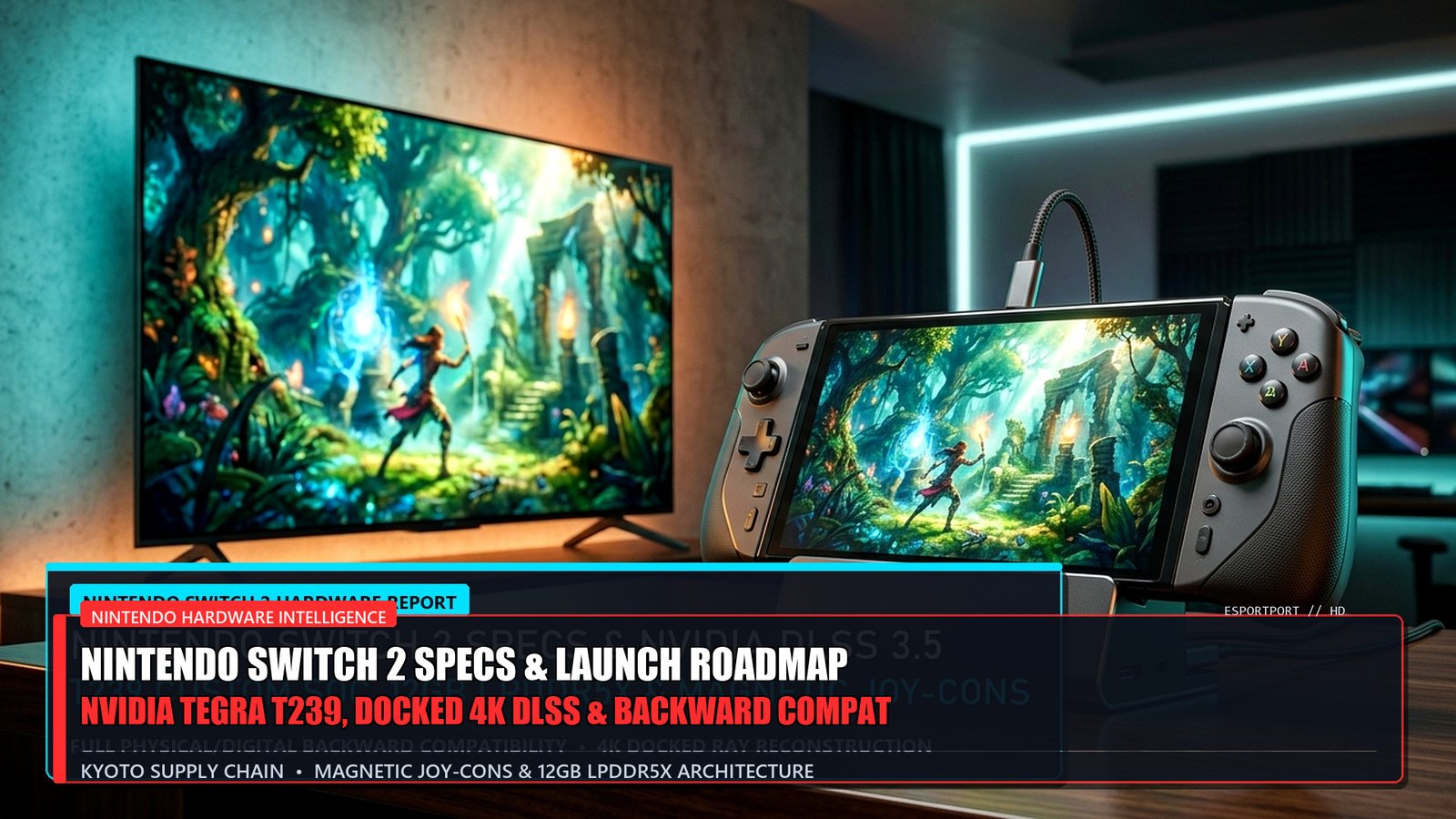
🌍 Nintendo Corporate Announcement & Global Retail Window
Official Reveal Window: Confirmed by President Shuntaro Furukawa before March 31, 2025 fiscal year-end.
Target Commercial Rollout: Autumn / Holiday 2025 – Early 2026 | MSRP Estimate: $399 – $449 USD (₹34,990 – ₹38,990 INR)
With lifetime sales of the original Nintendo Switch surpassing 143 million units—solidifying its legacy as the second best-selling dedicated home console in gaming history—Nintendo Co., Ltd. is preparing to unveil its long-awaited successor: the Nintendo Switch 2. Confirmed officially by Nintendo President Shuntaro Furukawa as entering public view within the current fiscal year, shipping manifests, customs declarations, and component supply contracts have illuminated the technical architecture of Kyoto’s next hybrid marvel.
Engineered in deep collaboration with NVIDIA, the Switch 2 bridges the technological chasm between portable efficiency and modern living-room visual fidelity. By integrating a customized Tegra T239 silicon processor with dedicated Ampere GPU streaming multiprocessors and Tensor Core hardware, Nintendo is set to deliver native 1080p handheld gaming alongside AI-accelerated 4K 60 FPS docked television output via Deep Learning Super Sampling (DLSS 3.1). In this hardware intelligence report, we evaluate leaking specifications, inspect manufacturing supply chains, and break down backward compatibility.
Custom NVIDIA Tegra T239 Architecture: Ampere Graphics & Tensor Cores
The beating heart of the Switch 2 is the custom NVIDIA Tegra T239 (codenamed “Drake”), fabricated on Samsung’s enhanced 8nm (8LPP) foundry node. The CPU cluster features eight ARM Cortex-A78C cores operating in an efficient single-cluster configuration, representing a 400% processing uplift over the aging four-core Cortex-A57 architecture of the 2017 Switch.
On the graphics side, the SoC incorporates 1,536 CUDA cores derived from NVIDIA’s Ampere (RTX 30-series) microarchitecture, coupled with dedicated hardware ray tracing cores and fourth-generation Tensor Cores. When connected to power in the redesigned docked station, the GPU boosts up to 1.2 GHz. Utilizing DLSS Super Resolution, the console reconstructs internal 1080p/1440p frame buffers into crisp 4K outputs on high-end OLED and Mini-LED TVs with astonishing clarity.
| Hardware Component | Original Nintendo Switch (OLED) | Nintendo Switch 2 (Leaked Specs) | Generational Performance Leap |
|---|---|---|---|
| Processor (SoC) | NVIDIA Tegra X1 (20nm / 16nm) | NVIDIA Tegra T239 (8nm) | 8x ARM Cortex-A78C cores; 4.2x raw multi-threaded throughput. |
| Graphics & CUDA Cores | 256 Maxwell CUDA Cores | 1,536 Ampere CUDA Cores | 6x shader compute uplift + dedicated RT & Tensor Core hardware. |
| System Memory (RAM) | 4GB LPDDR4 (25.6 GB/s) | 12GB LPDDR5X (102 GB/s) | Triple memory capacity; enables ports of modern PS5/Xbox Series X titles. |
| Internal Storage | 32GB / 64GB eMMC 5.1 | 256GB UFS 3.1 Flash | Read speeds up to 2,100 MB/s; slashes loading times down to 3-5 seconds. |
| Handheld Display | 7.0″ 720p 60Hz OLED | 8.0″ 1080p LCD (VRR Ready) | Larger viewing area with Variable Refresh Rate to eliminate handheld tearing. |
Magnetic Joy-Cons & Universal Backward Compatibility
Patent filings published by the Japan Patent Office disclose that Nintendo has retired the traditional mechanical rail-sliding mechanism used on the original Joy-Cons. In its place, the Switch 2 introduces an electro-magnetic coupling system that snaps the controllers into place with high-strength rare-earth magnets, completely eliminating wobbling rails while adding an optical sensor and an additional back-paddle button.
Crucially for Nintendo’s loyal audience, the Switch 2 features dual-medium backward compatibility. Both physical game cartridges and digital eShop libraries will carry over seamlessly. Enhanced “Switch 2 Edition” patches are anticipated for tentpole blockbusters including The Legend of Zelda: Tears of the Kingdom and Metroid Prime 4: Beyond, boosting frame rates to stable 60 FPS while upgrading resolution to native 4K docked via DLSS.
| Anticipated Software Title | Original Switch State | Switch 2 Enhanced Profile | Technical & Visual Enhancements |
|---|---|---|---|
| Zelda: Tears of the Kingdom | 900p Dynamic / 30 FPS | 4K (DLSS) / 60 FPS | Eliminates Ultrahand physics frametime drops; enhances draw distance on sky islands. |
| Metroid Prime 4: Beyond | 1080p / 60 FPS | 4K / 60 FPS + Ray Tracing | Hardware-accelerated visor reflections and dynamic volumetric lighting. |
| Brand-New 3D Mario Title | N/A (Switch 2 Exclusive) | 4K 60 FPS Native Asset | Open-world sandbox sequel following Super Mario Odyssey’s architectural blueprint. |
| Cyberpunk 2077 (Port Leak) | Not Possible on Switch 1 | 1080p 40 FPS (Handheld) | Validates 12GB RAM bandwidth, handling heavy third-party AAA open-world assets. |
+EV Consumer Hardware Signals
- Hold Off on Switch OLED Purchases: Unless discounted below $249, purchasing an original Switch now will result in immediate buyer remorse.
- Stockpile Digital Switch eShop Games: Physical and digital libraries carry over, with free performance patches anticipated for major first-party titles.
- Prepare High-Speed MicroSD Express Cards: Switch 2 supports faster SD Express transfer protocols exceeding 800 MB/s.
Pre-Launch Misconceptions to Avoid
- Expecting Native 4K Handheld Displays: Driving 4K on an 8-inch screen is battery suicide; 1080p is the ideal pixel density sweet spot.
- Assuming Joy-Con Drift Returns: Magnetic Hall Effect sensor patents indicate Nintendo has fundamentally redesigned the stick mechanism.
Strategic Cross-Links & Hardware Intelligence Guides
Explore more in-depth gaming hardware analysis and benchmarks across EsportPort:
- Next-gen console roadmap analysis: PlayStation 6 vs Xbox Next-Gen Strategy Report
- PC handheld and budget laptop benchmarks: Best Gaming Laptops Under 85000 in India and Best Gaming Laptops Under $1,000 / ₹85k
- Action RPG and open-world performance: Path of Exile 2 Early Access Review & PC Lab
- Mobile gaming flagship hardware: Best Flagship Gaming Phones 2026 and Best Gaming Phones Under 50000
Frequently Asked Questions (FAQ)
Q1: What processor powers the Nintendo Switch 2?
A: The console is powered by a custom NVIDIA Tegra T239 processor featuring 8 ARM Cortex-A78C CPU cores and 1,536 Ampere CUDA cores with dedicated Tensor Cores for DLSS.
Q2: Will the Switch 2 play original Nintendo Switch physical cartridges?
A: Yes, customs data and developer briefings confirm that the Switch 2 cartridge slot is backward compatible with original Switch game cards.
Q3: How does the Switch 2 achieve 4K resolution on television screens?
A: By utilizing NVIDIA DLSS 3.1, the GPU renders games internally at 1080p or 1440p and uses AI Tensor Cores to reconstruct frames to a sharp 4K 60Hz output.
Q4: Why does the Switch 2 use an 8-inch LCD instead of OLED at launch?
A: Utilizing an 8-inch 1080p LCD allows Nintendo to keep the launch price competitive ($399–$449) while allocating manufacturing budget to 12GB of LPDDR5X RAM.
Q5: What is the expected retail price in India and globally?
A: Globally, the console is expected to launch at $399 to $449 USD, which translates to approximately ₹34,990 to ₹38,990 INR in India following import duties.
Related posts:
 Path of Exile 2 Early Access Review & PC Performance Lab: WASD Movement, 100+ Boss Mechanics, Skill Gem Overhaul & 120 FPS Settings
 PlayStation 6 & Xbox Next-Gen Strategy Report: Sony Custom Silicon vs Microsoft Cloud Dominance, Studio M&A & 2027 Console Timelines
 Nintendo Switch 2 Hardware Leak & Backward Compatibility Report: NVIDIA DLSS 3.5, Magnetic Joy-Cons & Launch Lineup
 Apex Legends Season 23 Pro Aim Hacks & Audio Equalizer Settings: Superglide Binds, Zero-Deadzone Linear Curves & 240Hz Footstep EQ