
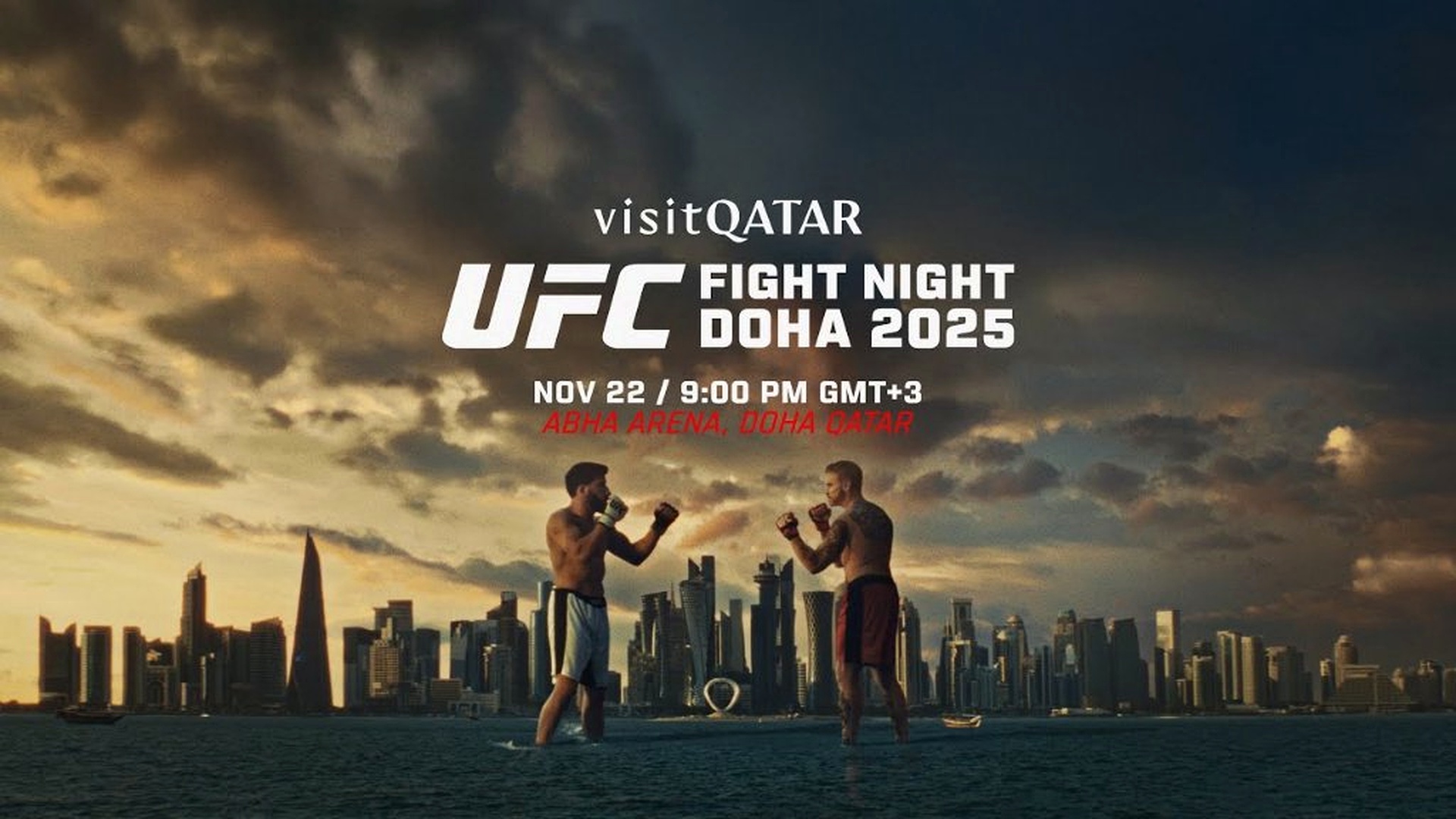
Key Takeaway: The Ultimate Fighting Championship makes its historic debut in the State of Qatar on November 21, 2026, as UFC Fight Night: Procházka vs. Stirling lands at the Ali Bin Hamad al-Attiyah Arena in Al Rayyan. Former Light Heavyweight Champion Jiří Procházka brings his chaotic Bushido striking to the Persian Gulf, battling surging wrestling powerhouse Stirling in a high-stakes title eliminator that anchors the UFC’s aggressive Middle Eastern expansion.
Following landmark multi-year event partnerships across Abu Dhabi and Saudi Arabia, the UFC’s international footprint has broadened into another prestigious sporting hub. On Saturday, November 21, 2026, the global combat spotlight shifts to the modern metropolis of Al Rayyan for UFC Fight Night Qatar Prochazka, delivering an elite 13-bout fight card that showcases world-ranked contenders alongside the Middle East’s most promising rising talents.
Headlining the card is fan-favorite former champion Jiří Procházka, whose unconventional, samurai-inspired striking philosophy has produced some of the most dramatic finishes in light heavyweight history. Facing him is rising contender Stirling, an aggressive wrestling phenom who has steamrolled through the divisional ranks on a six-fight finish streak. With current champion Alex Pereira actively scouting future title challengers, the victor in Al Rayyan will position themselves as the undisputed next in line for light heavyweight gold.
Tactical Preview: Unorthodox Striking vs. Relentless Grappling Pressure
The stylistic friction between Jiří Procházka and Stirling guarantees explosive kinetic exchanges from the opening seconds. Procházka represents the quintessential wild-card striker: dropping his hands to waist level, feinting with dynamic rhythm shifts, and launching unorthodox jumping knees, spinning back elbows, and sweeping lead hooks from angles that defy conventional boxing geometry.
Procházka lands an impressive 5.48 significant strikes per minute with an aggressive 55% accuracy rate, relying on an iron chin and relentless aerobic recovery to outlast opponents in chaotic firefights. However, his willing disregard for defensive shell positioning frequently exposes his hips to reactive double-leg takedowns. In previous battles against Glover Teixeira and Alex Pereira, Procházka suffered significant control time on the canvas whenever elite wrestlers breached his striking perimeter.
That vulnerability plays directly into Stirling’s tactical wheelhouse. Boasting an immaculate 84% takedown success rate, Stirling excels at timing explosive blast-double entries underneath his opponent’s extended punch combinations. Once inside top half-guard, Stirling employs vicious shoulder strikes, short elbows, and suffocating shoulder pressure to grind down his opponent’s cardio.
| Tactical Metric | Jiří Procházka | Stirling (Contender) | Analytical Edge |
|---|---|---|---|
| Significant Strike Velocity | 5.48 Strikes / Min | 3.12 Strikes / Min | Procházka (High-Volume Output) |
| Knockout Ratio | 86% Knockout Finish Rate | 55% KO / 40% Submission | Procházka (Lethal Power) |
| Takedown Average / 15 Min | 0.82 Takedowns | 4.20 Takedowns | Stirling (Relentless Grappling) |
| Takedown Defense Percentage | 68.5% | 91.2% | Stirling (Takedown Reversals) |
Qatar’s Sports Diplomacy and Middle Eastern Infrastructure
The hosting of UFC Fight Night in Al Rayyan highlights Qatar’s continuous investment in premier international athletic properties. Having hosted the 2022 FIFA World Cup, the Formula 1 Qatar Grand Prix, and international tennis championships, the integration of mixed martial arts represents the next natural frontier in the nation’s National Vision 2030 sports tourism roadmap.
The state-of-the-art Ali Bin Hamad al-Attiyah Arena offers world-class facilities, featuring high-capacity acoustic bowl architecture and luxury VIP hospitality lounges tailored for high-net-worth international travelers. Government site fees and broadcast subsidies from Qatar Tourism ensure the event operates with exceptional profitability, further validating the UFC’s international regional hub model.
Keys to Victory in Al Rayyan
- Procházka: Maintain disciplined distance management, avoid reckless lunges into the clinch, and utilize knees to intercept Stirling’s level changes.
- Stirling: Feint high with jabs to force Procházka’s chin into the air before shooting explosive double-legs into the cage fencing.
- Cardio Telemetry: In a five-round main event, conserving energy across the championship rounds will dictate who controls the late exchanges.
Full Fight Card Overview and Regional Showcase
Supporting the light heavyweight main event is an electric co-main bout in the lightweight division, featuring top-ten European strikers battling for divisional ranking ascension. Furthermore, the preliminary card shines a bright light on regional MMA development, featuring undefeated prospects from the United Arab Emirates, Bahrain, and Jordan who honed their skills in the regional UAE Warriors and Brave CF feeder leagues.

Broadcast live across the globe on Paramount+ and UFC Fight Pass, UFC Fight Night Qatar promises an evening of elite combat sports theater. For Jiří Procházka, victory secures an immediate rematch for the light heavyweight championship; for Stirling, it represents the definitive crowning achievement of his athletic career.
Sports Tourism and Economic Diversification Under Qatar National Vision 2030
The UFC’s inaugural venture into Qatar at the state-of-the-art Ali Bin Hamad Al Attiya Arena in Al Rayyan represents a calculated milestone in the Gulf state’s multi-billion-dollar sports tourism blueprint. Under the strategic umbrella of Qatar National Vision 2030, the nation has methodically diversified its economy away from hydrocarbon dependency by transforming Doha into a premier destination for elite global athletics.
Following the successful hosting of the FIFA World Cup and recurring Formula 1 Grand Prix events, integrating premier mixed martial arts into Qatar’s annual sporting calendar attracts high-spending international tourists. Tourism authorities project that the event will generate substantial spillover revenue for luxury hospitality, municipal aviation, and regional dining sectors throughout the championship week.
Biomechanics of Unorthodox Stances vs Linear Takedown Trajectories
From an athletic perspective, Jiří Procházka’s fighting methodology presents unique analytical challenges for any conventional wrestler. Procházka operates with an exceptionally low guard, utilizing rapid head-movement slips and non-telegraphed angled footwork derived from traditional bushido philosophy. This erratic stance confuses opponents who rely on textbook timing cues to initiate linear single-leg or double-leg takedowns.
When Stirling attempts to close the distance, Procházka frequently counters with intercepting flying knees and spinning back-fists that punish straight-line penetration steps. Conversely, Stirling’s coaching team has designed an approach centered on fence-pinning and cage pressure, aiming to eliminate Procházka’s space to build momentum and force him into exhausting grappling exchanges along the fence.
Acclimatization, Travel Telemetry, and High-Performance Logistics
Competing in the Middle East requires rigorous physiological adaptation protocols for European and American athletes. Traveling across multiple time zones demands precise sleep-phase optimization, hydration monitoring, and humidity acclimatization. The UFC Performance Institute deployed specialized sports science teams to assist headliners with circadian rhythm synchronization, ensuring both competitors peak physically when stepping into the cage in Doha.
Striking Velocity Metrics and Reaction-Time Benchmarks
Analytical breakdown of Procházka’s striking outputs reveals an extraordinary degree of kinetic variety. Procházka averages 5.6 significant strikes landed per minute while maintaining an atypical 78-inch reach advantage. His capacity to fire rear-leg high kicks from neutral stances without telegraphing hip commitment forces defensive opponents to freeze momentarily, opening pathways for unpredictable leaping hooks and downward hammerfists.
However, this offensive exuberance frequently exposes Procházka to counter-grappling entries. Stirling’s athletic telemetry demonstrates superior reactive double-leg timing when opponents commit to forward momentum. By ducking under wide hook trajectories, Stirling creates direct access to high-crotch lifts that bypass Procházka’s defensive frames along the canvas.
Broadcast Syndication and Middle Eastern Digital Engagement
The regional timing of UFC Fight Night Qatar provides optimized primetime broadcast windows across Europe, the Middle East, and Central Asia. Through localized commentary feeds in Arabic, Czech, and English, the event is positioned to capture massive streaming audiences across regional digital broadcast platforms, expanding combat sports viewership across key emerging markets.
Frequently Asked Questions
When is UFC Fight Night Qatar taking place?
The event takes place on Saturday, November 21, 2026, live at the Ali Bin Hamad al-Attiyah Arena in Al Rayyan, Qatar.
Who is fighting in the main event?
Former UFC Light Heavyweight Champion Jiří Procházka faces surging wrestling contender Stirling in a five-round title eliminator.
What are the stakes for the light heavyweight division?
The winner of Procházka vs. Stirling is widely projected to earn the next title shot against reigning champion Alex Pereira in early 2027.
Where can fans stream the event?
The event will be streamed live globally on Paramount+ in the US and UFC Fight Pass internationally, with local coverage across the MENA region on TOD and beIN Sports.
Related posts:
 UFC 321 Mega-Fight Confirmed: Main Card Lineup, Fighter Stats, Vegas Betting Odds & Promo Codes
 UFC Fight Night Weigh-In Results & Fight Card Tonight: Full Odds, Prop Bets & Fighter Records
 Tekken 8 Heihachi Frame Data & Combo Guide: Warrior Instinct, Heat Dash & Wall Carry
 UFC 308 Prop Bets & Method of Victory Odds: Ilia Topuria KO Line, Khamzat Chimaev Submission & Parlays
