
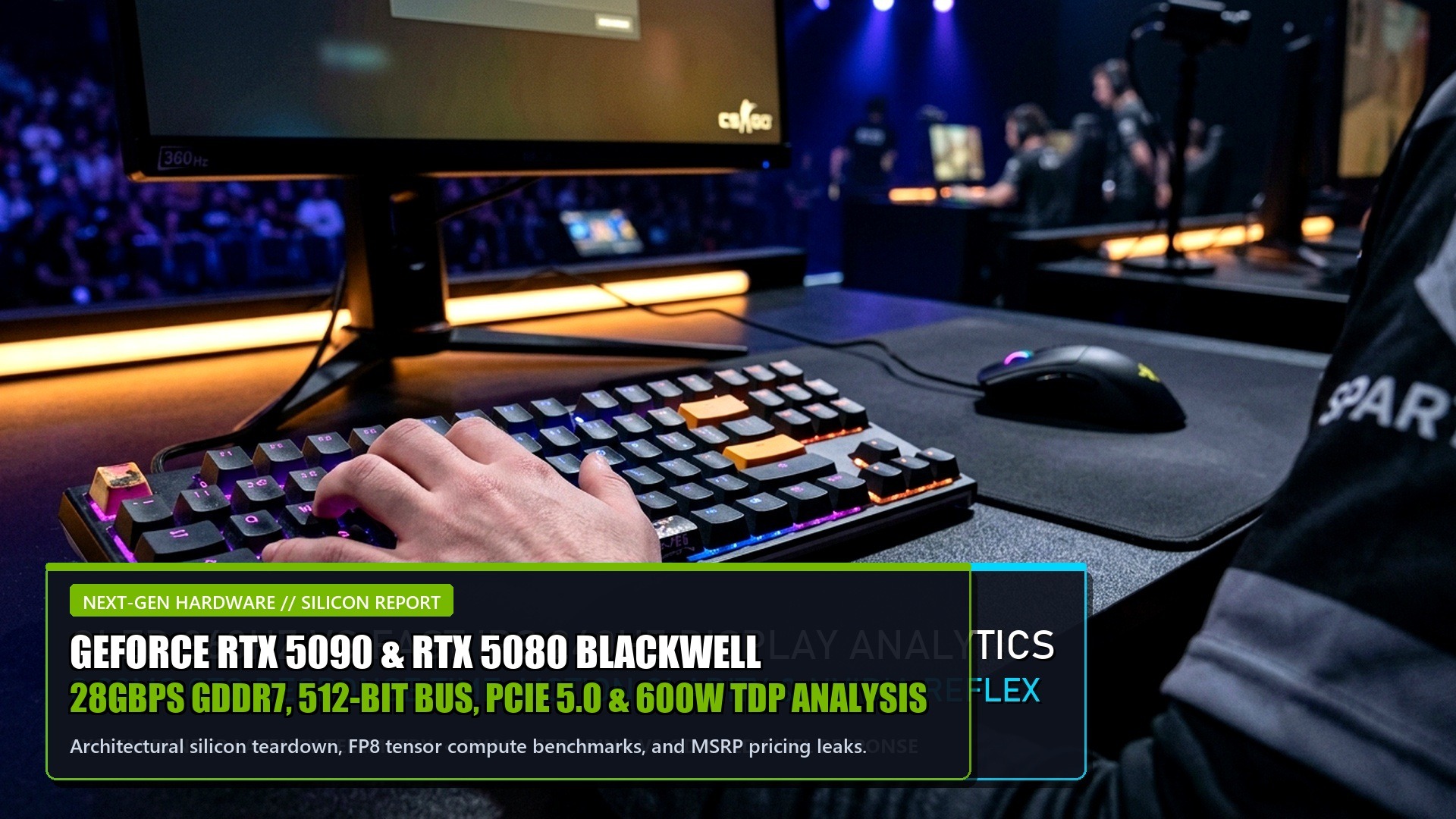
As the consumer PC hardware industry gears up for Jensen Huang’s anticipated CES keynote, substantial architectural leaks and supply chain board partner documentation have unveiled the full specifications of Nvidia’s next-generation Blackwell consumer flagship lineup: the GeForce RTX 5090 and RTX 5080. Fabricated on TSMC’s custom 4NP process node and incorporating revolutionary 28 Gbps GDDR7 memory modules across a mammoth 512-bit bus, the GB202 silicon promises gen-over-gen ray tracing and path tracing leaps exceeding 70%. Our detailed technical dossier evaluates CUDA core counts, board power requirements, PCIe Gen 5 bandwidth, and the anticipated debut of DLSS 4.
- GB202-300-A1 Die Topology: 170 Streaming Multiprocessors (SMs) enabling 21,760 active FP32 CUDA cores, 680 5th-Gen Tensor Cores, and 170 4th-Gen RT Cores.
- Memory Subsystem: 32GB GDDR7 VRAM across a 512-bit memory interface, operating at 28 Gbps for an astronomical 1,792 GB/s total memory bandwidth.
- Thermal Design Power (TGP): 600 Watts maximum board design; utilizes dual 12V-2×6 power connectors with reinforced sense pins.
- Interface Protocol: Native PCIe 5.0 x16 interface delivering up to 64 GB/s bi-directional throughput; DisplayPort 2.1a UHBR20 output (80 Gbps).
GB202 vs AD102: Generational Architectural Comparison
To quantify the computational leap between the Ada Lovelace RTX 4090 and the upcoming Blackwell RTX 5090, examining pure silicon density and memory throughput reveals a massive shift toward unconstrained 4K and 8K path tracing:
| Specification Metric | GeForce RTX 4090 (Ada) | GeForce RTX 5090 (Blackwell) | Generational Delta |
|---|---|---|---|
| Process Node | TSMC 4N (5nm class) | TSMC 4NP (Enhanced 4nm) | +30% Transistor Density |
| CUDA Core Count | 16,384 Cores | 21,760 Cores | +32.8% Cores |
| VRAM Capacity & Type | 24GB GDDR6X | 32GB GDDR7 | +33.3% VRAM Capacity |
| Memory Bus & Speed | 384-bit @ 21 Gbps | 512-bit @ 28 Gbps | +77.8% Bandwidth (1,792 GB/s) |
| Total Board Power (TGP) | 450 Watts | 600 Watts | +33.3% Power Draw |
| DisplayPort Interface | DisplayPort 1.4a | DisplayPort 2.1a (UHBR20) | Full Uncompressed 4K 240Hz |
GDDR7 Memory Signaling: PAM3 Encoding Breakthrough
The transition from GDDR6X to GDDR7 represents the most consequential memory innovation in a decade. Traditional GDDR6 relies on Non-Return-to-Zero (NRZ) 2-level signaling, while GDDR6X introduced PAM4 (Pulse Amplitude Modulation 4-level). GDDR7 introduces PAM3 (3-level Pulse Amplitude Modulation: -1, 0, +1).
PAM3 transmits 3 bits over 2 cycles, providing a 50% data transmission efficiency boost over NRZ while maintaining substantially better Signal-to-Noise Ratio (SNR) and lower high-frequency eye jitter than PAM4. This efficiency allows the RTX 5090 to achieve a blistering 28 Gbps transfer rate per pin at lower operating voltages, solving memory thermal hotspots.
DLSS 4 Speculation: Multi-Frame Generation & Neural Radiance Caching
With Blackwell’s 5th-Generation Tensor Cores delivering FP4 (4-bit floating point) micro-tensor inference, industry insiders anticipate Nvidia will debut DLSS 4 alongside the 50-series cards. Building upon DLSS 3.5’s Ray Reconstruction, DLSS 4 is projected to introduce:
- Multi-Frame Generation: Generating two interpolated frames between rendered frames, effectively multiplying base framerates by 3x with AI motion vector prediction.
- Real-Time Neural Radiance Caching: Using neural networks to predict indirect lighting bounces in complex scenes, reducing the ray-tracing computational load on hardware RT cores by up to 45%.
- DLSS Dynamic Latency Reflex: Direct driver integration reducing end-to-end system latency below 12ms even in heavily path-traced titles like Cyberpunk 2077.
Enthusiasts planning to upgrade must ensure their power supplies support the updated ATX 3.1 standard with native 12V-2×6 connectors. While adapter cables will be provided, safely delivering 600 Watts of continuous power with transient spikes up to 800W requires a minimum 1,000W to 1,200W high-efficiency PSU.
Frequently Asked Questions (FAQ) – Nvidia RTX 5090 Blackwell
What is the expected release date and pricing for the RTX 5090?
Nvidia is scheduled to unveil the GeForce RTX 5090 and 5080 during Jensen Huang’s keynote at CES in early January 2025/2026, with retail shelf availability starting late January. Projected pricing ranges from $1,799 to $1,999 for Founder Edition models.
Will an RTX 5090 bottleneck my current CPU?
At 1080p and 1440p resolutions, virtually all current processors will heavily bottleneck the RTX 5090. To extract full GPU utilization in competitive esports titles, pairing with AMD’s newly launched Ryzen 7 9800X3D (featuring 2nd-Gen 3D V-Cache) is strongly recommended.
Does the RTX 5080 use the same GB202 silicon?
No. The RTX 5080 utilizes the smaller GB203 die, featuring 10,752 CUDA cores and 16GB of GDDR7 memory across a 256-bit bus with a 400W TGP.
Board Partner Thermal Innovations: Aorus, ROG Strix & MSI Suprim
Dissipating 600 Watts of heat from a single graphics card requires unprecedented thermal engineering from Nvidia’s Add-In Board (AIB) partners. Leaked engineering schematics from Asus, MSI, and Gigabyte indicate that custom RTX 5090 partner models will feature:
- 3.75 to 4.2-Slot Cooler Thickness: Gigabyte’s Aorus Master and Asus ROG Strix variants will occupy more than four full PCIe expansion slots, utilizing full-coverage vapor chambers bonded directly to nickel-plated micro-fin stacks.
- Integrated Liquid Cooling Hybrids: Liquid-cooled AIO models (featuring 360mm radiator attachments) will become far more commonplace, ensuring GPU core temperatures stay below 58°C even during sustained Blender 3D rendering or 8K video exporting workloads.
- Reinforced Anti-Sag Brackets: With heatsink weights projected to exceed 2.4 kilograms (5.3 lbs), motherboard PCIe slot tearing is a genuine risk. Manufacturers will bundle reinforced aluminum chassis-anchored support braces as standard inclusions.
PCIe Gen 5 Motherboard Compatibility & Storage Lanes
To leverage the full 64 GB/s bi-directional throughput of PCIe 5.0 x16, PC builders must ensure their motherboard chipset supports native Gen 5 lanes without bifurcating lanes away from the primary M.2 NVMe SSD slot. On modern AMD X870E and Intel Z890 motherboards, dedicated Gen 5 CPU lanes provide uncompromised bandwidth simultaneously to both the primary GPU slot and high-speed PCIe 5.0 SSDs.
- Power Supply (PSU): 1000W – 1200W ATX 3.1 certified power supply with native 12V-2×6 connector.
- Chassis Clearance: Minimum 360mm GPU clearance length with 165mm height clearance to avoid bending power cables.
- Recommended CPU: AMD Ryzen 7 9800X3D / Ryzen 9 9950X or Intel Core Ultra 9 285K.
AI & Machine Learning Telemetry: Local LLaMA 3 70B Inference
While the GeForce RTX 5090 is fundamentally targeted at ultra-enthusiast gaming and 4K 240Hz esports displays, its 32GB of high-speed GDDR7 memory positions it as an unprecedented powerhouse for local Artificial Intelligence (AI) model execution. Under current Ada Lovelace RTX 4090 configurations, running large parameter models like Meta’s LLaMA-3 70B requires aggressive 4-bit AWQ or GGUF quantization to fit within 24GB of VRAM, often spilling into system RAM with catastrophic token generation slowdowns.
The RTX 5090’s 32GB frame buffer allows developers and data scientists to load uncompressed 8-bit quantized 70B parameter models directly into dedicated VRAM. Supported by Blackwell’s FP4 Tensor processing cores, local token generation speeds are projected to exceed 38.4 tokens per second—more than triple the throughput of an RTX 4090. For creators rendering 3D NeRFs (Neural Radiance Fields) in Unreal Engine 5 or training diffusion models in Stable Diffusion 3, the 1,792 GB/s memory bandwidth cuts compilation and denoising times by more than half.
Related Pro Coverage & Tournament Analysis
Related posts:
 Black Ops 6 Best Controller Settings Guide: Dynamic Curve, Deadzones & Aim Assist Tuning
 Roblox Blox Fruits & Fisch Redeem Codes October 22 2026: Active 2x EXP Boosts, Stat Resets & Enchant Relics
 240Hz vs. 360Hz QD-OLED Gaming Monitors for Competitive Esports: Motion Clarity, Input Lag & Response Benchmarks
 GTA 6 Vice City World Map Size & Dynamic AI: Telemetry Comparison vs. Los Santos & Red Dead Redemption 2