
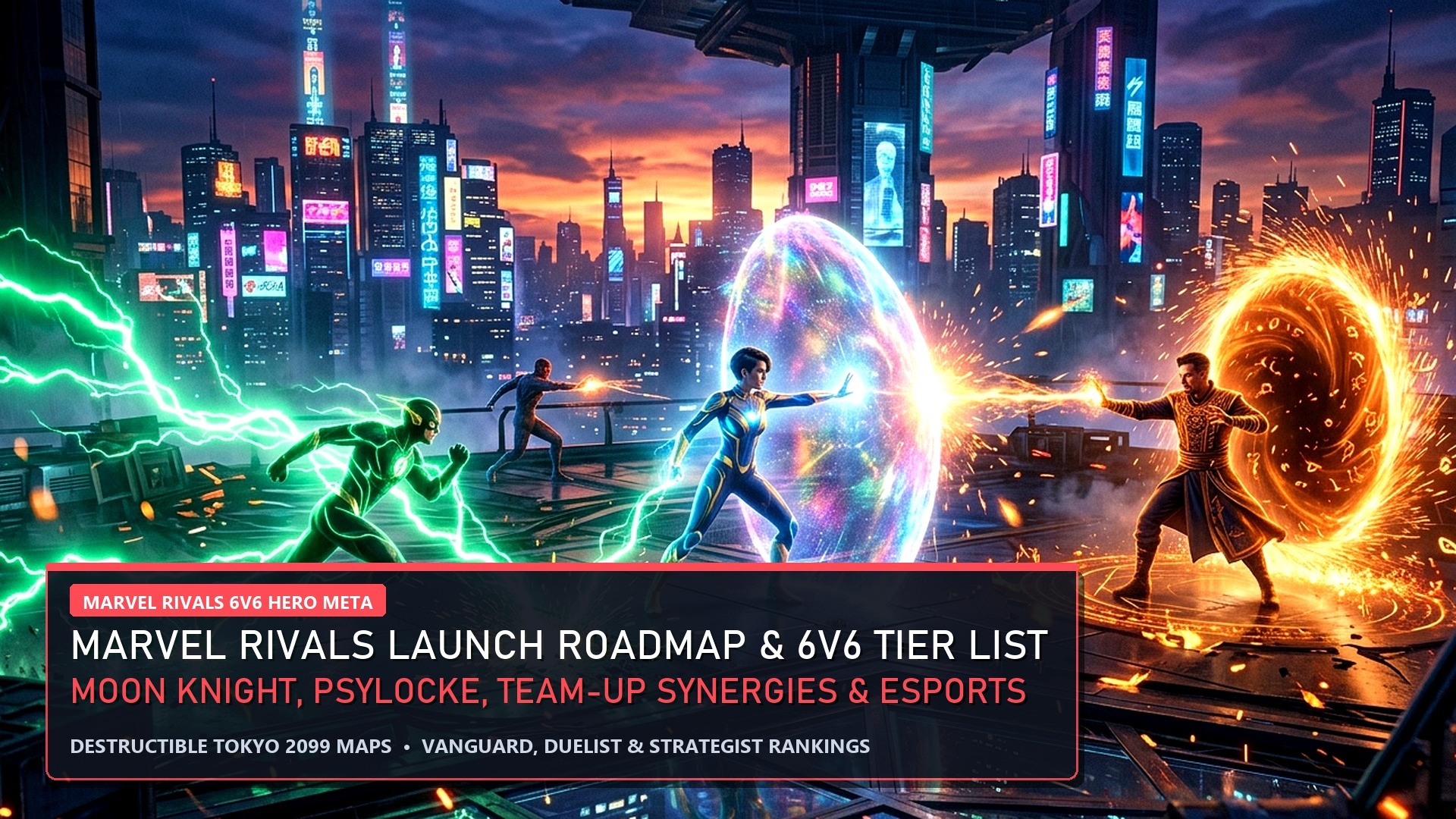
The hero shooter landscape has received an electric jolt of adrenaline with the official global launch of NetEase Games’ Marvel Rivals. Pitting legendary Marvel comic superheroes and villains against one another in frantic 6v6 team-based objective battles, the free-to-play title blends third-person shooter mechanics, destructible environment physics, and explosive Team-Up abilities. As competitive players rush into Ranked mode to climb through Bronze, Diamond, and Eternity ranks, understanding the current meta hierarchy is essential for securing victory.
Much like other tactical team shooters where hero synergy and cooldown economy dictate matches, Marvel Rivals revolves around three foundational roles: Vanguards (tanks), Duelists (damage dealers), and Strategists (support healers). However, the game’s revolutionary Dynamic Team-Up system adds a profound strategic dimension, granting passive buffs and game-changing active abilities when specific lore-accurate heroes fight side-by-side on the battlefield.

The S-Tier Vanguard Anchors: Venom, Magneto, and Doctor Strange
In high-tier competitive lobbies, Vanguard selection sets the operational tempo for the entire squad. Without durable frontline initiators capable of absorbing burst damage and creating spatial territory, fragile Duelists cannot secure elimination angles. Leading the Vanguard class in S-Tier is Venom. Boasting an immense health pool, vertical mobility via web-swinging, and a massive overshield mechanic through Cellular Corrosion, Venom excels at diving into enemy backlines, disrupting fragile Strategists, and escaping unscathed.
Equally dominant is Magneto, who serves as the definitive anchor tank. Magneto’s electromagnetic barrier shields teammates from incoming projectile spam, while his metallic projectile volleys inflict punishing ranged poke damage. Furthermore, pairing Magneto with Scarlet Witch unlocks their iconic Team-Up ability, empowering Magneto with an explosive chaos blade that can decisively break contested choke points on escort and convergence maps.
Doctor Strange rounds out the top Vanguard echelon through sheer utility. His mystical Portals allow coordinated teams to bypass fortified defensive chokepoints entirely, teleporting entire squads directly onto capture points. Combined with his Dark Dimension ultimate that stuns caught adversaries in stasis, Doctor Strange commands unmatched macro-level tactical control.
| Hero Name | Role Class | Meta Tier Placement | Team-Up Synergy Partner | Primary Kit Advantage | Ultimate Ability Impact |
|---|---|---|---|---|---|
| Venom | Vanguard (Tank) | S-Tier (Absolute Meta) | Spider-Man, Peni Parker | Massive cellular overshield and disruptive dive mobility | Feast: Crushing leap that slows and deals massive AoE burst |
| The Punisher | Duelist (DPS) | S-Tier (Absolute Meta) | Rocket Raccoon | Versatile rifle/shotgun swapping with stationary turret | Final Judgement: Heavy dual-wield missile barrage |
| Luna Snow | Strategist (Support) | S-Tier (Absolute Meta) | Namor, Jeff the Land Shark | High burst healing darts with passive ice-skate aura | Fate of the Both Worlds: Game-saving invulnerability & amp |
| Magneto | Vanguard (Tank) | S-Tier (Absolute Meta) | Scarlet Witch | Robust directional shields with lethal chaos blade Team-Up | Meteor M: Giant magnetic scrap projectile with huge radius |
| Hela | Duelist (DPS) | A-Tier (High Pick) | Loki, Thor | Deadly hitscan crow daggers with punishing headshot damage | Goddess of Death: Airborne transformation raining blades |
| Mantis | Strategist (Support) | A-Tier (High Pick) | Star-Lord, Adam Warlock | Targeted damage boosts and long-duration sleeping spores | Soul Resurgence: High-speed healing aura that cleanses cc |
The Duelist Meta: The Punisher, Hela, and Iron Man Dominance
The Duelist roster is brimming with iconic firepower, but competitive success in Season 1 hinges on reliable, sustained damage delivery. Frank Castle, The Punisher, stands out as an uncontested S-Tier powerhouse. Armed with an assault rifle for mid-range tracking and a fully automatic combat shotgun for close-quarters shredding, Frank dismantles enemy tanks with unmatched efficiency. When combined with Rocket Raccoon’s Ammo Overcharge Team-Up, The Punisher gains infinite ammunition and fire-rate buffs, enabling him to melt opposing shields in seconds.
For precision marksmen, Hela offers lethal hitscan burst potential. Her Nightsword projectiles deal devastating critical headshot damage, allowing skilled players to eliminate opposing Strategists with two well-placed strikes. Additionally, her Crow Transformation provides an instant vertical escape tool when dove by enemy Vanguards, ensuring she maintains advantageous high-ground positioning across Asgard and Tokyo 2099 battlefields.
Aerial duelists like Iron Man and Storm also present formidable threats when opposing teams lack disciplined hitscan aiming. Iron Man’s armor repulsors and Unibeam disintegrate grounded clusters of enemies, while his EMP ultimate shuts down enemy defensive shields during climactic overtime pushes.
Strategist Synergies: Luna Snow and Mantis Triage Healing
Supporting your team in Marvel Rivals requires far more than passive healing; modern Strategists must actively contribute offensive crowd control and team-wide offensive buffs. Luna Snow reigns as the premiere S-Tier Strategist. Her Ice Arts allow her to skate effortlessly across the map while firing freezing projectiles that pierce allies to heal and damage enemies. Her ultimate ability, Fate of Both Worlds, provides massive area-of-effect invulnerability and damage amplification, acting as the ultimate counter-measure against wiped-out team ultimates.

Complementing Luna is Mantis, whose single-target healing leaves and Life Spores keep dive tanks healthy at extended ranges. Mantis’s ability to boost allied damage output transforms good Duelists into unstoppable killing machines. Furthermore, her Sleep Spore projectile neutralizes raging enemy ultimates, putting diving Venoms or Hulk players into deep slumber before they can disrupt the backline.
Environmental Destruction as a Tactical Tool
One of Marvel Rivals’ most defining technological features is dynamic architectural destruction. Buildings, bridges, archways, and interior walls are not static geometry; they possess realistic material durability. High-damage abilities from heroes like Hulk, Thor, and Magneto can collapse entire second-story balconies, destroying sniper perches and crushing enemies standing beneath falling debris.
Smart squads leverage destruction tactically. If an enemy team establishes a fortified defensive nest behind Doctor Strange shields inside a building, blasting out the foundation walls collapses their high-ground advantage and creates brand-new flanking sightlines. Conversely, defensive teams can use Peni Parker’s cyber-webs and deployable mines to turn destroyed chokepoints into lethal kill boxes.
Drafting Winning 2-2-2 Team Compositions in Ranked Mode
While experimental triple-tank or triple-support compositions can occasionally surprise uncoordinated opponents, the standardized 2-2-2 composition (2 Vanguards, 2 Duelists, 2 Strategists) remains the most robust formula for climbing Ranked tiers. A quintessential S-Tier composition features Venom and Magneto on the frontline, The Punisher and Hela dealing ranged and close burst damage, and Luna Snow paired with Mantis providing layered defensive healing and damage amplification.
Communication regarding ultimate ability economy is crucial. Chaining Doctor Strange’s Dark Dimension stasis with The Punisher’s Final Judgement missile barrage guarantees team wipes on contested objective zones. In Marvel Rivals, individual mechanical skill will win isolated skirmishes, but disciplined Team-Up synergy and cooldown coordination will win tournaments.
High-Ground Dominance, Chokepoint Defense, and Resource Tracking
Positioning across iconic Marvel battlefields like Yggsgard’s Bifrost Garden and Tokyo 2099’s Shin-Shibuya sector demands rigorous vertical control. Duelists who surrender elevated balconies and rooftop terraces immediately fall victim to diving tanks and flanking assassins. Ranged specialists like Hela and Iron Man must claim high perches early, forcing opposing Vanguards to expend mobility cooldowns upward rather than contesting objective carts.
Furthermore, managing team ultimate economy separates amateur squads from elite Eternity-ranked competitors. Never commit more than two ultimates to win an isolated skirmish; holding defensive ultimates like Luna Snow’s Fate of Both Worlds to counter incoming enemy team wipes ensures your squad retains the tactical advantage on subsequent objective capture waves. Constant awareness of allied respawn timers and pinging enemy flanking routes transforms chaotic comic-book skirmishes into masterclasses of tactical objective warfare.
Frequently Asked Questions Regarding Marvel Rivals Launch Meta
What is the most effective team composition in Marvel Rivals?
The classic 2-2-2 setup is most effective: 2 Vanguards (e.g., Venom, Magneto), 2 Duelists (e.g., The Punisher, Hela), and 2 Strategists (e.g., Luna Snow, Mantis) ensuring balanced durability, burst damage, and healing.
How do Team-Up abilities function in Marvel Rivals?
Team-Ups are passive and active synergistic abilities unlocked when lore-connected heroes are picked together, such as Rocket Raccoon granting The Punisher infinite ammo and deployable ammo stations.
Who is the best support healer for climbing competitive ranks?
Luna Snow is considered the top S-Tier Strategist due to her high piercing healing darts, mobility, and game-saving ultimate ability that grants massive healing and damage amplification.
Can environmental destruction be used tactically during matches?
Yes, high-impact abilities can collapse balconies, bridges, and walls, removing enemy sniper high ground and burying opponents beneath falling debris to break fortified chokepoints.
Related posts:
 Marvel Rivals Season 11 Launches Tomorrow (Nov 13): Nightcrawler Strategist Kit, 18v18 & Free 2,500 Units
 Call of Duty Warzone Nov 12 Patch Analysis: Smoke Aim-Assist Removal & Black Ops 7 M10 Breacher Meta Breakdown
 Wuthering Waves 3.8 vs Honkai: Star Rail 4.7 vs Genshin Impact 7.2: November 2026 Banner Pull & F2P Value Guide
 Top 5 Blockbuster Video Games Launching in Holiday 2026: Marvel Rivals, Indiana Jones, Path of Exile 2 & System Specs
