
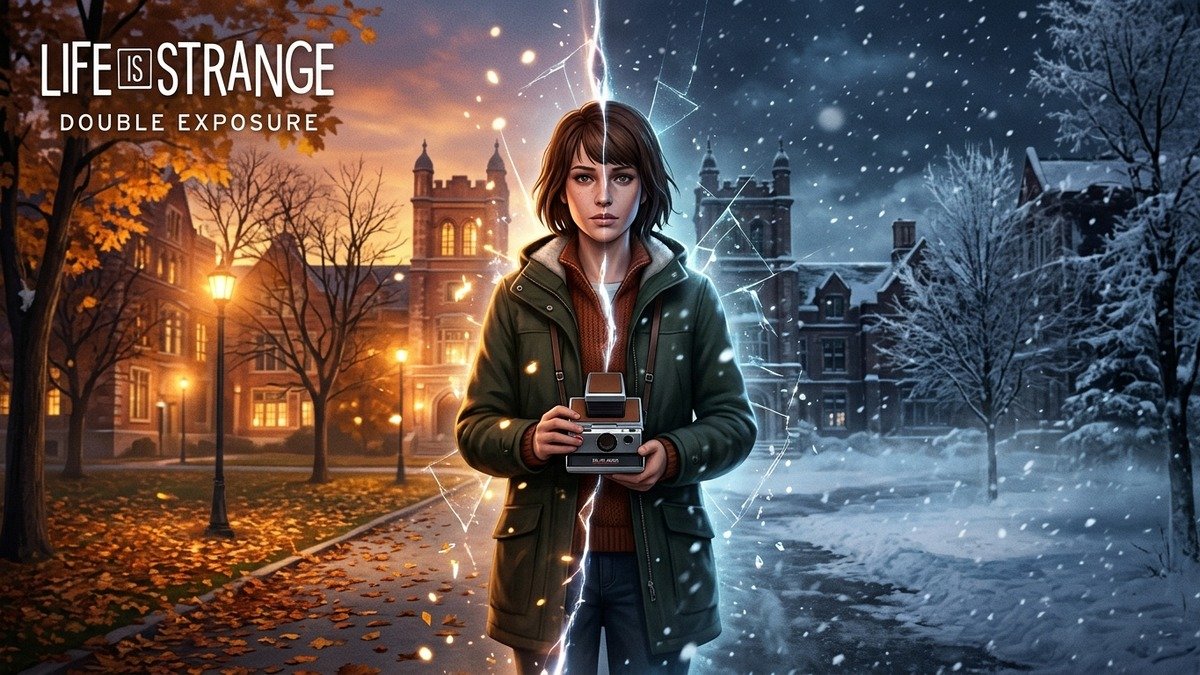
Deck Nine and Square Enix officially unveil Life is Strange: Double Exposure, marking the highly emotional return of original protagonist Max Caulfield in an ambitious supernatural murder mystery set against the snowy, gothic backdrop of Caledon University. Armed with an entirely new timeline-shifting power, Max must navigate two parallel realities to both investigate and prevent the unsolved murder of her closest friend, Safi.
As one of the most beloved narrative adventure franchises in modern gaming history, the return of Max Caulfield represents a monumental narrative gamble that directly honors the bifurcated ending of the original 2015 classic while forging an audacious new future.
Our comprehensive launch guide delivers the complete story primer, timeline-shifting mechanics breakdown, platform release schedules, system requirements, and critical decision insights to prepare you for Max’s most dangerous supernatural journey yet.
In Life is Strange: Double Exposure, Max Caulfield is no longer the timid high school photography student of Blackwell Academy. Years after the traumatic catastrophe of Arcadia Bay, Max has established a quiet, creative life as an artist-in-residence at prestigious Caledon University in upstate Vermont. However, the psychological weight of her temporal rewinding ability led her to vow never to use her powers again—fearing that altering the natural flow of time would invite another apocalyptic storm.
That resolve is violently shattered when Max discovers her vibrant friend Safi shot dead in the snowy campus woods. In an explosion of grief and panic, Max attempts to rewind time, only to discover that her supernatural gift has evolved. Instead of rewinding past seconds, Max tears open a gateway into a parallel timeline—one where Safi is still very much alive, but where the killer remains lurking in the shadows, actively plotting their next move.
This dynamic shifts the gameplay loop into an intricate dual-reality puzzle box. Max can utilize her ‘Shift’ ability to seamlessly transport herself between the living timeline and the murder timeline. Locations, character relationships, and physical clues differ dramatically between the two realities. A locked door in the living timeline might be unbarred in the murder timeline; a critical witness willing to speak in one reality might be hostile or absent in the other.
Furthermore, Max possesses a ‘Pulse’ ability that allows her to glimpse spectral silhouettes and overhear conversations occurring in the adjacent timeline without actually crossing over. This mechanic introduces unprecedented tactical depth to conversational interrogation scenes, enabling players to gather confidential leverage from one universe to solve deadlocks in the other.
How Double Exposure Respects the Arcadia Bay Endings
One of the most pressing questions surrounding Double Exposure is how Deck Nine handles the monumental choice from the climax of the original game: sacrificing Chloe Price or sacrificing Arcadia Bay. The development team has confirmed that Double Exposure does not canonize one single choice.
Instead, during early conversational dialogues with Safi, players can organically establish whether Chloe and Max remained together or drifted apart, and whether Arcadia Bay was destroyed. Max’s journal entries, text messages, internal monologues, and Polaroid photographs dynamically adjust based on your chosen backstory, preserving the emotional authenticity of each player’s individual canon.
| Feature / Aspect | Original Life is Strange (2015) | Life is Strange: Double Exposure (2024) |
|---|---|---|
| Primary Power | Short-term temporal rewind | Dual timeline shifting & pulse eavesdropping |
| Setting & Tone | Arcadia Bay, Oregon (High school coming-of-age) | Caledon University, Vermont (Adult murder mystery) |
| Visual Engine | Unreal Engine 3 (Stylized watercolor aesthetic) | Unreal Engine 5 (Lumen lighting, full motion capture) |
| Release Structure | Episodic releases spaced months apart | Full game unlock at launch across five chapters |
PC System Requirements: Unreal Engine 5 Performance
Life is Strange: Double Exposure is built upon Unreal Engine 5, featuring advanced character facial motion capture and realistic snow deformation:
- Minimum (1080p / 30 FPS Low): Intel Core i5-2400 / AMD FX-6300, 12 GB RAM, NVIDIA GTX 960 (4GB) / AMD Radeon RX 470, 25 GB SSD storage.
- Recommended (1080p / 60 FPS High): Intel Core i7-7700K / AMD Ryzen 5 3600, 16 GB RAM, NVIDIA RTX 2060 Super / AMD Radeon RX 5700 XT, SSD storage required.
- Performance Note: Enable DirectX 12 and DLSS/FSR Quality mode to ensure smooth 60 FPS performance during complex timeline shifting transitions where both realities are partially rendered simultaneously.
Platform Release Dates & Editions
Life is Strange: Double Exposure launches globally across PC (Steam, Windows Store), PlayStation 5, and Xbox Series X/S, with a dedicated Nintendo Switch version arriving at a later date. Players who purchased the Deluxe or Ultimate Editions receive exclusive cosmetic outfits and bonus cat-adoption content that enriches Max’s university studio apartment.
For gamers following massive open-world updates and map lore, don’t miss our comprehensive analysis of GTA 6 Vice City Map Analysis & Enterable Interiors, showcasing how environmental storytelling continues to evolve across premier AAA titles.
Soundtrack Curation, Vocal Performances & Modern Interactive Storytelling
No Life is Strange adventure is complete without an impeccably curated indie-folk soundtrack, and Double Exposure continues this celebrated tradition with distinction. Deck Nine partnered with rising indie musicians and established alternative songwriters to produce a rich sonic atmosphere that captures the melancholy beauty of a Vermont winter. Ethereal acoustic guitar melodies, warm analog synthesizers, and haunting vocal tracks swell dynamically during pivotal narrative sequences, amplifying the emotional gravity of Max Caulfield’s supernatural dilemmas.
Hannah Telle returns to voice Max Caulfield, delivering an extraordinary, layered vocal performance that captures a decade of emotional maturation. Max’s voice balances the quiet trauma of Arcadia Bay with an adult world-weariness, making her interactions with Safi, Moses, and Amanda feel deeply authentic. In an era where many narrative adventures rely on superficial choices, Double Exposure re-establishes the Life is Strange franchise as the emotional standard-bearer for choice-driven interactive fiction.
Comprehensive Life is Strange: Double Exposure FAQ & Player Advice
Do I need to play the original Life is Strange before playing Double Exposure?
While Life is Strange: Double Exposure is constructed to welcome newcomers with an autonomous, self-contained murder mystery narrative at Caledon University, playing the original 2015 game or its Remastered Collection substantially enriches the emotional resonance. Understanding Max Caulfield’s past trauma, her complex bond with Chloe Price, and the haunting psychological burden of her temporal powers adds profound narrative weight to her dialogue choices, journal entries, and hesitations throughout Double Exposure.
How long does it take to beat Life is Strange: Double Exposure?
A standard playthrough exploring the main storyline across all five chapters takes approximately 12 to 14 hours. However, completionists dedicated to finding every optional photograph, discovering hidden collectible Polaroid film canisters, overhearing every cross-timeline conversation via the Pulse mechanic, and interacting with all student art installations at Caledon University will easily spend 18 to 22 hours experiencing everything the game has to offer.
Can Safi be saved in both parallel timelines?
Without delving into major climax spoilers, Deck Nine’s narrative architecture revolves around the inevitable friction between fate and free will. Your choices throughout the investigation determine whether you can uncover the killer’s identity before they strike again, how deeply the two timelines bleed into one another, and which version of reality ultimately survives. Critical moral dilemmas force you to choose between personal loyalty and objective justice, ensuring multiple distinct narrative conclusions.
Environmental Storytelling & Caledon University Exploration Tips
Deck Nine has meticulously populated Caledon University with rich environmental world-building. Take your time wandering through the snowy courtyards, the bustling student union, and the cavernous fine arts studios. Reading flyers posted on campus bulletin boards, checking emails on university library terminals, and inspecting student sculpture projects provide vital context regarding faculty rivalries, clandestine campus societies, and the dark historical secrets buried beneath the university’s prestigious veneer.
Max’s vintage camera remains her primary lens for processing the world. Whenever you encounter the camera icon prompt, take the time to compose the shot. These collectible photographs not only unlock trophies and achievements but also unlock intimate journal monologues that reveal Max’s innermost thoughts regarding her evolving identity and lingering survivor’s guilt.
Accessibility Features & Motion Sickness Options
Deck Nine has incorporated an extensive suite of modern accessibility settings into Life is Strange: Double Exposure. Players susceptible to motion sickness during high-contrast timeline shifts can toggle off camera bobbing, reduce motion blur, and disable the chromatic aberration distortion effect during Pulse eavesdropping sequences. Furthermore, dialogue choice timers can be set to unlimited, allowing players with cognitive or reading accessibility requirements to digest complex conversational branches at their own comfortable pace without artificial urgency penalties.
Additionally, visual cues can replace auditory directional sound effects, ensuring that hearing-impaired players can effortlessly navigate temporal anomalies and locate hidden Polaroid film canisters scattered across Caledon University’s snow-covered courtyards.