
While PlayStation 5, PlayStation 5 Pro, and Xbox Series X|S players celebrate launch day celebrations across the globe, the millions-strong PC master race community is confronting a familiar and agonizing question: When is Grand Theft Auto VI releasing on PC? With search queries regarding “GTA 6 PC release date”, “GTA 6 PC system requirements”, and “is GTA 6 delayed on PC” breaking search engine records across Europe and North America, gaming enthusiasts demand clarity. Rockstar Games and Take-Two Interactive have maintained their historical launch playbook: prioritizing console hardware at launch while holding back the PC edition for a dedicated future release window. Here is the verified analysis of GTA 6’s PC release timeline, anticipated hardware specifications, and technical engine demands.
The Historical Precedent: Rockstar’s PC Stagger Window
To understand why GTA 6 is not launching day-and-date on PC, one must examine Rockstar Games’ multi-decade commercial and technological history. Historically, every premier Rockstar title since Grand Theft Auto III has followed a deliberate staggered release model.
| Rockstar Games Title | Initial Console Launch Date | PC Version Launch Date | Release Delay Gap |
|---|---|---|---|
| Grand Theft Auto IV | April 29, 2008 (PS3 / Xbox 360) | December 2, 2008 | 7 Months |
| Grand Theft Auto V | September 17, 2013 (PS3 / Xbox 360) | April 14, 2015 | 19 Months (574 Days) |
| Red Dead Redemption 2 | October 26, 2018 (PS4 / Xbox One) | November 5, 2019 | 12 Months (375 Days) |
| Grand Theft Auto VI | November 18, 2026 (PS5 / Xbox Series) | Targeted Fall 2027 (Projected) | 10 to 14 Months |
When questioned during recent earnings calls regarding the absence of a simultaneous PC launch, Take-Two Interactive CEO Strauss Zelnick offered an illuminating response: “Rockstar has an approach to platforms which we’ve seen before, and they will make more announcements in due course. I do believe that the right strategy for our business is to be where the consumer is, and historically what this company has done is address consumers on leading platforms first, and then address other platforms in turn.”
Why Rockstar Launches Consoles First: Anti-Piracy, Double-Dipping & Optimization
The decision to hold back the PC release is driven by three decisive corporate and technological factors:
- Double-Dipping Commercial Maximization: Millions of dedicated PC gamers also own a PlayStation 5 or Xbox Series X. By releasing exclusively on consoles first, Take-Two captures immediate $70 to $100 retail sales from PC enthusiasts who cannot bear to wait a full year. When the definitive PC edition launches later with uncapped framerates and modding support, a vast percentage of those same players purchase the game a second time.
- DRM Integrity & Piracy Mitigation: Console operating systems feature closed, cryptographically sealed hypervisors that prevent day-one digital cracking. Releasing simultaneously on PC opens the door to executable memory tampering, code reverse-engineering, and pirated torrent distribution within days of release.
- Hardware Fragmentation Optimization: Consoles possess uniform silicon architecture (AMD Zen 2 CPU + RDNA 2 GPU). Optimizing GTA 6’s complex RAGE 9 engine—which relies on DirectStorage NVMe streaming, hardware ray tracing, and volumetric fluid simulation—for thousands of distinct PC hardware configurations requires an additional 12 to 14 months of dedicated engineering.
Projected Minimum & Recommended PC System Requirements
Based on internal RAGE 9 engine benchmarks and console hardware parity, hardware analysts have modeled the projected PC system requirements for GTA 6:
| Hardware Component | Minimum Specs (1080p 30 FPS / Low) | Recommended Specs (1440p 60 FPS / High) | Ultra Enthusiast (4K 60+ FPS / RT Ultra) |
|---|---|---|---|
| Operating System | Windows 11 (64-bit Build 22H2+) | Windows 11 (64-bit Latest) | Windows 11 Pro (DirectStorage Enabled) |
| Processor (CPU) | Intel Core i5-10600K / AMD Ryzen 5 3600X | Intel Core i7-13700K / AMD Ryzen 7 7800X3D | Intel Core i9-14900KS / AMD Ryzen 9 9950X |
| Graphics Card (GPU) | NVIDIA GeForce RTX 2070 / AMD Radeon RX 6600 XT (8GB) | NVIDIA GeForce RTX 4070 Super / AMD Radeon RX 7800 XT (12GB) | NVIDIA GeForce RTX 5080 / RTX 5090 (16GB – 24GB VRAM) |
| System Memory (RAM) | 16 GB Dual-Channel DDR4 | 32 GB High-Speed DDR5 (6000 MHz) | 64 GB DDR5 (Zero Pagefile Swapping) |
| Storage Drive | 250 GB Available Space (SATA SSD Required) | 250 GB M.2 NVMe PCIe Gen 4.0 SSD (5,000+ MB/s) | PCIe Gen 5.0 NVMe SSD (DirectStorage Bypass) |
For console gamers setting up their pre-loads today, verify your drive capacity with our live guide on GTA 6 Preload Storage Verification: Freeing 250GB on PS5 & PS5 Pro 60FPS Setup.
Ray Tracing Architecture on PC: Path Tracing & DLSS 3.5
When Grand Theft Auto VI eventually lands on PC, it is expected to serve as the definitive graphical showcase for modern GPU hardware. While console versions rely on hybrid ray-tracing pipelines (combining hardware ray-traced shadows and reflections with pre-calculated ambient lighting), the PC edition is being built to support full Path Tracing (Full Ray Tracing).
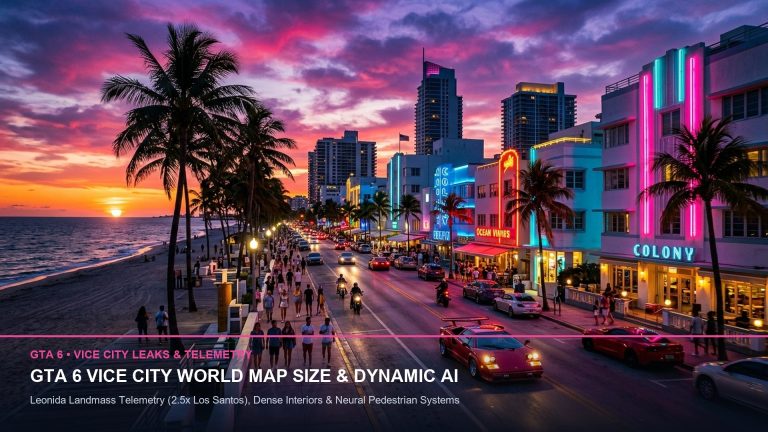
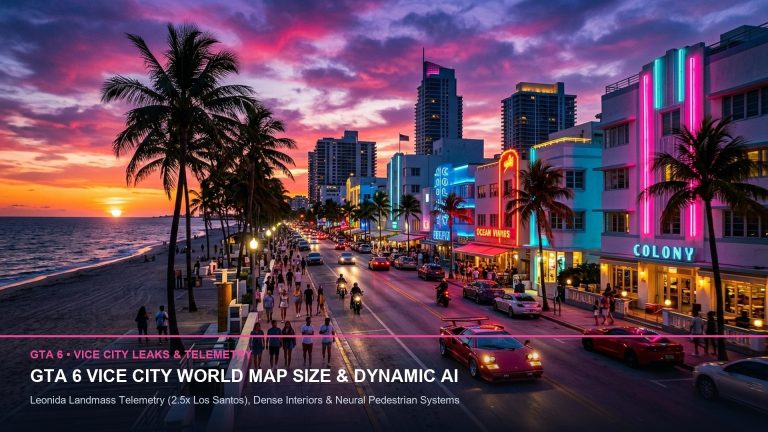
Powered by NVIDIA RTX technologies—including DLSS 3.5 Ray Reconstruction and next-generation Frame Generation on Blackwell RTX 50-series architectures—PC players wielding top-tier silicon will experience mathematically accurate light transport. Every neon light tube in Vice City will cast realistic, indirect color bounces onto wet asphalt, chrome bumpers, and pedestrian clothing, creating an uncanny level of visual realism that blurs the boundary between digital rendering and live-action cinematography.

DirectStorage 1.2 & NVMe Asset Streaming Without Load Screens
The sheer density of Leonida—which streams uncompressed 8K textures, dynamic crowd AI paths, and complex physical meshes simultaneously—mandates modern Microsoft DirectStorage 1.2 architecture on PC. DirectStorage bypasses the traditional CPU bottleneck by decompressing game assets directly on the GPU’s onboard VRAM via high-speed PCIe Gen 4.0 and Gen 5.0 lanes.
PC gamers operating on legacy SATA SSDs or mechanical hard drives will face severe performance throttling, asset pop-in, and micro-stuttering. To experience Vice City at high settings, a dedicated NVMe drive with sequential read speeds exceeding 5,000 MB/s will be a mandatory prerequisite.
Modding Ecosystem & Official FiveM Roleplay Integration
Perhaps the most transformative dimension of GTA 6’s PC future is Rockstar Games’ historic acquisition of Cfx.re—the engineering team behind the wildly successful FiveM and RedM multiplayer roleplay frameworks. Rather than treating modders as legal adversaries, Rockstar is integrating custom server architecture directly into the PC client.
This will allow community creators, roleplay enthusiasts, and esports organizers to host dedicated roleplay servers with custom scripts, law enforcement roleplay systems, and user-generated businesses from day one of the PC release, guaranteeing GTA 6 a thriving multi-decade lifecycle on the platform.
Modding Community Readiness & Photorealistic ENB Shaders
Historically, the Grand Theft Auto PC community has transformed each release into an evergreen sandbox through community modding. With GTA 6 built upon RAGE 9, graphic artists and modding collectives are already preparing custom 8K texture replacement packs, ultra-realistic vehicle replacement libraries, and custom post-processing shaders.
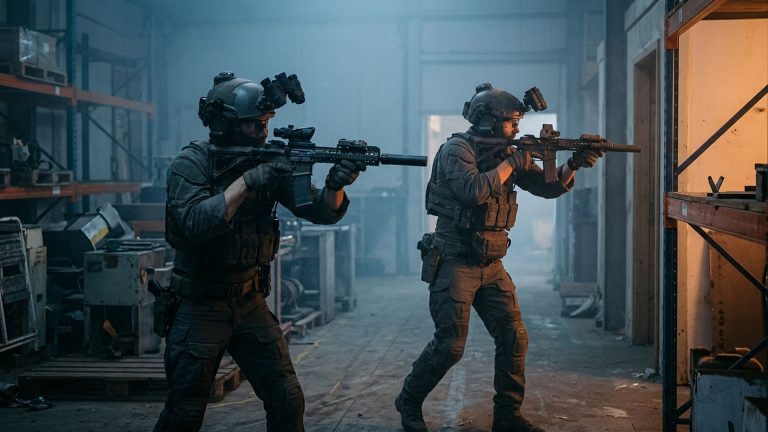
Because the PC edition will feature unlocked framerates and multi-monitor aspect ratio support (including 21:9 and 32:9 super-ultrawide monitors), PC enthusiasts with custom water-cooled rigs will be able to push Vice City to photorealistic visual standards that surpass even current console Fidelity modes.
Handheld PC Feasibility: Steam Deck OLED, ROG Ally X & Legion Go
Another massive consideration for the PC launch is compatibility with portable gaming handhelds. Devices like the Valve Steam Deck OLED, ASUS ROG Ally X, and Lenovo Legion Go have revolutionized mobile PC gaming. While running GTA 6 at native 1080p will prove impossible on 15W to 25W mobile APUs, aggressive resolution scaling via AMD FSR 3.1 and low graphic presets may allow handheld enthusiasts to achieve a playable 30 to 40 FPS mobile experience on the go.
Related posts:
 GTA 6 Launch Eve Technical Telemetry: PS5 Pro PSSR 60FPS Benchmarks, Leonida Map Size & Digital Midnight Unlock Times
 GTA 6 New Zealand Region Unlock Live Countdown Today: Xbox Location Switch Guide, PS5 Country Lock & Midnight Server Decryption
 GTA 6 Preload Storage Verification: Freeing 250GB on PS5, Day-One Patch 1.002 Decryption & PS5 Pro 60FPS Optimization
 GTA 6 Map Size vs GTA 5 & RDR2: Full Vice City & Leonida State Leaked Map Comparison, 3 Major Cities, Everglades & Secret Islands