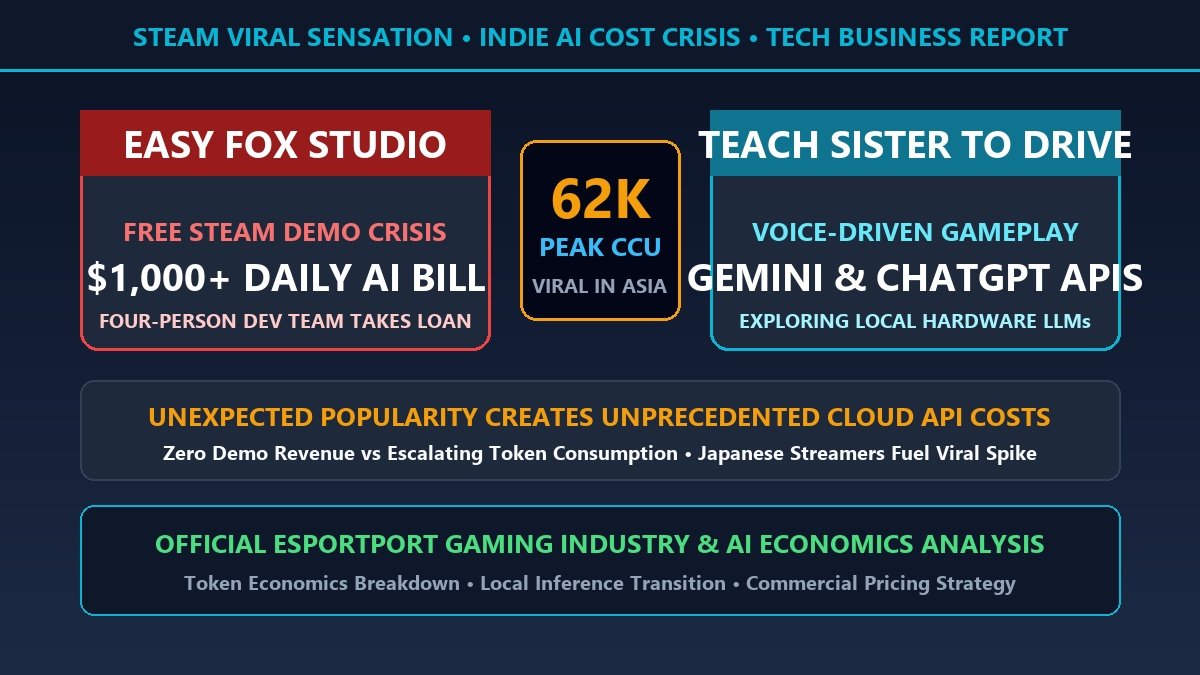
In a striking illustration of the economic realities facing next-generation artificial intelligence in gaming, four-person indie studio Easy Fox has taken out a commercial bank loan to keep the free Steam demo for their upcoming title, Teach My Little Sister How To Drive, from being shuttered by skyrocketing cloud bills. The game’s sudden viral explosion propelled daily AI API expenses past $1,000 per day, creating an existential cash crunch for the independent team.
Studio: Easy Fox (Four-Person Independent Developer) | Game: Teach My Little Sister How To Drive
The Problem: Free Steam demo generated over $1,000 daily in cloud LLM API fees with $0 incoming revenue.
Traffic Milestone: Peaked at 62,000 concurrent players following viral streams in Japan and Asia (20x traffic increase in 30 days).
AI Architecture: Real-time voice commands processed by Google Gemini API with OpenAI ChatGPT fallback.
Emergency Strategy: Secured commercial bank loan; actively developing on-device local hardware LLM inference to bypass cloud API limits.
- The Mechanics: Why Are Easy Fox’s AI Costs So High?
- The 62,000 CCU Viral Explosion in Japan and Asia
- AI Token Economics: Cloud APIs vs Free-to-Play Demos
- Easy Fox’s Survival Strategy: Bank Loans & Local Models
- Final Retail Release: Bundled AI Costs Without Subscriptions
- Frequently Asked Questions (FAQ)
The Mechanics: Why Are Easy Fox’s AI Costs So High?
Unlike conventional video games where dialogue trees are scripted and rendered locally on the CPU, Teach My Little Sister How To Drive is constructed around an interactive voice-driven gameplay loop. Players speak directly into their microphone to navigate an erratic NPC driver through treacherous traffic and hazardous obstacles.
Every spoken word is captured via speech-to-text algorithms and instantly transmitted to external large language model (LLM) endpoints. The game utilizes Google Gemini as its primary conversational engine, dynamically generating real-time verbal reactions, emotional panic responses, and car steering adjustments.
To avoid immersion-breaking silence when Google Gemini hits rate limits or latency spikes, the game automatically falls back to OpenAI’s ChatGPT. However, because API token charges accumulate with every single prompt and completion token generated, continuous verbal banter translates into relentless API expenditure.
The 62,000 CCU Viral Explosion in Japan and Asia
What was intended as a modest indie vertical slice turned into a viral sensation overnight. Prominent VTubers and content creators across Japan, South Korea, and Southeast Asia discovered the demo on Steam, streaming hilarious driving mishaps to hundreds of thousands of live viewers.
In less than a month, player traffic expanded by more than 2,000 percent, culminating in a concurrent player peak of 62,000 active users. While sudden virality is the ultimate dream for independent developers, for a free demo connected to metered cloud APIs, it proved to be a financial nightmare.
| Metric Parameter | Pre-Viral Baseline | Peak Viral Reality | Financial Impact |
|---|---|---|---|
| Concurrent Players (CCU) | ~300 – 500 Players | 62,000 CCU | 20x Traffic Surge |
| Daily Cloud API Expenses | ~$20 – $50 / Day | $1,000+ / Day | ~$30,000+ Monthly Run Rate |
| Demo Revenue Inflow | $0.00 (Free Demo) | $0.00 (Free Demo) | 100% Negative Margin |
| Studio Financing | Bootstrapped Savings | Commercial Bank Loan | Debt Secured to Keep Servers Live |
AI Token Economics: Cloud APIs vs Free-to-Play Demos
The situation highlights a fundamental flaw in deploying cloud-based generative AI within free gaming demos. Traditional multiplayer games incur bandwidth and matchmaking server costs, which scale relatively predictably on lightweight server fleets.
In contrast, multimodal LLM pipelines require substantial compute for audio transcription, natural language comprehension, contextual prompt formatting, and text-to-speech synthesis. When tens of thousands of players engage simultaneously for hours, token consumption compounds exponentially with zero ad impressions or microtransactions to offset the expenditure.
Easy Fox’s Survival Strategy: Bank Loans & Local Models
Rather than taking down the demo and alienating their surging fanbase, the four-person studio made the bold decision to secure a bank loan to guarantee server uptime. However, recognizing that bank debt is an unsustainable stopgap, Easy Fox is implementing fundamental architectural shifts.
The primary technical solution under active development is transitioning toward on-device local language models. By compiling quantized, efficient small language models (such as 2B to 4B parameter models) directly into the game engine, speech inference will execute locally on the player’s GPU and NPU hardware.
Local inference removes third-party cloud API fees entirely, immunizes the studio against third-party rate limits, and delivers near-zero latency for vocal responses. It also eliminates the need for fallback systems that previously introduced erratic conversational behavior.
Final Retail Release: Bundled AI Costs Without Subscriptions
Addressing player anxiety regarding potential recurring fees, Easy Fox confirmed their commercial monetization model. For the full release on Steam, the projected cost of AI operations will be bundled directly into the game’s one-time base retail price.
Players will not be subjected to token meters, hourly limits, or paid AI credits. By combining local hardware inference with a fair upfront purchase price, Easy Fox aims to establish a healthy commercial model that protects both the studio’s margins and the player’s wallet.
Frequently Asked Questions (FAQ)
Why did Easy Fox take out a bank loan for their game demo?
Their free Steam demo for Teach My Little Sister How To Drive went viral, peaking at 62,000 concurrent players. Because the game uses cloud LLM APIs (Google Gemini and ChatGPT) for real-time voice interaction, daily costs exceeded $1,000 without any revenue from the free demo.
Which AI models power Teach My Little Sister How To Drive?
The game primarily relies on Google Gemini’s multimodal API for voice processing and conversational responses, with OpenAI’s ChatGPT serving as an automatic fallback when rate limits are reached.
How is Easy Fox fixing the high cloud AI costs?
The developers are actively testing quantized local language models that execute directly on the player’s PC hardware, completely bypassing cloud API token fees.
Will players have to pay for AI tokens in the full release?
No. Easy Fox confirmed that all AI functionality will be fully bundled into the standard retail price of the game, requiring no separate token subscriptions.