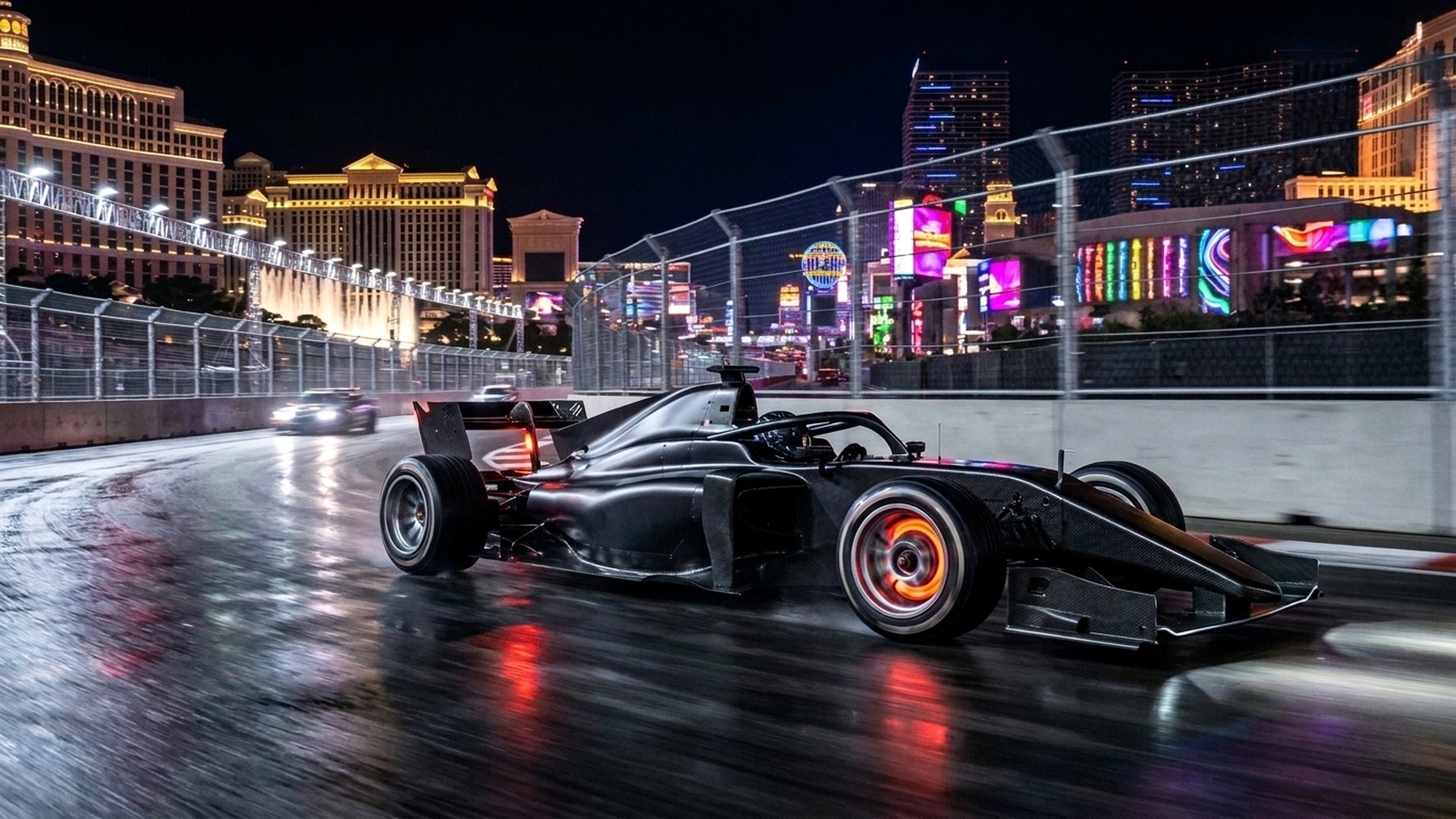
The global motorsport community focuses its gaze on the glittering neon boulevards of Nevada this Saturday for the 2026 Formula 1 Las Vegas Grand Prix. Combining hyper-speed straightaways along the world-famous Strip with freezing ambient temperatures and treacherous low-grip asphalt, the Las Vegas street circuit has established itself as one of the most unpredictable and tactically challenging events on the FIA Formula 1 World Championship calendar. With the Drivers’ and Constructors’ Championships hanging in the balance, world champion Max Verstappen and McLaren challenger Lando Norris are locked in a fierce battle for supremacy.
For motorsport aerodynamicists, data engineers, and sports bettors, the Las Vegas Grand Prix introduces extreme thermal physics. Cars reach blistering top speeds exceeding 350 km/h (217 mph) down the 1.9-kilometer Strip straight, only to encounter severe braking into tight 90-degree corners with brake and tire temperatures plummeting rapidly in the 10°C (50°F) desert night air. Below is our comprehensive Saturday event preview, qualifying telemetry breakdown, pit stop tire strategies, and championship ramifications.

Thermal Warfare: Why Cold Desert Asphalt Dictates the Winner
Unlike traditional circuits where overheating tires pose the primary engineering headache, Las Vegas demands mastery of tire graining and thermal warmup. Pirelli has brought their softest tire compounds—C3 (Hard), C4 (Medium), and C5 (Soft)—to maximize mechanical grip. However, the unique surface of the newly paved public streets features low macro-roughness, preventing rubber from easily embedding into the asphalt.
When drivers encounter the cold desert air on long straightaways, front tire surface temperatures drop by up to 35°C in a matter of seconds. When decelerating from 350 km/h into Turn 14 at the end of the Strip, front tires can easily lock up, causing severe flat-spots and localized surface tearing (graining). Teams whose suspension geometry generates rapid front-axle heat without overworking the rear tires hold a decisive advantage during both qualifying flying laps and long race stints.
| Championship Contender | Constructor | Top Speed (Strip Trap) | Low-Speed Corner Grip | Championship Stake |
|---|---|---|---|---|
| Max Verstappen | Red Bull Racing | 351.4 km/h (Low Drag Wing) | High Traction / Stable Entry | Can clinch Drivers’ World Championship |
| Lando Norris | McLaren F1 Team | 348.2 km/h (Medium Downforce) | Superb Tire Warmup & Apex Speed | Must outscore Verstappen to prolong title race |
| Charles Leclerc | Scuderia Ferrari | 352.8 km/h (Fastest Trap Speed) | Exceptional Kerb Riding Performance | Hunting Ferrari Constructors’ Title |
| George Russell | Mercedes-AMG F1 | 347.6 km/h (Downforce Bias) | Prone to Bouncing / Ride Height Limits | Podium Outsider & Pole Threat |
Verstappen’s Title Clinch Scenario & Ferrari’s Straight-Line Threat
The sporting stakes could not be higher. Max Verstappen enters Saturday night with a mathematical opportunity to secure his fourth consecutive Drivers’ World Championship. If Verstappen finishes ahead of Lando Norris, or if Norris fails to outscore Verstappen by at least three points, the Dutch maestro officially seals the championship trophy with two rounds to spare. Red Bull has introduced a bespoke ultra-low-drag rear wing package designed specifically to unleash the Honda RBPT powertrain’s top-end acceleration.
However, Scuderia Ferrari represents the most dangerous spoiler on the grid. In previous outings on low-downforce street tracks like Monza and Baku, the Ferrari SF-24 exhibited blistering straight-line efficiency and immediate tire activation. Charles Leclerc captured pole position in Las Vegas last year and demonstrated formidable race pace during practice sessions, making Ferrari a prime contender to disrupt both Red Bull and McLaren’s championship calculations.
| Circuit Parameter | Las Vegas Strip Circuit Specification | Engineering Consequence |
|---|---|---|
| Circuit Length / Total Laps | 6.201 km (3.853 miles) / 50 Laps | High Fuel Consumption & ERS Deployment Strain |
| The Strip Straightaway | 1.9 km Flat-Out Full Throttle Section | Extreme Slipstream Effect & Overtaking Zone |
| Ambient Night Temperatures | Expected 9°C to 12°C (48°F to 54°F) | Coldest Grand Prix of the 2026 Calendar |
| Safety Car Probability | 82% Statistical Likelihood | High Likelihood of Strategic ‘Free’ Pit Stops |
Aerodynamic Efficiency & Wing Trim Optimization
In preparation for the 1.9-kilometer Strip straight, engineering teams have spent dozens of hours in computational fluid dynamics (CFD) simulation optimizing rear wing downforce. Red Bull’s beam wing configuration features a single-element flap, shedding drag to maximize top speed. This allows Max Verstappen to reach peak velocity earlier in the straight, making him virtually impossible to defend against when DRS (Drag Reduction System) is enabled.
Meanwhile, McLaren’s technical director Andrea Stella has opted for a slightly higher downforce beam wing. While this trim sacrifices approximately 3 km/h down the main straight, it provides Lando Norris with significantly greater stability through Turn 1 to 4 and Turn 7 to 9. This compromise reduces tire sliding through medium-speed corners, potentially preserving front-tire life for late-race overtaking opportunities.
In addition to wing trim, energy recovery system (ERS) harvesting plays an outsized role on the Las Vegas circuit. The MGU-K deploys maximum hybrid electrical boost along the 1.9-kilometer Strip straight, delivering an extra 160 horsepower for over 15 seconds. Drivers who drain their battery too early in the straight become sitting ducks for trailing cars enjoying DRS slipstream advantages, requiring precise energy management through steering wheel rotary dials.
In addition to wing trim, energy recovery system (ERS) harvesting plays an outsized role on the Las Vegas circuit. The MGU-K deploys maximum hybrid electrical boost along the 1.9-kilometer Strip straight, delivering an extra 160 horsepower for over 15 seconds. Drivers who drain their battery too early in the straight become sitting ducks for trailing cars enjoying DRS slipstream advantages, requiring precise energy management through steering wheel rotary dials.
Pit Stop Strategies: One-Stop vs Safety Car Gambles
Pirelli’s simulation models indicate that a one-stop strategy—starting on the Medium compound before switching to the Hard tire around Lap 18–22—is the theoretically fastest path to victory. However, the high probability of Safety Car interruptions caused by driver lockups and barrier collisions frequently upends traditional race modeling. Teams with flexible pit crews capable of reacting instantly to virtual safety cars will hold the strategic upper hand.
Furthermore, managing brake temperatures is critical. Braking into Turn 1 and Turn 14 exerts over 5G of deceleration force, causing carbon-carbon brake discs to glow at 1,000°C before cooling down to near-ambient levels along the massive straightaways. Drivers must continually manage brake bias toggles on their steering wheels to prevent catastrophic glazed pads during late-race restarts.


| Strategic Variant | Tire Compound Sequence | Target Pit Stop Window | Tactical Risk / Reward Profile |
|---|---|---|---|
| Primary Strategy (Optimal) | Medium (C4) to Hard (C3) | Laps 19 to 24 | Lowest total race time; vulnerable to late safety car |
| Aggressive Two-Stop | Medium (C4) to Hard (C3) to Soft (C5) | Laps 16 and Lap 36 | High grip for late-race charges; requires green-flag overtakes |
| Reverse Gamble | Hard (C3) to Medium (C4) | Laps 30 to 35 | Survives chaotic opening laps; attacks on fresh tires late |
What to Expect: Pure High-Speed Spectacle in Sin City
The Las Vegas Grand Prix combines world-class technological innovation with unforgettable visual grandeur. Racing past the illuminated Sphere, Caesars Palace, and the Bellagio fountains under millions of lumens of neon lighting, 20 drivers will battle at 220 miles per hour where a millimeter of understeer means direct contact with concrete barriers.
Max Verstappen’s relentless racecraft makes him the betting favorite at +140 to take the checkered flag, while Charles Leclerc (+250) and Lando Norris (+320) will push their machines to the absolute limit. Expect dramatic slipstream overtakes along the Strip, heart-stopping pit lane drama, and a potential world championship coronation on Saturday night in Las Vegas.
Frequently Asked Questions: Las Vegas Grand Prix
What time does the Las Vegas Grand Prix start?
The race begins at 10:00 PM local Pacific Time on Saturday night (11:30 AM IST Sunday morning).
Can Max Verstappen win the World Championship in Las Vegas?
Yes, Verstappen will officially clinch his fourth world title if he finishes ahead of Lando Norris or if Norris fails to outscore him by 3+ points.
How long is the main straightaway down the Las Vegas Strip?
The main straight spans 1.9 kilometers (1.2 miles), allowing Formula 1 cars to reach speeds exceeding 350 km/h (217 mph).
Why is tire temperature such a major problem in Las Vegas?
The race takes place late at night in the desert with ambient temperatures around 10°C, causing cold tires to slide and suffer severe graining.
Recommended Reading & Related Dossiers
Deepen your motorsport knowledge and high-speed sports analysis with our related technical breakdowns:
- GTA 6 Gameplay Engine Review: Next-Gen Vehicle Physics & World Scale
- PC Performance Hacks: Registry Tweaks, GPU Scheduling & Latency Optimization
- Premier League Saturday Matchday 12 Betting Guide: High Value Selections
Related posts:
 Yankees on Brink of Elimination: Rays Win Game 3 (4-3) in ALDS Drama – Volpe Overturn & Game 4 Schedule
 Lisandro Martinez Statement: Man United Defender Meets Carrick & Hierarchy Ahead of Leeds Clash
 India vs New Zealand 1st Test Bengaluru: Sarfaraz Khan 150 & Rishabh Pant 99 Ignite Historic Fightback
 Real Madrid Tchouameni Injury Scare Leaves José Mourinho Awaiting Scans After France Statement