
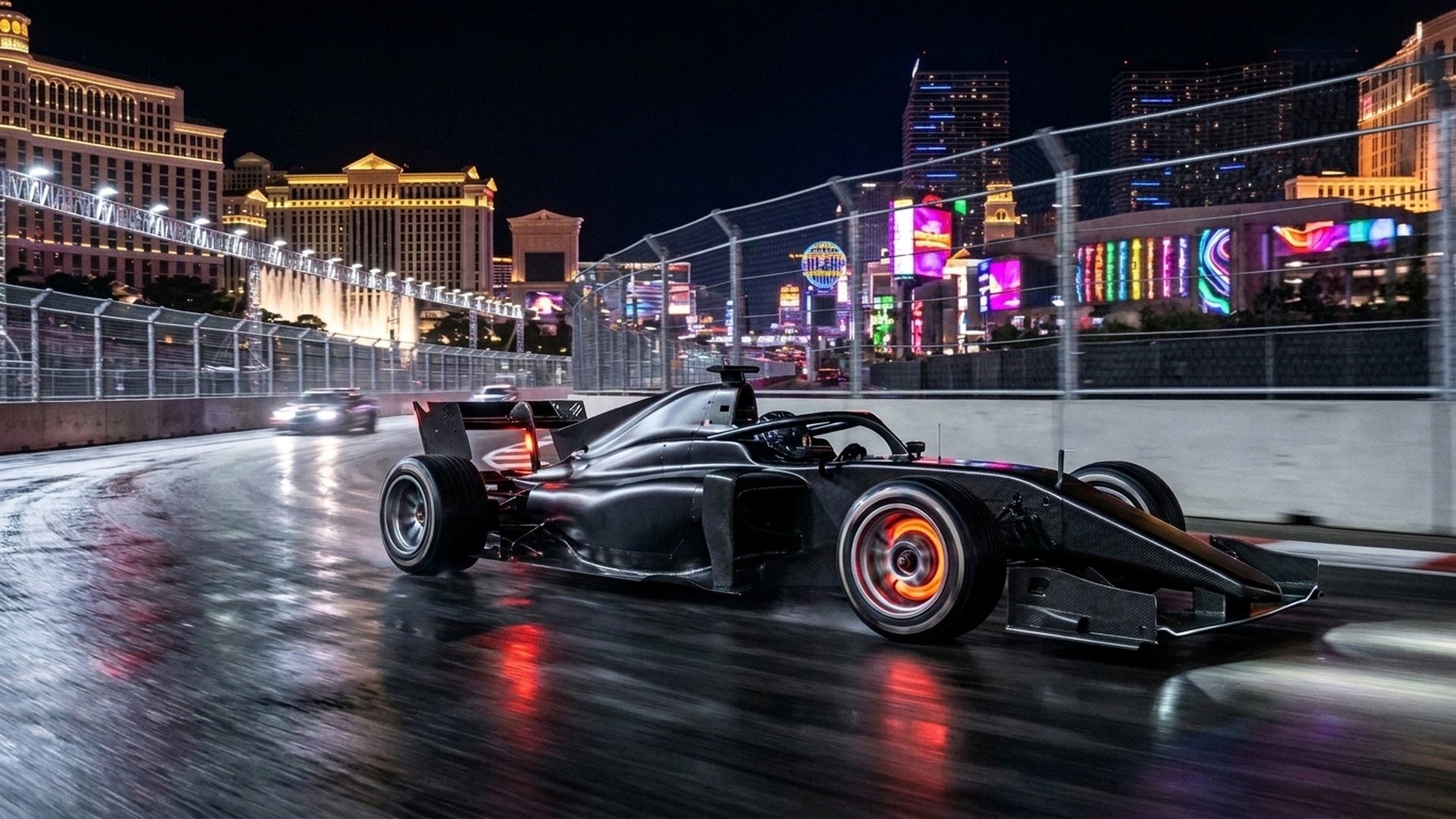
Under the blinding neon glow of the Las Vegas Strip and chilling desert night temperatures of just 12 degrees Celsius, qualifying for the 2026 Formula 1 Heineken Silver Las Vegas Grand Prix delivered one of the most unpredictable and tactically punishing shootouts of the season. Mercedes ace George Russell produced a breathtaking final flying lap in Q3, hooking up all three sectors around the high-speed 6.201-kilometer street circuit to claim a sensational pole position. Russell clocked a blistering 1:32.312, narrowly edging Ferrari’s Carlos Sainz by just 0.098 seconds in a thrilling climax that had the grandstands along the Koval straight roaring.
The defining technical challenge of the midnight qualifying session was the critical tire warmup window. With track surface temperatures barely scraping 15 degrees Celsius, Pirelli’s softest C5 compound struggled immensely for mechanical bite on the smooth, low-abrasion public asphalt. Drivers were forced into complex two-lap preparation cycles, weaving furiously along the endless 1.9-kilometer Strip straight to generate core carcass temperature without blistering the outer tread block before launching into their timed laps.
Behind the front row, championship leader Max Verstappen secured a resilient third place on the grid for Red Bull Racing, extracting every ounce of straight-line performance from a heavily trimmed low-downforce rear wing setup. Meanwhile, McLaren’s title hopeful Lando Norris endured a frustrating session, battling severe front-locking into Turn 14 and Turn 1 to qualify sixth, leaving him facing a formidable overtaking challenge on Sunday evening.
| Qualifying Session Parameter | Telemetry & Environmental Data | Technical Significance |
|---|---|---|
| Circuit & Layout | Las Vegas Strip Circuit (6.201 km, 17 Turns) | Second-longest track on calendar; speeds exceeding 350 km/h |
| Air & Track Temperatures | Air: 12.4°C | Track: 15.2°C (Desert Night Chill) | Severe tire graining and thermal warmup window hurdles |
| Pole Position Lap Time | George Russell (Mercedes) – 1:32.312 | Dominated Sector 1 and low-speed Turn 7-9 complex |
| Tire Compound Allocation | Pirelli C3 (Hard), C4 (Medium), C5 (Soft) | C5 soft required double prep-lap to prevent front graining |
Sector Analysis: Where George Russell Conquered the Las Vegas Strip
Micro-sector GPS telemetry reveals that George Russell’s pole-winning effort was built upon clinical braking precision and traction recovery rather than raw top speed down the Strip. While Ferrari’s SF-24 and Red Bull’s RB20 clocked superior terminal velocities at the end of Sector 2—with Verstappen reaching 351.4 km/h through the speed trap—Russell made his time in the tight low-speed corners where the Mercedes W15 demonstrated sublime mechanical grip.
In Sector 1, Russell carried 4 km/h more minimum apex speed through Turn 1 and Turn 2, allowing him to apply full throttle earlier down the long curving blast past the Sphere. Sainz looked poised to snatch pole as he illuminated the timing screens purple through the Sector 2 split, utilizing Ferrari’s superior low-drag efficiency. However, in the tight Turn 12 chicane and Turn 14 braking zone, Sainz suffered slight rear-axle instability, costing him nearly 0.15 seconds as he corrected a snap of oversteer on the painted kerb.
Charles Leclerc qualified fourth, frustrated by setup compromises made after FP3 that biased his car toward race trim rather than single-lap tire firing. Pierre Gasly delivered the shock performance of qualifying, dragging his Alpine into fifth place with an audacious tow behind Oscar Piastri along the Koval straight, further scrambling the championship grid order.
Front-wing angle adjustments between runs also proved decisive. Mercedes mechanics dialed in two additional clicks of front flap ahead of Russell’s final Q3 run, effectively neutralizing the mid-corner understeer that had compromised Lewis Hamilton’s qualifying, which saw the seven-time champion relegated to tenth after an uncharacteristic lockup into Turn 14.
| Grid Pos | Driver & Team | Q3 Lap Time | Gap to Pole | Top Speed (Trap) |
|---|---|---|---|---|
| 1 | George Russell (Mercedes) | 1:32.312 | Leader | 346.8 km/h |
| 2 | Carlos Sainz (Ferrari) | 1:32.410 | +0.098s | 350.2 km/h |
| 3 | Max Verstappen (Red Bull) | 1:32.584 | +0.272s | 351.4 km/h |
| 4 | Charles Leclerc (Ferrari) | 1:32.615 | +0.303s | 349.8 km/h |
| 5 | Pierre Gasly (Alpine) | 1:32.658 | +0.346s | 348.1 km/h |
| 6 | Lando Norris (McLaren) | 1:32.708 | +0.396s | 345.2 km/h |
Race Strategy & Grand Prix Starting Grid Telemetry
Looking ahead to the 50-lap Grand Prix, tire degradation and graining will dictate pit wall strategy. During Friday’s long-run simulations, teams discovered that the soft C5 tire suffers severe front-left graining after just 7 to 9 laps, rendering it an impractical starting compound for the leading pack. Consequently, the top ten drivers are projected to launch on the medium C4 compound before executing a one-stop transition to the durable hard C3 tire between laps 18 and 24.
However, the statistical probability of Safety Car interruptions in Las Vegas sits at an astronomical 85%. With narrow concrete barriers flanking every straight and zero runoff areas through the hotel corridors, any minor clash or mechanical retirement immediately triggers a neutralization. Strategists at Mercedes and Ferrari have prepared split contingency plans: keeping one car out on track position while pitting the other for fresh rubber under virtual or physical Safety Cars.
Overtaking opportunities are plentiful down the Strip straight, where the massive DRS zone yields speed differentials of over 25 km/h. Max Verstappen and Carlos Sainz possess superior straight-line machinery, meaning George Russell will face relentless defensive pressure into Turn 14 on every single restart. Russell must build a gap greater than one second before DRS is activated on Lap 2.
Brake cooling management presents another severe headache. In freezing night air, carbon-carbon brake discs lose optimal operating temperature (350°C-600°C) along the 1.9 km straight, leading to sudden pedal glazing and glazed pad lockups into the heavy braking zones at Turn 1 and Turn 14.
| Strategy Option | Stint 1 (Laps) | Stint 2 (Laps) | Strategic Risk / Advantage |
|---|---|---|---|
| Optimal One-Stop (Medium to Hard) | Laps 1-20 (C4 Medium) | Laps 21-50 (C3 Hard) | Fastest theoretical race time; vulnerable to late Safety Car |
| Alternative One-Stop (Hard to Medium) | Laps 1-28 (C3 Hard) | Laps 29-50 (C4 Medium) | Strong overcut potential; tricky launch off dirty grid side |
| Aggressive Two-Stop (Med – Hard – Soft) | Laps 1-14 (C4) | Laps 15-36 (C3) | Laps 37-50 (C5 Soft) | Deadly attack pace on cold tires if late Safety Car bunches pack |
Betting Market Intelligence & Grand Prix Victory Odds
Following his commanding pole lap, George Russell surged into 2.60 favoritism on international betting exchanges. However, sharp money continues to back Max Verstappen at 3.00, acknowledging Red Bull’s superior race-pace degradation metrics and Verstappen’s ruthless racecraft on cold tire restarts. Carlos Sainz offers tempting value at 4.25, while Charles Leclerc sits at 5.50 for a podium surge.
Prop markets offer high-value angles around race incidents. Over 1.5 Safety Car Deployments is heavily backed at 1.72, given the zero-tolerance street circuit layout. Furthermore, Fastest Lap wagers lean toward Verstappen or Leclerc, who frequently pit for soft tires in the final five laps if they hold a sufficient pit-stop delta to the cars behind.
Expect a dramatic, attrition-heavy Grand Prix where straight-line speed down the Strip ultimately tips the scales in favor of Red Bull or Ferrari over Mercedes across fifty demanding laps under the Nevada stars.
| Driver | Starting Grid | Outright Win Odds | Podium Finish Odds |
|---|---|---|---|
| George Russell (Mercedes) | P1 (Pole) | 2.60 | 1.35 |
| Max Verstappen (Red Bull) | P3 | 3.00 | 1.40 |
| Carlos Sainz (Ferrari) | P2 | 4.25 | 1.55 |
| Charles Leclerc (Ferrari) | P4 | 5.50 | 1.70 |
Frequently Asked Questions (FAQ)
Who took pole position for the 2026 F1 Las Vegas Grand Prix?
George Russell captured pole position for Mercedes with a stunning Q3 lap time of 1:32.312, narrowly edging Ferrari’s Carlos Sainz by 0.098 seconds.
What time does the Las Vegas Grand Prix start on Sunday?
The 50-lap Las Vegas Grand Prix starts at 22:00 local time on Saturday night in Nevada (06:00 GMT / 11:30 IST on Sunday morning, November 22).
Where can I watch the Las Vegas GP live?
In the United States, the race airs live on ESPN and ESPN+. In the UK, it is shown on Sky Sports F1, while international fans can stream live via F1 TV Pro and FanCode in India.
Why are tire temperatures so critical at the Las Vegas Strip Circuit?
Due to cold desert night air (around 12°C) and smooth public street asphalt, tires cool down dramatically along the 1.9 km straight, leading to severe graining and braking lockups.
Related posts:
 Lisandro Martinez Statement: Man United Defender Meets Carrick & Hierarchy Ahead of Leeds Clash
 Mikel Arteta Tactical Crisis: How Arsenal Rebuilds After William Saliba Red Card Ahead of Liverpool Blockbuster
 Real Madrid Tchouameni Injury Scare Leaves José Mourinho Awaiting Scans After France Statement
 Man Utd Michael Carrick Plan Emerges Ahead of Monaco Summit: Targeting Bayern’s Aaron Danks
