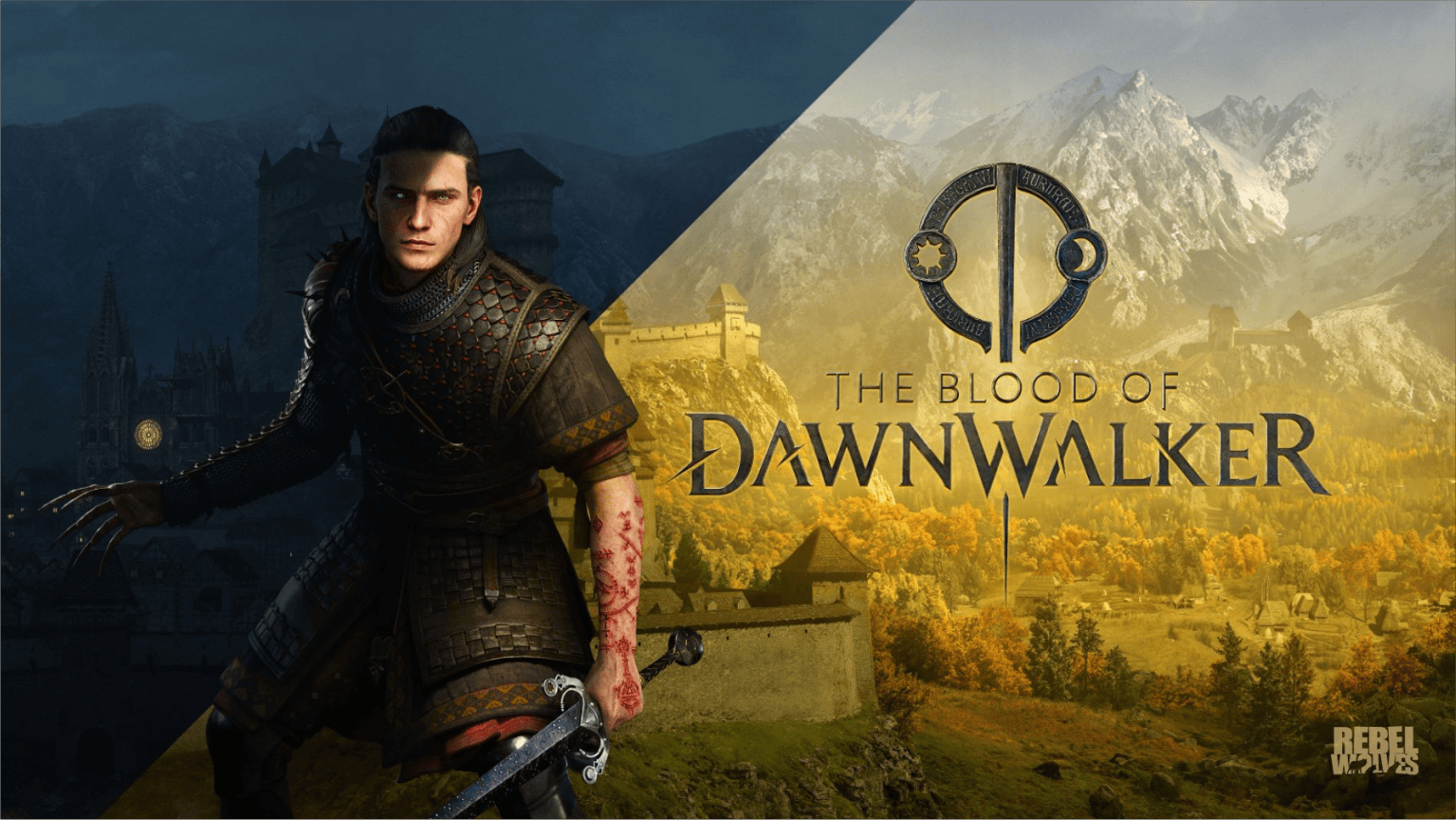
When Rebel Wolves—the highly ambitious studio formed by veteran developers who previously spearheaded the critically acclaimed The Witcher 3: Wild Hunt—officially announced their dark fantasy RPG, The Blood of Dawnwalker, the global PC gaming community was immediately put on high alert.
Promising an unparalleled narrative experience and stunning visual fidelity powered by Unreal Engine 5 (UE5), Dawnwalker is poised to push current-generation hardware to its absolute breaking point. The transition to UE5 has historically been a double-edged sword for PC gamers; while the graphics are breathtaking, the hardware optimization is often brutal.
Today, the EsportPort hardware desk is breaking down exactly what it will take to run The Blood of Dawnwalker. We are analyzing the minimum and recommended PC specs, examining the intense CPU bottlenecks caused by UE5’s Nanite geometry, and explaining why upscaling technology will be mandatory for a stable 60fps experience.
Part I: The Official Spec Breakdown
Based on early telemetry from the Unreal Engine 5 pipeline and cross-referencing recent AAA dark fantasy releases, we have compiled the definitive hardware baseline required to step into the world of Dawnwalker.
If you are attempting to play this game on a hard drive (HDD) or an older GTX-series graphics card, you are going to face insurmountable loading screens and catastrophic framerate drops.
| Hardware Component | Minimum Specs (1080p / 30fps / Low) | Recommended Specs (1440p / 60fps / High) |
|---|---|---|
| Operating System | Windows 10/11 (64-bit) | Windows 11 (64-bit) |
| Processor (CPU) | Intel Core i5-10400F / Ryzen 5 3600 | Intel Core i7-13700K / Ryzen 7 7800X3D |
| Memory (RAM) | 16 GB DDR4 | 32 GB DDR5 |
| Graphics Card (GPU) | NVIDIA RTX 2060 / AMD RX 6600 | NVIDIA RTX 4070 / AMD RX 7800 XT |
| Storage (SSD Required) | 120 GB NVMe SSD | 120 GB PCIe Gen4 NVMe SSD |
Part II: The Unreal Engine 5 CPU Bottleneck
When most gamers evaluate PC requirements, they immediately look at the Graphics Card (GPU). However, The Blood of Dawnwalker is going to test the absolute limits of your Processor (CPU).
UE5 utilizes a technology called “Nanite” to render virtualized, hyper-dense geometric detail without relying on traditional “Level of Detail” (LOD) pop-ins. While this makes the dark fantasy forests and Gothic architecture look incredibly lifelike, it places a massive computational strain on the CPU.
If you are running an older 6-core processor (like an Intel i5-9400 or Ryzen 3600), you will likely experience severe stuttering and “frame-time spikes” when entering densely populated NPC cities, regardless of how powerful your graphics card is. We highly recommend upgrading to a modern processor equipped with 3D V-Cache (such as the Ryzen 7 7800X3D) to brute-force the engine and maintain smooth frame pacing.
Part III: Why 32GB of RAM is the New Standard
For the last decade, 16GB of system RAM was considered the gold standard for PC gaming. The launch of The Blood of Dawnwalker officially puts that era in the grave.
Massive, seamless open-world RPGs require the system to hold gigabytes of high-resolution textures, dialogue trees, and NPC behavioral scripts in active memory. When a 16GB system maxes out its memory capacity, it is forced to “page” data to the storage drive, resulting in catastrophic stuttering that ruins combat fluidity. Upgrading to a 32GB DDR5 RAM kit is the cheapest and most effective way to guarantee your PC can handle the sheer scale of the Dawnwalker universe.
Part IV: The Necessity of Upscaling Technology
Gone are the days of “Native Rendering.” In order to achieve the coveted 1440p / 60fps benchmark on High settings in a modern UE5 title, you must actively utilize AI upscaling technology.
The Blood of Dawnwalker will heavily lean into NVIDIA’s DLSS (Deep Learning Super Sampling) and AMD’s FSR (FidelityFX Super Resolution). By rendering the internal game resolution at 1080p and using dedicated AI tensor cores to upscale the image to a crisp 1440p or 4K, players can regain upwards of 40% of their framerate.
Furthermore, if you are attempting to enable Lumen (UE5’s highly taxing Global Illumination ray-tracing system), enabling DLSS 3.0 Frame Generation on an RTX 40-series card is absolutely mandatory to keep the game playable.
Conclusion: Time to Upgrade
The Blood of Dawnwalker is shaping up to be a generational masterpiece, guided by developers who deeply understand mature, narrative-driven RPG mechanics. However, they are not compromising on graphical fidelity. If your PC is still rocking parts from 2020, you have roughly a year to begin planning your upgrade path. Don’t let a hardware bottleneck ruin your immersion in one of the most anticipated dark fantasy games of the decade.
🚨 Elevate Your Hardware Intelligence
Join the Network on EsportPort
Are you upgrading your GPU for The Blood of Dawnwalker, or holding out for the next console generation? Bookmark EsportPort for premium PC build guides, hardware benchmarking, and the fastest breaking RPG news on the net.