
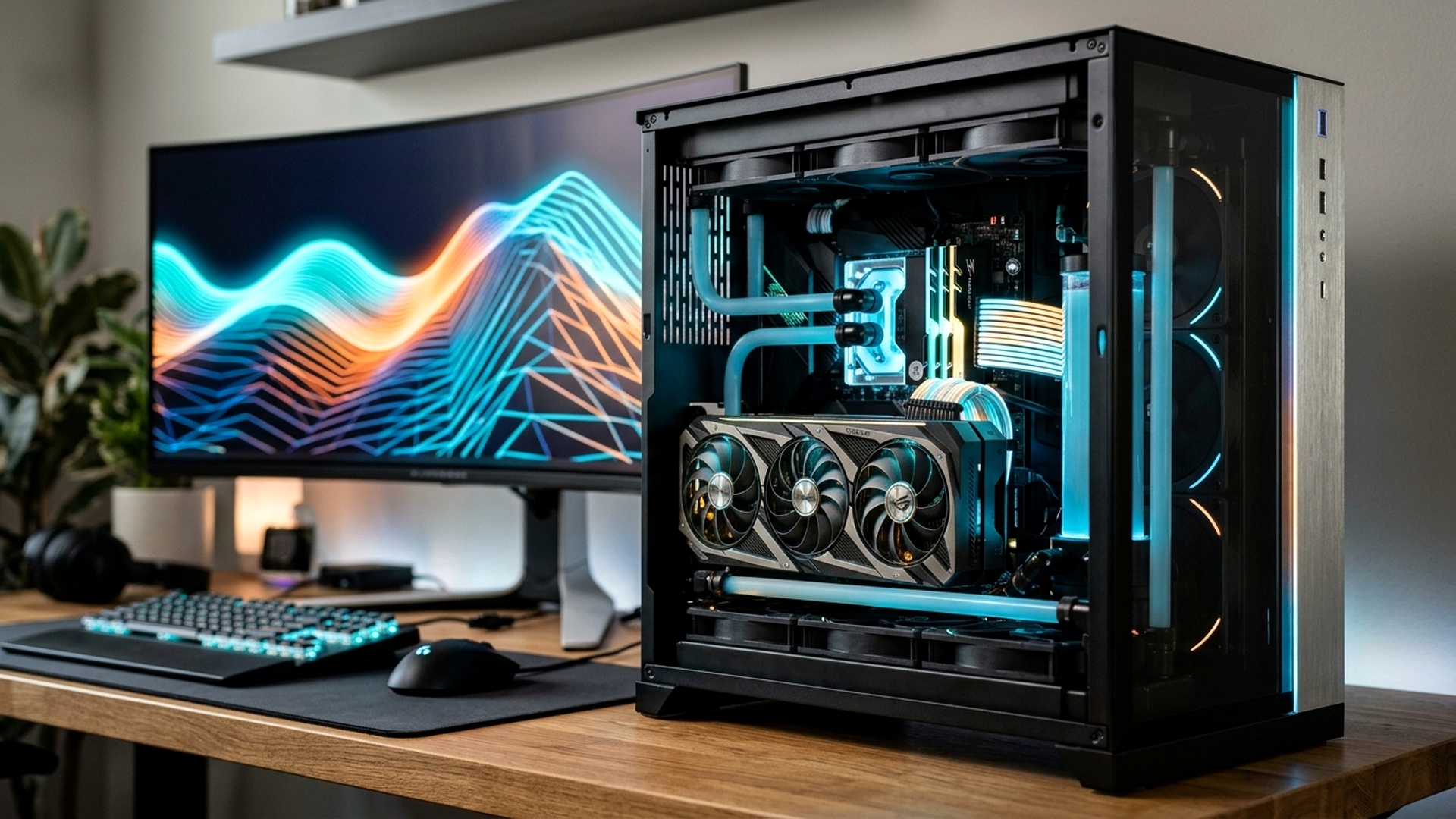
With holiday sales kicking off across major retail and digital storefronts on Friday, November 20, 2026, PC enthusiasts and budget-conscious builders face an unprecedented buyers’ market. Aggressive pricing skirmishes between Nvidia and AMD, coupled with oversupplied memory fabrication lines, have unleashed substantial markdowns on high-tier graphics cards, blazing-fast OLED gaming panels, and next-generation PCIe Gen 5 solid-state drives. Navigating through manufactured discounts to secure genuine hardware bargains requires meticulous price tracking and architectural scrutiny.
The centerpiece of this year’s seasonal discount warfare is the fierce mid-to-high tier confrontation between Nvidia’s GeForce RTX 4070 Ti Super and AMD’s Radeon RX 7900 XT. As game developers optimize modern titles around heavy ray tracing, neural upscaling, and hefty VRAM allocations, choosing between Team Green’s DLSS 3.7 feature suite and Team Red’s raw rasterization muscle at the sub-$700 price point has become the definitive dilemma for 1440p and 4K gamers.


Graphics Card Showdown: RTX 4070 Ti Super vs. AMD Radeon RX 7900 XT
Retail price reductions have pushed both graphics processing units into identical pricing territory, hovering between $679 and $719 across major retailers. However, their internal architectures cater to markedly different performance priorities. Nvidia’s RTX 4070 Ti Super features 16GB of GDDR6X memory riding on a 256-bit bus, resolving the memory bandwidth bottleneck that plagued its predecessor. More critically, its dedicated fourth-generation Tensor Cores and third-generation RT cores deliver superior ray-reconstruction and frame-generation stability in demanding path-traced titles like Cyberpunk 2077 and Alan Wake 2.
On the opposing front, AMD’s Radeon RX 7900 XT counters with a massive 20GB GDDR6 buffer and a wider 320-bit bus interface. In pure traditional rasterized workloads, the 7900 XT outpaces the 4070 Ti Super by an average of 7% to 12% at native 4K resolutions. For enthusiasts who prioritize open-source software, high native frame rates in esports titles, and long-term VRAM headroom for heavily modded titles, AMD’s flagship silicon presents compelling cost-per-frame metrics.
| GPU Specification | Nvidia RTX 4070 Ti Super | AMD Radeon RX 7900 XT | Target Sweet-Spot Performance |
|---|---|---|---|
| VRAM Capacity & Bus | 16GB GDDR6X (256-bit) | 20GB GDDR6 (320-bit) | AMD leads for raw buffer capacity |
| Black Friday Sale Range | $679 – $719 | $649 – $689 | AMD holds slight price advantage |
| Ray Tracing & Path Tracing | Exceptional (DLSS 3.7 + Frame Gen) | Moderate (FSR 3.1 Supported) | Nvidia dominates path-traced lighting |
| Total Board Power (TBP) | 285 Watts (16-pin 12VHPWR) | 315 Watts (Standard 2x 8-pin) | Nvidia offers superior power efficiency |
| Native 1440p Raster Avg | 142 FPS | 156 FPS | AMD leads in pure rasterization |
High-Refresh OLED Displays: The 27-Inch 1440p 240Hz Sweet Spot
Display technology has witnessed dramatic price compression heading into Black Friday. Third-generation QD-OLED and WOLED panels from Asus, LG, and MSI that commanded four-figure premiums twelve months ago have plunged into the $599 to $699 bracket. Featuring near-instantaneous 0.03ms pixel response times and infinite contrast ratios, these monitors eliminate motion blur in competitive esports while delivering peerless HDR highlights in AAA cinematic campaigns.
When selecting an OLED panel, buyers should prioritize models featuring custom heat sinks and modern firmware mitigation routines designed to combat pixel retention and burn-in. Furthermore, ensure the display supports full-bandwidth HDMI 2.1 and DisplayPort 1.4 or 2.1 to enable uncompressed 10-bit color depth at maximum refresh rates without requiring aggressive display stream compression.
PCIe Gen 4 vs Gen 5 NVMe Solid-State Drives
Storage pricing presents a bifurcated landscape this holiday season. While cutting-edge PCIe 5.0 SSDs boast eye-watering sequential read speeds exceeding 12,000 MB/s, their real-world gaming load time advantage over mature PCIe 4.0 drives remains within single-digit percentage margins. Modern game engines utilizing Microsoft DirectStorage benefit far more from sustained random 4K read throughput and consistent thermal throttling resistance than theoretical sequential bursts.
| Drive Model & Interface | Sequential Read Speed | 2TB Sale Price | DirectStorage Game Load Time | Thermal Requirements |
|---|---|---|---|---|
| Samsung 990 Pro (PCIe 4.0) | 7,450 MB/s | $139 – $149 | 1.85 Seconds | Standard Motherboard Heatsink |
| WD Black SN850X (PCIe 4.0) | 7,300 MB/s | $129 – $139 | 1.90 Seconds | Standard Motherboard Heatsink |
| Crucial T700 (PCIe 5.0) | 12,400 MB/s | $219 – $249 | 1.72 Seconds | Mandatory Massive Passive / Fan Heatsink |
| Kingston KC3000 (PCIe 4.0) | 7,000 MB/s | $119 – $129 | 2.05 Seconds | Low Thermal Footprint |
DDR5 Memory Kits: 6000MT/s CL30 Remains the Sweet Spot
For PC builders pairing new hardware with AMD Ryzen 7000/9000 or Intel Core 14th/Ultra series processors, memory kit selection requires careful timing matching. The undisputed sweet spot for AMD’s AM5 memory controller remains 32GB (2x16GB) dual-channel kits operating at 6000 MT/s with low CAS latency 30 timings. Black Friday promotions have reduced these low-latency kits to under $85, making them an essential baseline for stutter-free frame delivery.

Buyer Checklist for Friday Deal Hunting
- Verify PSU Compatibility: If purchasing an RTX 40-series card, ensure your power supply natively supports the ATX 3.0 12V-2×6 / 12VHPWR connector to avoid bulky adapter clusters.
- Beware Artificial Inflated MSRPs: Use browser price-history extensions to verify that ‘50% off’ banners reflect genuine discounts against 90-day moving price averages.
- Prioritize 2TB Storage Over 1TB: Modern AAA titles frequently exceed 120GB install footprints; 2TB drives currently offer the highest cost-per-gigabyte discount ratios.
- Check Motherboard Lane Sharing: Installing PCIe 5.0 M.2 drives on certain motherboards can bifurcate your primary graphics card slot from x16 down to x8 lanes.
For additional PC optimization and hardware advice, review our in-depth PS5 Pro vs PC Hardware Optimization Guide or explore our Steam Autumn & Winter Seasonal PC Game Sales Guide.
Power Supply Units (PSU): ATX 3.1 & PCIe 5.1 Standards Explained
When investing in flagship graphics cards during Black Friday sales, upgrading your power supply unit is frequently non-negotiable. Modern GPUs exhibit transient power spikes that can trip over-current protection mechanisms on older power supplies. The newly ratified ATX 3.1 standard incorporates revised 12V-2×6 connectors featuring recessed contact pins and reinforced sense circuits that ensure solid mechanical contact, effectively eliminating the thermal melting concerns that afflicted earlier 12VHPWR revisions.
For systems housing an RTX 4070 Ti Super or RX 7900 XT alongside a modern multi-core processor, an 850-watt 80-Plus Gold or Platinum certified power supply represents the ideal efficiency baseline. Operating within the 50% to 70% load curve ensures whisper-quiet acoustic profiles and maximizes electrical longevity across multi-year gaming sessions.
| PSU Model | Wattage & Efficiency | Connector Standard | Black Friday Price | Warranty Coverage |
|---|---|---|---|---|
| Corsair RM850x Shift | 850W 80+ Gold | ATX 3.0 Native Side-Modular | $119 – $129 | 10-Year Comprehensive |
| Seasonic Focus GX-850 V3 | 850W 80+ Gold | ATX 3.1 Native 12V-2×6 | $124 – $134 | 10-Year Comprehensive |
| be quiet! Dark Power 13 | 850W 80+ Titanium | ATX 3.0 Frameless Fan | $189 – $199 | 10-Year Comprehensive |
CPU Cooler Clearance & Case Airflow Configurations
Modern gaming hardware generates substantial thermal exhaust that must be expelled efficiently from the chassis. Liquid cooling all-in-one (AIO) systems with 360mm radiators have dropped under $100, providing whisper-quiet CPU cooling for high-TDP chips. However, dual-tower air coolers such as the Thermalright Peerless Assassin and Noctua NH-D15 remain virtually indestructible alternatives with zero pump-failure risks.
When selecting a high-airflow chassis, prioritize cases featuring mesh front fascias and bottom intake fan mounts. Directing cool ambient air directly into the graphics card cooling fans reduces GPU temperatures by up to 6 degrees Celsius, maintaining higher sustained boost clock speeds throughout extended gameplay marathons.


Retailer Return Policies & Extended Holiday Warranties
Major electronic retailers including Amazon, Best Buy, and Micro Center have initiated extended holiday return windows covering purchases through January 31, 2027. Savvy consumers should preserve original packaging and serial number barcodes, enabling effortless hassle-free exchanges should deeper price drops materialize during Cyber Week promotions.
Pre-Built Gaming PC vs Custom DIY Assembly Value Analysis
For gamers reluctant to assemble delicate components themselves, system integrators like CyberPowerPC, iBUYPOWER, and Skytech are offering aggressive pre-built desktop discounts. During Black Friday sales events, pre-built desktop rigs featuring AMD Ryzen 7 7800X3D processors paired with RTX 4070 Ti Super graphics cards are retailing for approximately $1,499. While DIY builders can shave roughly $80 to $120 off this total by sourcing individual components across separate promotions, pre-built systems bundle single-source system warranties, pre-installed Windows 11 Home licenses, and stress-tested assembly. When evaluating pre-built options, always verify that the manufacturer utilizes standard standardized ATX motherboards and reputable brand-name power supplies rather than proprietary chassis form factors.
Related posts:
 Singapore & APAC Pro Hardware Playbook: Sub-5ms Fiber Routing to Singapore AWS Servers, Marvel Rivals 120 FPS UE5 Settings & 360Hz QD-OLED Monitor Calibration
 Black Friday 2026 PC Hardware & Monitor Deals: Buy QHD 180Hz IPS Displays Now or Wait for Nov 27 GPU Cuts?
 Monster Hunter Wilds PC System Requirements & Best Optimization Guide: VRAM Memory Leak Fixes & Stable 60 FPS
 Golden Joystick Awards 2026 Winners: Resident Evil Requiem Sweeps Ultimate Game of the Year & 4 Trophies
