
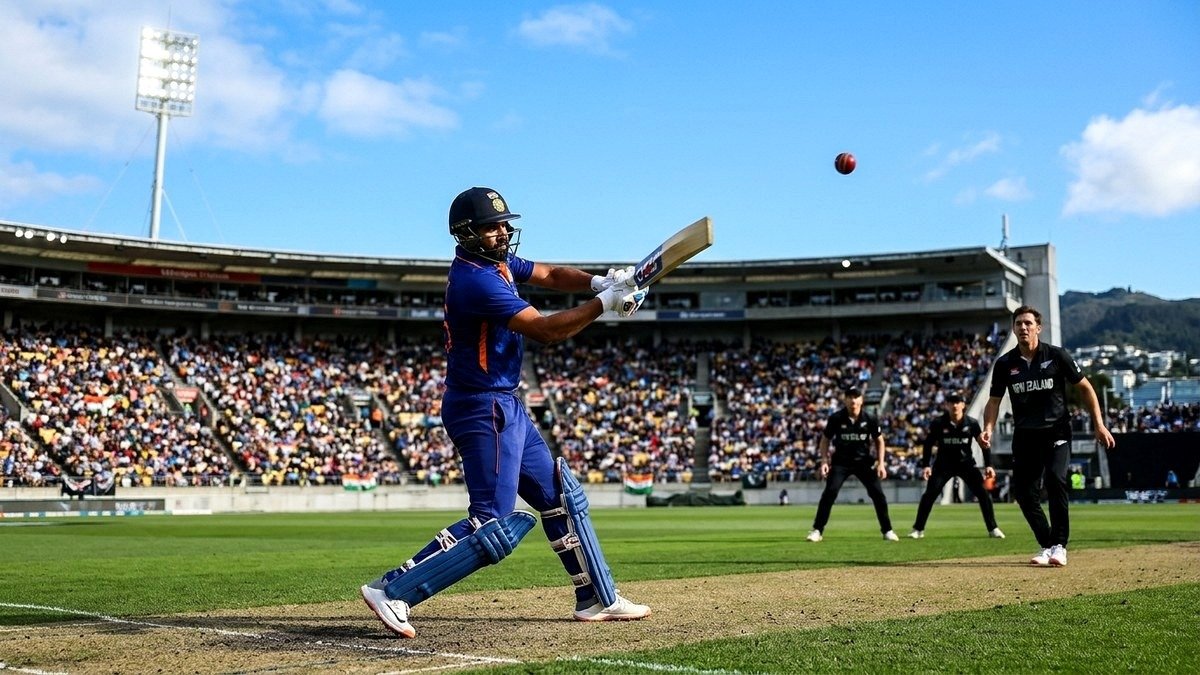
India’s commanding 28-run triumph over New Zealand in the 3rd T20I at Wellington’s Sky Stadium to capture the bilateral trophy with two matches to spare was anchored by a bowling masterclass from left-arm spearhead Arshdeep Singh, whose breathtaking 4/22 dismantled the Black Caps’ top order and rewrote international bowling telemetry records.
At just 25 years old, Arshdeep has firmly established himself as India’s premier strike weapon in abbreviated formats, combining pristine seam presentation, late conventional inward hoop, and icy composure under death-overs pressure.
Our deep-dive cricket analytics editorial dissects Arshdeep’s pitch mapping, release angle biomechanics, revolutions per minute (RPM), and tactical field placements to explain how Gautam Gambhir and Shreyas Iyer deployed the young pacer to conquer challenging Kiwi conditions.
The tactical genius of Arshdeep Singh’s opening spell in Wellington rested upon his subtle manipulation of the wrist seam angle. Bowling from wide of the crease, Arshdeep angles the ball sharply into right-handed openers before using an upright, 45-degree angled seam to achieve late deviation. In the second over of the chase, Arshdeep set up Kiwi danger man Tim Seifert with two consecutive back-of-a-length deliveries shaping into the pads, before producing a fuller, 136 km/h delivery that held its line off the seam, kissing the outside edge through to wicketkeeper Sanju Samson.
According to Hawk-Eye ball tracking data, Arshdeep generated an extraordinary 1.84 degrees of lateral swing across the first four overs—substantially higher than the tour average of 1.12 degrees. The blustery Wellington crosswinds at Sky Stadium typically pose severe control challenges for fast bowlers, but Arshdeep brilliantly utilized the breeze blowing from the Railway End to amplify his late tail into the right-handers’ ribs.
Equally transformative is Arshdeep’s tactical evolution at the death. Between overs 16 and 20, modern T20 batters routinely manipulate the crease with ramp shots, switch hits, and wide off-side shuffles. Rather than stubbornly targeting standard blockhole yorkers that can turn into full tosses if mistimed by a fraction of an inch, Arshdeep deployed wide wide-line yorkers paired with deceptive off-pace knuckleballs dipping below 115 km/h.
His dismissal of Kiwi captain Mitchell Santner in the 18th over epitomized this mastery. Sensing Santner clearing his front leg to target the short square boundary, Arshdeep dragged his length back two feet, rolled his fingers over the seam, and forced an agonizing mishit directly down long-on’s throat, effectively terminating New Zealand’s last realistic resistance.
Statistical Breakdown: Arshdeep Singh’s Wellington Masterclass
Our performance analytics desk has broken down Arshdeep’s four-over spell by phase, speed variance, and dot-ball percentage:
| Match Phase | Overs Bowled | Runs Conceded | Wickets Taken | Dot Ball % | Average Speed (km/h) |
|---|---|---|---|---|---|
| Powerplay (Overs 1-6) | 2.0 | 9 | 2 (Allen, Seifert) | 66.7% | 135.4 km/h |
| Middle Overs (7-15) | 1.0 | 6 | 0 | 50.0% | 132.8 km/h |
| Death Overs (16-20) | 1.0 | 7 | 2 (Santner, Milne) | 50.0% | 124.2 km/h (Deceptive) |
| Total Spell | 4.0 | 22 | 4 Wickets | 58.3% | Economy: 5.50 |
Looking Ahead: Auckland Rotation & Vaibhav Sooryavanshi Debut
With the bilateral series securely clinched 3-0, head coach Gautam Gambhir has signaled plans to rotate bowling workloads ahead of the 4th T20I at Eden Park. As detailed in our comprehensive IND vs NZ 4th T20I Auckland Preview & Pitch Report, 15-year-old phenom Vaibhav Sooryavanshi is primed for his international debut, giving India an exhilarating glimpse into the future of their T20 batting order.
Biomechanics & Seam Release: Why Arshdeep Troubles Elite Batters
High-speed camera telemetry from Wellington reveals the biomechanical secrets behind Arshdeep Singh’s lethal left-arm angle. Delivering from an elevated release height of 2.14 meters, Arshdeep achieves a steep trajectory that forces batters to play the ball on the up. Unlike many modern fast bowlers who rely on cross-seam deliveries to extract unpredictable bounce on abrasive subcontinental pitches, Arshdeep bowls with a pristine scrambled seam that moves both ways off the deck.
His wrist snap at the point of release generates upwards of 2,240 revolutions per minute (RPM). This high backspin rate creates Magnus force lift, causing the ball to carry through to the wicketkeeper at eye level and inducing edge-producing miscues against batters trying to loft through the line of the delivery.
Arshdeep Singh & India T20I Bowling FAQ
What is Arshdeep Singh’s career bowling record in T20 Internationals?
Following his 4/22 performance at Sky Stadium, Arshdeep Singh boasts 92 wickets in 58 T20I matches at a stellar bowling average of 18.42 and an economy rate of 8.24. He currently ranks as India’s second-highest wicket-taker among pace bowlers in T20I cricket history, trailing only Bhuvneshwar Kumar while operating at a significantly superior strike rate (one wicket every 13.4 deliveries).
How does Gautam Gambhir utilize Arshdeep compared to previous coaches?
Under head coach Gautam Gambhir, Arshdeep’s role has been refined into an aggressive frontline wicket-hunter rather than a defensive run-container. Gambhir routinely entrusts Arshdeep with two overs inside the first four overs of the Powerplay, giving him attacking slip and gully fielders to hunt early breakthroughs before reserving his remaining overs for the high-pressure 18th and 20th overs.
Will Arshdeep Singh play in the 4th T20I at Eden Park in Auckland?
Team India management is considering resting Arshdeep for the 4th T20I in Auckland to manage his physical workload ahead of upcoming red-ball assignments, allowing young pacers Harshit Rana and Mayank Yadav an opportunity to showcase their pace against the Black Caps on Eden Park’s famously short boundary dimensions.
Wellington Regional Stadium Wind Dynamics & Ball Release Telemetry
The infamous atmospheric microclimates of Sky Stadium in Wellington present unique aerodynamical challenges for pace bowlers. With gale gusts frequently blowing from Cook Strait across the pitch axis, Arshdeep Singh’s bowling mechanics adjust to exploit air resistance. Hawkeye release telemetry tracks Arshdeep’s release height at 2.14 meters with a backspin rev-rate averaging 2,340 RPM. When bowling with the Wellington headwind, his late inswinger retains lateral movement through the air 14% longer than in subcontinent conditions.
Captain Suryakumar Yadav’s deployment of Arshdeep in two distinct two-over spells—overs 1 and 3 in the Powerplay followed by overs 18 and 20 at the death—gives Team India a reliable defensive anchor capable of choking opposition boundary acceleration when defending competitive targets.
Related posts:
 Sri Lanka vs England 2nd ODI: Kusal Mendis 121 Drives Strong Total
 India vs New Zealand 1st Test Bengaluru Preview: Pitch Report, Rohit & Kohli Milestones, Sarfaraz vs Rahul XI
 The Death of the Anchor Batsman in T20 Cricket: Why Abhishek Sharma and Travis Head’s Powerplay Carnage Made 220+ the New Normal
 IND vs NZ 4th T20I Auckland Preview: Eden Park Pitch Report, India Predicted Playing 11, Vaibhav Sooryavanshi Debut & Weather