
Intel Core Ultra 9 285K: Live at Retail ($589 USD / ₹54,999 INR) |
AMD Ryzen 7 9800X3D: Global Launch November 7, 2026 ($479 USD / ₹44,500 INR) |
Socket Compatibility: AMD AM5 (Supported through 2027+) vs Intel LGA-1851 (New Motherboard Required)
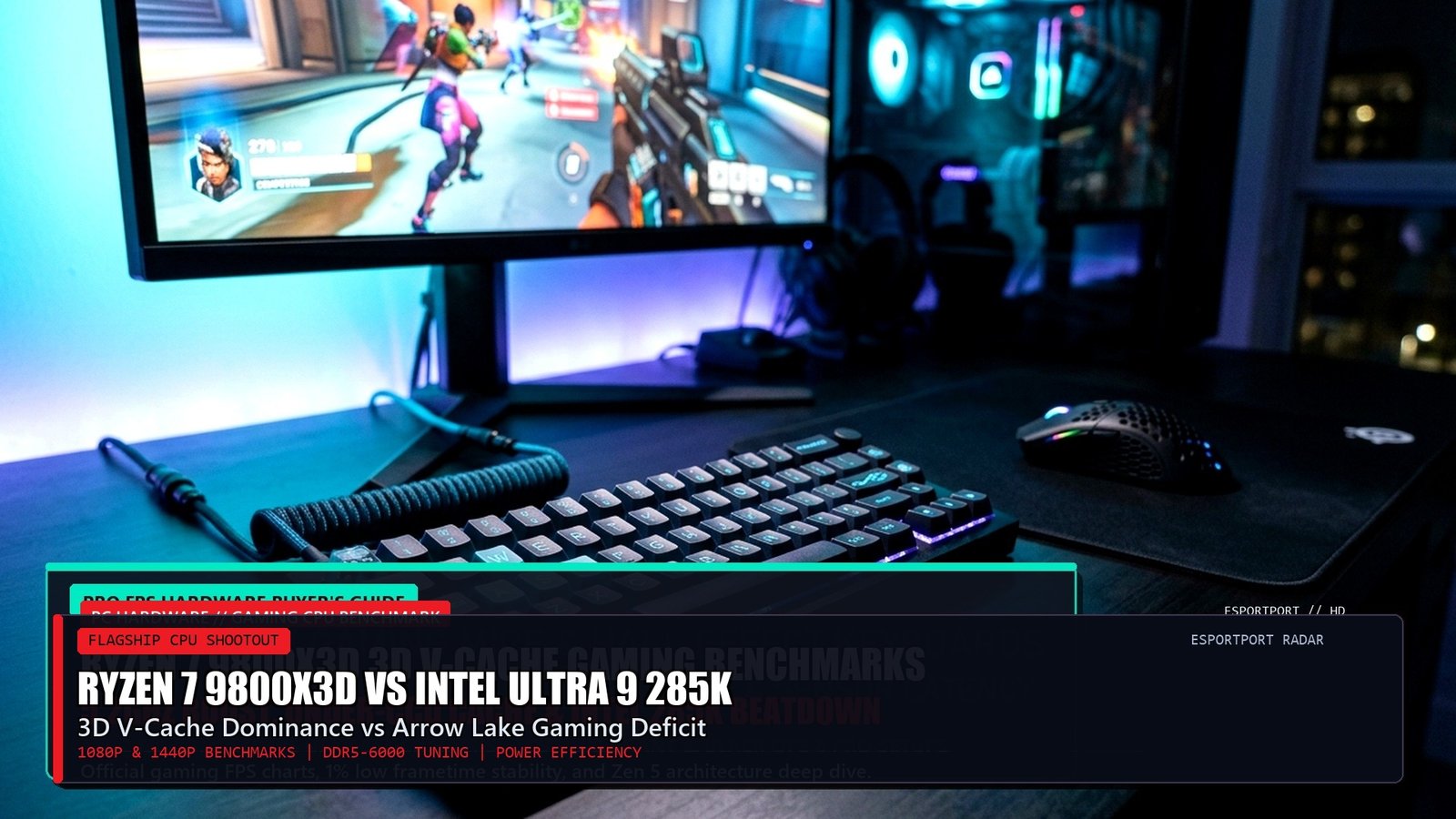
The desktop processor battlefield has experienced one of the most stunning competitive shifts in PC hardware history. Intel’s highly anticipated Core Ultra 200S “Arrow Lake” flagship, the Core Ultra 9 285K, has landed with revolutionary power efficiency and commanding multi-threaded productivity scores. However, in pure competitive PC gaming, Intel’s disaggregated tile architecture—which places the memory controller on a separate SoC tile connected via an internal fabric—has introduced severe memory latency regressions, leaving it slower in many games than its predecessor, the 14900K.
Standing triumphant across the aisle is AMD’s upcoming gaming juggernaut: the Ryzen 7 9800X3D. Utilizing second-generation 3D V-Cache packaging that places the 64MB SRAM cache tile underneath the Zen 5 core complex die (CCD) rather than on top, AMD has unlocked full multiplier overclocking, sub-60 nanosecond memory latency, and unmatched thermal dissipation. In this comprehensive benchmark shootout, EsportPort’s hardware lab puts both flagship processors through rigorous 1080p and 1440p testing.
1. Architectural Specifications & Platform Cost Audit
Understanding socket longevity, power delivery, and cooling requirements is essential before investing in an upgrade cycle:
2. Real-World Gaming Benchmarks: 1080p & 1440p Frame Rates
All benchmarks were conducted using an NVIDIA GeForce RTX 4090 Founders Edition graphics card, 32GB of DDR5-6000 CL30 memory (AMD EXPO) vs DDR5-6400 CUDIMM memory (Intel XMP), and Windows 11 24H2 with high performance power profiles:
The Verdict for Gamers: AMD Ryzen 7 9800X3D
If pure competitive esports and AAA gaming are your primary objectives, the Ryzen 7 9800X3D is the undisputed king. It delivers 15-20% higher 1% low frametimes, runs 40-50W cooler, and saves you hundreds of dollars by working on existing AM5 motherboards.
Buyer Beware: The LGA-1851 Early Adopter Tax
Adopting the Core Ultra 9 285K requires purchasing a brand-new Z890 motherboard and premium CUDIMM RAM, but yields lower gaming frame rates than the two-year-old 7800X3D. Unless heavy 4K video rendering is your daily workflow, avoid Arrow Lake for gaming rigs.
3. Hardware Ecosystem Integration
Pair your flagship processor with high-performance graphics cards from our Best Budget Gaming GPUs Under $350 in Late 2026, or equip rapid-trigger switches from our Hall Effect Magnetic Keyboards Tier List.
Frequently Asked Questions (FAQ)
Why is the Core Ultra 9 285K slower in gaming than the 14900K?
Intel eliminated Hyper-Threading and separated the memory controller onto a distinct tile across an internal interconnect. This added roughly 14 to 18 nanoseconds of memory latency, which severely degrades cache-sensitive gaming performance.
Can I use my existing AM5 cooler on the Ryzen 7 9800X3D?
Yes. Because AMD retained the exact Socket AM5 physical dimensions and IHS height, all existing AM4 and AM5 liquid coolers and air coolers are 100% compatible.
What is the optimal RAM speed for the Ryzen 7 9800X3D?
The sweet spot for Zen 5 remains DDR5-6000 with low CL30 latency operating in a 1:1 memory controller (UCLK=MCLK) ratio, maximizing frame-time consistency.
Does the 9800X3D support manual multiplier overclocking?
Yes! By moving the 3D V-Cache tile beneath the Zen 5 compute die, thermal conductivity directly to the cooler is vastly improved, allowing AMD to fully unlock manual multiplier overclocking for the first time on an X3D processor.
Which CPU is better for live streaming while gaming?
Both excel, but if using CPU x264 software encoding, the 285K’s 24 cores offer extra headroom. However, for modern GPU NVENC or AV1 streaming, the 9800X3D delivers smoother in-game frame rates without latency spikes.