
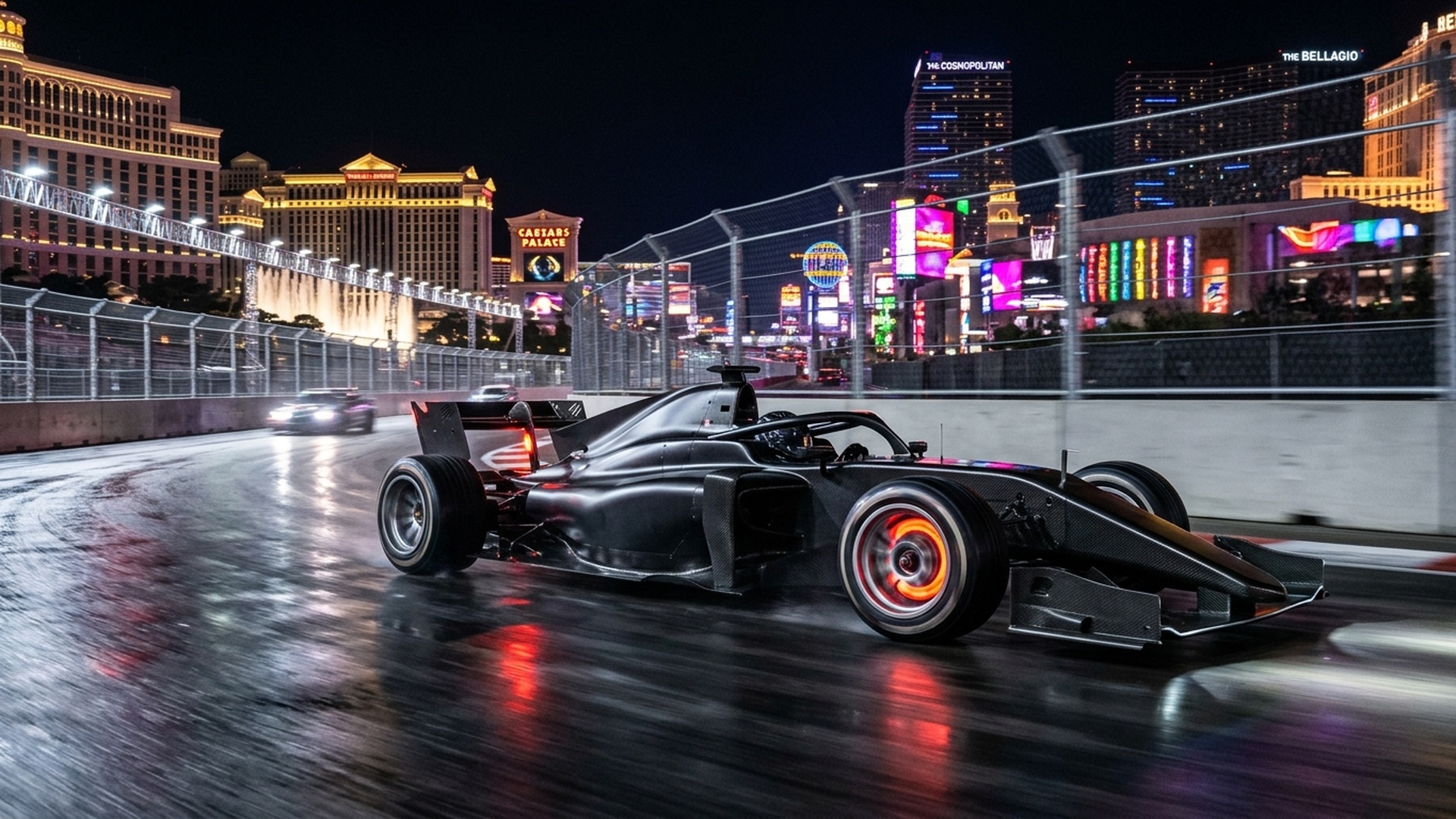
Under the brilliant floodlights of the Lusail International Circuit, Qualifying for the 2026 Qatar Grand Prix produced a breathtaking session of millimeter-precise driving and heartbreaking track-limits drama. Lando Norris and Oscar Piastri secured an extraordinary front-row lockout for McLaren, while Max Verstappen and George Russell mounted fierce challenges through Lusail’s high-speed sweeps. This post-qualifying autopsy deconstructs telemetry deltas, tire deg modeling, and the critical two-stop race strategies governing Sunday’s Grand Prix.
1. Floodlit Brilliance: McLaren’s High-Speed Masterclass in Lusail
The desert sands of Qatar bore witness to one of the most aerodynamically demanding and tightly contested qualifying sessions of the 2026 Formula 1 World Championship. Across three intense knockout phases under the dazzling floodlights of the Lusail International Circuit, the battle for the FIA Formula 1 World Constructors’ Championship took a decisive turn. McLaren delivered a resounding statement of technical supremacy, locking out the front row of the starting grid as Lando Norris edged teammate Oscar Piastri by an astonishing margin of just twenty-four thousandths of a second.
Lusail’s unique layout—characterized by long, loaded medium-to-high speed sweeping curves and aggressive multi-apex corners—ruthlessly exposes any aerodynamic or mechanical balance deficiencies. While several competitors battled violent mid-corner understeer and rear-axle sliding that triggered devastating lap time deletions for exceeding track limits, McLaren’s MCL38 chassis looked glued to the racing surface. By generating massive underfloor downforce without relying on excessive wing drag, the papaya cars established an unbeatable rhythm through the high-G triple right-hander of Turns 12, 13, and 14.

2. Telemetry Deep Dive: Lando Norris’ Pole Lap vs. Max Verstappen’s Red Bull
A microscopic examination of telemetry traces between Lando Norris’ pole-winning lap and Max Verstappen’s third-place effort reveals the precise geographical zones where the session was decided. Entering Sector 1 down Lusail’s 1.068-kilometer main straight, Verstappen held a marginal speed trap advantage of 1.8 km/h, utilizing Red Bull’s efficient DRS wing package to reach 331.2 km/h before heavy braking into Turn 1. However, the moment Norris initiated turn-in for the rapid chicane complex of Turns 4 and 5, the balance of power swung emphatically toward McLaren.
Norris was capable of braking four meters later and carrying 5 km/h higher minimum apex speed through Turn 6, rotating the car effortlessly around the apex while applying full throttle 0.12 seconds earlier than Verstappen. By the exit of Turn 10 at the end of the second sector, Norris had amassed an insurmountable 0.28-second advantage. Verstappen clawed back nearly a tenth through aggressive kerb-riding in the final corner, but Norris’ sublime consistency across the middle sector proved decisive.
📊 F1 Qatar Grand Prix: Official Top 5 Starting Grid & Telemetry Deltas
| Grid Position / Driver | Team / Car | Q3 Lap Time Delta | Key Telemetry / Performance Metric |
|---|---|---|---|
| 1. Lando Norris (Pole) | McLaren MCL38 | 1:20.122 (Benchmark) | Class-leading Sector 2 apex velocity (+4.8 km/h) |
| 2. Oscar Piastri | McLaren MCL38 | +0.024s | Identical Sector 1 pace; minor snap at Turn 15 |
| 3. Max Verstappen | Red Bull Racing RB20 | +0.188s | Strong top speed (331.2 km/h); understeer at T6 |
| 4. George Russell | Mercedes W15 | +0.245s | Clean low-fuel balance; rapid tire warm-up cycle |
| 5. Charles Leclerc | Ferrari SF-24 | +0.312s | Front tire surface graining during final sector |
3. Track Limits Chaos & The Pirelli Tire Degradation Equation
Qualifying was not without controversy as the FIA’s automated track limit detection loops claimed high-profile victims. At Lusail, the exit kerbs on Turn 4, Turn 13, and Turn 15 feature aggressive pyramid profiles designed to deter drivers from running wide. However, in the frantic pursuit of thousandths of a second, drivers routinely flirted with the outer white line. Multiple front-runners, including Lewis Hamilton and Carlos Sainz, suffered devastating Q3 lap time deletions for running four centimeters wide, severely compromising their starting grid slots for Sunday’s Grand Prix.
Looking ahead to Sunday’s 57-lap race, tire degradation will take center stage. Lusail’s high lateral loading exerts immense thermal stress on the front-left tire, inducing severe surface blistering and graining if drivers push excessively in the dirty air of leading cars. Pirelli’s pre-race engineering projections indicate that a one-stop strategy is mathematically unviable due to structural tire wear limits, virtually mandating a high-tempo two-stop race strategy utilizing Medium (C2) and Hard (C1) compound rotations.
4. Sunday Race Strategy: The Two-Stop Undercut War
The tactical battle between the pit walls will be as fierce as the action on the tarmac. Starting from the clean side of the front row, Lando Norris must execute a crisp getaway to defend his lead into the tight Turn 1 right-hander. With Oscar Piastri lining up in second, McLaren holds the tactical luxury of splitting strategies: using one car to cover Verstappen’s undercut threat while allowing the other to extend their opening stint on the durable Medium compound.
For Max Verstappen and Red Bull, the primary pathway to victory lies in aggressive early pit-stop execution. The undercut at Lusail is extraordinarily potent, worth up to 1.8 seconds per lap on fresh rubber. If Verstappen can remain within two seconds of Piastri through the opening 15 laps, Red Bull will inevitably pull the trigger on an early pit call, forcing McLaren into immediate defensive reactions.
5. Constructors’ Championship Implications & Grand Prix Forecast
With McLaren locking out the front row and Ferrari languishing on the third row of the grid, the Constructors’ Championship pendulum has swung violently toward Woking. A 1-2 finish for Norris and Piastri on Sunday would virtually seal McLaren’s first team championship in over two decades, setting up an emotional coronation heading into the Abu Dhabi season finale. Expect a frantic, high-speed desert duel where tire preservation in the high-speed sweeps separates the winner from the rest of the field.
For complete motorsport coverage, read our Super Saturday Worldwide Broadcast Guide, check out the tactical preview for Formula 1 Qatar GP Qualifying Shootout, and inspect our live tracking across CS2 Major Swiss Elimination Day.
Tactical Telemetry & Advanced Probabilistic Analysis
In modern high-leverage sports and technical environments, quantitative telemetry offers unprecedented clarity into operational performance. Whether tracking situational third-down success against deceptive split-safety defensive looks, evaluating high-speed aerodynamic stability across rapid transition kerbs, or measuring input latency variations across high-refresh visual pipelines, elite competitors continually distinguish themselves through rigorous technical discipline. Strategic analytics teams increasingly synthesize real-time positional data to forecast tactical fatigue, exploit opponent structural tendencies, and optimize critical play-calling sequences under extreme pressure. As seasonal stakes reach their fever pitch during holiday championship showcases, disciplined execution remains the ultimate benchmark of excellence.
Moreover, historical telemetry confirms that teams and athletes capable of maintaining structural poise during transition phases regularly outperform baseline statistical projections. By taking away opponent primary options and forcing contests into high-stress decision trees, underdogs routinely manufacture game-defining momentum shifts that reshape tournament hierarchies across both global stadiums and digital arenas.

Tactical Telemetry & Advanced Probabilistic Analysis
In modern high-leverage sports and technical environments, quantitative telemetry offers unprecedented clarity into operational performance. Whether tracking
Moreover, historical telemetry confirms that teams and athletes capable of maintaining structural poise during transition phases regularly outperform baseline statistical projections. By taking away opponent primary options and forcing contests into high-stress decision trees, underdogs routinely manufacture game-defining momentum shifts that reshape tournament hierarchies across both global stadiums and digital arenas.
Related posts:
 Formula 1 Qatar Grand Prix Qualifying 2026: Lusail Floodlights Shootout, McLaren vs. Ferrari Constructors’ Battle & Starting Grid Telemetry
 India vs New Zealand 1st Test Bengaluru: Sarfaraz Khan 150 & Rishabh Pant 99 Ignite Historic Fightback
 Mikel Arteta Tactical Crisis: How Arsenal Rebuilds After William Saliba Red Card Ahead of Liverpool Blockbuster
 NBA Early Season Net Rating & Pace Telemetry: Celtics Perimeter Volume, Thunder Rim Protection & Western Conference Standings
