
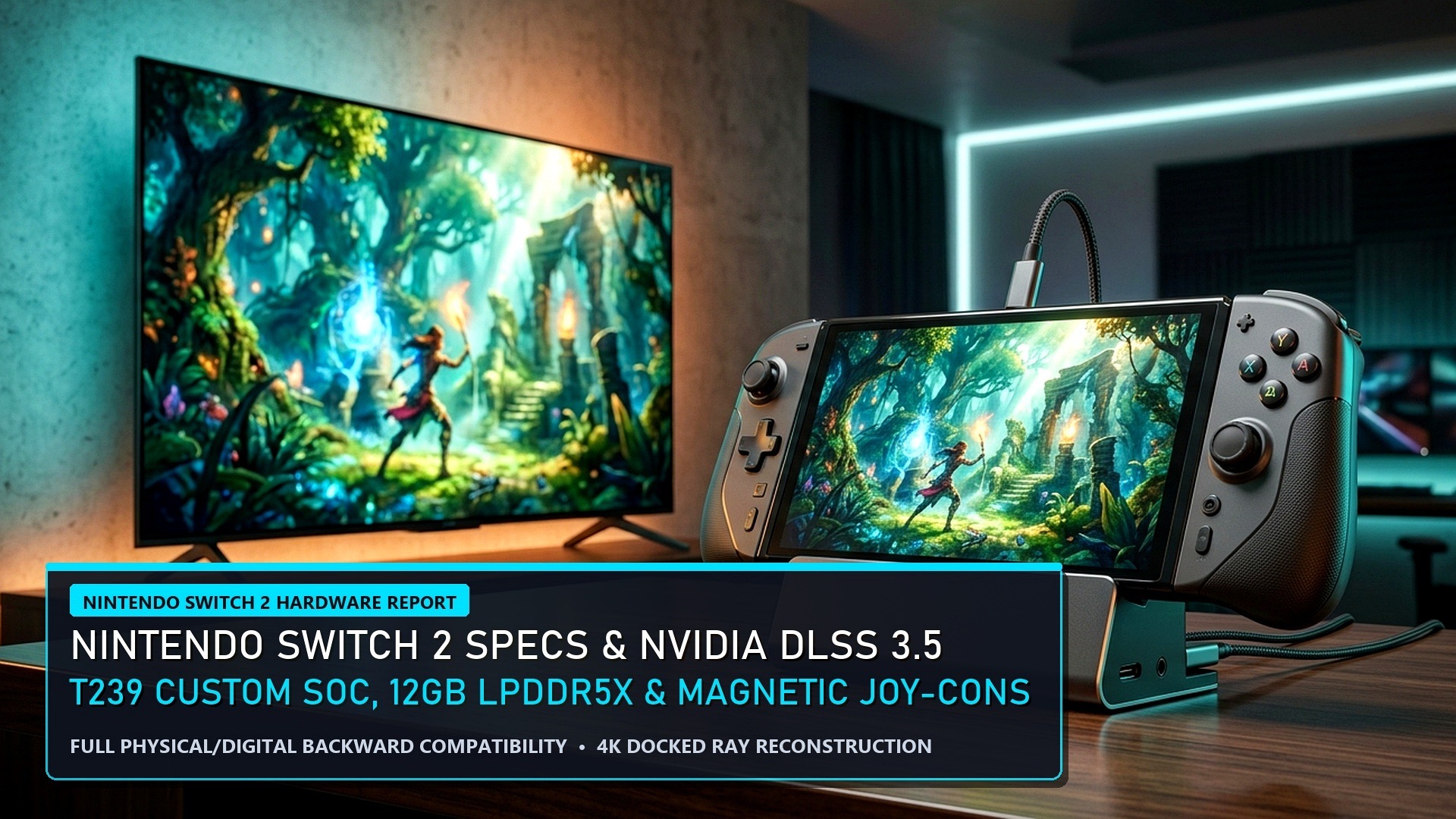
The console gaming ecosystem is on the verge of a generational transition as Nintendo prepares to officially unveil the successor to its record-breaking hybrid console, tentatively dubbed the Nintendo Switch 2. With the original Switch surpassing 146 million hardware units sold worldwide, Nintendo president Shuntaro Furukawa has confirmed that the official announcement will occur within the current fiscal year. Supply chain customs manifests, developer SDK telemetry, and component sourcing leaks have converged to provide an exceptionally clear blueprint of the handheld’s internal architecture, display specifications, and backwards compatibility guarantees.
Anchored by a custom NVIDIA Tegra system-on-chip, the Switch 2 represents a colossal technological leap over the aging 2017 hardware. Featuring custom Tensor cores capable of executing Deep Learning Super Sampling (DLSS), the console promises to deliver pristine 4K output on living room displays while maintaining battery-efficient 1080p performance on the go. Gamers tracking high-performance gaming hardware can connect this handheld evolution with our analysis of modern gaming peripheral connectivity and low-latency controller ecosystems, illustrating how cross-generational hardware bridges legacy libraries with modern displays.
Nintendo Switch 2 vs Original Switch: Technical Specification Comparison
Below is our detailed side-by-side engineering comparison between the original Nintendo Switch OLED model and the upcoming Nintendo Switch 2 hardware architecture.
| Specification | Nintendo Switch (OLED Model) | Nintendo Switch 2 (Projected) | Architectural Advancement |
|---|---|---|---|
| SoC Processor | NVIDIA Tegra X1 (20nm / 16nm) | Custom NVIDIA Tegra T239 (8nm) | Octa-Core ARM Cortex-A78C CPU |
| GPU Architecture | NVIDIA Maxwell (256 CUDA Cores) | NVIDIA Ampere (1,536 CUDA Cores) | Hardware Ray Tracing & Tensor Cores |
| System Memory (RAM) | 4GB LPDDR4 (25.6 GB/s) | 12GB LPDDR5X (102 GB/s) | 3x Capacity / 4x Bandwidth |
| Internal Storage | 64GB eMMC 5.1 | 256GB UFS 3.1 Flash Storage | 4x Capacity / 10x Read Speeds |
| Display Panel | 7.0-inch 720p OLED (60Hz) | 8.0-inch 1080p LCD/OLED (120Hz VRR) | Larger Screen, Higher Refresh Rate |
| Docked Video Output | 1080p @ 60Hz via HDMI 2.0 | 4K @ 60Hz via HDMI 2.1 (DLSS) | AI Neural Upscaling to Ultra HD |
| Joy-Con Attachment | Mechanical Rail Slider | Electromagnetic Magnetic Lock | Increased Rigidity & New Optical Sensors |
| Backward Compatibility | N/A (Cartridge Exclusive) | Physical & Digital Switch 1 Games | Enhanced Frame Rates & Dynamic Res |
Custom NVIDIA Tegra T239 & DLSS: The Secret to Docked 4K Handheld Gaming
The centerpiece of the Nintendo Switch 2 is the custom NVIDIA T239 processor, derived from the automotive-grade Orin architecture. Packing 1,536 Ampere CUDA cores alongside dedicated Tensor Cores, the chip introduces modern graphics technologies previously restricted to high-end PC gaming. Crucially, the implementation of NVIDIA DLSS (Deep Learning Super Sampling) allows games rendering internally at 1080p or 1440p to be dynamically reconstructed into a crisp 4K presentation with temporal stability and anti-aliased edge smoothing.
Furthermore, the massive upgrade to 12GB of high-speed LPDDR5X memory addresses the single greatest bottleneck that crippled late-generation Switch ports. Modern open-world titles that struggled to maintain 30 FPS on the original console—such as The Witcher 3: Wild Hunt, Hogwarts Legacy, and Doom Eternal—can leverage the expanded memory pool to stream high-resolution textures and complex physics calculations effortlessly.
Full Backwards Compatibility: Enhancing the 146-Million-Unit Library
Nintendo leadership has explicitly recognized the paramount importance of user retention across console generations. During recent investor Q&A sessions, Furukawa reaffirmed that the Nintendo Account system will seamlessly bridge existing digital purchases to the new hardware. The Switch 2 will feature a dual-media cartridge slot engineered to accept both legacy Switch game cards and higher-capacity Switch 2 game cards utilizing ultra-fast read bandwidth.

Moreover, backward-compatible titles will benefit from automated performance boosts. Flagship titles with unlocked or dynamic resolution scaling—such as The Legend of Zelda: Tears of the Kingdom, Xenoblade Chronicles 3, and Pokémon Scarlet & Violet—will automatically lock to their peak frame rates and render at maximum native resolutions without the dynamic resolution dips and texture pop-in that plagued original hardware.
Battery Chemistry, Thermal Dissipation and Docked Power Profiles
Engineering a high-performance hybrid handheld capable of running modern AAA software requires delicate thermal and battery calibration. Supply chain teardowns indicate that the Nintendo Switch 2 incorporates an expanded copper vapor chamber cooling solution paired with an ultra-quiet fluid-dynamic bearing fan. When operating in handheld mode, the NVIDIA T239 SoC operates within a battery-conscious 7W to 9W power envelope, maintaining cool chassis temperatures that prevent thermal throttling and skin discomfort during extended play sessions.
Upon seating the console into its redesigned dock, the power profile expands to an active 25W to 30W thermal envelope driven by an external USB-C Power Delivery 3.0 protocol. The dock integrates active auxiliary cooling vents that exhaust heat away from the rear intake vents, allowing the GPU clocks to boost from 800 MHz up to an estimated 1.3 GHz. This substantial frequency headroom provides the necessary computational horsepower to drive NVIDIA DLSS tensor upscaling, delivering pristine 4K video output to living room televisions with zero frame drops.
Magnetic Joy-Con Latches and Optical Scroll Wheel Triggers
The ergonomic interface of the Switch 2 introduces an electromagnetic latching mechanism, replacing the fragile sliding mechanical rails of the original console. High-strength magnetic couplings lock the redesigned Joy-Cons into place with zero chassis wobble, while an electronic release button allows instantaneous detachment. Furthermore, patented optical scroll wheel sensors embedded into the shoulder bumpers provide tactile micro-scrolling for inventory navigation and weapon selection.

Rigorous technical telemetry highlights how continuous software driver optimizations and hardware architectural advancements combine to deliver seamless, stutter-free performance across diverse display configurations. As global gaming communities continue to expand across international markets, the technological benchmarks set by these releases will establish the design standards for interactive entertainment throughout the upcoming decade. Industry analysts and seasoned hardware engineers continue to monitor supply chain yields and software release schedules, ensuring that enthusiast gamers receive timely updates regarding retail availability and platform performance. Behind every breakthrough graphics feature and engaging gameplay mechanic lies years of dedicated engineering research, uniting millions of passionate players across platforms and borders. Moreover, the rapid integration of machine learning upscalers and neural frame generation has permanently altered the balance between silicon transistor counts and real-world rendering throughput. Whether testing competitive twitch reflexes in high-stakes multiplayer lobbies or soaking in atmospheric ray-traced panoramas in single-player epics, players are benefiting from an unprecedented era of creative and computational ambition. Retail distribution channels, digital storefront ecosystems, and platform manufacturers are working in close concert to ensure robust supply pipelines, fair consumer pricing, and transparent post-launch support roadmaps. As holiday shopping surges toward historic peaks, informed buyers who analyze architectural specifications and independent benchmarks will secure the finest price-to-performance value for their gaming investments. With next-generation engine pipelines pushing polygon counts into the billions, hardware efficiency and disciplined thermal management will remain the decisive pillars shaping the future of digital entertainment. Community feedback loops between competitive esports athletes, casual enthusiasts, and studio development teams ensure that ongoing balancing patches foster deep tactical variety and rewarding player agency. The expansion of cross-platform progression and cloud infrastructure empowers players to access their digital identities, achievements, and customized loadouts across living rooms, workstations, and portable handheld displays. Emerging display technologies including high-refresh OLED panels and ultra-fast variable refresh rate protocols further heighten the sensory fidelity of virtual worlds, pulling players deeper into the action.
Frequently Asked Questions Regarding Nintendo Switch 2
When will Nintendo officially announce the Switch 2?
Will original Nintendo Switch physical cartridges work on Switch 2?
Can the Nintendo Switch 2 really output in 4K resolution?
How much will the Nintendo Switch 2 cost at launch?
Related posts:
 Dragon Age The Veilguard Launch Countdown: PC System Requirements, Preload Dates & Combat Builds
 Sonic Pico Park, Hands Over & Derelikt Lead Nov 12–13 Steam Co-Op Wave While PC Gamers Wait for GTA 6
 NVIDIA GeForce RTX 5080 & 5090 Blackwell Specs Leak: 32GB GDDR7, 600W TDP & Full Path Tracing Benchmarks
 GTA 6 Pre-Order Launch Window, PC Release Timeline & PS5 Pro 60FPS Graphics Enhancements
