
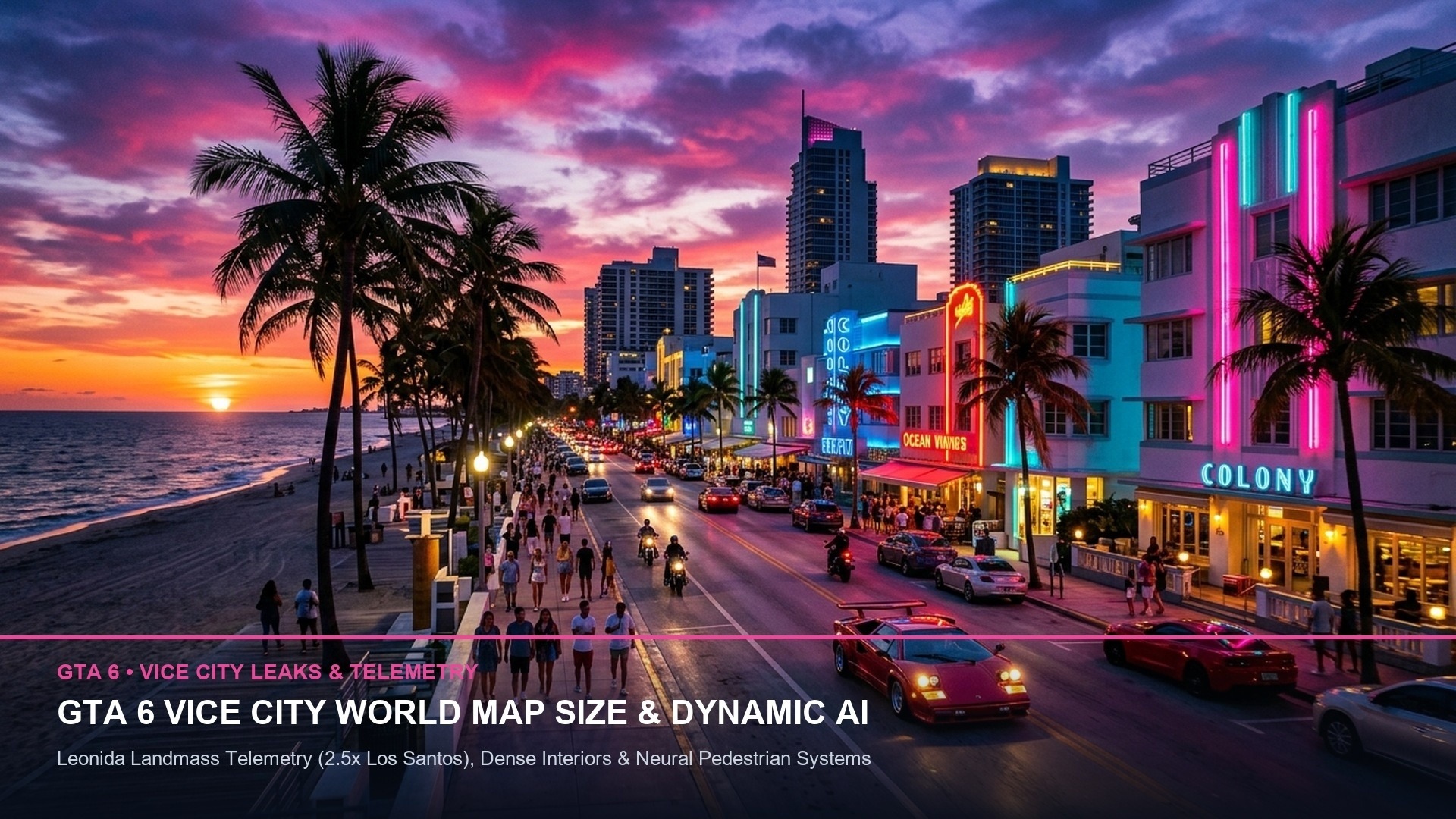
As console players prepare for the historic launch of Grand Theft Auto VI across PlayStation 5 and Xbox Series X|S, the global PC gaming community is intensely focused on Rockstar Games’ upcoming Windows release. Fresh technical leaks from Rockstar’s Edinburgh and New England engineering depots have revealed groundbreaking details regarding the RAGE 9 engine, DirectStorage 1.2 decompression pipelines, hardware-accelerated path tracing, and mandatory 16GB VRAM configurations required to render Vice City’s photorealistic sprawling open world.
Leaked GTA 6 PC Hardware Specifications Matrix
According to engineering documentation circulated among third-party graphics API partners, Rockstar Games is designing GTA 6 on PC as an uncompromising next-generation showcase. The RAGE 9 engine completely deprecates mechanical hard drives, mandating ultra-fast NVMe SSD storage with high-speed direct GPU streaming.
| Specification Tier | Target Resolution & FPS | Processor (CPU) | Graphics Card (GPU) | System RAM / VRAM | Storage Requirement |
|---|---|---|---|---|---|
| Minimum Spec | 1080p @ 30 FPS (Low/Med) | Intel Core i5-11600K / AMD Ryzen 5 5600X | NVIDIA RTX 2070 Super / AMD Radeon RX 6700 | 16GB DDR4 / 8GB VRAM | 150GB Gen3 NVMe SSD |
| Recommended Spec | 1440p @ 60 FPS (High Settings) | Intel Core i7-13700K / AMD Ryzen 7 7800X3D | NVIDIA RTX 4070 Super / AMD Radeon RX 7900 GRE | 32GB DDR5 / 12GB VRAM | 150GB Gen4 NVMe SSD (DirectStorage) |
| Ultra / Path Tracing | 4K @ 60+ FPS (Ultra Ray Tracing) | Intel Core i9-14900K / AMD Ryzen 7 9800X3D | NVIDIA RTX 4090 / RTX 5080 (16GB+) | 32GB DDR5 / 16GB+ VRAM | 150GB Gen4/Gen5 NVMe SSD (DirectStorage) |
The RAGE 9 Engine: Architectural Revolution
Rockstar’s proprietary RAGE 9 engine represents a quantum leap in open-world simulation technology. Unlike previous iterations that relied on rasterized approximations and cubemap reflections, GTA 6 implements unified global illumination, volumetrically simulated oceanic tides across the Leonida Keys, and machine-learned pedestrian AI pathfinding routines.
Every individual building interior in Vice City features physically based lighting that dynamically adjusts when sunlight pierces tinted storefront glass. To eliminate immersion-breaking pop-in, Rockstar employs DirectStorage 1.2 GPU decompression, streaming geometric assets and high-resolution textures directly from NVMe storage into GPU memory without choking the central processing unit.
The 16GB VRAM Mandate: The Death of 8GB GPUs
The most consequential technical finding for PC enthusiasts is the engine’s intense Video RAM consumption. At 1440p with ray-traced reflections, ambient occlusion, and sun shadows enabled, GTA 6 allocates over 11.4GB of dedicated VRAM. Running in native 4K or utilizing path-traced lighting modes pushes active memory usage beyond 14.8GB.
Players clinging to 8GB graphics cards like the RTX 3070 or RTX 4060 will encounter severe texture paging stutters and dynamic resolution downsampling. Upgrading to a 16GB VRAM buffer has transformed from an enthusiast luxury into an essential requirement for modern AAA open-world gaming.
Ray Reconstruction, DLSS 3.7 & FSR 3.1 Integration
To deliver fluid framerates in densely populated metropolitan areas like downtown Vice City and Ocean Beach, Rockstar has integrated the latest neural upscaling and frame generation technologies. NVIDIA’s DLSS 3.7 featuring Ray Reconstruction replaces hand-tuned denoisers with AI models trained on supercomputer simulations, resolving fine wire fences, neon reflections, and wet asphalt ripples with pristine clarity.
AMD players will benefit from FSR 3.1 frame interpolation, allowing Radeon users to decouple temporal upscaling from frame generation pipelines. Additionally, Rockstar is reportedly partnering with Intel to optimize XeSS 1.3 for integrated and discrete Arc silicon.
Just as competitive gaming communities debate performance thresholds in tournaments celebrated at The Game Awards, the PC gaming community views GTA 6 as the ultimate generational hardware benchmark that will define system builds for the next decade.
PC Release Window & Pre-Launch Optimization Roadmap
While Rockstar Games prioritizes the initial console launch, internal roadmaps indicate that the dedicated PC version is targeting a release window approximately 12 to 14 months post-console launch. This expanded development buffer allows Rockstar’s technical engineers to implement extensive mouse-and-keyboard tuning, ultrawide 21:9 and 32:9 aspect ratio support, unlocked framerates, and comprehensive graphical customization menus that PC players demand.
DirectStorage 1.2 GPU Decompression Pipeline Architecture
Rockstar’s technical breakthrough with the RAGE 9 engine lies in its uncompromised implementation of Microsoft’s DirectStorage 1.2 API. In traditional PC game engines, compressed texture and geometry packages must first travel from storage to system RAM, undergo decompression via the central processing unit (CPU), and finally transfer across the PCIe bus to GPU VRAM. This legacy pipeline introduces massive CPU overhead and micro-stutters during rapid vehicle travel.
With RAGE 9’s direct GPU decompression, compressed GDeflate asset streams travel directly from NVMe storage into the graphics card’s compute pipeline. The GPU decompressor unrolls thousands of 4K texture arrays and micro-polygon geometry meshes in parallel within fractions of a millisecond. This revolutionary pipeline enables Vice City’s bustling streetscapes, detailed interior skyscrapers, and complex cloud formations to stream seamlessly without a single loading screen.
VRAM Allocation Curves: The 8GB vs 16GB Reality
Detailed architectural analysis of modern ray-traced rendering demonstrates why 8GB graphics cards face obsolescence in next-generation AAA titles. When hardware-accelerated path tracing is engaged, the GPU must build and maintain extensive Bounding Volume Hierarchy (BVH) acceleration structures in dedicated VRAM. These ray-tracing spatial trees consume between 2.5GB and 3.8GB of memory before a single scene texture is even loaded.
When combined with 1440p or 4K framebuffers, render targets, and high-resolution geometry buffers, an 8GB card exhausts its physical memory instantly. Once VRAM is saturated, the engine pages memory over the PCIe bus to system RAM, cutting framerates by over 60% and causing catastrophic hitching. Rockstar’s engineering leaks confirm that GTA 6 requires a minimum 12GB VRAM buffer for high-settings ray tracing, with 16GB recommended for native 4K ultra configurations.
Ultrawide 21:9 / 32:9 Aspect Ratio & Uncapped Framerates
Unlike previous console-first ports that locked cinematics to 16:9 aspect ratios, Rockstar’s dedicated PC team is engineering full native support for 21:9 ultrawide and 32:9 super-ultrawide displays across gameplay and cutscenes alike. PC players will also benefit from fully uncapped framerates, comprehensive field-of-view sliders, and customizable dual-monitor telemetry dashboards displaying vehicle telemetry and in-game mini-maps.
DirectX 12 Agility SDK & Work Graphs Pipeline Optimization
Rockstar’s technical collaboration with hardware vendors incorporates Microsoft’s latest DirectX 12 Agility SDK featuring GPU Work Graphs. In conventional rendering architectures, the CPU must examine the scene, determine visibility culling, and issue separate draw call dispatches for every pedestrian, vehicle, and building facade. This CPU-heavy pipeline creates severe bottlenecks in sprawling open-world cities filled with thousands of dynamic environmental assets.
With GPU Work Graphs enabled in the RAGE 9 engine, the GPU generates its own rendering workloads autonomously based on ray-traced scene queries. Once the central processor hands off the primary simulation frame, the graphics silicon self-schedules geometry generation, shadow cascades, and path-traced lighting passes directly in hardware cache. This revolutionary architectural paradigm liberates modern multi-core processors to focus entirely on advanced crowd behavioral simulations, physical vehicle destruction modeling, and fluid volumetric weather dynamics.
Dynamic Weather Telemetry & RAGE 9 Physics Simulation
Rockstar’s technical ambition with the RAGE 9 engine extends far beyond high-resolution textures into sophisticated environmental physics simulations. Vice City’s tropical climate features dynamic meteorological systems where localized thunderstorms form over the ocean and sweep across urban districts in real time. Wind velocities dynamically influence palm tree sway, standing puddle ripple reflections, and high-speed vehicle traction across wet asphalt highways.
To process these complex environmental calculations without sacrificing rendering framerates, Rockstar utilizes asynchronous compute queues within the DirectX 12 Agility SDK. The physics simulation operates on dedicated compute threads decoupled from the graphics rendering pipeline, ensuring that sudden downpours and debris physics do not trigger jarring frametime drops. PC enthusiasts equipped with high-core-count processors will experience unmatched environmental realism as Vice City’s vibrant open world reacts dynamically to changing weather conditions.
In addition, advanced shader compilation caching ensures that visual assets transition smoothly across high-speed chases through downtown Vice City without hitching.
Frequently Asked Questions
Can I run GTA 6 PC on a traditional mechanical Hard Drive (HDD)?
No, Rockstar’s RAGE 9 engine mandates a high-speed NVMe Solid State Drive (SSD) utilizing DirectStorage to stream open-world assets and prevent catastrophic texture pop-in.
Why does GTA 6 require 16GB of VRAM for 4K ray tracing?
Unified path tracing, uncompressed 4K texture arrays, and high-resolution geometry buffers consume massive video memory, causing 8GB and 10GB graphics cards to suffer severe performance bottlenecks.
Will GTA 6 support ultrawide monitors and multi-monitor setups?
Yes, leaked development builds confirm native support for 21:9 and 32:9 super ultrawide resolutions, complete with customizable field-of-view (FOV) sliders.
When is the GTA 6 PC version expected to launch?
Following Rockstar’s historical release cadence with GTA V and Red Dead Redemption 2, the PC version is projected to arrive approximately 12 to 14 months after the initial console launch.
Related posts:
 GTA 6 Vice City Ray Tracing & Audio Physics: Dolby Atmos Spatial Sound, RAGE 9 Acoustics & City Ambient Telemetry
 GTA 5 Cheat Codes Complete Guide (2026): PS5, Xbox Series X|S Buttons, Phone Numbers & PC Console Commands
 Who Is Lucia in GTA 6? Meet the Actress Behind Rockstar’s First Female Protagonist, Voice Cast, Face Model & Motion Capture Leaks
 GTA 6 Leaked Cars, Supercars & Vehicle Customization: RAGE 9 Physics, Midnight Club Tuning & 500+ Drivable Vehicles
