
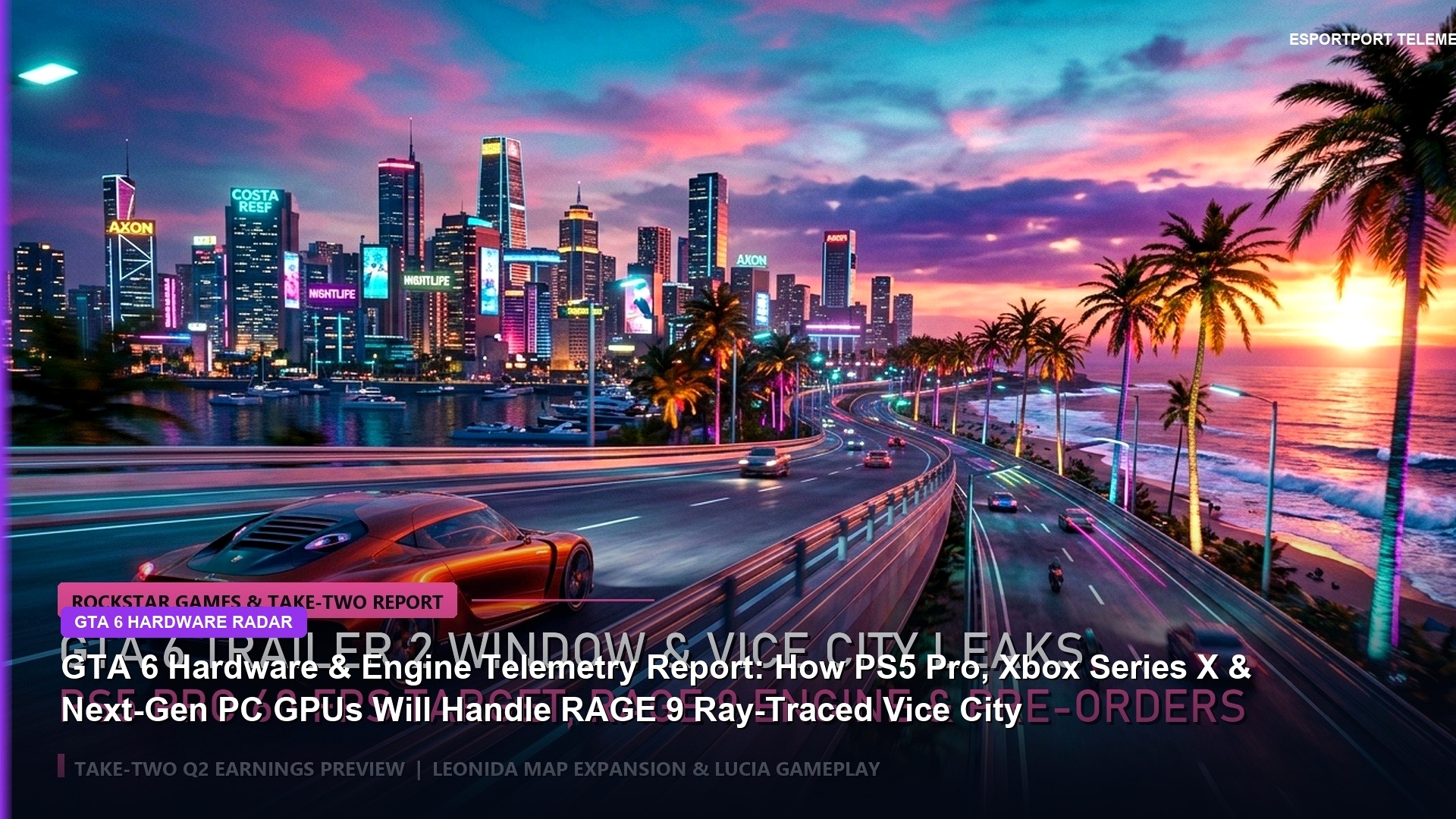
As the countdown toward the seismic launch of Grand Theft Auto VI accelerates, technical engineers and gaming enthusiasts have turned their analytical focus toward Rockstar Games’ proprietary RAGE 9 (Rockstar Advanced Game Engine) architecture. Representing the most ambitious leap in interactive simulation in video game history, RAGE 9 is designed from the silicon up to harness the full computing capability of current-generation hardware and the newly deployed PlayStation 5 Pro console.
The technological centerpiece of GTA 6 is its revolutionary real-time hydrodynamic water simulation. Set in the sub-tropical state of Leonida, encompassing the neon-soaked canals of Vice City, expansive open ocean coastlines, and the shallow mangrove waterways of the Everglades, water is not merely a visual shader—it is a physically simulated, interactive fluid matrix. Powered by advanced computational fluid dynamics (CFD), waves generated by passing speedboats interact realistically with wind direction, underwater topography, and coastline piers, creating dynamic buoyancy and drag forces that physically impact vessel handling.
Complementing this environmental fidelity is the next evolution of NaturalMotion’s Euphoria procedural animation engine. In previous Rockstar titles like GTA V and Red Dead Redemption 2, Euphoria created industry-defining ragdoll reactions to physical trauma. In RAGE 9, Euphoria is tightly coupled with contextual machine-learning physics, enabling non-player characters (NPCs) to display realistic self-preservation behaviors, muscle stiffness adjustments, and momentum transfer during vehicular collisions or ballistic impacts.
| Engine Architecture Pillar | RAGE 9 Technical Implementation | Next-Gen Gameplay Impact |
|---|---|---|
| Hydrodynamics & Water Waves | Real-time CFD Navier-Stokes fluid modeling | Physical ocean wave buoyancy, airboat wake interaction, dynamic storm flooding |
| Procedural AI & Euphoria | Context-aware Euphoria ML physics integration | Stumbling momentum, protective bracing, dynamic vehicle impact reactions |
| Vehicle Deformation Modeling | Multi-layer structural crumple zones & soft-body physics | Realistic high-speed chassis warping, tire blowouts, engine component damage |
| Global Illumination & Ray Tracing | Hardware-accelerated BVH ray-traced reflections & GI | True-to-life neon specular highlights on wet asphalt, volumetric coastal fog |
| PlayStation 5 Pro Optimization | PSSR (PlayStation Spectral Super Resolution) AI Upscaling | Crisp 4K 60FPS target with advanced ray tracing enabled simultaneously |
Vehicle Soft-Body Deformation & Aerodynamic Handling Models
Vehicular physics have undergone a massive overhaul in RAGE 9. Moving away from the relatively forgiving arcade driving mechanics of GTA V, GTA 6 strikes an intricate equilibrium between the heavy, grounded simulation of GTA IV and the responsive high-speed control demanded by modern open-world gameplay. Each vehicle possesses an individual center of gravity, suspension travel telemetry, and tire grip coefficient that changes dynamically based on road surface—ranging from scorching dry highway tarmac to rain-slicked suburban streets and thick Everglades mud.
The soft-body vehicle deformation system calculates impact velocity and structural stress across hundreds of localized damage nodes. In severe head-on collisions, engine blocks will bend radiator frames, steering columns will seize, and wheels can be sheared cleanly off their axles. Furthermore, glass fracture physics utilize realistic tempered safety glass patterns, shattering into thousands of physics-rendered pebbles upon bullet penetration or violent rollover impacts.
Aerodynamic modeling extends to high-speed supercars, where active rear wings deploy under heavy braking to provide tangible aerodynamic downforce. This physics depth transforms street racing into a skill-expressive pursuit, where trail-braking into corners and managing weight transfer across elevation changes dictate lap times.

| Vehicle Class | Physics Simulation Parameter | Surface Interaction | Damage Vulnerability Profile |
|---|---|---|---|
| Modern Muscle Cars | High torque, live-axle rear suspension, oversteer bias | Loss of traction on wet asphalt; heavy burnout smoke generation | Rear quarter-panel crumpling; driveshaft disconnects |
| Everglades Airboats | Flat-bottom hydrodynamic glide, rear thrust steering | Frictionless travel over swamp reeds, mudbanks, and shallow water | Propeller cage damage; engine overheating in stagnant water |
| Exotic Supercars | Active aero downforce, carbon-ceramic brake heat fade | High mechanical grip on smooth tarmac; bottoming out on curbs | Carbon fiber shatter physics; fragile exposed radiators |
| Heavy Duty 4×4 Trucks | Independent suspension travel, locking differentials | Mud displacement and deep rutting in unpaved swamp tracks | Armored frame resistance; tire sidewall puncture risks |
Lighting and volumetric rendering inside RAGE 9 achieve breathtaking realism through advanced ray-traced global illumination (RTGI). In the neon-drenched nightlife districts of Vice City, reflections on puddle-soaked asphalt, polished chrome bumpers, and glass storefronts accurately trace light bounces from hundreds of real-time point sources. Rather than relying on static cube maps, headlights from passing traffic illuminate volumetric coastal mist, casting dynamic shadows that physically react to wind currents.
Furthermore, Rockstar’s audio engineering team has implemented physics-based sound propagation. Engine roars, gunshots, and tire screeches reverberate dynamically based on surrounding geometry—echoing sharply down narrow concrete alleyways while diffusing naturally across wide-open Everglades wetlands, immersing players into an unparalleled living audiovisual world.
Particle physics have also been upgraded to simulate localized weather phenomena. Tropical rainstorms feature dynamic wind vectors that blow rain sideways against skyscraper windows, creating authentic sheeting water effects and dynamic puddling on road surfaces that directly diminish vehicular braking distance.
Hardware Scaling: PS5 Pro PSSR AI Upscaling vs Base Consoles
The introduction of the PlayStation 5 Pro console marks a pivotal milestone for GTA 6’s technical deployment. On base PlayStation 5 and Xbox Series X hardware, RAGE 9 is expected to deploy dynamic resolution scaling targeting a native 1440p upscaled to 4K, locked at 30 frames per second to accommodate the immense CPU demands of simulation-heavy NPC crowd density and complex traffic pathfinding.
On PlayStation 5 Pro, however, Rockstar has access to Sony’s proprietary PlayStation Spectral Super Resolution (PSSR) machine-learning hardware. Utilizing 16.7 teraflops of enhanced GPU compute and custom neural processing, the PS5 Pro renders an internal 1080p to 1440p image and reconstructs it with sub-pixel temporal stability into pristine 4K. This unlocks the potential for a dedicated 60 FPS Performance Mode with ray-traced reflections enabled simultaneously, eliminating the traditional compromise between visual fidelity and fluid frame rates.
| Console Platform | Target Resolution | Target Framerate | Ray Tracing & Upscaling Features |
|---|---|---|---|
| PlayStation 5 (Base) | Dynamic 1440p – 4K (FSR 2 Temporal) | 30 FPS Locked (Fidelity Mode) | Ray-traced ambient occlusion and sun shadows |
| Xbox Series X | Dynamic 1440p – 4K (FSR 2 Temporal) | 30 FPS Locked (Fidelity Mode) | Ray-traced ambient occlusion and contact shadows |
| PlayStation 5 Pro | Dynamic 4K via PSSR AI Reconstruction | 60 FPS Target (Performance Pro Mode) | Full ray-traced reflections on water, glass, and vehicle paint |
| Xbox Series S | Dynamic 1080p (FSR 2) | 30 FPS Locked | Standard screen-space reflections; reduced crowd density |
| Simulation Subsystem | GTA V (RAGE 7/8 Era) | GTA VI (RAGE 9 Era) | Generational Technical Leap |
|---|---|---|---|
| Water Physics | Heightmap wave animation | Real-time volumetric fluid dynamics | Vessels displace water with true physical buoyancy |
| NPC Euphoria AI | Pre-scripted blend-to-ragdoll | Full procedural muscular reaction | Realistic bracing, balance recovery, and stumbling |
| Weather & Atmosphere | Static skybox transitions | Volumetric cloud simulation & tropical storms | Hurricanes with localized wind forces affecting trees and debris |
| Interior Transitions | Limited interior loading gates | Seamless physical building interiors | Zero loading screens entering malls, clubs, and motels |
Frequently Asked Questions (FAQ)
What is the RAGE 9 engine powering GTA 6?
RAGE 9 (Rockstar Advanced Game Engine) is Rockstar Games’ proprietary next-generation game engine, featuring real-time computational fluid dynamics, Euphoria procedural physics, and hardware ray tracing.
How does GTA 6’s water simulation differ from previous games?
Unlike GTA V’s pre-rendered wave heightmaps, GTA 6 simulates water as a dynamic physical fluid where boat wakes, wind currents, and coastal tides physically interact with vessels and surrounding environments.
Will GTA 6 run at 60 FPS on the PlayStation 5 Pro?
With PlayStation Spectral Super Resolution (PSSR) AI upscaling and enhanced GPU hardware, technical analysts anticipate a dedicated 60 FPS Performance Mode on PS5 Pro with ray tracing enabled.
When is Grand Theft Auto VI scheduled to release?
Rockstar Games and Take-Two Interactive have confirmed a Fall 2026 worldwide release window on PlayStation 5 and Xbox Series X/S consoles.
Recommended Gaming Analysis & Hardware Tech Dossiers
Explore our deep-dive gaming hardware benchmarks, technical engine breakdowns, and industry reports:
- GTA 6 Wildlife & Everglades Ecosystem Guide: Alligators, Airboats & Hunting
- F1 Las Vegas Grand Prix 2026 Saturday Night Showdown: Verstappen vs Norris Title Battle
- CS2 Shanghai Major 2026 Opening Stage Preview: VRS World Standings & Swiss Schedule
Related posts:
 India vs New Zealand 1st Test Fallout: Sarfaraz 150, Rachin Ravindra Heroics & WTC Scenarios
 IND vs NZ 4th T20I Auckland Preview: Eden Park Pitch Report, India Predicted Playing 11, Vaibhav Sooryavanshi Debut & Weather
 IND vs NZ 5th T20I Wellington Series Finale Preview: Pitch Telemetry, Playing XI Changes & Jacob Duffy Counter-Strategy
 ESL One Bangkok 2026 Closed Qualifiers: Team Spirit vs Gaimin Gladiators Tactical Breakdown & Patch 7.37e Meta Report
